Marcel Bigeard
Human Design Chart
Biography
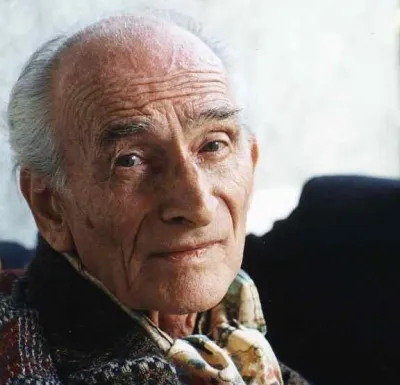
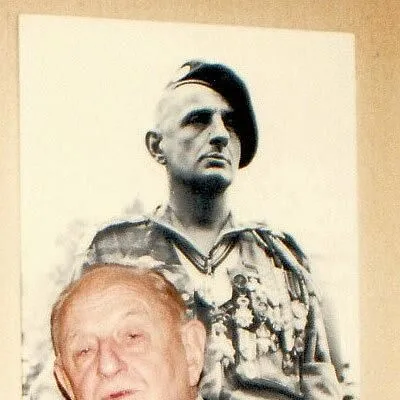
He was one of France's most decorated career soldiers, known as the "world's best paratrooper." Charles DeGaulle dubbed him a hero; he had been wounded several times and escaped from prisoner-of-war camps on three different occasions. He fought with French Resistance forces during WWII, parachuted with his troops into Indochina, fighting the Vietnamese in the early 1950s and led his paratroopers into Algiers in 1957.
He died at age 94 on June 18, 2010 in Toul, France.
The Human Design of Marcel Bigeard: Manifesting Generator 6/2
Manifesting Generator 6/2 — Design at a Glance
Marcel Bigeard's design tends towards extreme speed coupled with the ability to constantly provide energy. As an Manifesting Generator, he was a hybrid of Manifestor quickness and Generator stamina. His defined Sacral Center endowed him with this constant power source that served not for initiation but rather for responding to impulses. This mechanism allowed him to skip steps and achieve results at lightning speed.
This rapid pace, however, harbored an internal tension: the risk of skipping important stages or overwhelming himself through parallel multitasking. Ignoring the strategy of waiting for the inner impulse led to frustration as a manifestation of his non-self. Conversely, correct responding – supported by the approval of his Sacral Center – brought deep satisfaction. In this state, he fell into a 'play mode' that allowed him to work on multiple projects simultaneously without losing creative power. His energy was most effective when seeking variety and regularly checking whether his inner authorities still supported current activities. Thus, potential frustration transformed into productive dynamics as long as he waited for the life signal before acting.
Emotional Authority
Marcel Bigeard's design tends towards cautious decision-making that resists spontaneous impulses. He recognized that initial emotional reactions were often misleading and did not reflect his deepest truth. This stance stemmed from his emotional authority, carried by the defined Solar Plexus Center. This center was subject to a constant wave of emotions moving up and down continuously. Marcel Bigeard saw the world colored by his current mood; what excited him in one moment could appear negative in another. Since this first impression was only a snapshot, he risked negative consequences with quick, emotion-driven decisions. His inner truth emerged only after the emotional wave subsided. The design demanded time and multiple reconsiderations – so-called 'sleeping on questions.' Through patience, Marcel Bigeard gained emotional distance, intense feelings dissipated, clarity and calmness set in. This process was particularly crucial for long-term life-defining decisions. Emotional authority took precedence over all other defined centers in his chart, regardless of which additional areas were active. Only by enduring until inner peace arrived could he achieve objective composure and take grounded steps instead of being led by the subjective mood of the moment.
The 6/2 Profile — Role Model / Hermit
Marcel Bigeard's design is characterized by a clear two-phase life path. In his youth, before turning 30 years old, the energy of Line 3 of his Profile 6/2 (Role Model/Natural Talent) dominated. This phase was marked by experimentation, trial and error, and intense accumulation of personal life experiences. The withdrawal after failed attempts served as a driving principle for early learning.
Around age 30, Line 6 activated. Marcel Bigeard metaphorically retreated into a 'cave on the mountain' to reflect upon his past experiments from a distance. This period of intensive reflection was also one of healing and deep self-awareness. The sixth line introduced themes such as revolution, transformation, and testing principles. His decisions were based on emotional clarity and whether his actions promoted positive principles.
Emerging from this introspective phase, he appeared as a wise figure. Others sought him out to partake in his life wisdom and learn the skill of deep introspection. Simultaneously, the energy of Line 2 came into play: it focused on expertise and waiting for the call. Marcel Bigeard demonstrated the ability to delegate responsibility and trust experts rather than proving everything himself. This enabled him to effectively share his gained wisdom without falling into frustration over lack of control.
Single Definition — Defined & Open Centers
Marcel Bigeard's Human Design configuration tends towards mechanical stability paired with a high vulnerability to external mental and emotional conditioning. His defined Sacral Center provided a constant energy source, but it was only usable correctly through reactive waiting; he had vital power if he listened to inner signals. This foundation was complemented by his defined G Center, which gave him a firm identity and direction, as well as a defined Throat Center that allowed reliable communication. Additionally, his defined Solar Plexus and Root Centers shaped his approach to emotions and stress: He needed time for emotional clarity and had a constant internal pressure towards forward movement.
In contrast, the Head, Ajna, Heart, and Spleen Centers were open. Marcel Bigeard did not have consistent mental clarity or willpower. His open Head and Ajna Centers made him susceptible to inspiration from his environment; he tended to be influenced by others' doubts or sought answers that he could not generate himself. The open Heart Center lacked a constant energy source for promises; he was prone to wanting to prove his worth through performance, often leading to frustration as this energy source was not continuously available. Finally, his open Spleen Center reflected the health and fears of those around him. He tended to cling to people or situations that radiated a sense of security, even if they were not correct for him, driven by the deep fear of being unprepared to survive alone. This configuration created tension between his inner mechanical stability and the need to protect himself from the takeover of others' mental and emotional burdens.
Channels for rhythm, leadership, emotional depth and synthesis.
Marcel Bigeard's design tends towards a strict definition of 'Us against Others'. This attitude was shaped by the Synthesis Channel (Channel 19-49), which combined tribal loyalty with ideological purity: Gate 19 pushed for unity and protection of territory, while Gate 49 excluded everything that contradicted shared principles. This created almost tribal bonds within the group with clear boundaries to the outside.
This tribal dynamic flowed into a natural biological rhythm. The Rhythm Channel (Channel 5-15) connected fixed habits (Gate 5) with a magnetic attraction towards the diversity of humanity (Gate 15). Bigeard drew others into his specific energy flow if they adapted to this pattern; outside of this timing, he was disruptive.
Leadership claims did not arise solely from charisma but through demonstrated competence and claiming collective approval. The Alpha Animal Channel (Channel 7-31) conveyed logical leadership: Gate 7 defined the role within society, while Gate 31 acted as a collective leader who only became effective when chosen and recognized by the majority.
Emotional communication followed a whimsical wave. The Openness Channel (Channel 22-12) ensured that his impact strongly depended on inner timing: Gate 22 allowed passionate expression, while Gate 12 maintained cautious restraint. He could inspire or repel depending on how he felt in the moment.
Reflection and learning from the past rounded out the picture. The Lost Son Channel (Channel 13-33) gathered experiences through listening (Gate 13) and processed them in withdrawal (Gate 33), before passing along insights. Additional Gates like 14 (Power), 8 (Contribution), and 56 (Narration) supported this structure by skillfully handling influence, individual engagement for group goals, and the figurative representation of mental processes.
Collective Circuitry — Circuit Signature
Marcel Bigeard's design tends towards cooperation and the joint creation of resources within a group. His ego circuit was active, with the Synthesis Channel (49-19) connecting his Solar Plexus Center to his Root Center. This created an emotional intuition that directly translated into adaptability and the dynamics of giving and taking. Since his design did not connect to the Sacral Center, rest periods for regenerating energy were essential; he could not act continuously but needed pauses to generate resources.
Parallel to this, Marcel Bigeard showed additional energetic streams. The Knowledge Circuit connected his Throat with his Solar Plexus Center through the Openness Channel (12-22). This allowed him to express and transform emotional waves and individual identity acoustically. In the Understanding Circuit, Throat, Identity, and Sacral Centers were linked via Channels 'The Alpha Animal' (31-7) and 'Rhythm' (15-5). Here a focused rational energy worked, structuring logical insights into the future. Finally, the Meaning-Finding Circuit connected his Throat to his Identity Center through Channel 'The Lost Son' (33-13). This served to reflect past experiences and emotions and make their meaning tangible for the collective. Although all these centers were defined, they formed distinct, coexisting energy fields due to separate circuits: emotional expressiveness, rational structuring, meaningful reflection, as well as cooperative adaptation in the tribe.
Left Angle Cross of Revolution 1
Marcel Bigeard's design revealed a tendency towards strategic vision and the potential for profound, systemic changes. He was someone who questioned the status quo and designed new orders. This configuration corresponded to the left cross of Revolution 1.
This cross emphasized his role as an architect of change. The energy did not lie in chaotic upheaval but rather in targeted, long-term restructuring of existing systems through clear visions. The focus was on the 'what' and 'why' of a revolution, less so on the tactical execution of conflict itself. Marcel Bigeard lived this ability to penetrate the core of systems and design alternative structures. His design promoted an attitude that went beyond superficial adjustments; it was about fundamental redesigning. The power of this cross showed in his capacity to grasp complex interconnections and derive coherent, future-oriented models from them. It was not about spontaneous destruction but rather a well-thought-out reconstruction. Marcel Bigeard used this energy to critically examine existing frameworks and develop solutions that created more sustainable foundations. Vision was the central tool for steering change in a meaningful way.
Saturn Return · Uranus Opposition · Chiron Return · 2nd Saturn Return — Life Cycles
Marcel Bigeard's life path was strongly marked by the cyclical structure of Saturn returns, which in his design signified moments of maturation and structural consolidation. These cycles functioned as natural hinges where inner development translated into stable outer forms.
His first significant Saturn return occurred in 1942 at the age of 26. During this period, he married Gabrielle Grandemange. This event underscores the typical dynamics of this first cycle: The search for stability and partnership crystallizes into a solid life structure. It was not mere coincidence but rather aligned with his inner necessity to create a viable foundation for the following years.
His second Saturn return took place in 1976 when Marcel Bigeard was 60 years old. Here, the other end of the spectrum became apparent: The conclusion of his career as Général de corps d’armée. This cycle marked the closure of a long phase of active shaping and responsibility. While the first return emphasized the establishment of stability, the second closed an era and demanded detachment from the previous role. Both events illustrate how these planetary cycles worked in his chart: They brought inner maturation processes to a halt in the form of clear external milestones – whether through commitment or by ending a path.
Manifesting Generator · Emotional Authority — Synthesis
Marcel Bigeard navigated his life through a dynamic interplay between action and reflection. His design as an Manifesting Generator, fueled by a defined Sacral Center and emotional authority, points to someone who tended towards quick initiation but also had the need to weigh decisions deeply within their emotions. This combination led him to invest energy in diverse projects (sacral center) while seeking a clear direction through the ups and downs of his emotions – a process that could provide him with deep satisfaction but also made him vulnerable to frustration when inner clarity was lacking. The connection between G Center and Throat Center further strengthened this tendency by giving him a strong identity he wanted to carry outwardly, while simultaneously valuing confirmation of his principles (Channel 19/49).
A central paradox in Marcel Bigeard's design lies in the interplay between initiation and reaction. As a Manifesting Generator, he possessed the ability to quickly set things in motion, yet his Sacral Center demanded that he first react. This tension between the urge to act and the necessity of responding to life characterized his path. The connection of undefined Head and Ajna Centers further amplified this dynamic by making him open to new ideas but also risking getting lost in unconfirmed concepts. He was thus a man driven both to action and inner reflection – a tension that marked his life journey.
5 Defined Channels
Incarnation Cross - Left Angle Cross of Revolution 1
Solar Return
The Solar Return shows the moment when the sun returns to its exact birth position - your personal solar year.
Life Cycles
Discover the life cycles with a detailed triple view (birth chart, cycle chart, composite).
Human Design Profile
- Strategy
- To respond - wait for something to respond to
- Authority
- Emotional Authority
- Profile
- 6/2 - Role Model / Hermit
- Definition
- Single Definition
- Incarnation Cross
- Left Angle Cross of Revolution 1
- Date of Birth
- 14.02.1916 01:00
- Place of Birth
- Toul, France
Frequently Asked Questions
What is Marcel Bigeard's Human Design type?
What Profile did Marcel Bigeard have in Human Design?
What Authority did Marcel Bigeard have?
What incarnation cross was assigned to Marcel Bigeard?
When was Marcel Bigeard born?
Discover your own Human Design
Are you also a Manifesting Generator? Find out in a personal reading how to unfold your multi-talents and direct your energy wisely.
More Personalities
Back to overviewAldair

Alizée

Angeli
Arletty

Artus

Balthus