
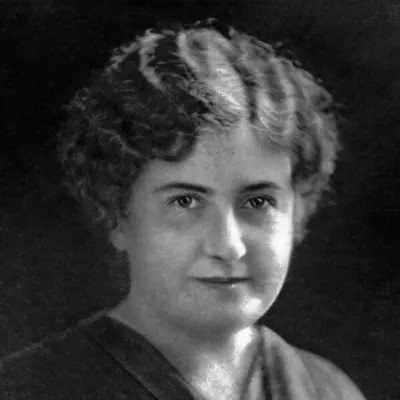
Maria Montessori
Human Design Chart
Biography
Maria Montessori — Generator with Profile 2/4
Generator 2/4 — Design at a Glance
Maria Montessori showed herself to be someone with immense endurance, able to unleash her strength primarily when reacting to concrete impulses from her environment. As a Generator, she possessed a great deal of sacral energy that she used like a workhorse – strong and steady, provided she was motivated for her tasks. This energy did not become free through mere initiating but only when life gave a signal and her inner self responded with a clear "yes."
Her strategy consisted in heeding these internal signals and acting upon them. If she followed this principle, she experienced deep satisfaction and fulfillment in her work. However, if one goes against this design by doing things that do not resonate internally or is prevented from pursuing their heart's project even though the energy is still present, it inevitably leads to frustration and a lack of energy. Maria Montessori’s effectiveness therefore did not lie in constantly pushing forward her own plans but rather in reacting intuitively. Only through this could she unleash her full potential and avoid burnout risks. Her design required waiting for the impulse and then responding with full force instead of fighting against the current or being blocked by external constraints.
Emotional Authority
Maria Montessori did not act impulsively but allowed decisions to mature until emotional clarity set in. Her design featured Emotional Authority: The Solar Plexus Center was defined and determined her inner decision-making process, independent of all other defined centers in the chart. This configuration followed a wave motion of feelings; moods swung between enthusiasm and distance, coloring the current perspective at any given moment. A first impression was not considered final truth but rather a snapshot. Spontaneous judgments based on intense emotions carried the risk of being misleading. Instead, her mechanics required patience and time to pass. She let important questions rest for several days, slept on them, and re-examined them once the initial emotional wave had subsided. Only then, when calm returned and inner noise faded, did deep clarity emerge, necessary for long-term life decisions. This process of "decorating" – consciously waiting for emotional neutrality – protected her from misjudgments and ensured that her choices came from a stable, thoughtful stance, not fleeting excitement or depression.
The 2/4 Profile — Hermit / Opportunist
Maria Montessori's Design established a tendency towards a pendulum rhythm: between the need for withdrawal and the urge to connect. As someone with Profile 2/4, the "Natural Talent / Networker," she constantly oscillated between two fundamental needs. Line 2 demanded solitude to deepen inner processes and gain clarity. Without this phase of isolation, her willpower remained untrained; she appeared then like a "paper tiger" – resolute in appearance but lacking the necessary preparation for real effectiveness.
Only after completing this quiet period and restoring energy did the need of Line 4 come into play. Then Maria Montessori actively sought exchange with her familiar community. This line understood itself as a leadership figure on a transpersonal level, not only pursuing its own goals but also discovering and nurturing talents in others. The tension between these poles required clear communication from her to the outside world: she had to make it evident when she needed company and when she wanted to remain undisturbed.
During times of withdrawal, she reflected and evaluated the knowledge of her network. From this synthesis emerged brilliant ideas that she then put into effect within the community. Her Design thus did not show a static personality but rather a cyclical process: first inner work alone, followed by creative leadership and support for others in the social space. This shift characterized how she used and passed on knowledge.
Split Definition — Defined & Open Centers
Maria Montessori was a person with a clear inner structure and a strong, available energy source. Her design featured defined centers that provided willpower, vital energy, and emotional depth. The defined Heart Center gave her natural authority regarding resources and self-worth; she preferred to set her own working conditions and kept promises reliably, which strengthened her trust as long as she did not try to overwhelm others with her high willpower.
At the same time, she had a defined Sacral Center, meaning that she possessed a constant source of life energy. This energy was available only when reacting to external stimuli rather than initiating on her own. Her design required her to wait and retrieve inner confirmation ("Yes" or "No") before committing herself. This ensured endurance in tasks that truly engaged her energy and protected against exhaustion from false initiatives.
Her decision-making was further influenced by the defined Solar Plexus Center, which acted as an emotional authority. Here patience was key: Maria Montessori had to wait out the waves of her emotions to reach clarity. Immediate decisions based on emotional highs or lows would have been impulsive; only after cycling through the emotion cycle did a grounded truth emerge. The also-defined Root Center provided steady pressure for movement and survival, driving her actions as long as it did not lead to obsessive stress.
In contrast, several open centers revealed her vulnerabilities to conditioning. The open Head and Ajna Centers meant that she lacked constant access to inspiration or conceptual truth. She tended to feel mental questions of others as her own urgency or get caught in confusion if she did not trust her inner authority. The open G Center showed a flexible identity; she did not actively seek a fixed direction or love but was initiated by the environment and relationships. An incorrect environment could lead to feelings of disorientation. Additionally, the open Spleen Center indicated sensitivity towards health and well-being as well as a tendency to cling to people with defined security or make spontaneous decisions out of fear of survival issues. The open Throat Center finally showed that she could not communicate consistently; the pressure to attract attention was a non-self theme while proper communication only came through invitation and timing.
Channels for community spirit and maturing growth.
Maria Montessori sought to build functional communities through carefully negotiated connections. Channel Community 37-40 connected her emotional intuition with her willpower. She waited for personal invitations to find her place in a group and did not make spontaneous agreements. For her, a good deal was based on mutual respect and loyalty, not hierarchy. This channel shaped her ability to build bridges between individuals so that everyone could contribute honorably.
At the same time, Maria Montessori lived through the process of maturation by experience. Channel Maturation 42-53 connected her primal power with her life energy and pushed her to complete each cycle fully. She began new experiences without rigid expectations to avoid frustration. Only after completion did she reflect on the gained insights to derive wisdom for others. This abstract experiential process allowed her to learn from empirical history and not repeat mistakes.
Additionally, specific gates in her design were active. Gate 16 promoted experimenting to improve new things and led through skill identification to mastery. Gate 9 enabled focused goal-setting on details and perfection through repetition, though a lack of energy input could lead to depression. Gate 26 in the Heart Center helped move the conservative tribe towards accepting innovations while she herself needed rest periods. Gate 54 connected worldly success with mystical insight and underscored that material achievements were a prerequisite for spiritual development. This constellation shaped her way of translating experiences into information for the greater good of humanity.
Tribal Circuitry — Circuit Signature
Maria Montessori was a person whose inner world consisted of two clearly separated, parallel existing energy fields. As she had a Split Definition, there was no continuous energetic flow between these areas; instead, they acted as independent poles of her experiential world.
One pole connected the Heart with the Solar Plexus Center in the Ego Circuit. This was not an individual I-theme but a tribal energy of cooperation. The channel "Community" (37-40) promoted clear understanding of giving and taking: support was expected to create shared resources together. Since there was no connection to the Sacral Center, constant life force was missing; rest periods were necessary to bring new strength for the collective.
The second, isolated pole united in the Meaning Circuit the Sacral with the Root Center. Here energy flowed cyclically and wave-like through the channel "Maturation" (42-53). This energy referred to emotions and experiences from the past, not cool logic or future visions. The insights were visually and emotionally marked, subject to a natural rhythm of beginning, middle, and end. They served to find meaning behind the past and share these felt truths with the collective to learn together.
This structure shaped Maria Montessori: on one hand, pragmatic, rest-seeking cooperation in the here and now; on the other hand, a deep, cyclical reflection of the past whose emotional resonance she passed on. Both forces existed side by side without directly overlapping.
Right Angle Cross of Planning 3
Maria Montessori's design showed a tendency towards a very specific kind of structuring. She was someone who did not separate inner order from outer form but experienced them as inseparable. This was not just a preference for lists or plans in the everyday sense, but rather a deeper architectural stance.
In Human Design, this is described by the configuration 'The Right Cross of Planning 3'. This mechanism points to a system that integrates both logical clarity and aesthetic or spiritual dimensions. It's about the ability to translate complex ideas into tangible, functional structures without losing their deeper meaning. For Maria Montessori, this meant her approach was always based on a solid foundation that was both practically applicable and conceptually thought out. She sought ways to shape abstract principles so they could be effective in everyday life. This connection of form and content characterized her entire approach: every measure had a clear purpose and fit into a larger whole. It was a natural inclination to transform chaos through targeted planning into order, where the planning itself was already an expression of inner values. Thus, a system emerged that not only worked but also made sense – a unity of method and spirituality characteristic of her design.
Saturn Return · Uranus Opposition · Chiron Return · 2nd Saturn Return — Life Cycles
Maria Montessori's design showed a tendency towards structured authority and institutional anchoring. She developed her visions not just theoretically but translated them into concrete, sustainable organizational forms. This became evident in the first Saturn Return: in 1899 at age 29, she led the Sanatorium School for Special Education in Rome as director. This cycle condensed years of groundwork into a solid professional foundation that underscored her ability to take responsibility for complex systems.
Later, during the Uranus Opposition, a phase of radical renewal began. In 1907 at age 37, Maria Montessori founded the first Casa dei Bambini in Rome's working-class district San Lorenzo. This configuration promoted breaking with established norms and implementing innovative ideas in practice. She used this energetic push to test and anchor her pedagogical insights directly in children's lives.
The second Saturn Return marked the final consolidation of her work. In 1926 at age 56, Benito Mussolini took the honorary presidency of the Opera Montessori. This event signaled broad societal recognition and political integration of her work. For her design, this was a moment of confirmation: the previously established structures now held external pressure and gained a stable public position. Through these cycles, her life mission became visible – creating orders that support education sustainably.
Generator · Emotional Authority — Synthesis
Maria Montessori was a Generator whose life was marked by a deep inner drive to bring energy into the world – as long as this energy was aligned with her heart's project. The defined willpower (Heart Center) and access to sacral energy enabled her to persistently hold onto her endeavors with endurance and fulfill promises, yet always under the condition that the work felt meaningful. This focus on inner motivation corresponded with a need for withdrawal (Line 2) to gain clarity, followed by a desire for exchange and community (Line 4) – an ongoing interplay between self-reflection and social engagement.
A central paradox in her design lay in the combination of emotional authority and the Community Channel. While she had to let decisions mature to gain clarity about her feelings (Perception Circuit), she simultaneously pushed forward connections with the collective and sharing insights. This likely led to a tension between the need for inner emotional validation and the responsibility, as a pioneer in her work, to form and lead a community – a field of tension that manifested in events such as leading an institution (29) and founding children's houses (37).
2 Defined Channels
Incarnation Cross - Right Angle Cross of Planning 3
Solar Return
The Solar Return shows the moment when the sun returns to its exact birth position - your personal solar year.
Life Cycles
Discover the life cycles with a detailed triple view (birth chart, cycle chart, composite).
Human Design Profile
- Type
- Generator
- Strategy
- To respond - wait for something to respond to
- Authority
- Emotional Authority
- Profile
- 2/4 - Hermit / Opportunist
- Definition
- Split Definition
- Incarnation Cross
- Right Angle Cross of Planning 3
- Date of Birth
- 31.08.1870 03:30
- Place of Birth
- Chiaravalle, Italy
Frequently Asked Questions
What was Maria Montessori's Human Design type?
What Profile did Maria Montessori have in Human Design?
What Authority did Maria Montessori have?
What incarnation cross did Maria Montessori have?
When was Maria Montessori born?
Discover your own Human Design
Are you also a Generator? Find out in a personal reading how to use your sacral energy correctly and discover deep satisfaction.
More Personalities
Back to overviewAaliyah

Alexia

Angèle

Anne-Marie

Arcángel

Arno
