
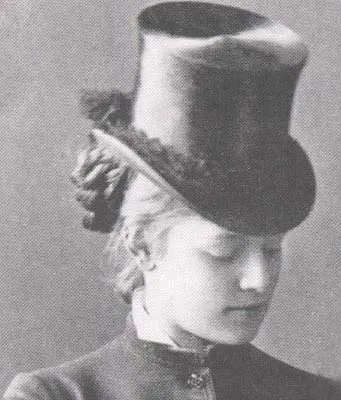
Marie Louise von Larisch-Wallersee
Human Design Chart
Biography
On 20 October 1877, at Jagdschloß Gödöllő in Hungary, she married Count Georg Larisch von Moennich, Baron of Ellgoth and Karwin (1855–1928). They had 5 children.
After divorcing Count Larisch on 3 December 1896, she married musician Otto Brucks (1854–1914) in Munich on 15 May 1897. They had one child. Brucks died in 1914.
On 2 September 1924, she married naturopath William H. Meyers (1859-1930) in Elizabeth, New Jersey and they lived in Florida. In 1926, she fled to New Jersey, to work as a housemaid.
Marie returned to Germany in 1929. She died very poor on 4 July 1940 at age 82 in a nursing home at Augsburg.
Human Design Analysis: Marie Louise von Larisch-Wallersee as Generator 6/2
Generator 6/2 — Design at a Glance
Marie Louise von Larisch-Wallersee had the Generator design with immense inner endurance and high levels of life energy. Her design suggested that she was most effective when responding to external impulses rather than initiating actions independently. This energy was released primarily when her Sacral Center – the motor of her actions – gave clear confirmation.
The central challenge for her well-being lay in not going against this internal rhythm. If she threw herself into tasks without genuine resonance, she risked a rapid loss of energy and frustration. Conversely, suppressing her urge to work on projects that inspired inner enthusiasm also led to dissatisfaction. Her path to deep fulfillment involved waiting for signals from the environment and then responding with full force once her gut feeling gave a clear “yes”. This principle of reacting rather than initiating was crucial in ensuring that her great endurance did not lead to burnout but instead manifested as sustainable creative power. Anyone who prevented her from trusting these inner responses interrupted the flow of her natural energy, leading to feelings of blockage.
Emotional Authority
Marie Louise von Larisch-Wallersee revealed herself as someone whose internal compass needle was steered by a deep emotional wave. Her emotional authority carried the defined Solar Plexus Center – a mechanism that always claimed priority in decisions regardless of other definitions in her design. She experienced constant ups and downs of her feelings; the world appeared colored by her current mood. What seemed inspiring at one moment could appear negative the next. This first impression was merely a snapshot, not necessarily her truth. Quick, spontaneous decisions based on such emotion often proved problematic. Instead, her design required patience: she took time to let decisions mature, slept on them multiple times, and repeatedly questioned herself. Only when intense feelings subsided and emotional distance was gained did clarity and calmness set in. This process of waiting and maturing shaped her approach to long-term life decisions significantly, as only then could deeper, comprehensive insight be accessed beyond transient affect.
The 6/2 Profile — Role Model / Hermit
Marie Louise von Larisch-Wallersee revealed herself as someone whose life path was marked by a clear transition from experimental variety to profound wisdom. In her early years, she appeared like a natural talent learning through trial and error. This phase was preceded by the energy of Line 2: She radiated a natural problem-solving competence that attracted others and promoted collaboration. However, this focus on details and expansion could lead to a weakening of willpower and thus to depressive states if it did not result in genuine abilities.
After about thirty years, her fundamental attitude changed fundamentally. The sixth line of her profile became active. She metaphorically retreated into a “cave” to look back at the numerous experiments of her youth with distance. This period of intense reflection served for healing and self-knowledge. Previously, she had been deeply engaged in individual development and material survival. Meeting material needs was essential for her to unfold her mind; a lack thereof or compulsive self-provisioning hindered this process.
From this phase of withdrawal, she emerged as a wise person. Others recognized her life wisdom and sought her advice to learn from her ability for deep introspection. The transition from role-model experimenting to wise teacher marked the core of her design: only through overcoming individual and material challenges could she achieve spiritual maturity that she later imparted to others.
Split Definition — Defined & Open Centers
Marie Louise von Larisch-Wallersee was characterized by a design based on a solid inner identity and a constant energy source. Her defined G Center provided her with reliable self-perception and a clear sense of personal direction; she intuitively knew where she belonged and could communicate this orientation to others. This was complemented by her defined Sacral Center, which acted as the motor: She had a steady vital force that only became effective when responding to external impulses rather than initiating action herself. This combination shaped her way of communicating via her also defined Throat Center – her expression arose from this stable basis of identity and energy, allowing her to speak with clarity as long as she followed her inner logic.
At the same time, her system was marked by several open centers that harbored specific vulnerabilities. Her open Head and Ajna Centers meant mental inspiration wasn’t constant; Marie Louise von Larisch-Wallersee tended to get entangled in foreign questions or doubts when trying to force intellectual answers rather than trusting her emotional authority in the Solar Plexus. Additionally, her open Heart Center acted as a mirror for others’ will: She was not geared towards making promises or proving her worth through performance but suffered from the pressure of constantly having to justify herself. The open Spleen Center amplified this by deepening survival anxiety; she often sought safety in her environment and risked clinging to unhealthy situations just to avoid losing a sense of well-being. Finally, her open Root Center absorbed external stress, which could lead to cycles of avoidance or overactivity if she failed to distinguish between her own and others’ pressure.
Channels for inspiring presence and deep intimacy.
Marie Louise von Larisch-Wallersee was characterized by a configuration geared towards exemplary presence and deep emotional fusion. Her design suggested that she inspired others less through explicit instructions than through living her own individual truth. This occurred via the Inspiration Channel 1-8, connecting the G Center with the Throat Center. This mechanism acted as a public outlet for creative potential and leadership: By living her unique identity, she drew attention to herself and transformed the perspective of those around her. She relied on acting from an inner, authentic authority since this channel did not offer built-in social adaptability; her success depended on others’ recognition of her individuality.
Parallel to this, the Pairing Channel 59-6 shaped her interpersonal dynamics. It connected the Sacral Center with the Solar Plexus and rooted in a powerful quantum energy described as intimacy. Through Gate 59 (Sexuality) and Gate 6 (emotional wave from pleasure and pain), she sought fusion in relationships that were personal and penetrating. Her emotional wave determined the timing for friendships or partnerships; patience was necessary to wait until clarity about the value of a connection emerged, avoiding confusion.
Additionally, Gates like 55 (emotional awakening) and 9 (detail work) pointed towards extreme mood swings and a need for perfection through repetition. Gate 16 promoted mastery through experimentation while Gate 13 emphasized collective memory and continuity. This combination underscored a lifestyle oscillating between intense emotional depth, detailed elaboration, and the drive for individual, inspiring leadership.
Individual Circuitry — Circuit Signature
Marie Louise von Larisch-Wallersee’s design inclined towards impulsive, inspired expressions parallel to deep, instinctive care. Her Shared Definition meant these two energy areas did not flow directly into each other but existed as separate, coexisting forces.
The Knowledge Circuit in her connected the Throat with the Identity Center through the Inspiration Channel (Gates 1 and 8). This promoted creative flashes of insight and the ability to set new ideas acoustically or verbally into the world. It was about expressing a unique individuality driven by sudden insights directly translated into communication.
Simultaneously, there existed a separate piece in the Protector Circuit. Here, the Pairing Channel (Gates 59 and 6) connected the Sacral with the Solar Plexus Center. This connection generated an ancient, timeless energy of protection and preservation. It manifested as instinctive care based on survival and nurturing one’s own genetics. The emotional wave in this area was strong and directly linked to life force, resulting in intense bonding capacity and a need for physical closeness and security.
These two systems – the creative, inspired expression on one hand and the instinctive protective care on the other – formed distinct pillars of Marie Louise von Larisch-Wallersee’s personality. They acted independently yet collectively shaped her actions through the drive towards individual self-expression as well as a deep longing for protecting and nourishing her family or closest community.
Left Angle Cross of Spirit 1
Marie Louise von Larisch-Wallersee carried the design of the left cross of spirit. This configuration shaped her inner orientation through a deep connection with the invisible and intuition. She was someone who navigated primarily not by external logic but by a fine sense for the energetic quality of situations.
In Human Design, this cross describes a specific combination of Gates 37 (the power of trust) and 42 (knowledge about life). This connection created an inner compass in her that guided her to rely on her own experience rather than seeking external confirmations. She had the ability to intuitively grasp complex connections and translate these insights into clear, often simple language.
This profile promoted a stance of silent observation and trust in one's process. Marie Louise von Larisch-Wallersee lived with the task of not only keeping her spiritual insights for herself but sharing them so that others could grow from them. Her energy was geared towards building bridges between everyday material life and higher wisdom, helping others walk their own path with more clarity and self-confidence.
Saturn Return · Uranus Opposition · Chiron Return · 2nd Saturn Return — Life Cycles
Marie Louise von Larisch-Wallersee experienced a phase in which external crises challenged her inner structure. In 1889, at the age of 31, her first Saturn return marked a turning point: After the scandal surrounding the suicide of her cousin Rudolf, she was no longer received by her aunt Empress Elisabeth. This cycle often condensed years of preparatory work into solid results or forced structural reorientation, which here manifested as social isolation and an identity crisis.
At 39 years old in 1897 came the Uranus opposition, a time of profound change and liberation. She married Otto Brucks, a Bavarian court opera singer and chamber singer. This configuration broke old bonds and created new, often unexpected relationship structures that concerned her personal freedom.
The Chiron return around age 49 is an achievement cycle in which the life purpose unfolds or confronts one. In 1907, her child Marie Henriette died of smallpox. Instead of merely healing old wounds, this time point revealed the harsh reality of the incarnation cross: Confrontation with final loss as part of soul maturation and sense-making, far from romanticized narratives.
Finally, in 1914 at age 56, her second Saturn return occurred. Otto Brucks died of cirrhosis of the liver. This cycle tests the stability of established life structures and forces confrontation with responsibility and finiteness, presenting Marie Louise with the task of redefining and stabilizing her existence without her partner.
Generator · Emotional Authority — Synthesis
Marie Louise von Larisch-Wallersee lived a life deeply marked by creative energy and the need for authentic expression. As a Generator with defined Throat (and associated channel of Inspiration), she possessed strong sacral power that drove her to create things and express her unique perspective. Her profile as an exemplar suggests that initially, through experimentation, she had to gather her own experiences before gaining wisdom in later years and passing it on to others – a process accompanied by phases of withdrawal and intense self-reflection. Emotional authority demanded a mature confrontation with her feelings while the left cross focused on spiritual development.
A central paradox in her design lay in the interplay between creative inspiration (Channel 1-8) and emotional wave. On one hand, she was destined to inspire others through self-expression and initiate changes; on the other hand, she needed time to process her feelings and find a clear direction. The recurring crises and losses (documented by cycles), especially in connection with relationships and loss of family members, pointed towards an inner struggle between the desire for connection and the necessity to walk one's own path – a tension field that shaped her life journey.
2 Defined Channels
Incarnation Cross - Left Angle Cross of Spirit 1
Solar Return
The Solar Return shows the moment when the sun returns to its exact birth position - your personal solar year.
Life Cycles
Discover the life cycles with a detailed triple view (birth chart, cycle chart, composite).
Human Design Profile
- Type
- Generator
- Strategy
- To respond - wait for something to respond to
- Authority
- Emotional Authority
- Profile
- 6/2 - Role Model / Hermit
- Definition
- Split Definition
- Incarnation Cross
- Left Angle Cross of Spirit 1
- Date of Birth
- 24.02.1858 10:15
- Place of Birth
- Augsburg, Germany
Frequently Asked Questions
What was Marie Louise von Larisch-Wallersee's Human Design type?
What Profile did Marie Louise von Larisch-Wallersee have in Human Design?
What Authority did Marie Louise von Larisch-Wallersee possess?
What incarnation cross did Marie Louise von Larisch-Wallersee have?
When was Marie Louise von Larisch-Wallersee born?
Discover your own Human Design
Are you also a Generator? Find out in a personal reading how to use your sacral energy correctly and discover deep satisfaction.
More Personalities
Back to overviewAaliyah

Alain-Fournier

Alexia

Angèle

Angeli

Anne-Marie
