Photo: Wikimedia Commons
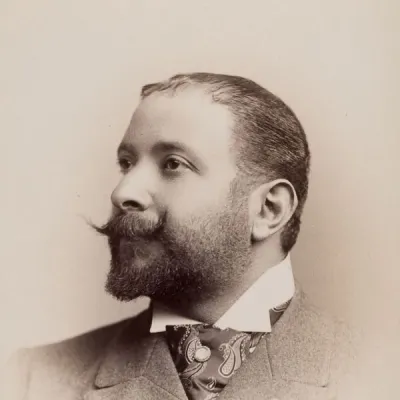
Mario Ancona
Human Design Chart
Biography
Mario Ancona died from lung cancer on 23 February 1931 at age 70 in Florence, Italy. His thoroughbred voice lives on in a series of gramophone recordings which he made during the first decade of the 20th century for Pathé in 1905–1906 and, more rewardingly, for the Victor Talking Machine Company in 1907–1908.
Human Design Analysis: Mario Ancona as Projector 4/6
Projector 4/6 — Design at a Glance
Mario Ancona appeared through his Projector Aura like a focused flashlight. His design gave him the ability to immediately recognize and precisely identify system errors in his environment. This intense perception could be felt as uncomfortable or intrusive by those around him when he addressed these deficits directly – similar to shining bright light directly into someone's face.
His optimal strategy was to shine passively and wait for honest, appreciative invitations. Instead of actively seeking recognition or exercising criticism, he drew others in through his own harmony. People came to him naturally to seek advice because his design automatically attracted them. This waiting was essential to avoid the bitterness of his non-self and instead be rewarded successfully.
Moreover, his undefined Sacral required cyclical rest phases. Without a constant intrinsic energy source, he worked in phases of high productivity followed by necessary pauses for regeneration. Without these rhythms, there was a risk of burnout. His design showed itself as a mechanism of targeted leadership: He brought light into the darkness of other systems not through coercion or constant presence but through radiant role-modeling and waiting to be invited.
Emotional Authority
Mario Ancona needed time delay and going through emotional wave patterns when making decisions to gain clarity. Spontaneous judgments based on current mood proved error-prone, as they were merely a snapshot. His design carried emotional authority, meaning his defined Emotional Center took over this inner leadership function – regardless of which other centers were also defined. This configuration was subject to constant ups and downs in feelings; the world appeared colored by the respective current mood. What was exciting at one moment could be negative the next. However, immediate feeling was not a final judgment but only an initial impression that did not necessarily reflect the truth yet. Quick reactions from this emotional wave often led to negative consequences. The longer Mario Ancona let a decision mature, the deeper and more comprehensive his insight became. This required patience and repeatedly sleeping on important steps. He should be courted and repeatedly asked for input. Over time, intense feelings subsided, an emotional distance developed, and calmness set in. This process was crucial for long-term course corrections that significantly shaped his life path.
The 4/6 Profile — Opportunist / Role Model
Mario Ancona's design laid out a life dynamic revolving around the inner conflict between the heart's desire for community (Line 4) and the head's need for wise distance (Line 6). In his first half of life, before Saturn's return, the exploratory energy of Line 4 dominated. He actively sought belonging and intensively tested relationships, with the heart always cautious to avoid being hurt by false people. This phase was marked by searching for the right environment and testing social bonds.
With the activation of Line 6, his approach fundamentally changed. The desire to think about life's meaning from a high mountain came into tension with an ongoing need for cooperation. Mario Ancona now showed himself as someone expected to fulfill the high standards of a wise role model. His leadership was no longer based solely on social network but on exemplary behavior and providing resources for his family or community.
Simultaneously, he developed deep gratitude for the process itself. The sixth line taught him to trust in details and find joy in small steps without forcing an end result. He understood that the journey is the goal and never truly completed. This combination of traditional authority through role modeling and persistent, process-oriented wisdom shaped his later years. He learned to use the tension between emotional engagement and intellectual overview to stand out through cooperation while not losing his inner integrity or trust in the natural flow of things.
Triple Split Definition — Defined & Open Centers
Mario Ancona's Human Design profile was characterized by significant internal density paired with a high susceptibility to exhaustion. Six defined centers – Head, Ajna, Throat, G, Heart, and Solar Plexus – formed a closed system for thinking, feeling, and identity, creating constant mental pressure and inspiration but lacking direct generative power. The connection between Ajna and Throat allowed the articulation of these concepts, while the defined G Center provided stable self-identity and the Heart supplied willpower. The Solar Plexus as an emotional authority required patience until clarity emerged.
At the same time, he lacked engines for physical endurance: Sacral, Spleen, and Root were open. His open Sacral Center led to a tendency to run on borrowed energy from others, which could lead to breakdowns under overexertion. He did not have consistent vital force but had to learn to respect his fluctuating energy flow and rest before fatigue set in. The open Spleen Center made him vulnerable to health-related fears and the absorption of uncertainty from the environment. Spontaneous decisions were risky here, often based on conditioned impulses rather than inner security. Additionally, the open Root Center absorbed external stress and adrenaline, leading to a sense of pressure that he did not generate himself.
The challenge was to avoid discharging the immense mental, emotional, and identity-related energy into unhealthy actions or overwork. Without a Sacral or Root Center to physically dissipate this pressure, there was a risk of causing his own collapse through 'too much doing.' Instead, his design required a strategic use of his clear thoughts and strong willpower while strictly observing his energetic limits and the need to withdraw from overwhelming environments.
Channels for logic, community, presence and reflection.
Mario Ancona's profile revealed an active, skeptical mind that filtered patterns and found truth through logical experimentation. This resulted from Channel Logic 63-4, connecting Head Center with Ajna Center. Here doubt was essential; it served as a filter for consistency. Only when a pattern was practically testable and consistent did it qualify as logical. Unresolved questions generated mental pressure that could turn into fear if no solution was found. This individual process stood in tension to his emotional foundation: Channel Community 37-40, connecting Solar Plexus and Heart Center through the Gate of Friendship (37) and Solitude (40). It created a basis for belonging and fair agreements. Mario Ancona sought his place in structures where everyone had an honorable position. Good business required time and emotional clarity; spontaneous decisions were impossible. The interaction between the doubting individual (Logic) and the collective need for justice (Community) shaped his interactions. While the mind tested whether something worked, the emotional center secured loyalty to the group. Other channels like Awakening or The Lost Son were undefined and not part of his constant energy. His mechanics thus emphasized the necessity of aligning individual skepticism with readiness to build stable community structures.
Collective Circuitry — Circuit Signature
Mario Ancona's Human Design profile unfolded as a Triple Definition, indicating three separate, non-directly connected energetic streams. These parallel forces required clear differentiation of life areas since no continuous flow existed between them.
The Understanding Circuit connected his Head and Ajna Centers, imprinting a tendency towards logical analysis and strategic planning that looked into the future free from emotional influence. Parallel to this, the Meaning Circuit worked through Throat and Identity Center. Here it was about emotional waves from the past; insights became clear only after a complete feeling cycle and were then shared for collective learning.
Especially defining was the Ego Circuit connecting Heart and Solar Plexus. This root-oriented circuit emphasized cooperation and building communal resources. The dynamics of 'give today, take tomorrow' formed the basis for interpersonal support. Without a Sacral Center, there was no constant life force; rest periods were essential to regenerate energy for these social obligations.
Finally, the Integration Circuit also secured individual survival through Throat and Identity Centers by focusing on the present moment, channeling power from reactions to life through proper behavior and intuition. These four circuits formed a complex pattern: cool logic, emotional reflection, traditional tribal support, and immediate self-affirmation coexisted without mixing energetically.
Right Angle Cross of Planning 1
Mario Ancona's design showed a clear tendency towards strategic orientation and the development of long-term visions. He was someone who could see the big picture and devise plans for the future. This ability stemmed from his Incarnation Cross in Planning 1 on his Human Design chart.
This cross describes an inner architecture designed to oversee complex situations and derive coherent strategies from them. It wasn't about spontaneous impulses but rather a structured approach to life. Mario Ancona had a tool that allowed him to anticipate the path ahead and make decisions based on a deeper understanding. The mechanics of this design promoted the ability to define goals clearly and plan steps towards their achievement.
It was not just about short-term solutions, but a deeper order guiding his actions. Through this configuration, he could reduce uncertainties with clear predictions and designs. His design supported him in acting as a strategic thinker who did more than react; he actively shaped the world around him. This trait characterized how he dealt with challenges: He sought patterns behind events and used this knowledge to anticipate future developments and prepare for them accordingly. Thus, his lifestyle was based on foresight and thorough preparation.
Saturn Return · Uranus Opposition · Chiron Return · 2nd Saturn Return — Life Cycles
Mario Ancona's life followed a clear cyclical structure marking his professional turning points. In 1889, at the age of 29, he first appeared professionally in Trieste as Scindia. This coincided with his first Saturn Return, a period often signaling the transition from training to established career and laying the groundwork for sustainable public presence.
His Chiron Return around 1906, when he was 46 years old, ushered in a phase of fulfillment. During this time, his engagement at the Manhattan Opera began. This cycle represents the blossoming of one's purpose; here, his artistic identity increasingly found meaning and recognition if he followed his inner authority. It wasn't about healing but realizing his potential on the highest level.
His second Saturn Return in 1916 marked the conclusion of this active phase. At age 56, Mario Ancona ended his singing career and moved to Florence as a vocal teacher. This cycle often demands reorientation and consolidation after an extended period of creation. His design shows how these astrological markers shaped concrete life stations: from initial establishment through artistic bloom to structural adjustment into retirement.
Projector · Emotional Authority — Synthesis
Mario Ancona was a Projector, defined by his mental centers – Head and Ajna – destined to recognize patterns and inspire others. This ability to see the potential in others and point out errors (Gate 63/4) shaped his path as a teacher and mentor, while he always ensured not to impose his insights but attract them through his own harmonious behavior. His G Center anchored a strong self-understanding and direction that manifested in the transmission of his expertise, while his emotional center compelled him to carefully weigh decisions for clarity both for himself and others.
A central tension lay in the combination of his need for recognition (Gate 37/40) and the natural withdrawal brought by his defined G Center. He sought community and sharing wisdom but also needed space for reflection and inner retreat to process personal experiences authentically and share them further. This interplay between the desire for connection and the necessity of isolation shaped his life path and influenced his ability to act as a teacher while growing from within.
4 Defined Channels
Incarnation Cross - Right Angle Cross of Planning 1
Solar Return
The Solar Return shows the moment when the sun returns to its exact birth position - your personal solar year.
Life Cycles
Discover the life cycles with a detailed triple view (birth chart, cycle chart, composite).
Human Design Profile
- Type
- Projector
- Strategy
- Wait for the respectful invitation
- Authority
- Emotional Authority
- Profile
- 4/6 - Opportunist / Role Model
- Definition
- Triple Split
- Incarnation Cross
- Right Angle Cross of Planning 1
- Date of Birth
- 28.02.1860 03:00
- Place of Birth
- Livorno, Italy
Frequently Asked Questions
What was Mario Ancona's Human Design type?
Which Profile did Mario Ancona have?
What was Mario Ancona's Authority?
What incarnation cross was assigned to Mario Ancona?
When was Mario Ancona born?
Discover your own Human Design
Are you also a Projector? Find out in a personal reading how to unfold your leadership qualities and recognize the right invitations.
More Personalities
Back to overviewSissy Spacek
Aaliyah

Alain-Fournier

Alexia

Alizée
Anémone