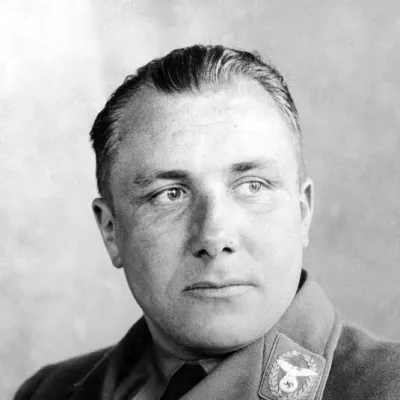
Martin Bormann
Human Design Chart
Biography
Bormann joined a paramilitary Freikorps organisation in 1922 while working as manager of a large estate. He served nearly a year in prison as an accomplice to his friend Rudolf Höss (later commandant of Auschwitz concentration camp) in the murder of Walther Kadow.
Bormann joined the Nazi Party in 1927 and the Schutzstaffel (SS) in 1937. He initially worked in the party's insurance service, and transferred in July 1933 to the office of Deputy Führer Rudolf Hess, where he served as chief of staff.
He began acting as Hitler's personal secretary on 12 August 1935. He had final approval over civil service appointments, reviewed and approved legislation, and by 1943 had de facto control over all domestic matters.
Bormann was one of the leading proponents of the ongoing persecution of the Christian churches and favoured harsh treatment of Jews and Slavs in the areas conquered by Germany during World War II.
Bormann returned with Hitler to the Führerbunker in Berlin on 16 January 1945 as the Red Army approached the city. Bormann was named executor of Hitler's estate. After Hitler committed suicide on 30 April, Bormann and others attempted to flee Berlin on 1-2 May to avoid capture by the Soviets. Bormann probably committed suicide on a bridge near Lehrter station. His body was buried nearby on 8 May 1945, but was not found and confirmed as Bormann's until 1973; the identification was reaffirmed in 1998 by DNA tests.
The missing Bormann was tried in absentia by the International Military Tribunal in the Nuremberg trials of 1945 and 1946. He was convicted of war crimes and crimes against humanity and sentenced to death by hanging.
Martin Bormann as a Manifesting Generator 4/6 in Human Design
Manifesting Generator 4/6 — Design at a Glance
Martin Bormann's design tended towards quick and parallel execution. As an Manifesting Generator, he had constant sacral energy that gave him a hybrid profile: He combined the endurance of a generator with the ability to skip steps in action and produce results quickly. However, this configuration created central tension between his high speed and the risk of neglecting important process steps.
His life task was to wait for the inner impulse – the 'yes' of the sacral center – despite this quickness. Only through this reaction to external stimuli rather than self-initiated action could he avoid frustration, a typical trap of this type when acting against his internal rhythm. His creativity found its deepest satisfaction in the 'play mode', characterized by variety and parallel processing of different tasks.
This mode only worked effectively if strategy and inner authority were consistently aligned. Without this inner consent, the joy of creation quickly turned into frustration, especially when he tried to push too many projects simultaneously without clear confirmation. His success therefore depended on channeling his natural urgency through regular checks of his own consent rather than blindly rushing forward.
Emotional Authority
Martin Bormann's design tended towards emotional volatility: His perception of the world was always colored by his current mood. In one moment, he could be enthusiastic about something, in the next view the same situation as negative. These fluctuations originated from his defined Solar Plexus Center, which also carried his inner authority.
A central mechanism of this design stated that whenever the emotional center is activated, it functions as the decisive internal instance regardless of other defined centers. This meant for Martin Bormann that quick, spontaneous reactions to emotional waves were often deceptive and error-prone. The first impression did not necessarily correspond with his deepest truth.
Instead, his system required patience and time. Decisions had to mature ideally overnight or even multiple times 'slept on'. Only when the intense feelings subsided and an emotional distance was gained, clarity and calmness set in that enabled a grounded action. This process of waiting for emotional calming was essential for long-term orientation. Martin Bormann thus showed himself as someone whose judgment depended on the ability to not immediately act upon initial affect but let it run its course before taking a final position.
The 4/6 Profile — Opportunist / Role Model
Martin Bormann's design tended towards experimental behavior in early relationships, before a fundamental inner conflict between the desire for community and the drive for distant meaning-seeking became apparent. As Profile 4/6, he was influenced by Line 3 during his first thirty years: He actively sought contact and tested various social roles. This phase served as preparation for later activation of Line 6, often experienced as a contradiction between emotional need for belonging (Line 4) and intellectual desire for wisdom and distance (Line 6).
This tension shaped his development: The 'big heart' of the networker line remained cautious to avoid being hurt by false people. At the same time, the transpersonal Line 4 carried the task of passing on mutations and removing blockages, requiring precise communication and recognizing the right moment without endangering his own emotional integrity. The sixth line complemented this with a stance of expectation freedom; justice was valued not as an aim but as pure experience here. Martin Bormann thus moved in a dynamic aimed at integrating this inner conflict to later function as a wise role model – a role that demanded cooperation with others, yet also entailed the risk of disappointment through inappropriate bonds.
Split Definition — Defined & Open Centers
Martin Bormann's design was characterized by a constant, independent mental and energetic architecture. His mind was consistently active (defined Ajna Center), leading to continuous concept formation that he reliably communicated (defined Throat Center). This connection allowed him to translate his thoughts directly into words or actions without them being filtered through emotional fluctuations. His identity and direction were firmly anchored (defined G Center), giving him a clear self-image that he conveyed to others. The driving force came from his vital energy (defined Sacral Center), which was based on reactions; he acted most effectively when responding to external impulses rather than initiating himself.
In contrast, Head, Heart, Spleen, and Root were open. His open Head Center made him vulnerable to external mental pressure and the search for inspiration from outside, sometimes disrupting his own clear thought structure. His open Heart Center led him often into competition for recognition and trying to prove his worth through performance, although he lacked the constant willpower for it. The open Spleen reflected fears and health conditions of the environment, making spontaneous decisions risky as they were not based on his own intuition. Finally, his open Root Center absorbed stress from the environment, leading to a sense of urgency that did not align with his own priorities. This openness meant he situatively reacted to the energies of others while his defined centers provided a stable foundation that he had to use to avoid conditioning patterns.
Channels for self-acceptance, logical order and emotional change.
Martin Bormann's design tended towards deep, mutative restraint. His Personality Sun was in Gate 12, a 'Stop Codon' emphasizing poetry and individual mutation. This shaped him as someone influenced by emotional mood and poetic expression without directly acting or pushing. This energy worked subtly, carried by an inner creativity that showed itself in the restraint.
This dominant mutative quality stood in tension with the Research Channel 34-10 in his Personality. This channel connected the Sacral Center to the G Center through Gate 34 (Power) and Gate 10 (Self Behavior). It promoted a drive for self-love and authenticity, which only became effective through reaction. Martin Bormann sought confirmation of his inner convictions by reacting to external impulses. Without this reaction, the energy from Gate 34 could not interact correctly with others for individualization; instead, he risked being perceived as rigid or self-centered. His focus was on how he could stay centered in his own beliefs, which helped him honor and love himself.
As situational tools, two Juxta-Channels worked in the background. The Acceptance Channel 17-62 connected the Ajna Center to the Throat Center through Gate 17 (Opinions) and Gate 62 (Details). It helped him organize information mentally and translate visual patterns into language to logically structure his worldview. Simultaneously, the Transience Channel 35-36 between Solar Plexus and Throat Centers through Gate 36 (Crisis) and Gate 35 (Change) provided emotional impulses. It drove him to seek new experiences often to balance the inadequacy of his feelings or create crises that brought movement into rigid patterns. These elements served only as stimulus sources while the mutative restraint of the Sun formed the core of his essence.
Collective Circuitry — Circuit Signature
Martin Bormann appeared as someone with deep inner strength, though it was not primarily articulated through words. His design connected the Sacral to the Identity Center (Channel 10-34), leading to a strong, individualistic personality with firm self-worth. As this energy source worked centrally within and had no connection to the Throat Center, his fundamental convictions often remained unspoken; he acted from inner certainty, not rhetorical necessity.
Parallel to this existed a separate energetic structure: The connection of Ajna and Throat Centers (Channel 17-62) allowed logical, future-oriented thinking. Here lay the ability to strategically plan and clearly communicate rational insights. This stood in contrast to the third element, the channel between Solar Plexus and Throat Center (35-36). This circuit brought emotional reflection of past experiences. While strategic thinking looked into the future, this component processed past experiences wave-like.
In Martin Bormann, these three areas - inner conviction, rational strategy, and emotional past reflection - were energetically separate from each other. They did not work as a continuous flow but rather as parallel forces. The inner strength remained private while speaking served either cold logic or emotional afterthoughts. This separation created a complex dynamic: He could argue strategically clearly and simultaneously reflect emotionally without these aspects directly touching his deep, silent identity. The split definition emphasized this parallelism; there was no direct bridge between his inner essence and his external expression or rational processes.
Right Angle Cross of Eden 2
Martin Bormann's Human Design profile featured the right cross of Eden 2. This configuration characterized a fundamental approach marked by inner discipline and a clear focus on what is essential. In Human Design, this cross describes a specific life task: the ability to organize complex situations and bring structure to chaos through consistent action. It was not about external brilliance or spontaneous impulses but rather about quiet yet powerful work behind the scenes.
This mechanism meant for Martin Bormann a deep anchoring in reality. He demonstrated himself as someone who used his energy purposefully to achieve goals often overlooked or underestimated by others. The right cross of Eden 2 demands a certain hardness and determination, as it is about setting boundaries and taking responsibility for one's own fate. This trait influenced all areas of life by providing clear direction and pushing back abstractions in favor of concrete results.
The strength of this design lay in its constancy. Martin Bormann lived according to an inner compass that drove him to create order and control processes. It was a path of self-control and strategic thinking, where every action served a purpose. This structure allowed him to remain stable during difficult times and influence others through his reliability. The right cross of Eden 2 is thus a sign of someone who draws power from the ability to make the impossible possible by proceeding step-by-step without ever losing sight of the big picture.
Saturn Return · Uranus Opposition — Life Cycles
Martin Bormann's Human Design profile indicated a tendency towards structural anchoring once youth ended. His first Saturn return around age 27 marked the transition from development to serious, long-term responsibility. During this phase, earlier impulses condensed into a solid foundation for his later work.
In 1927, at the age of 27, he joined the NSDAP. This event illustrates the mechanics of the first Saturn return: A young person seeks stability and structure to channel their life energy into a stable vessel. Membership was not just a political decision but the moment when his life's work solidified. The design shows how external circumstances and inner maturity come together to set a clear direction.
Saturn energy demands discipline and constancy. Martin Bormann used this period to secure his position and lay the groundwork for future authority. It was not about spontaneous impulses, but about consciously choosing a path that offered stability. This early commitment shaped his subsequent journey significantly. The structure he sought in this year became the framework of his later role. Without this step towards binding himself, his subsequent work would not have been possible. Thus, the design underscores the importance of this transitional age for shaping character and life task.
Manifesting Generator · Emotional Authority — Synthesis
Martin Bormann's life was marked by an inner dynamic resulting from the interplay of his manifesting generator energy and emotional authority. He possessed the ability to quickly react to impulses (Sacral Center) while simultaneously experiencing a deep emotional wave that ripened decisions. This combination led to a personality both action-oriented and deeply influenced by internal processes – someone who seemingly effortlessly set things in motion (Channel 34-10), but always navigated through the ups and downs of his emotions. His defined Throat and Ajna Centers pointed towards clear expression and conception, yet these were modulated by emotional authority. The profile as a networker/role model underscored his ability to connect with others and inspire them while simultaneously grappling with the inner tension between community and individual reflection (Line 4-6).
A central paradox in Martin Bormann's design lay in the connection of quick action and emotional depth. His manifesting generator energy urged him to tackle things and make them happen, while his emotional authority required waiting and thorough examination. This tension between initiation and reaction may have led to an inner conflict that manifested as a tendency towards quick decision-making, which needed to be balanced by the need for emotional clarity. The open definition in key centers (Heart, Root, Spleen) pointed to high sensitivity to external influences, making him vulnerable to conditioning while simultaneously enhancing his ability to adapt and learn.
3 Defined Channels
Incarnation Cross - Right Angle Cross of Eden 2
Solar Return
The Solar Return shows the moment when the sun returns to its exact birth position - your personal solar year.
Life Cycles
Discover the life cycles with a detailed triple view (birth chart, cycle chart, composite).
Human Design Profile
- Strategy
- To respond - wait for something to respond to
- Authority
- Emotional Authority
- Profile
- 4/6 - Opportunist / Role Model
- Definition
- Split Definition
- Incarnation Cross
- Right Angle Cross of Eden 2
- Date of Birth
- 17.06.1900 22:45
- Place of Birth
- Halberstadt, Germany
Frequently Asked Questions
What is Martin Bormann's Human Design type?
What Profile did Martin Bormann have in Human Design?
What authority did Martin Bormann have?
What incarnation cross did Martin Bormann have?
When was Martin Bormann born?
Discover your own Human Design
Are you also a Manifesting Generator? Find out in a personal reading how to unfold your multi-talents and direct your energy wisely.
More Personalities
Back to overviewAldair

Alizée

Angeli

Arletty

Artus

Balthus