
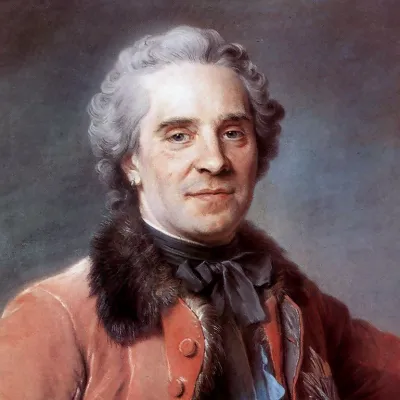
Maurice de Saxe
Human Design Chart
Biography
The Human Design of Maurice de Saxe: Generator 5/1
Generator 5/1 — Design at a Glance
Maurice de Saxe revealed himself as someone with immense endurance who made his strength effective primarily when responding to external signals. As a Generator, he had plenty of sacral energy that turned him into an extremely powerful 'workhorse' - provided he acted in harmony with his inner drive. His life force was unleashed not through independent initiatives but by reacting to impulses from the environment. When his sacral center gave a clear yes, he responded with full action and could then hardly be stopped.
This design, however, brought two specific stumbling blocks. On one hand, he tended towards energy loss or burnout if he carried out tasks that did not bring him joy for too long and which he actually had no desire to do. On the other hand, his strength suffered when prevented from working on his heart project even though he still wanted to continue with full power. The successful use of his resources depended on not initiating but reacting from the gut. Living according to this strategy rewarded his design with a deep sense of fulfillment and satisfaction. If he constantly initiated independently against his inner rhythm, sooner or later he would encounter persistent frustration and a noticeable lack of energy. His path lay in recognizing the right signals and then following through.
Sacral Authority
Maurice de Saxe lived as a Generator whose decision-making was characterized by sacral authority. This internal guidance did not come from the head but showed itself physically: as spontaneous gut feelings or an immediate surge of power in response to external stimuli. His design required listening to these bodily sounds – whether grunts, hums, or simple 'mmms'. When this reaction occurred, he felt vital and energized; without it, his urge to act was absent. This mechanism simplified his process as strategy and authority were identical: waiting for what actively engaged him before acting with enthusiasm.
Central to this dynamic was his open emotional center. Since it was undefined, Maurice de Saxe could not use emotional waves that often delayed or distorted decisions. Instead, he reacted directly at the moment of demand. When additionally the spleen center was activated and connected to the sacral center, this reaction gained speed. The spleen provided an instinctive, quick perception of danger or safety that supported the sacral response. This allowed him spontaneous, reliable decisions based on physical well-being. He did not act out of strategic planning but let himself be guided by this immediate, living resonance, which enabled him to immerse himself in tasks without seeking a higher purpose.
The 5/1 Profile — Heretic / Investigator
Maurice de Saxe showed himself as someone who used deep knowledge to find solutions for others – a typical characteristic of the 5/1 profile. This design combined Line 1, which stands for research and reflection, with Line 5, which passes problem-solving on to the collective. Others often sought his advice, but without clear boundaries this could lead to exhaustion, similar to an expert who is drained after intensive consultation. His design required the ability to also say no in order to maintain a balance between personal learning and helping others.
Additionally, Gate 28 shaped his attitude towards life's struggles: he questioned whether conflicts were worth the effort and possessed the intuitive gift of dissolving alliances or joining stronger coalitions. This contrasted with Gate 33, which emphasized retreat and reflection. Unreflective courage was seen as risky here; instead, it was about wisely retreating in weak positions to find meaning before acting once the inner process was complete. This combination of strategic alliance thinking and necessary restraint formed his way of dealing with challenges – not through blind advancement but through careful consideration of fight and rest phases.
Split Definition — Defined & Open Centers
Maurice de Saxe revealed himself as someone whose design combined a consistent mental structure with a deep inner direction. His defined Ajna Center provided continuous conceptual clarity; he thought constantly and could directly translate his ideas into the world through his defined Throat Center. This connection allowed him to speak what his mind conceived without this voice being easily distracted by external influences. At the same time, his defined G Center gave him a reliable sense of self-identity and a clear sense of direction in life. He possessed the inner security of feeling loved and could show others new paths without needing their approval.
These stable internal pillars stood in contrast to his open centers, which made him vulnerable to certain conditioning. His open Head Center had no source for inspiration; instead, he tended to absorb mental pressure from the environment and identify with other people's questions, leading to confusion if he did not trust his inner authority. Similarly, his open Heart Center lacked a consistent willpower, making him susceptible to the temptation of making promises or proving worth through performance to compensate for a felt lack of self-worth.
His open Solar Plexus absorbed and amplified the emotions of his environment. He could identify with foreign feelings and avoid confrontation to prevent emotional waves from being triggered rather than living his own truth. The open Spleen Center brought fundamental survival anxiety; he tended to cling to situations or people that gave a false sense of security, avoiding spontaneous decisions as his instinct for well-being could be distorted by external conditioning. Finally, his open Root Center took on the stress of his environment, leading to a cycle of adrenalized pressure that he often misinterpreted as his own drive to constantly achieve and accomplish.
Channels for bold impulses and clear structuring.
Maurice de Saxe was characterized by an approach that used material resources strategically to drive new directions and innovations. This stemmed from Channel 14-2, connecting the Sacral Center with the G Center. Gate 14 focused on the availability of material means for mutation, while Gate 2 as a driver directed movement through space and time. This configuration gave him the ability to create an empowering new orientation by trusting his generative energy without needing to know the exact path in advance.
At the same time, he had the gift of structuring complex insights so that they promoted efficiency and changed collective thinking. Channel 23-43 connected his Ajna Center with his Throat Center. Here, Gate 43 received spontaneous breakthroughs as inspired reason, which were then assimilated and clearly expressed through Gate 23. His thinking often felt light-years ahead; only when he communicated his unique perspectives at the right time was his genius recognized and could organizations be elevated to a higher level.
Additionally, he was marked by the readiness to take risks in the here and now (Gate 28), combined with deep care for the tribe (Gate 27). His creativity without limitations (Gate 1) as well as his ability for meticulous refinement (Gate 9) allowed him to correct patterns and act at the right time. The persistence of saying yes (Gate 29) underpinned these efforts, while he centered himself through reflection (Gate 33) and mystical innocence (Gate 25). His role as a transmitter of forces (Gate 31) and his focus on resources and territory (Gate 19) rounded out a design aimed at bringing about sustainable changes in the collective through individual mutation and clear communication.
Individual Circuitry — Circuit Signature
Maurice de Saxe revealed himself through his design as someone who carried two separate, parallel operating energetic streams within him. As a person with Split Definition, he did not have an uninterrupted connection of all centers; instead, there existed two isolated groups that did not communicate directly.
The Knowledge Circuit marked him through its specific segments. The first group connected the Ajna Center with the Throat Center via Channel 23-43. This allowed him to articulate and express inner thoughts and concepts in clear, structured words. His ideas were thus not only thought but verbally organized and communicated.
The second group linked the Identity Center with the Sacral Center through Channel The Beat (Gates 2-14). Here a connection occurred between his deepest essence core and life energy. This gave him a rhythmic, pulsing expression of his individual identity, drawing directly from his physical power.
Although both parts belonged to the same Knowledge Circuit, they were energetically separate in Maurice de Saxe. The verbal structuring in Head-Throat did not flow directly with the rhythmical identity-forming energy of Sacral and Identity. He had to live these two different forces – clear formulation on one hand and rhythmic being on the other – as separate, co-existing abilities without them automatically intermingling.
Left Angle Cross of Alignment 2
Maurice de Saxe was marked by the left cross of alignment 2, a configuration that aims at seeking inner truth and spiritual understanding. His design suggested he was striving to recognize deeper connections and integrate these insights into his actions. This tendency towards self-reflection and the pursuit of clarity shaped how he perceived the world.
The left cross of alignment 2 describes a path where the individual learns to rely on inner guidance while simultaneously aligning with external reality. It is about developing an authentic stance that unites personal intuition with practical implementation. For Maurice de Saxe, this likely meant that he always strove to make decisions from a place of deeper certainty.
Although no specific events are mentioned in the raw content, it can be assumed that this aspect of his design prompted him to seek ways to penetrate complex situations and find solutions meaningful both for himself and others. His ability to navigate between the visible and the hidden was an essential part of his personality.
Saturn Return · Uranus Opposition · Chiron Return — Life Cycles
Maurice de Saxe showed a life path marked by clear structural milestones pointing towards inner maturation processes. In 1726, at age 30, he was elected as Duke of Courland. This step marked his first Saturn Return, a phase where long-term work and development often condenses into a stable, solid result. It was less about a sudden coincidence than the crowning of a preceding developmental stage.
Later, in 1734 at age 38, he received the title of Lieutenant General. This fell during the Uranus Opposition period, a cycle often associated with unexpected changes or new perspectives that challenge and expand existing structures. The conferral of this high rank confirmed his growing authority and adaptability to new demands.
The peak of this development was shown in 1745 when he won at the Battle of Roucoux at age 49. This event fell precisely during his Chiron Return, a fulfillment cycle between ages 49 and 51. During this phase, one's incarnation cross increasingly unfolds in life; meaning and purpose become experiential if the person has lived according to their strategy and authority beforehand. The victory at Roucoux was thus not an isolated military success but an expression of a personal bloom period where Maurice de Saxe experienced and realized his deeper life mission.
Generator · Sacral Authority — Synthesis
Maurice de Saxe was a Generator whose life was marked by deep sacral energy. This showed in his ability to dedicate himself with enthusiasm and perseverance to tasks that aligned with his inner drive (sacral authority). His Hero/Researcher Profile (5/1) reinforced this trait: he actively sought challenges and deepened his knowledge to make it available to others. The defined Ajna Center indicated a consistent way of thinking that created concepts and inspired others – a process fueled by the Beat Channel (14/2) with innovative power. Thus, he lived a path marked by energy, thirst for knowledge, and the desire for problem-solving.
At the same time, his design revealed a central paradox: the combination of deep creative potential (Generator) and the tendency to get lost in endless learning processes (5/1 Profile). The defined mental function could lead him to constantly seek new concepts while his sacral authority actually demanded clear yes or no decisions. This led to a tension between the need for constant knowledge acquisition and the challenge of focusing on truly important tasks – a dynamic reflected in the documented events of his career.
2 Defined Channels
Incarnation Cross - Left Angle Cross of Alignment 2
Solar Return
The Solar Return shows the moment when the sun returns to its exact birth position - your personal solar year.
Life Cycles
Discover the life cycles with a detailed triple view (birth chart, cycle chart, composite).
Human Design Profile
- Type
- Generator
- Strategy
- To respond - wait for something to respond to
- Authority
- Sacral Authority
- Profile
- 5/1 - Heretic / Investigator
- Definition
- Split Definition
- Incarnation Cross
- Left Angle Cross of Alignment 2
- Date of Birth
- 28.10.1696 19:30
- Place of Birth
- Goslar, Germany
Frequently Asked Questions
What was Maurice de Saxe's Human Design type?
What Profile did Maurice de Saxe have in Human Design?
What Authority did Maurice de Saxe possess?
What incarnation cross was assigned to Maurice de Saxe?
When was Maurice de Saxe born?
Discover your own Human Design
Are you also a Generator? Find out in a personal reading how to use your sacral energy correctly and discover deep satisfaction.
More Personalities
Back to overviewAaliyah

Alain-Fournier

Alexia

Angèle

Angeli

Anne-Marie
