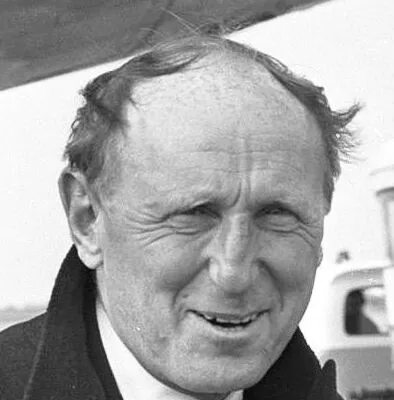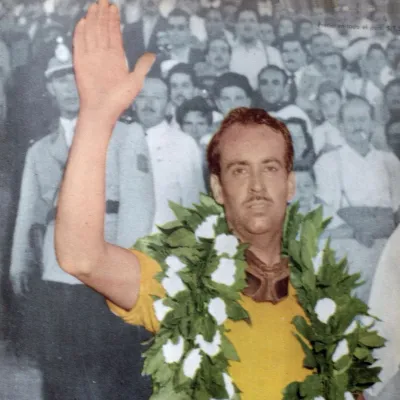
Maurice Trintignant
Human Design Chart
Biography
Maurice Trintignant was the brother of Bugatti race car driver Louis Trintignant — who was killed in 1933, in practice, at Péronne, Picardy — and the uncle of renowned French film actor Jean-Louis Trintignant.
He died 13 February 2005.
Human Design Analysis: Maurice Trintignant as Projector 5/1
Projector 5/1 — Design at a Glance
Maurice Trintignant revealed himself as someone who could instantly identify weaknesses in systems and relationships. His Human Design type was Projector, which brought with it a specific kind of perception: his aura acted like a focused beam of light that directed itself towards areas where other people had problems or uncertainties. However, this ability to immediately pinpoint flaws was only effective if he did not use it aggressively. Directly addressing these issues often would have caused resistance, much like shining a bright light directly into someone's face.
The appropriate strategy for his design involved waiting for an honest invitation from the environment. Instead of taking the initiative himself or imposing solutions, he should live in harmony and let his clarity shine through. This made him attractive to others; people came to him voluntarily seeking advice because they felt his clarity. Since Projectors do not have a defined Sacral Center, they lack a constant source of life energy. As such, Maurice Trintignant experienced phases of high activity and fast work speed followed by necessary rest periods for regeneration. Without these breaks, he risked burning out. Living according to the principle of waiting for an invitation led to success in his path. Ignoring this principle sooner or later resulted in bitterness as a manifestation of his non-self.
Emotional Authority
Maurice Trintignant showed himself as someone who did not immediately act on inner impulses but subjected them to a necessary maturation period. His design carried emotional authority, meaning that his defined Emotional Center was always the final instance for decisions – regardless of which other centers were also defined. This priority required specific patience: his feelings ebbed and flowed in waves, with each current mood only temporarily coloring perception rather than being the ultimate truth. A spontaneous reaction to an emotional peak or low would often have led him astray, as the initial impression was not yet clarified. Instead, it was important for Maurice Trintignant to sleep on decisions and give himself time until the initial emotional heat had dissipated. Only when these waves subsided and emotional distance was gained did the necessary clarity set in. This process of waiting was no sign of hesitation but an essential strategy to ensure that his actions were based on a stable, well-thought-out foundation rather than fleeting moods. Thus, he used time as a tool to distinguish between transient feelings and his true inner direction.
The 5/1 Profile — Heretic / Investigator
Maurice Trintignant revealed himself as someone who utilized his deep, individually acquired knowledge to offer concrete solutions for others' problems. His design as Hero/Researcher (Profile 5/1) gave him almost magnetic appeal; others actively sought out his advice and the treasures of his experience. Yet this ability came with a specific risk: without clear boundaries, he ran the danger of being exhausted by the abundance of inquiries and expectations from others, similar to an expert breaking under the weight of countless questions.
This tension resulted from the interaction of his lines. Line 5 demanded exchange and solution for the collective, while Line 1 required a necessary retreat for reflection and survival. Trintignant had to learn to strategically withdraw in order to find meaning and not fall into unreflective battles or manipulations. His path lay in balancing the research process for himself with problem-solving for others. Only through consciously setting boundaries could he optimally use his gifts without depleting his own energy. This characterized his life as a constant weighing between engagement and necessary distancing to maintain inner clarity.
Split Definition — Defined & Open Centers
Maurice Trintignant revealed himself as someone with a fixed, reliable self-identity and a clear sense of direction. His defined G Center gave him an inner security in the love for himself, which allowed him to love others without dependency. This constancy was reflected through his defined Throat Center, serving as a pivot point to carry messages from within clearly and honestly outward. His communication was not a random product of the mind but rather an expression of his deep identity.
Parallel to this, he possessed a profound emotional intelligence through his defined Solar Plexus Center. This worked as his inner authority: He had to wait out the waves of his feelings to reach clarity. Impulsive decisions were avoided; instead, he used time to explore emotions before acting. His defined Spleen Center complemented this with spontaneous intuition in the present moment, helping him intuitively recognize health-promoting situations and protect himself from danger. The pressure of his defined Root Center propelled him materially and existentially forward, managing stress in a fixed way to secure his well-being.
In contrast, Maurice Trintignant was open in mental and will-related areas. His open Head and Ajna Centers meant he did not have consistent mental processing. He tended to identify with questions or doubts of others when he did not trust his inner authority. Instead of constructing answers from the mind, his mind served as a mirror for inspirations from the environment. His open Heart Center made him vulnerable to the pressure of proving his worth through willpower or promises – a trap that he had to avoid by recognizing that he needed no proof. Similarly, his open Sacral Center lacked consistent generative energy; he was sensitive to the vitality of others and had to learn not to run on borrowed energy but respect his rest phases to avoid exhaustion.
Channels for leadership, synthesis and life struggle.
Maurice Trintignant showed a tendency towards logical, collective leadership based on tested patterns. The Alpha Animal Channel 7-31 connected his G Center with the Throat Center, giving him the ability to act as a trustworthy leader who understands trends and must be invited by the majority to lead effectively. His voice had influence, yet he led more through representation than absolute authority.
At the same time, he was deeply sensitive to tribal belonging and emotional bonds. The Synthesis Channel 19-49 connected his Root Center with the Solar Plexus Center, ensuring that he experienced loyalty and the protection of shared resources as a basic need. This channel determined who entered his inner circle based on an emotional frequency of acceptance or rejection, holding family and community together.
Furthermore, he was driven by a strong will towards individualization. The Life Struggle Channel 28-38 connected his Root Center with the Spleen Center, giving him the determination to walk his own path even against resistance. He found meaning in life's struggles and stubbornly resisted expectations that contradicted his integrity to express his uniqueness.
Additionally, other gates influenced him: Gate 27 promoted genetic care for the tribe, while Gate 33 required reflection and withdrawal to process experiences. Gate 10 shaped his behavior through complex adaptation to situations, and Gate 39 brought a selective process of analysis and provocation with it. Gate 15 supported him in organizing collective structures by adapting to natural rhythms, while Gate 16 encouraged experimentation to master skills. Finally, Gate 52 required focused pauses for pattern correction and silence to gain clarity.
Individual Circuitry — Circuit Signature
Maurice Trintignant presented himself as someone who acted through inner tensions and logical clarity. His design was divided: Two energetically independent blocks existed parallel without direct exchange. The first block connected the Throat with the Identity Center via the Understanding Circuit. Here, the Alpha Animal Channel (Gates 31-7) worked to allow Maurice Trintignant to directly articulate rational strategies and future-oriented visions – a capacity for clear, emotionless communication of his own identity.
The second block included Spleen, Solar Plexus, and Root Centers. In this area, two circuits worked side by side. The Knowledge Circuit connected via the Life Struggle Channel (Gates 28-38) intuitive spleen energy with root tension. This created a pulsing, acoustic rhythm of survival instinct: Maurice Trintignant reacted to situations with deep, instinctive urgency that was not directly linked to his logical expression ability in the first block.
Parallel to this, the Ego Circuit worked within this second block. The Synthesis Channel (Gates 49-19) connected the Solar Plexus Center with the Root Center. This generated an emotional wave aimed at synthesis and mutual support. Maurice Trintignant sought emotional validation in interpersonal dynamics, where this emotional search was fueled by the same root energy that also drove his instinctive survival struggle. Both energies – the instinctive fight and the emotional synthesis – formed a closed unit in the lower chart area, separate from his rational voice above.
Left Angle Cross of Alignment 2
Maurice Trintignant displayed an internal attitude marked by the search for a clear personal direction. His design included the 'left alignment cross'. This configuration is not just a trait but a deeply rooted life task: to find and walk one's own path with clarity. It was not about external fame or confirmation from others, but rather the inner certainty of being on the right path. This energy challenged him to continuously confront his own orientation to avoid confusion and establish a stable foundation for his decisions. It acted as an ongoing internal compass that pushed him to prioritize authenticity over adaptation. Maurice Trintignant lived this dynamic not as a single event but as an ongoing process of self-positioning. The challenge lay in trusting this inner voice, even when it was not always comprehensible from the outside. His design suggested that his greatest strength lay in staying true to himself and drawing a coherent life line based on personal truth. This shaped his character sustainably and significantly influenced how he dealt with environmental demands – always striving not to lose sight of his own orientation.
Saturn Return · Uranus Opposition · Chiron Return · 2nd Saturn Return — Life Cycles
Maurice Trintignant was someone whose life rhythm was strongly marked by cyclical turning points. His design indicated a tendency to take decisive steps in certain age phases that solidified or changed his professional identity.
In 1945, at the age of 28, he returned to the racetrack with his Bugatti Type 35 C. This fell during his first Saturn Return, a phase where years of groundwork and internal structuring often condense into a tangible external result. For his design, this moment marked the stabilization of his career foundation after an interruption.
Ten years later in 1955 at the age of 38, he celebrated a major victory at the Grand Prix of Monaco. This coincided with his Uranus Opposition, a time of heightened dynamics and sudden change. Here, the ability of his design to respond to unexpected opportunities and turn them into concrete successes was evident, solidifying his position in motorsport sustainably.
In 1964, at age 47, he achieved his last successful result with a fifth place finish at the German Grand Prix. This was close to his Chiron Return, a cycle of fulfillment and bloom. During this phase, one's incarnation cross increasingly unfolds in life; Maurice Trintignant experienced here a late confirmation of his purpose, not as healing old wounds but as meaningful completion of his previous paths.
Projector · Emotional Authority — Synthesis
Maurice Trintignant acted as a projector who, through his defined throat and emotional authority, possessed the ability to recognize patterns and articulate them (Alpha Animal Channel). He was designed to bring 'light into darkness' for others by pointing out weaknesses – though always filtered through an evolving emotional wave that required time for maturation. This combination of sharp perception and emotional depth shaped his approach to complex situations and revealed a talent that worked both as a problem solver and observer.
A central paradox in his design lay in the interplay between inner sensitivity and the drive towards leadership. Emotional authority demanded careful balancing, while the Alpha Animal Channel predisposed him to logical leadership – a tension field between the need for emotional space and the natural impulse to provide direction. This was evident during cycles where both career successes and setbacks correlated with specific time points, suggesting an interaction between internal readiness and external demands.
3 Defined Channels
Incarnation Cross - Left Angle Cross of Alignment 2
Solar Return
The Solar Return shows the moment when the sun returns to its exact birth position - your personal solar year.
Life Cycles
Discover the life cycles with a detailed triple view (birth chart, cycle chart, composite).
Human Design Profile
- Type
- Projector
- Strategy
- Wait for the respectful invitation
- Authority
- Emotional Authority
- Profile
- 5/1 - Heretic / Investigator
- Definition
- Split Definition
- Incarnation Cross
- Left Angle Cross of Alignment 2
- Date of Birth
- 30.10.1917 08:00
- Place of Birth
- Sainte-Cecile-les-Vignes, France
Frequently Asked Questions
What was Maurice Trintignant's Human Design type?
Which Profile did Maurice Trintignant have?
What Authority did Maurice Trintignant have?
What incarnation cross was assigned to Maurice Trintignant?
When was Maurice Trintignant born?
Discover your own Human Design
Are you also a Projector? Find out in a personal reading how to unfold your leadership qualities and recognize the right invitations.
More Personalities
Back to overviewSissy Spacek

Alain-Fournier

Aldair

Anémone

Ann-Margret

Bourvil