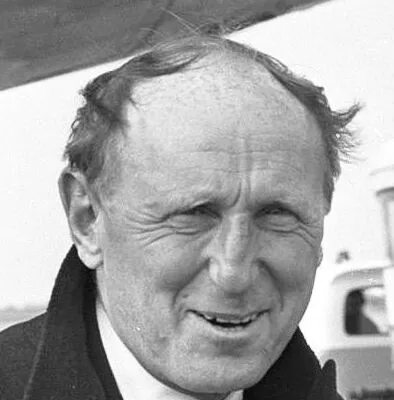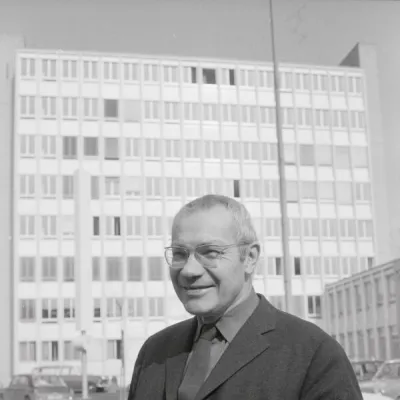
Max Bill
Human Design Chart
Biography
Died on 9 December 1994.
What does Projector 3/5 mean for Max Bill?
Projector 3/5 — Design at a Glance
Max Bill's Human Design emphasized a tendency towards precise system analysis. As a projector, he had a dense, focused aura that worked like a bright flashlight, revealing immediately where systems or people were not functioning optimally. This ability to spot errors in the system was his core strength.
However, the mechanics of his design required restraint. Direct criticism of these weaknesses would often trigger defensive reactions from those around him, akin to shining a bright light into someone's face. Instead, Max Bill attracted others through his radiant presence and personal harmony. His strategy involved waiting for a respectful invitation before sharing his knowledge. This way, his intense aura was perceived as helpful rather than threatening.
Since his Sacral Center was undefined, Max Bill lacked constant life energy. His rhythm consisted of phases of high activity followed by necessary rest to avoid burnout. Living according to this pattern of patience and waiting for invitations rewarded him with success. Ignoring this structure and acting impulsively without invitation led sooner or later to the experience of bitterness as his non-self theme.
No Inner Authority
Max Bill did not have an internal, physical authority for decision-making. Instead, he oriented himself externally: through dialogue with others or cyclical conditioning. As a mental projector, he had no center activation below the Throat Center. This configuration suggested that Max Bill found decisions by intensely exchanging ideas with various people. Through energetic interactions in his open centers, dormant potentials were activated and provided specific information. This allowed him to view issues from many perspectives and express them differently. His high resonance ability helped him identify the right environment and suitable conversation partners for this exchange.
Evaluating these diverse impulses was a complex process requiring time and solitude. Max Bill needed quiet to recognize the thread of meaning and distinguish what made sense and belonged to him. This developed his specific intelligence: filtering essential information from a mass of data, organizing it meaningfully, and structuring it. This formed his capital for success as a projector. A key aspect for him was being in an environment where he felt comfortable. There, he met people with whom he could confidently discuss decision-making processes. Over time, this exchange deepened his sense of what was right for him.
The 3/5 Profile — Martyr / Heretic
Max Bill's design leaned towards experimental action: He learned primarily through personal experimentation and the analysis of failures rather than relying on preconceived beliefs. This approach stemmed from Line 3 of his Profile 3/5, the Adventurer who initially accepts nothing as true until he has experienced it himself. The practical experience gained served not only for self-education but also became a tool to solve others' problems – the domain of Line 5, the Hero. This combination created a specific dynamic: Max Bill's wealth of lived practice made him attractive to his surroundings, who saw him as an advisor or rescuer. However, the projected expectation that he could handle crises stood in tension with his need to test new things. The risk was that failure during such experimentation would become publicly visible and thus endanger his heroic role. Nevertheless, Line 3 allowed him to adapt without losing his essence; it transformed potential martyrdom into a learning mutation. Conversely, Line 5 demanded the right timing and rhythm for success. Thus, Max Bill moved between the private necessity of trial-and-error and public pressure to always have solutions ready, with his charm arising precisely from this authentic, experience-based approach.
Single Definition — Defined & Open Centers
Max Bills Human Design suggests a persistent mental pressure to question and understand connections. This constant inspiration from his defined Head Center and Ajna Center was the source of his thinking. However, since these centers did not provide energy for direct manifestation, he could not independently manifest ideas. Attempting to relieve this mental pressure through hasty actions would only have led to frustration. Instead, his mechanics worked by waiting for the right timing and transmitting impulses to others who had the energy to implement them.
This clear mental process contrasted with his high receptivity in open centers. His open Throat Center meant he did not carry a fixed identity but adapted situatively to his environment and was initiated through relationships. He tended to seek direction shown from outside rather than asserting it himself. His open Heart Center made him vulnerable to the pressure of proving worth or making promises – a trap he had to avoid by not trying to simulate willpower.
His open Solar Plexus absorbed emotions from the surroundings, leading to experiencing foreign moods as his own. He relied on observing these emotional waves without personalizing them. His open Sacral Center showed an unstable energy flow; he worked in spurts and needed to learn not to react to borrowed energy from the environment to avoid exhaustion. His open Spleen Center carried a deep survival fear, making him prone to clinging to unhealthy situations just because they provided a sense of security. Finally, his open Root Center absorbed stress from the environment, leading to a pressure to constantly do or achieve something. The wisdom of his design lay in recognizing this external pressure as non-self and relying on inner authority to distinguish between healthy impulses and conditioning.
Channels for mental patterns and abstract comprehension.
Max Bills Human Design suggests a tendency towards permanent active thought based on experience. He was someone who sought to construct meaning from the chaos of daily life, not through direct analysis but by filtering experiences through kaleidoscopic mental images. This attitude was significantly influenced by Channel Abstraction 64-47. This channel connects the Head Center with the Ajna Center and creates a constant internal pressure to interpret every life situation – even dreams. Max Bill felt compelled to understand the past and gain perspective. His mind served not for self-determination or solving personal problems; it was unsuitable for that. Instead, his intellect functioned as an inspiration source for the collective. Clarity emerged only through patience: he had to wait until swirling images condensed into a story he could then share with others. This process of storytelling was essential to avoid inner authority in the head and mental confusion.
Additionally, Gates like 46 (Devotion, Body Love), 10 (Integration, Genetic Behavioral Rules), and 25 (Innocence, Mysticism) influenced him. These configurations emphasized the importance of presence in the here and now as well as a spiritual stance of individuation. Gate 15 brought collective behavior and natural rhythms into play, while Gate 11 promoted visual memories and collective ideas. Gate 17 stood for logical teaching and organizing the future through readiness to serve. Together, these elements formed a complex pattern: Max Bills mind was a factory for perspectives that only worked when he shared their results. His design challenged him not to seek final answers for himself but to act as a medium transforming confusion into inspiring stories for others. The strength of his design lay in the ability to give the collective new angles after patiently waiting for the emergence of meaning.
Collective Circuitry — Circuit Signature
Max Bills Human Design suggests a tendency towards cyclical emotional processing of past events. He was someone who sought the meaning behind already occurred events and wanted to share these insights visually and emotionally with others. This attitude was shaped by the active Meaning Maker Circuit, whose energy flowed in wave-like patterns – with beginning, middle, and end – often independent of pure logic.
In Max Bill, this circuit operated through Abstraction (Channel 64-47). This channel connects the Head Center with the Ajna Center. Thus, a direct energetic bridge was formed between spontaneous inspiration and pictorial form-giving. The energy did not flow linearly but in emotional waves serving to reflect on past experiences and give them meaning. The goal of this mechanism was to prepare these felt insights so they became accessible for the collective, contributing to learning from the past together.
Since Max Bill had a Simple Definition, Head Center and Ajna Center formed a closed, connected group. There were no further direct connections to other centers within this specific circuit. Thus, all dynamics focused on Abstraction: translating inner impulses often illogical into clear visual forms that generated emotional resonance and contributed to collective meaning-making.
Right Angle Cross of the Vessel of Love 4
Max Bill was marked by the configuration of the right cross of the Love Vessel. This structure established a fundamental dynamics where the ability to give and the need for deep connection were at the center. It wasn't about superficial emotions, but rather an archetypal life task: understanding and living love as transformative power.
The 'Love Vessel' describes not passive receptivity, but an active stance of holding. Max Bill's design indicated that he was called to create spaces – whether interpersonal or creative contexts – where affection and understanding could unfold. The emphasis on this archetypal nature meant that his actions and decisions were often guided by the question of how to sustainably shape connection.
This mechanism worked as a constant undercurrent: it challenged him to use his capacity for empathy and care without losing himself in the process. Instead, love became the measure he sought orientation from. Through this alignment, he could nourish relationships and projects with depth that went beyond the momentary. It was about the essence of giving and receiving in its purest form, embedded in a structure that combined stability and emotional resonance.
Saturn Return · Uranus Opposition · Chiron Return · 2nd Saturn Return — Life Cycles
Max Bill's design was characterized by phases of institutional anchoring, where his work was officially recognized by established structures. This tendency to integrate into existing systems became concrete in 1951: at the age of 43, he received the Grand Plastic Prize at the Biennale in São Paulo. This event fell during the Uranus opposition cycle, often marked by breaking old patterns and opening up new, broader horizons – here manifesting as international appreciation for his work beyond local boundaries.
Later, this recognition deepened through structural validation. In 1964, at the age of 56, Max Bill became an honorary member of the American Institute of Architects (AIA). This occurred during his second Saturn return. The second Saturn return marks a time of maturation and consolidation in Human Design mechanics, where years of work condense into a stable, recognized position. His honorary membership was not a sudden success but the logical consequence of long-term development, where his principles were confirmed as valuable and sustainable by a leading institution. Both events underscore how Max Bill's life was marked by cycles that linked individual creative power with societal validation – first through the impulsive breakthrough of the Uranus cycle, then through the gravitational affirmation of the Saturn rhythm. His strategy was to see these external recognitions not as ends in themselves but as mirrors reflecting the inner integrity of his design.
Projector · No Inner Authority — Synthesis
Max Bill lived a process of continuous abstraction (Channel 64-47), driven by a deep need to grasp the complexity of the world and transform it into new forms. This drive to recognize and order patterns (Gate 47) manifested in an ongoing engagement with experience, trying to develop a coherent narrative from it – an inner urge that never left him. Through the connection between Head Center and Ajna Center, he was always inspired to pose questions but without the possibility of mentally concluding these processes definitively. Instead, he drew on the flow of life itself by embracing constant change and sharing his insights.
A central tension in Max Bill's design lay between his need for abstraction and his openness to the emotional world (open Solar Plexus Center). He was an observer who absorbed and amplified other people's energies but without an inner, defined source of stability. This led to a dynamic interaction between the pursuit of clarity and immersion in the multifacetedness of life, a constant balancing act between distance and engagement. This tension created space for innovation and creativity, yet also required a high degree of self-awareness to not be overwhelmed by external influences.
1 Defined Channel
Incarnation Cross - Right Angle Cross of the Vessel of Love 4
Solar Return
The Solar Return shows the moment when the sun returns to its exact birth position - your personal solar year.
Life Cycles
Discover the life cycles with a detailed triple view (birth chart, cycle chart, composite).
Human Design Profile
- Type
- Projector
- Strategy
- Wait for the respectful invitation
- Authority
- No inner authority - learn more
- Profile
- 3/5 - Martyr / Heretic
- Definition
- Single Definition
- Incarnation Cross
- Right Angle Cross of the Vessel of Love 4
- Date of Birth
- 22.12.1908 16:30
- Place of Birth
- Winterthur, Switzerland
Frequently Asked Questions
What was Max Bill's Human Design type?
Which Profile did Max Bill have in Human Design?
What authority did Max Bill possess?
What incarnation cross did Max Bill have?
When was Max Bill born?
Discover your own Human Design
Are you also a Projector? Find out in a personal reading how to unfold your leadership qualities and recognize the right invitations.
More Personalities
Back to overviewSissy Spacek

Alain-Fournier

Anémone

Angeli

Ann-Margret

Bourvil