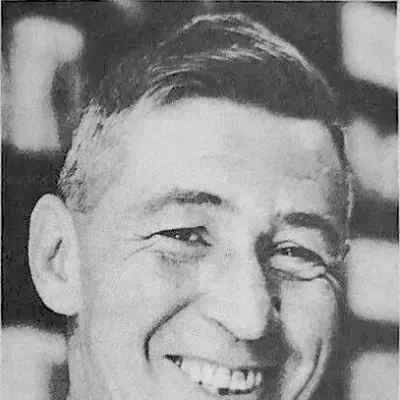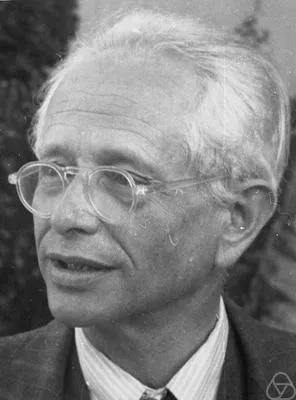
Max Dehn
Human Design Chart
Biography
Dehn was a student of David Hilbert, and in his habilitation in 1900 Dehn resolved Hilbert's third problem, making him the first to resolve one of Hilbert's well-known 23 problems. Dehn's students include Ott-Heinrich Keller, Ruth Moufang, Wilhelm Magnus, and the artists Dorothea Rockburne and Ruth Asawa.
Dehn stayed in Germany until January 1939, when he fled to Copenhagen, and then to Trondheim, Norway, where he took a position at the Norwegian Institute of Technology. In October 1940 he left Norway for America by way of Siberia and Japan (the Atlantic crossing was considered too dangerous).
Dehn married Antonie Landau on 23 August 1912. He died from an embolism on 27 June 1952 at age 73 in Black Mountain, North Carolina.
Human Design Analysis: Max Dehn as Projector 3/5
Projector 3/5 — Design at a Glance
Max Dehn appeared as someone with a dense, focused aura. His Human Design type was Projektor, meaning he did not have an intrinsic source of life energy within himself. Instead, his energy projected like a bright beam onto the environment and could quickly identify weaknesses or errors in systems there. This ability to immediately recognize where something wasn't functioning properly was characteristic of his design.
However, this sharpness required a specific strategy: waiting for an honest invitation from others. If Max Dehn jumped in without such an invitation and corrected directly, his presence often felt unpleasant or too intrusive – similar to being blinded by direct light. It was more effective for him to attract through harmonious actions of his own so that others would naturally seek out his advice.
Since his Sacral Center was undefined, his energy followed a rhythmic pattern. Phases of high productivity and rapid workability alternated with necessary rest phases to avoid exhaustion. The conforming societal structure rarely fit this need. Living according to this dynamic rewarded him with success. Ignoring this structure and acting out of initiative without invitation led sooner or later to feelings of bitterness as an expression of his non-self-experience.
Self-Projected Authority
Max Dehn was a Projektor with the rare authority in Self. This configuration marked him by extreme openness, which was always accompanied by the danger of being distracted by external motoric energies. The central challenge lay in not sinking into this vastness and chasing after energy. His inner truth resided in his identity. Decisions took place on two paths: through self-dialogues or dialogues with others if he was invited to do so. Crucial here was listening to one's own speaking and separating spontaneous expression from the mind. What spoke without thinking revealed his true essence and made his uniqueness visible to others. Alternatively, a physical feeling acted as a compass that drew him geographically or thematically in a direction. By following this inner orientation faithfully, Max Dehn could become a guide for others. There lay his specific potential for success. This mechanism determined how he navigated life and communicated.
The 3/5 Profile — Martyr / Heretic
Max Dehn was someone who experienced his life path through active experimentation and direct experience. His design was shaped by the Profile of the Experimenter: He learned not just by listening but had to do things himself to test their validity. This process of trial and error formed the basis of his knowledge. Failure was not an end, but a necessary step towards adaptability and renewal.
From these practical experiences, he later developed a role as a hero or savior for others. Profile 3/5 described this dynamic: Those who try much accumulate a treasure of solutions that can be attractive to others. Max Dehn used his logical abilities to organize complex connections and pave the way to insight for others. In doing so, he tempted others to take responsibility and protect themselves from mistakes. His authority did not arise through doctrines but through shared results of his own experiments. When he failed, it often happened publicly, which could be painful but also underlined his authenticity. He tolerated criticism because he knew that only in this way new knowledge would emerge and be passed on. His life task was to uncover hidden logical structures and convey them so that others could learn from them.
Single Definition — Defined & Open Centers
Max Dehn's design indicated a tendency towards conceptual clarity and stable inner alignment. His defined Ajna Center ensured continuous mental processes; he thought continuously, processed data, and formulated theories in a trustworthy manner. These cognitive structures flowed into his defined Throat Center, allowing him to manifest his thoughts directly through language – not just as impulses but as well-thought-out concepts. Simultaneously, the defined G Center provided him with reliable self-identity and clear direction sense; he knew who he was and where life was leading him without relying on others or adopting their paths.
These stable pillars contrasted with the sensitivity of his open centers. The open Head Center made him vulnerable to external mental pressure; he tended to identify with other people's questions and sought inspiration that wasn't his own, which could lead to confusion. His open Heart Center lacked consistent willpower; he found himself in a cycle of wanting to make promises to prove value despite not having the energy for it. The open Sacral Center led him to absorb others' vital energy and overexert himself without clear boundaries for his own endurance. Additionally, his open Solar Plexus picked up emotional waves from the environment, making him appear emotionally unstable if he didn't recognize these as external. His open Spleen was marked by fundamental survival fears that prompted him to cling to uncertain things just to simulate a sense of well-being. Finally, his open Root Center absorbed external stress, leading to cycles of avoidant flight or excessive adrenaline build-up when he failed to recognize this pressure as non-self.
Channels for clarity, bold expression and logical leadership.
Max Dehn showed through his design someone who not only developed innovative perspectives but translated them into clear structures. This ability resulted from the Channel of Structuring 43-23, which connected spontaneous insights from the Ajna Center with assimilation in the Throat Center. His thinking often seemed light-years ahead; he had to learn patience and wait for the right timing so that his complex concepts could be understood and accepted by others. Without this inner authority, he risked being perceived as an outsider.
Alongside this individual intelligence, Max Dehn possessed the capacity for collective leadership. The Channel of Alpha Animal 7-31 gave him a logical leadership role based on tested patterns and future security. He did not seek sole dominion but gained trust from his environment to lead them from an influential position. His success depended on being invited by the majority, as his answers were rarely universally valid but required the specific context of each 'pack'.
Parallel to this, there was a tendency towards inspiring individuality in him. The Channel of Inspiration 1-8 connected his potential for self-expression with contributions to public life. Max Dehn became an example through his mere presence and authentic living of his uniqueness; he needed no words to move others; his bold emergence from the crowd inspired others to live out their own creativity. This effect was a co-creation between his dedication to individuality and recognition by the environment.
This structure was supported by Gate 4 of Formulation, which helped him develop formulas for clarifying suspicious patterns and thus creating future security. Additionally, Gate 62 with its love for detail and logical pattern recognition contributed to precisely naming facts. In the background, Gates like 49 (Transformation) and 15 (collective rhythm) shaped his adaptability to natural social flows while Gate 13 brought collective memory and continuity into his process.
Individual Circuitry — Circuit Signature
Max Dehn's design indicated a tendency towards structured, inspired self-expression. As someone with simple definition, he showed as a person whose energetic forces worked in a coherent flow: The Ajna Center (analytical thinking), the Throat Center (expression), and the Identity Center (who one is) were directly connected to each other. This connection allowed him to immediately express inner insights into words while bringing his unique individuality to light.
This process was marked by the Knowledge Circuit. In Max Dehn, two channels were active here: The Channel of Inspiration (Gates 1-8) promoted spontaneous flashes of insight, while the Channel of Structuring (Gates 23-43) helped bring these impulses into a clear form. The energy of this circuit was pulsing and acoustic; it served to transform new knowledge authentically through the emotional pulse of the Solar Plexus – which although not directly in the circuit, provided the emotional wave. Max Dehn used this configuration to walk his own unique path and initiate change.
Parallel to this, the Understanding Circuit worked. Here, the Channel of 'Alpha Animal' (Gates 7-31) also connected the Throat with the Identity Center in him. This channel stood for logical, rational insights shared free from conditioning; it was about improving society through focus and strategy. Since both circuits used the Throat and Identity Centers, emotional inspiration merged with rational logic into a coherent expression of his identity at Max Dehn's. He thus conveyed creative impulses as well as structured future visions always from his own, unmistakable perspective.
Right Angle Cross of Explanation 4
Max Dehns design carried the structure of the right cross of the statement four. This configuration shaped a fundamental attitude in which life was experienced as a process of clarification and understanding. It wasn't just about knowledge, but rather making connections so clear that they became comprehensible to others. The energy of this pattern promoted the ability to organize complex issues into forms that created clarity.
In Human Design, the right cross of statement four represents a specific kind of perception: it focuses on what is hidden or not yet fully recognized and brings it to light. For Max Dehn, this meant he was often perceived as someone who explained things by reducing them to their core essence. His way of communicating was characterized by an inner necessity to resolve misunderstandings and make structures visible.
This mechanism influenced how he dealt with information: He filtered out the essential elements and let the superfluous fall away. This created a clear line between what was relevant and what wasn't. Max Dehn thus showed himself as a person who, through his way of recognizing and passing on insights, brought order into apparent chaos situations. His influence lay in helping others to gain clarity by demonstrating how to separate the essential from the non-essential.
Saturn Return · Uranus Opposition · Chiron Return · 2nd Saturn Return — Life Cycles
Max Dehns design displayed a deep rootedness in the necessity of creating structure and stability. His second Saturn return, around his 57th year of life, marks in Human Design often a point where years of inner work meet outer reality – a phase of consolidation or hard testing of one's foundations. For Max Dehn, this cycle became active in 1935 when he was dismissed due to the Nazis' rise to power. This event was not just an accident but an expression of mechanical dynamics: The Saturn return demands the review of what truly carries weight and what rests on shaky ground. His dismissal shattered outer structures that might no longer have aligned with his inner truth or changed times. At this moment, the harshness of Saturn's influence showed itself: It dismantles to reveal the essential. Max Dehn faced the task of redefining his identity and path independent of external recognition or institutional roles. This period in life shaped a phase of deep reflection and adaptation, where questions about the meaning and alignment of one's work became central. The crisis served as a catalyst for inner clarity, even if it appeared externally as loss.
Projector · Self-Projected Authority — Synthesis
Max Dehn was a projector whose life seemed to be marked by a deep need to recognize patterns and make them understandable for others. His defined mental center (Ajna) points towards a consistent way of thinking aimed at developing concepts and conditioning knowledge – an inner drive that was amplified through the channel of inspiration (1-8). He sought ways to express his unique perspective and encourage others to bravely walk their own path. This showed in his ability, as an adventurer (line 3), to gather experiences and then pass them on as a hero (line 5).
A central paradox lay in the way he perceived and interacted with his environment. As a projector, he possessed the gift of uncovering weaknesses, yet there was also the danger that addressing these points directly could be seen as unpleasant. His authority within himself required self-dialogue and listening to his inner voice, while external influences made him particularly vulnerable to losing himself in the search for recognition. The experience of a crisis (1935) underscored the challenge of maintaining one's identity amidst outer circumstances.
3 Defined Channels
Incarnation Cross - Right Angle Cross of Explanation 4
Solar Return
The Solar Return shows the moment when the sun returns to its exact birth position - your personal solar year.
Life Cycles
Discover the life cycles with a detailed triple view (birth chart, cycle chart, composite).
Human Design Profile
- Type
- Projector
- Strategy
- Wait for the respectful invitation
- Authority
- Self-Projected Authority
- Profile
- 3/5 - Martyr / Heretic
- Definition
- Single Definition
- Incarnation Cross
- Right Angle Cross of Explanation 4
- Date of Birth
- 13.11.1878 12:00
- Place of Birth
- Hamburg, Germany
Frequently Asked Questions
What was Max Dehn's Human Design type?
What Profile did Max Dehn have in Human Design?
What Authority did Max Dehn have?
What incarnation cross did Max Dehn have?
When was Max Dehn born?
Discover your own Human Design
Are you also a Projector? Find out in a personal reading how to unfold your leadership qualities and recognize the right invitations.
More Personalities
Back to overviewSissy Spacek

Alain-Fournier

Anémone

Ann-Margret

Bourvil

Hergé