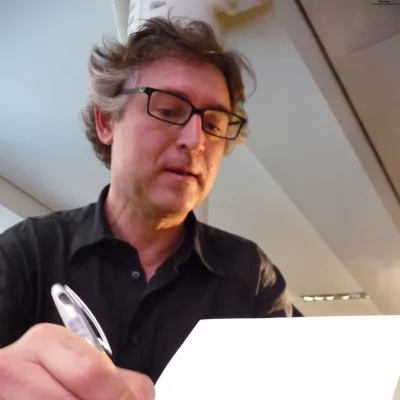
Michel Onfray
Human Design Chart
Biography
His book "La sculpture de soi" won the annual Prix Médicis in 1993.
His philosophy is mainly influenced by such thinkers as Nietzsche, Epicurus, the cynic and cyrenaic schools, French materialism, and individualist anarchism.
The Human Design of Michel Onfray: Manifesting Generator 1/3
Manifesting Generator 1/3 — Design at a Glance
Michel Onfray's design features a hybrid nature: the speed of a Manifestor paired with the constant energy flow of a Generator. This configuration allowed him to skip steps and quickly pull things into his life. However, this speed created a tension field. If strategy and authority were ignored, he tended towards multitasking frustration. Reacting simultaneously to many impulses led to multiple projects being started in parallel. Without the approval of the sacral center, the joy of creation quickly turned into frustration – the non-self theme of this type.
The mechanics show: As a Manifesting Generator, Michel Onfray had defined sacral energy. The advice was clear: do not initiate but react to impulses. Only when the Sacral gave a clear "yes!" after testing could his speed be beneficial. If this process was followed, he entered a state of deeper satisfaction. Then he fell into a "play mode." In this mode, variety was no obstacle but a source of strength. The demand to finish one thing before starting another became problematic. Instead, he drew satisfaction from parallel creation as long as his inner authority agreed and the play continued.
Emotional Authority
Michel Onfray's design tends towards not making decisions in the first impulse but letting them rest consciously. His inner authority is marked by a defined Solar Plexus Center. This configuration means that he was subject to an emotional wave showing permanent ups and downs of his feelings. The world appeared colored by his current mood: one moment totally enthusiastic about something, the next seeing the same thing completely negatively.
This immediate impression was only a snapshot, not necessarily his truth yet. Quick, spontaneous decisions from such emotion could therefore have negative effects. The more time Michel Onfray took to let a decision mature, the deeper and more comprehensive he could perceive the situation. This process required patience and multiple reconsiderations of decisions. He should take pride in this process and ask himself several times.
Over time, the intense feelings subsided, he gained emotional distance, clarity, and calmness set in. Only then had he gone through the process. This mechanism was primarily relevant for long-term decisions that could have a significant impact on his life course. The necessity of distancing was central: as long as the Solar Plexus Center is active, it functions as inner authority, regardless of what else is defined in his chart.
The 1/3 Profile — Investigator / Martyr
Michel Onfray's design tends towards not just studying knowledge theoretically but validating it through direct practice and mistakes. His Profile 1/3, the Researcher and Experimenter, marked him as someone who oscillates between a strong need for intuitive understanding (Line 1) and the urge to experiment (Line 3). Line 1 grants a combative spirit in search of life's worth; it can however trigger fear of insufficient knowledge blocking action. Here, Line 3 acts as corrective: it requires isolation from the collective to develop personal depth and teaches that mistakes are indispensable for authentic insights.
This configuration means that Michel Onfray's judgments were only trustworthy when they were both theoretically grounded and practically tested on heart and gut. The synthesis of Scientist (Line 1) and Adventurer (Line 3) required overcoming the paralyzing fear of implementation through a bold step into experimentation. Only through this cyclical process of study and trial did verified, authoritative insights emerge. His design thus shows an attitude that uses isolation to sharpen discernment before sharing results based on personal hard experience – not mere speculation.
Split Definition — Defined & Open Centers
Michel Onfray's Human Design profile suggests a tendency towards reliable communication and a firm internal direction. His defined centers – Throat, G Center, Sacral, Solar Plexus, Spleen, and Root – form the mechanical basis for consistent expression patterns, identity formation, and energy management. The defined Throat allows him to articulate messages from various sources clearly, while the defined G Center provides a stable self-identity and a sense of life purpose. His Sacral center supplies vital energy through reaction, meaning he must wait for offers to optimally use his power. Emotional clarity over time is fostered by the defined Solar Plexus center, which teaches him to make decisions only after experiencing an emotional wave. Spontaneous intuition and survival instincts stem from the defined Spleen center, while the Root center provides structural pressure to maintain life force.
In contrast, his open centers – Head, Ajna, and Heart – are situational. The open Head Center makes him vulnerable to mental inspiration or confusion as he lacks a consistent way of processing mental information. He tends to engage with questions that may not be his own and seeks answers outside himself. The open Ajna Center means flexible concepts without a fixed personal truth; he can adopt and reflect on ideas but cannot claim them as absolute certainty. Finally, the open Heart Center leads him to absorb foreign willpower or ego pressure without having consistent self-will energy. This could make him try to prove himself when his mechanics actually aim at not needing to prove worth. This combination of defined stability in expression and energy with open flexibility in mental and willful areas significantly shapes his human profile.
Channels for intuitive form, intimacy, presence, clarity and meaning.
Michel Onfray's Human Design profile establishes an inner foundation based on radical self-acceptance and intuitive adaptability. This internal stability contrasts dynamically with a profound need for deep intimacy.
The Channel of Union 59-6 connects the Sacral Center to the Solar Plexus through sexuality (Gate 59) and emotional friction (Gate 6). This urge towards merging allows him to quickly penetrate other people's aura. The emotional wave determines the timing of closeness or distance; waiting is essential to avoid misunderstandings in this intense aura, enabling fertility in relationships.
Simultaneously, the Channel of Awakening 10-20 between G Center (Gate 10) and Throat Center (Gate 20) promotes spontaneous action in the present without future anxiety, supported by self-love as a survival strategy. This clarity often inspires others unconsciously to be themselves. Additionally, the Channel of Perfect Form 57-10 brings intuitive insight (Gate 57), enabling spontaneous and appropriate reactions and resolving future anxieties. The Channel of Lightning Flash 57-20 gives this intuition a clear voice in the present, communicating existential knowledge directly.
The Motor is provided by the Channel of Life Struggle 38-28 between Root Center (Gate 38) and Spleen Center (Gate 28). The adrenalized energy drives the search for meaning through resistance. Gate 38 preserves individual integrity against external distractions, while Gate 28 recognizes which struggles have value. This stubborn will helps to assert uniqueness despite obstacles and gives life meaning beyond mere survival.
Individual Circuitry — Circuit Signature
Michel Onfray's Human Design profile sets a tension between the drive for unique personal expression and the primal obligation to protect genetics. This split definition shows two parallel existing forces that are not directly connected.
On one side, the Knowledge Circuit with its Channels Lightning Flash (20-57) and Life Struggle (28-38). It connects Throat Center to Spleen and Root Center into a continuous flow. This promotes pulsating creativity, innovative impulses, and the use of emotions for transformation. The stream of consciousness through intuition colors these decisions with intuitive perception.
Parallel to this exists the Archer Circuit with Channel Union (59-6). It directly connects Sacral Center to Solar Plexus Center. Here it's about timeless instinctive energies: protecting family, food, and preserving one's genetics through emotional bonds.
Additionally, the Integration Circuit (Channels Awakening 20-10 and Perfect Form 10-57) integrates Throat Center, Identity Center, and Spleen. This supports the manifestation of individual power in the present through proper behavior and intuitive knowledge.
The challenge lies in balancing: The pulsating energy of the Knowledge Circuit seeks novelty and personal expression while the Archer Circuit pushes for security, sustenance, and family protection. Michel Onfray thus manifests new identities in the present while simultaneously addressing instinctive needs for grounding effectively. Life Struggle serves to affirm individuality within this protective framework.
Right Angle Cross of Tension 4
Michel Onfray's Human Design suggests a tendency to experience life not as a harmonious flow, but rather as a field of friction. His structural alignment through the right cross of tension (Cross 4) defines him by his handling of internal and external tensions. This configuration makes tension the driving force of his existence.
For this design, the challenge is not to avoid conflicts or frictions, but to use them as sources of growth and consciousness. The mechanics of the right cross of tension show that development only arises through contact with resistance. Without this friction, potential remains untapped; the tension itself becomes the engine for clarity and depth.
Thus, Michel Onfray was marked by an attitude seeking distance from superficial peace to instead gain new insights in the intensity of conflict or difference. Life was defined by this dynamic: not as a state of rest, but as a continuous process of confrontation with what presses and demands. This orientation allowed him to draw necessary energy for personal evolution from seemingly negative experiences such as frustration or resistance. Tension was no obstacle, but rather the material of his development.
Saturn Return · Uranus Opposition · Chiron Return · 2nd Saturn Return — Life Cycles
Michel Onfray's Human Design points towards an inclination toward intellectual anchoring and existential proof. This structure is evident in phases marked by clear milestones. In 1989, at age 30, he published 'Le ventre des philosophes'. This marked the first Saturn Return, a cycle often condensing years of groundwork into a solid result and strengthening professional foundations.
The dynamics continued: In 2000, at 41 years old, came the publication of 'Théorie du corps amoureux'. This fell within the period of Uranus Opposition, a phase frequently understood in Human Design as a moment of sudden change or liberation from old structures. Here, his intellectual positioning developed through new perspectives.
The Chiron Return around age 51 is an achievement cycle where one's life purpose increasingly unfolds and becomes experientially meaningful – not as healing wounds but as the blooming of one's own purpose. In 2010, Onfray published 'Nietzsche: Se créer Liberté'. This work exemplifies this phase of deepening and realizing his intellectual core.
The second Saturn Return around age 54 often brings confrontation with limits and losses leading to maturity. In 2013, his partner Marie-Claude Ruel died from cancer. This event underscores the existential proof central in this cycle: grappling with finiteness and stabilizing internal structures even in the face of pain. The sequence of these events illustrates the path from professional anchoring through expansive transformation phases to profound existential affirmation and proof.
Manifesting Generator · Emotional Authority — Synthesis
A central red thread in this design is the dynamic connection between initiation and reaction. The configuration of a manifesting generator with defined sacral energy (Channel of Union) points towards someone who, while potentially acting swiftly, primarily finds true fulfillment by reacting to internal impulses and external circumstances. This ability for quick implementation is complemented by emotional authority, which requires a process of inner clarification and waiting before decisions can be made – an ongoing oscillation between the urge to act and the necessity of emotional maturity. The repeated documented events in the career domain (publications) seem to correspond with these cycles.
The central paradox lies in the tension between the need for independent discovery (Knowledge Circuit, Profile Researcher/Experimentor) and the emotional wave complicating clear decision-making. The energy of the Knowledge Circuit drives towards new paths and knowledge generation, while the emotional center demands a thorough engagement with one's feelings before this knowledge can be communicated or implemented. This leads to an internal dynamic of creative drive and emotional caution, which both strengths and challenges – particularly in relationships (Channel 59-6) and crisis processing (documented event)].
5 Defined Channels
Incarnation Cross - Right Angle Cross of Tension 4
Solar Return
The Solar Return shows the moment when the sun returns to its exact birth position - your personal solar year.
Life Cycles
Discover the life cycles with a detailed triple view (birth chart, cycle chart, composite).
Human Design Profile
- Strategy
- To respond - wait for something to respond to
- Authority
- Emotional Authority
- Profile
- 1/3 - Investigator / Martyr
- Definition
- Split Definition
- Incarnation Cross
- Right Angle Cross of Tension 4
- Date of Birth
- 01.01.1959 08:50
- Place of Birth
- Argentan, France
Frequently Asked Questions
What is Michel Onfray's Human Design type?
What Profile does Michel Onfray have in Human Design?
Which Authority guides Michel Onfray?
What incarnation cross does Michel Onfray have?
When was Michel Onfray born?
Discover your own Human Design
Are you also a Manifesting Generator? Find out in a personal reading how to unfold your multi-talents and direct your energy wisely.
More Personalities
Back to overviewAldair

Alizée

Angeli

Arletty

Artus

Balthus