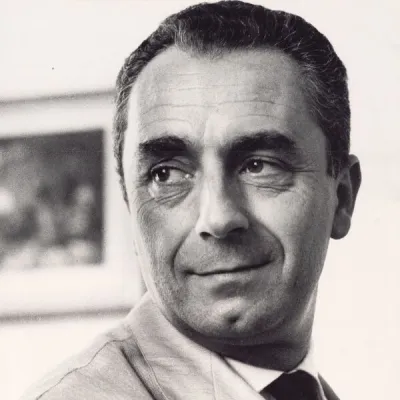
Michelangelo Antonioni
Human Design Chart
Biography
Antonioni received numerous awards and nominations throughout his career, being the first and one of two directors, the other being Jafar Panahi, to have won the Palme d'Or, the Golden Lion, the Golden Bear and the Golden Leopard. Three of his films are on the list of hundred Italian films to be saved. He received Academy Award nominations for Best Director and Best Original Screenplay for Blowup. In 1995, he received an Honorary Oscar "in recognition of his place as one of cinema's master visual stylists".
The Human Design of Michelangelo Antonioni: Manifesting Generator 3/5
Manifesting Generator 3/5 — Design at a Glance
Michelangelo Antonioni revealed himself as someone who possessed hybrid energy from Manifestor Speed and Generator Sacral power. His design allowed him to skip steps and quickly draw results into his life. This configuration combined constantly available sacral energy with the ability to set things in motion directly.
However, this interplay led to a paradox: On one hand, it enabled efficiency through parallelism in the „Play Mode“, on the other hand, frustration threatened when necessary steps were hastily skipped or multitasking occurred without inner consent. As a Manifesting Generator, his strategy was not initiating action but reacting to impulses. Only when his sacral center responded with a clear “Yes” could he sustainably utilize his creative power.
Without this inner resonance, he tended to start multiple projects simultaneously or skip important phases, forcing him later to backtrack and make up for missing steps. This was the source of his typical frustration. With correct application – that is, by constantly checking inner consent – he drew deep satisfaction from his work. For him, it then wasn’t a problem to work on different tasks in parallel; rather, variety and playful handling of his projects were essential for his energy. His design thus demanded a balance between the gift of quick progress and the discipline to only pursue what was internally reinforced.
Sacral Authority
Michelangelo Antonioni showed a decision-making structure that was not planned in the head but answered by the body. As a Generator, he possessed sacral authority, meaning his inner truth lay in physical signals. He responded to external stimuli with an immediate gut feeling or a surge of energy – audible as grunts, hums, or simple “Mhm” sounds. These bodily noises were his compass; they distinguished real resonance from mere reaction.
His strategy was to wait for this response to come. Planning wasn’t the way to clarity for him. When his sacral motor kicked in, vitality followed and an almost inexhaustible energy flow emerged. He then tackled his work with great enthusiasm, fully immersed in the activity itself without needing a goal-oriented purpose. Without this inner confirmation, the energy was lacking; there was no compulsion to act.
Since his Emotional Center was open, he couldn’t rely on emotional fluctuations but had to prioritize the clear, physical impulse of sacral authority. This simplified his process: He needed no complex analysis, only perception whether something brought him alive or not. Through this alignment, he was born to walk through life with joy and satisfaction, driven by authentic bodily consent rather than intellectual deliberation.
The 3/5 Profile — Martyr / Heretic
Michelangelo Antonioni revealed himself as someone who learned through radical independence and personal experimentation. His design inclined towards initially experiencing everything firsthand before sharing insights. This aligned with Profile 3/5, the Experimenter and Hero: Line 3 drove a fanatical zeal that learned through action, failure, and cleaning up material or structural connections. This process was central to his identity; he believed nothing without personal experience and used mistakes as correction mechanisms.
Simultaneously, Line 5, connected with Gate 52, acted in response to crises. It demanded silence, focus, and precise communication. While Line 3 could experiment chaotically and publicly fail, Antonioni had to offer solutions for others based on these collected experiences in the role of a Hero. The tension lay between the inner pressure to create order through personal action and the external expectation to lead calmly and competently during crises. His appeal to others resulted from possessing a rich trove of practical life experience that he presented as cool storytelling. Earth-elevation in Gate 52 promoted concise, precise statements effective in the collective while Neptune in Line 3 dissolved old forms to enable new connections. Thus, his personal experiments condensed into an attitude that attracted and taught others.
Single Definition — Defined & Open Centers
Michelangelo Antonioni had a robust foundation of defined energy and intuition. His defined Sacral Center provided a constant, vital source of power; he was most effective by reacting to external stimuli rather than initiating actions himself. This sacral authority combined with his defined Spleen Center gave him spontaneous, momentary intuition for health and survival – an instinct that worked in the present without requiring rational justification. Additionally, his defined Root Center stabilized his stress resistance; he had a steady internal pressure that propelled him forward in the material world and helped him overcome challenges without being overwhelmed by them.
His mental system was characterized by the connection between his defined Ajna and Throat Centers. He thought conceptually in a specific, trustworthy way and could translate these thoughts directly into clear communication. His mind was always active, which made meditation difficult but allowed him to express complex theories precisely. This mental clarity formed the core of his expression, independent of emotional fluctuations.
In contrast, four centers revealed themselves as mirrors for external influences. His open G Center meant that he did not carry a fixed inner identity; he tended to lose himself in relationships and environments or adopt borrowed roles rather than possessing a stable direction from within himself. The open Heart Center made him vulnerable to the pressure of proving his worth through performance or promises, even though he lacked consistent willpower for this. His open Solar Plexus absorbed and amplified the emotions of his surroundings; he could feel emotionally uncontrolled by interpreting foreign moods as his own rather than observing them neutrally. Finally, the open Head Center led him to take mental pressure and inspiration from the environment, which could easily lead him into doubt or confusion about issues not his own. His challenge lay in recognizing these open states as temporary reflections rather than mistaking them for his own truth.
Channels for focus, logic, intuition and clear communication.
Michelangelo Antonioni was someone whose inner process was marked by an unrelenting logical presence. His design laid a tendency towards permanent pattern recognition and the drive for perfection, driven by three defined channels within the circuit of understanding. This configuration created a constant pressure to organize details and make corrections, forcing him to always distinguish between the Logical and what he identified as errors.
The Channel of Concentration 52-9 connected the Root Center with the Sacral Center through the Gate of Non-action (52) and the Gate of Focusing (9). This gave him the ability to remain still and keep distractions at bay, focusing entirely on facts. As Format-Energy, this channel carried the qualities of all other Logic Channels within it and allowed him to challenge and perfect patterns as soon as he dedicated himself to something.
Parallel to this, the Channel of Acceptance 17-62 between Ajna and Throat Centers worked. Through the Gate of Opinions (17), he visualized mental images while the Gate of Details (62) translated these into language. This created a continuous internal process of organizing information and only accepting what logically fit into his worldview.
The critical conclusion was formed by the Channel of Judgment 58-18, connecting Root with Spleen Centers. The Gate of Vitality (58) drove the impulse towards 'better and more', while the Gate of Correcting (18) judged what was out of balance. This sentry forced him to continuously review and correct patterns to find satisfaction in the collective.
Additionally, Gates like 48 (Depth/Pattern Recognition), 50 (Protective Reflex/Values), and 60 (Acceptance of Limitations) shaped his personality, while Design Gates like 54 (Ambition/Spirituality), 4 (Formulating/Future Security), and 8 (Contribution/Identity) as well as 41 (Evolution/Feeling) influenced his expression possibilities. The tension between the drive for correction and the necessity to focus only on correctly identified patterns shaped his entire work.
Collective Circuitry — Circuit Signature
Michelangelo Antonioni's design unfolded a tension between pulsating individual creativity and focused, rational strategy. His Knowledge Circuit worked through Channel 20-57 (Flash of Insight), connecting Throat and Spleen Centers. This generated an impulsive, acoustic expression of unique identity driven by creative intuition and emotional waves.
Parallel to this, his Understanding Circuit structured these impulses through logic. Here flowed two separate segments: First, the Channel 17-62 (Acceptance) connected Ajna with Throat Center, offering the ability for visual focus and sharing rational strategies. Second, Channels 9-52 (Concentration) and 18-58 (Judgment), connecting Sacral, Root, and Spleen Centers, provided energetic endurance for future-oriented, conditioning-free analysis.
Although both circuits touched Throat Center, their energy sources – emotional intuition versus cool ratio – remained mechanically separate. Antonioni thus did not automatically translate individual flashes of insight into social strategies but kept both forces as parallel, complementary systems: spontaneous, melancholic creation on one hand and disciplined verbal structuring on the other. This configuration shaped a work style that oscillated between his own path and societal improvement without mixing the emotional wave with logical analysis.
Right Angle Cross of Service 3
Michelangelo Antonioni's design established an existential orientation that was shaped by the principle of service. His life path was determined by the 'Right Service Cross', indicating a profound motivation rooted in this act of service. This configuration described not only a personal inclination but also the central expression of his identity and destiny.
In Human Design, this specific cross marks an energetic structure aligning the individual to realize themselves through service. It went beyond mere helpfulness; it was a fundamental life task. Michelangelo Antonioni embodied this orientation, with service functioning as a crucial component of his inner compass. The mechanics of this design underscored that his path was inseparably linked to this stance.
Without specific events mentioned in the raw content, the description remains at this structural level. It was about how this energetic imprint shaped his fundamental approach. Michelangelo Antonioni lived in a dynamic where service acted as a central driving force, profoundly influencing his experience and actions without necessarily being dictated by external circumstances. The structure of his design provided the framework for this orientation, significantly shaping his character.
Saturn Return · Uranus Opposition · Chiron Return · 2nd Saturn Return — Life Cycles
In this phase of his life, Michelangelo Antonioni appeared as someone whose inner structure was solidified and who radiated authority in established fields. It was no longer about finding but confirming his body of work. This attitude matched the second Saturn Return cycle, a period of consolidation.
In 1971, at age 59, Michelangelo Antonioni received a nomination for the Golden Palm for Zabriskie Point. This event marked a peak in this phase. The second Saturn Return condensed years of groundwork into a sustainable outcome. Inner clarity had been achieved; the design now showed its full maturity. It was confirmation of his own paths, which emerged through consistent living according to strategy and authority.
The nomination did not stand alone but was an expression of long-term development. At this age, self-image stabilized. Michelangelo Antonioni acted from a position of security. The focus lay on deepening already established paths rather than new experiments. His design supported this phase with enhanced inner stability. External recognitions reflected internal order. It was a moment of collection and reflection upon the created work. The mechanics of this cycle promoted the integration of past experiences into a coherent whole. Michelangelo Antonioni used this time to solidify his position and place his work in the context of his entire career.
Manifesting Generator · Sacral Authority — Synthesis
Michelangelo Antonioni was a Manifesting Generator, whose life seemed marked by a deep tension between the drive for rapid implementation and the necessity to engage with sacral reactions. His ability to swiftly initiate things (design) was balanced by the authority of the body – an intuitive knowledge signaling when a project truly resonated or not. This interplay of initiative and reaction formed the red thread of his creation, as he constantly explored new paths while also paying attention to internal impulses. The Explorer/Hero aspect (Profile) further strengthened this process, as experimenting and learning from experiences was central to his work approach.
The core paradox in Antonioni's design lay in the combination of a defined throat and open centers for identity and emotions. On one hand, he could clearly communicate thoughts and visions (defined throat), on the other, he was susceptible to environmental influences, particularly regarding values and feelings. This tension between the need for authentic expression and the tendency to absorb external expectations created a dynamic field shaping his work – a search for personal truth amidst a complex world.
4 Defined Channels
Incarnation Cross - Right Angle Cross of Service 3
Solar Return
The Solar Return shows the moment when the sun returns to its exact birth position - your personal solar year.
Life Cycles
Discover the life cycles with a detailed triple view (birth chart, cycle chart, composite).
Human Design Profile
- Strategy
- To respond - wait for something to respond to
- Authority
- Sacral Authority
- Profile
- 3/5 - Martyr / Heretic
- Definition
- Single Definition
- Incarnation Cross
- Right Angle Cross of Service 3
- Date of Birth
- 29.09.1912 21:45
- Place of Birth
- Ferrara, Italy
Frequently Asked Questions
What is Michelangelo Antonioni's Human Design type?
What profile did Michelangelo Antonioni have?
What authority did Michelangelo Antonioni have?
What incarnation cross did Michelangelo Antonioni have?
When was Michelangelo Antonioni born?
Discover your own Human Design
Are you also a Manifesting Generator? Find out in a personal reading how to unfold your multi-talents and direct your energy wisely.
More Personalities
Back to overviewAlain-Fournier
Aldair

Alizée

Angeli
Arletty
Artus