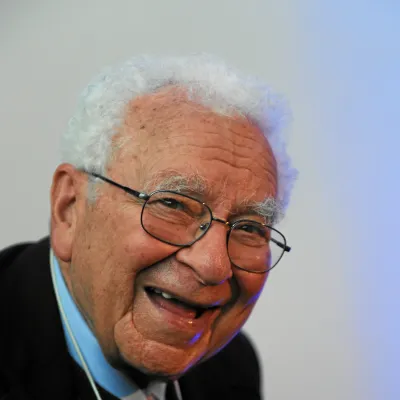
Murray Gell-Mann
Human Design Chart
Biography
Gell-Mann spent several periods at CERN, among others as a John Simon Guggenheim Memorial Foundation fellow in 1972.
Together with author Michael Crichton, Gell-Mann was responsible for defining the theoretical psychological phenomenon called the Gell-Mann amnesia effect.
Gell-Mann died on 24 May 2019, aged 89, at his home in Santa Fe, New Mexico.
What does Manifestor 6/3 mean for Murray Gell-Mann?
Manifestor 6/3 — Design at a Glance
Murray Gell-Mann was shown to be a pioneer and visionary whose design predestined him to lead the world into a new future. His Human Design type is the Manifestor, a configuration often compared to an emperor in ancient Rome: He had the grand vision of an empire but did not wage the necessary wars himself; instead, he sent others to conquer foreign lands for him. This structure led to Murray Gell-Mann being polarized and misunderstood because he often thought ahead of his surroundings. While some people loved his huge visions and followed him, others liked or disliked him precisely because of this superiority. This formed one of his greatest pain points. To find the right following and minimize conflicts, it was crucial for his design to inform others in a timely and precise manner about his intentions – his ideal strategy. If Murray Gell-Mann lived according to this principle and followed his inner authority, he was rewarded with a feeling of inner peace. When acting against this design, however, he felt more often a lasting, deep anger within himself. His path was thus marked by the tension between his leading role as a leader and the necessity to clearly communicate his visions to reduce resistance and move forward harmoniously.
Emotional Authority
Murray Gell-Mann lived with an inner authority deeply rooted in his emotional waves. His defined Emotional Center significantly influenced his decision-making; it had precedence over all other defined centers in his design, regardless of further configurations. This structure shaped him as someone who did not react to the first impulse but whose perception was colored by constant mood swings. What appeared exciting at one moment could turn negative in the next. Therefore, his immediate feeling served only as a snapshot, not as final truth.
Quick and spontaneous decisions from such an emotional state would often have been detrimental for him. Instead, his mechanics required patience and conscious postponement of judgments. Murray Gell-Mann used time to let decisions mature, often by sleeping on them multiple times. This process allowed intense feelings to subside and emotional distance to be gained. Only when this clarity and calmness entered was the inner process complete. This strategy was especially crucial for long-term, life-defining decisions as it ensured that his actions were based on a stable, profound insight rather than transient emotional excitement.
The 6/3 Profile — Role Model / Martyr
Murray Gell-Mann's design set a tendency towards persistent experimentation and an internal restlessness. As someone with Profile 6/3, he lived in the first three decades of his life as a pure adventurer who learned through numerous self-experiments. Although this phase slowed down after his first Saturn return at around thirty years old, experimenting never ended completely due to the permanent presence of the line of the experimenter within the profile. Murray Gell-Mann did not seek ordinary perfection but strove for an extraordinary life far from standards.
This attitude was shaped by specific lines. The sixth line of Gate 47 brought a capacity for overviewing cyclical processes, allowing him to distinguish sense from nonsense, yet also tended to evoke futility and complaining when clarity was lacking. Parallel to this, the third line of Gate 12 promoted self-analysis in social contexts. This led to a trial-and-error process where uncertainty and feelings of inadequacy could arise through false commitments or mistakes. Murray Gell-Mann, however, used these unusual experiences after his thirtieth year to take responsibility and develop into a far-sighted, humorous role model who passed on his profound insights.
Single Definition — Defined & Open Centers
Murray Gell-Mann's design was characterized by a consistent, trustworthy mental function. His defined Ajna Center ensured that he created concepts and theories in the same way every time, resistant to being heavily influenced by others and serving as an external authority shaping the mental field. This cognitive stability directly flowed into his defined Throat Center: He spoke reliably what his mind thought, making communication and action clear and authentic.
Deeply influential was also his defined Solar Plexus as an inner authority. Murray Gell-Mann was designed to wait for the emotional wave before making decisions. This patience allowed him to recognize deeper truths over time rather than impulsively reacting to highs or lows of his feelings. This was complemented by his defined Spleen Center, which gave him spontaneous intuitive intelligence in the present moment – a sensitive immune system for health and well-being that he had to trust without rationalizing.
In contrast, his vulnerability showed in the open centers. His open Head Center tended to pick up mental pressure from the environment; without his own consistent inspiration, he could easily be overwhelmed by doubts or questions of others that did not belong to him. His open G Center meant that he did not carry a fixed identity but needed to feel initiated through right places and relationships – at the wrong place he felt lost. The open Heart Center made him susceptible to the pressure to prove his worth, which could spiral into self-disapproval if he gave promises he couldn't keep. Finally, his open Root Center absorbed external stress; he amplified the adrenal impact of his environment, leading to exhaustion when dealt with incorrectly as this stress never truly came from himself.
Channels for emotional depth, intuition and clear structure.
Murray Gell-Mann's design inclined towards profound, structuring communication. He was someone who distilled complex connections into clear, efficient forms while using both emotional resonance and intellectual precision.
The Channel of Structuring 43-23 connected his mind to the Throat Center. This allowed him to process and express spontaneous insights (Gate 43) through assimilation (Gate 23). His thinking often felt far ahead; he had to learn patience so that his innovative perspectives could be understood by the collective rather than being rejected as foreign.
Simultaneously, the Channel of Openness 22-12 linked his Solar Plexus with the Throat Center. Here, his expression depended on the emotional wave. Gate 22 brought passion and creativity while Gate 12 added a cautious restraint. He spoke effectively only when his mood was right. In these moments, he could touch others with his voice and inspire change. When forced into social situations against his rhythm, harshness or misunderstandings were evident.
The Channel of Brainwave 57-20 also gave him the ability for intuitive self-awareness in the present moment. Through Gate 57 (intuitive insight) and Gate 20 (the now), he spoke truths based on deep primal instincts. This helped him act in the moment without being paralyzed by fear of the unknown.
Additionally, Gates like 47 (meaning in confusion), 11 (visual assessment), and 35 (learning through interaction) contributed to his ability to categorize experiences collectively and derive new advice from interactions. His design challenged him to listen to his inner authority and not act impulsively to unleash the full transformative power of his words.
Individual Circuitry — Circuit Signature
Murray Gell-Mann's design inclined towards a pulsating, acoustic expression style. He was someone who not only gathered but transformed and brought new insights into the world. This attitude resulted from his simple definition: The Centers Ajna, Throat Center, Solar Plexus, and Spleen formed one single, directly connected energetic group in him.
This continuous flow was marked by the Knowledge Circuit. Murray Gell-Mann had three specific channels within this circuit. The Channel of Structuring linked Gates 43 and 23, promoting the ability to organize ideas. The Channel of Flash (Gates 20-57) provided innovative impulses from the Ajna Center. Additionally, the Channel of Openness (Gates 12-22), connected with the Spleen, ensured intuitive perception.
This configuration allowed him to bring forth entirely new knowledge. Energy flowed from mental intuition through the emotional wave of the Solar Plexus directly into expression via the Throat Center. It was an expression of a unique identity supported by creative flashes and structured openness. As all involved centers were part of the same group, there emerged a seamless process: From inspiration to verbal manifestation in the world everything ran as one coherent experience without internal division or blockages between thinking, feeling, and speaking.
Left Angle Cross of Informing 2
Murray Gell-Mann's Human Design profile indicated a tendency towards a profound, almost fateful connection with the exchange of information. He was someone whose entire existence was oriented toward sharing and receiving knowledge. This disposition stemmed from the configuration of the 'left cross of communication 2'.
This specific Human Design constellation links inner intuition with outer expression through defined channels. It meant that Murray Gell-Mann was destined to not only gather information but actively carry it into his environment while simultaneously absorbing new impulses from the world. This was a cyclical process: insights were processed, shared, and refined further by the reactions of others.
For him, communication wasn't an optional tool but the central medium through which he defined himself and his surroundings. The energy of this cross drove him to clarify complex connections and disseminate that clarity. It was less about rhetorical brilliance than the structural necessity for knowledge to flow. Murray Gell-Mann lived in this rhythm of giving and receiving information, shaping how he interacted with his environment and found his place within it.
Saturn Return · Uranus Opposition · Chiron Return · 2nd Saturn Return — Life Cycles
Murray Gell-Mann's Human Design profile showed a clear structure where personal commitments and public recognition condensed into specific life phases. This configuration determined when inner maturity met external milestones.
In 1955, at the age of 26, he married J. Margaret Dow. This marked his first Saturn Return. In Human Design mechanics, this cycle is a moment of consolidation: what was previously an attempt or expectation becomes now binding reality. The marriage here wasn't just coincidence but anchoring a long-term structure in the private sphere, fitting with the energetic call for stability and responsibility triggered by this planetary position.
Decades later, in 1969 at age 40, Murray Gell-Mann received the Nobel Prize in Physics. This fell into the Uranus opposition phase. Mechanically described, this period breaks old patterns in favor of new, often unexpected possibilities. The prize wasn't confirmation of the status quo but an explosive validation of his unique worldview – a moment when the individual became universal and old boundaries of physics were shattered.
His second Saturn Return occurred in 1984 at age 55. Murray Gell-Mann founded the Santa Fe Institute. This second Saturn Return asks: 'What structure remains?' Here it wasn't about building a career but creating a lasting framework for interdisciplinary knowledge. The founding of the institute was the logical consequence of this energetic phase: transforming individual intelligence into an institutional pillar that endures beyond personal efforts.
Manifestor · Emotional Authority — Synthesis
He was a Generator who wanted to propel the world forward through his visions – a pioneer whose authority lay in emotional waves. This inner dynamism shaped his life as he developed concepts (defined Ajna Center) and expressed them with openness of channel 22-12, tinged with melancholy and passion. The profile as role model and experimenter reinforced this drive to explore new paths, seeking extraordinary solutions beyond conventional standards.
Recurring cycles – from marriage to the Nobel Prize and co-founding an institute – always emerged as results of deep emotional processes and creative impulses.
A central paradox lay in his ability to form concepts and mentally influence others combined with the open channel 22-12. Though he was an Initiator (Manifestor) whose ideas could be transformative, the articulation of these visions depended on fluctuating tides of emotion. This led to messages not always being linear or predictable but rather arriving in a pulsing, acoustic quality – an expression of his individuality and unique path.
3 Defined Channels
Incarnation Cross - Left Angle Cross of Informing 2
Solar Return
The Solar Return shows the moment when the sun returns to its exact birth position - your personal solar year.
Life Cycles
Discover the life cycles with a detailed triple view (birth chart, cycle chart, composite).
Human Design Profile
- Type
- Manifestor
- Strategy
- To inform others before acting
- Authority
- Emotional Authority
- Profile
- 6/3 - Role Model / Martyr
- Definition
- Single Definition
- Incarnation Cross
- Left Angle Cross of Informing 2
- Date of Birth
- 15.09.1929 19:00
- Place of Birth
- Manhattan, NY, United States
Frequently Asked Questions
What was Murray Gell-Mann's Human Design type?
Which Profile did Murray Gell-Mann have?
What Authority did Murray Gell-Mann have?
What incarnation cross was Murray Gell-Mann assigned to?
When was Murray Gell-Mann born?
Discover your own Human Design
Are you also a Manifestor? Find out in a personal reading how to use your initiation power peacefully and dissolve resistance.
More Personalities
Back to overviewChristian-Jaque
Kesha

Lucebert
Masaccio

Nadar
Papus