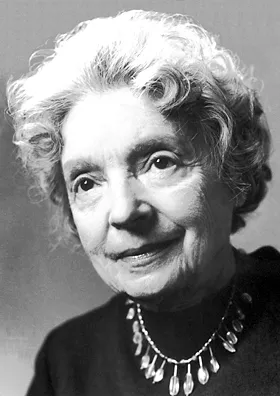
Nelly Sachs
Human Design Chart
Biography
Born to a wealthy manufacturer, she was educated at home because of frail health. She showed early signs of talent as a dancer, but her protective parents did not encourage her to pursue a profession. She grew up as a very sheltered, introverted young woman and never married. She pursued an extensive correspondence with, and was friends with, Selma Lagerlöf and Hilde Domin. As the Nazis took power, she became increasingly terrified, at one point losing the ability to speak, as she would remember in verse: "When the great terror came/I fell dumb." Sachs fled with her aged mother to Sweden in 1940. It was her friendship with Lagerlöf that saved their lives: shortly before her own death Lagerlöf intervened with the Swedish royal family to secure their release from Germany. Sachs and her mother escaped on the last flight from Nazi Germany to Sweden, a week before Sachs was scheduled to report to a concentration camp.
Living in a tiny two-room apartment in Stockholm, Sachs cared alone for her mother for many years, and supported their existence by translations between Swedish and German. After her mother's death, Sachs suffered several nervous breakdowns characterized by hallucinations, paranoia, and delusions of persecution by Nazis, and she spent a number of years in a mental institution. She continued to write even while hospitalized. She eventually recovered sufficiently to live on her own, though her mental health would always be fragile.
Nelly Sachs as a Manifestor 2/4 in Human Design
Manifestor 2/4 — Design at a Glance
Nelly Sachs had the design of a Manifestor. This configuration marked her as a pioneer and visionary whose task was to lead the world into a new future. Her internal structure worked similarly to that of an emperor in ancient Rome: She possessed the vision of a great whole, but did not wage the necessary wars herself; instead, she sent out her soldiers to conquer foreign lands for her.
This grand thinking often led to misunderstandings and polarization. Some people loved her huge visions and followed them; others disliked or even hated her precisely because of this foresight. For the right followers to find her, it was crucial for her to inform others about her plans in a timely and precise manner. This strategy of informing was key to her success.
If Nelly Sachs followed this strategy and lived up to her authority, her system rewarded her with an inner sense of peace. If she lived against this design, however, she felt instead a persistent, deep anger within herself. Her leadership trait was thus inseparable from the necessity to communicate her intentions clearly in order to reduce resistance and gain support.
Splenic Authority
Nelly Sachs possessed the authority of the Spleen Center, a configuration that only Projectors or Manifestors with open Emotional and Sacral Centers can have. This set a basic attitude: Her internal decisions did not arise through long-term planning or emotional weighing but as spontaneous, momentary impulses. The Spleen Center functioned as a fine alarm system for health and survival. It provided immediate physical knowledge about whether a situation, environment, or society was beneficial or harmful.
This instinct was subtle and only appeared once in each moment. It could easily be drowned out by external influences, requiring high vigilance. The first impulse was considered the right one; it served directly to protect her own well-being and allowed her to rigorously isolate herself from harmful influences. Since this knowledge was only available in the present, long-term commitments were difficult for her design. Plans could change quickly as she only knew what was right once in a concrete situation. Therefore, she needed much freedom and flexibility. A retreat for decision-making could be helpful to perceive the fine impulse without diluting it through overthinking. Her strategy consisted of not being bound by plans and acting spontaneously based on this immediate sense of health and survival.
The 2/4 Profile — Hermit / Opportunist
Nelly Sachs appeared as a person in constant oscillation between a deep need for withdrawal and the desire for connection. Her design created a tension that made her swing between the role of an anchorite and that of a network member. This configuration required her to set clear boundaries: She had to learn to communicate clearly when she sought company and when she wanted solitude.
During her alone time, Nelly Sachs immersed herself in internal processes to find peace and clarity. This withdrawal served reflection and the processing of experiences. Once this inner need was satisfied, the other element of her profile came into play: Line 4, which represents brotherhood and influence within a network. She then actively sought contact with her favorite people.
This cycle of isolation and community shaped her way of working. The time of seclusion allowed her to evaluate the knowledge and impressions from her network and develop new insights from it. Her design promoted a strong connection to memory; she learned from the past and used this reflection to further develop herself. Although she was often perceived as an anchorite, her energy was directed at being rooted in the tribe. The challenge lay in not getting caught up in distress or confusion through external influences but finding the solution in the balance between inner strength and outer networking. Thus, she could utilize the potential of her network without losing sight of her necessary recovery time.
Split Definition — Defined & Open Centers
Nelly Sachs revealed herself as someone whose expression and actions were marked by an inner willpower. Her defined Heart Center endowed her with the ability to keep promises and control her own resources; she acted from a clear 'I want'. This energy flowed into her defined Throat Center, making her communication not just words but a transformative force that translated messages directly from her inner self into the world.
At the same time, her defined Spleen Center served as an instance of protection in the present moment. It provided spontaneous, intuitive warning signals for survival, which she had to trust without rational analysis. Together with her defined Root Center, which prepared existential pressure for correction and progress, she possessed a robust foundation of instinct and endurance.
This solid core stood in contrast to her open centers. The open Head and Ajna Centers made her vulnerable to mental confusion and the urge to find answers to questions that were not hers. She tended to get lost in intellectual labyrinths or adopt foreign opinions as her own truth, rather than trusting her inner authority.
The open G Center also meant she did not have a fixed identity or direction. Instead, she reflected her environment and sought the right place to feel at ease. The open Sacral and Solar Plexus Centers made her susceptible to absorbing foreign energies and emotions, leading to exhaustion or emotional flooding if she failed to recognize them as borrowed. Her life's task was to use the stability of her defined centers to protect herself from conditioning through her open windows.
Channels for ego-driven leadership and meaningful life struggle.
Nelly Sachs had an energetic basic stance that combined material responsibility with inner determination. Her design suggested that she not only endured the pressure of life but actively transformed it into meaning. This was evident in the connection between willpower and intuitive valuation within her body.
The Money Line 21-45 linked her Heart Center to her Throat Center. This channel brought a drive to gain control over resources to establish security. Gate 21, The Hunter, demanded autonomy and the right to decide on work rhythms independently, while Gate 45, Voice of the People, called for authoritative clarity: 'I have or I do not.' For Nelly Sachs, this meant that she had to master the material plane by asserting her will without suppressing others. Success lay in maintaining independence while also serving the whole, rather than getting lost in hierarchies or shirking responsibility that burdened her heart.
At the same time, the Life Struggle 38-28 between Root and Spleen Centers was at work. Here it was about stubborn resistance against external forces threatening her integrity (Gate 38), paired with the intuitive ability to recognize which struggles had value (Gate 28). This channel drove her to find meaning in every difficulty and walk her own path, even against all odds. It was a process of individuation through resistance that helped her live out her uniqueness and encourage others.
Additionally, other gates shaped her nature: Gate 26 in the Heart Center enabled her to introduce innovations to keep the tribe from stagnation while she herself needed calmness. Gate 47 helped her draw clarity and collective meaning from the confusion of the subconscious. Gate 22 promoted a serene openness for mutations in social environments through listening. In the Root Center, Gate 58 fostered pattern recognition and life perfection under pressure through experimentation and cheerfulness. Further influences came from Gate 8 (contribution to the group), Gate 50 (protection of traditions), and Gate 16 (collective mastery through experiments).
Tribal Circuitry — Circuit Signature
Nelly Sachs revealed herself through two separate, parallel acting energetic poles. One pole connected her Heart with her Throat Center. This connection created a direct flow between her inner authority and her expression. She could articulate her values and decisions immediately in words without emotional filters intervening. This belonged to the Ego Circuit, which in her case only activated this specific channel. The focus here was on clear articulation of one's will within social or communal contexts, not on narrower individual self-presentation.
The second pole connected her Spleen with her Root Center via the Life Struggle Channel. This generated a pulsating energy of survival intelligence. Her perception of what is essential was closely tied to her ability to cope with stress and assert herself physically or mentally. This aspect of the Knowledge Circuit emphasized the need to find one's path through direct confrontation with reality.
As Nelly Sachs had a split definition, these two systems – value-oriented expression and survival-focused perception – existed as independent fields of power. They were not directly connected, meaning that her decisions (Heart/Throat) were not automatically steered by her current sense of security (Spleen/Root), but worked as separate, parallel competencies. This required a conscious integration of these different impulses in her daily life.
Right Angle Cross of Rulership 4
Nelly Sachs exhibited an inner disposition that aimed less at external power acquisition than at preserving a deep, often hidden order. Her design carried the 'right cross of governance,' a configuration that did not seek dominant leadership or visible authority. Instead, it shaped a stance of silent dedication to principles that transcend the visible.
This structure conveyed no need to control others or give instructions. Rather, it was about the integrity of one's inner compass and the ability to maintain a clear direction in uncertainty – not for others but as her own life task. The right cross of governance points to someone who exercises authority not through loudness or position but through consistent alignment with higher values.
For Nelly Sachs, this meant an existence marked by silent yet unshakable inner guidance. She did not seek applause or obedience but the truth of her own dedication. This energy often remains invisible to outsiders but is fundamental for one's sense of meaning and wholeness. It is a design that teaches: True governance begins within, long before it – if at all – enters the world. Nelly Sachs lived this silent authority as an inner necessity, far from theatrical power displays.
Saturn Return · Uranus Opposition · Chiron Return · 2nd Saturn Return — Life Cycles
Nelly Sachs’ design inclined towards deep internal processing and preserving what is essential. Her configuration described a life task connected to protecting and transforming pain, often by carrying another person or their fate.
In 1940, at the age of 49, Nelly Sachs fled with her elderly mother to Sweden. This coincided with the Chiron Return cycle (approximately 49–51 years). In Human Design mechanics, this period does not mark a mythological healing of old wounds but rather a fulfillment stage: The individual's incarnation cross unfolds increasingly in life if lived according to strategy and authority. Meaning and purpose became experiential. The escape was not mere survival but the beginning of this bloom phase, where her inner structure became supportive for her mother’s fate.
Ten years later, in 1950 at the age of 59, Nelly Sachs’ mother died. This hit her psychologically hard and fell into the second Saturn Return (approximately 57–60 years). This cycle condenses years of groundwork into sustainable results or demands a fundamental realignment of structure. The loss marked the end of a long phase of carrying; the severe psychological reaction showed how deeply her design was entwined with her mother’s fate; the Saturn Return cemented this experience as a permanent part of her inner landscape, rather than just temporarily burdening it.
Manifestor · Splenic Authority — Synthesis
Nelly Sachs’ life was characterized by an internal dynamic between the drive for pioneering roles and the necessity of self-care. As a Manifestor with defined communication and Spleen authority (and Channel 21-45), she acted as an initiator whose voice sprang from a deep instinct for survival and responsibility. This ability to react spontaneously to inner signals and make decisions in the moment allowed her to set boundaries and maintain health integrity – a crucial aspect given external influences. Her profile as a natural talent and networker amplified this shift between the need to withdraw into internal processes (Line 2) and the search for connection and exchange with others (Line 4).
A central paradox lay in the tension between her ability to transform messages through defined throat communication and the accompanying experiences of misunderstanding and polarization. The knowledge circuit reinforced her unique identity and creativity, while the right cross of governance 4 indicated a certain restlessness and desire for change. Experienced crises (such as her mother’s death) and flight (1940) showed how this internal tension mixed with external circumstances to further enhance her transformation ability.
2 Defined Channels
Incarnation Cross - Right Angle Cross of Rulership 4
Solar Return
The Solar Return shows the moment when the sun returns to its exact birth position - your personal solar year.
Life Cycles
Discover the life cycles with a detailed triple view (birth chart, cycle chart, composite).
Human Design Profile
- Type
- Manifestor
- Strategy
- To inform others before acting
- Authority
- Splenic Authority
- Profile
- 2/4 - Hermit / Opportunist
- Definition
- Split Definition
- Incarnation Cross
- Right Angle Cross of Rulership 4
- Date of Birth
- 10.12.1891 15:30
- Place of Birth
- Berlin-Schöneberg, GER
Frequently Asked Questions
What is Nelly Sachs' Human Design type?
What Profile did Nelly Sachs have?
Which authority guided Nelly Sachs?
What incarnation cross did Nelly Sachs have?
When was Nelly Sachs born?
Discover your own Human Design
Are you also a Manifestor? Find out in a personal reading how to use your initiation power peacefully and dissolve resistance.
More Personalities
Back to overviewAlain-Fournier

Angeli

Christian-Jaque

Juninho

Kesha

Lucebert