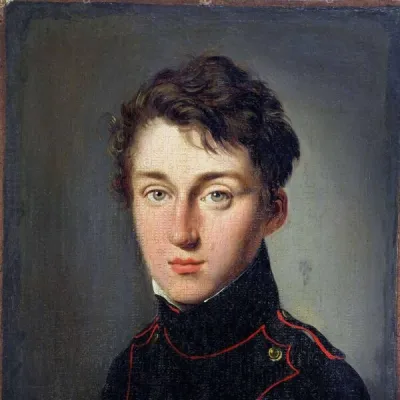
Nicolas Leonard Sadi Carnot
Human Design Chart
Biography
He died 24 August 1832
Nicolas Leonard Sadi Carnot — Generator with Profile 1/3
Generator 1/3 — Design at a Glance
Nicolas Leonard Sadi Carnot revealed himself as someone who did not unleash his power through spontaneous initiatives but rather through a reactive approach. As a Generator, he possessed considerable sacral energy, which enabled him to have immense endurance – comparable to a workhorse that could only fully display its strength when it actually had the energy for the task at hand. His design required him to wait for signals from the environment rather than taking the first step himself. The motto was clear: react, do not initiate.
This mechanism was crucial for his well-being. When he responded to impulses from life and his inner self signaled a clear “yes,” he could act accordingly through consistent action. In these moments, when he acted from his gut, he was rewarded with a deep sense of fulfillment. Conversely, ignoring these inner signals or forcing himself to do tasks that did not resonate quickly led to frustration and a lack of energy. His greatest danger lay in either doing things that did not touch him internally or being held back from his true heart project, even though he was still full of power. His effectiveness thus depended directly on whether he could consistently apply this reactive strategy and thereby sustainably utilize his intrinsic creative power without exhausting himself.
Sacral Authority
Nicolas Leonard Sadi Carnot's design inclined towards clear, body-based decision-making. As a Generator, he possessed sacral authority, which also served as his strategy. This configuration simplified his process, as inner guidance and life direction were identical. A prerequisite for this was his open emotional center, ensuring that he did not react to fleeting moods but rather to deeper, bodily signals.
His inner authority manifested through a direct reaction to external stimuli. Nicolas Leonard Sadi Carnot could listen to his “gut feeling,” which manifested in bodily sounds like grunting or in a palpable surge of energy. When his sacral motor engaged with a topic, he felt vital and possessed inexhaustible energy. This allowed him to immerse himself in tasks with great enthusiasm, without them needing to be strictly goal-oriented. He was born to go through life with joy and fully engage in his tasks.
Additionally, his activated spleen center acted as a supporting authority. Since it was connected to the sacral center, Nicolas Leonard Sadi Carnot could react particularly quickly and spontaneously to situations. He had immediate access to his instinctive well-being and was guided by this reliable bodily perception. This combination of sacral confirmation and spleen-based intuition shaped his ability to be action-ready in the here and now.
The 1/3 Profile — Investigator / Martyr
Nicolas Leonard Sadi Carnot showed himself to be someone who did not just collect knowledge theoretically but validated it through active experimentation and enduring setbacks. His design as a Researcher and Experimenter (Profile 1/3) inclined him to view life as a continuous learning process. Line 1 conveyed humility and the willingness to accept rejection as a necessary part of development. This created the foundation for deep reflection on changes. Simultaneously, Line 3 drove him to proceed through trial and error. Here, the rule was: good questions led to good answers. The pressure to resolve doubts was strong, yet only self-earned and practically tested insights counted. When Nicolas Leonard Sadi Carnot made a judgment, it was based on this double check – theoretically and empirically. His design required him to “bump into” things to see what would stand up. This process of persistence despite uncertainty shaped his work style. He learned that creativity lay in living life as an art and growing through experience. The combination of the development-oriented Line 1 and the experimental Line 3 meant that he never simply assumed but always verified. His trust in his conclusions only arose after he had thoroughly examined the matter at heart and gut.
Single Definition — Defined & Open Centers
Nicolas Leonard Sadi Carnot's Human Design profile indicated a tendency towards persistent, physical work driven by inner intuition and existential pressure. His defined Sacral Center generated a constant vital energy that he utilized in response to external stimuli to find satisfaction. Simultaneously, his defined Spleen Center acted as an intuitive authority, allowing him to make spontaneous, trustworthy judgments in the moment. The defined Root Center provided the necessary adrenalized pressure to maintain this life impulse and move forward. This combination characterized him as someone who relied on gut instinct and physical endurance rather than mental planning.
In contrast, his open Head Center revealed a vulnerability to mental confusion and the pressure to find answers to questions that were not his own. He tended to get lost in intellectual monologues when he did not trust his inner authority. His open Ajna Center meant that his conceptual thinking was flexible but not consistent; he could take in ideas without identifying them as his own truth, but risked feeling uncertain when trying to enforce conceptual certainty.
The open Throat Center showed a tendency to seek attention or feel the urge to speak when he did not wait for an invitation. His open G Center lacked a fixed identity; he was dependent on the environment and relationships to initiate his direction. The open Heart Center made him vulnerable to trying to prove his worth through promises, often leading to frustration. Finally, his open Solar Plexus absorbed the emotions of his environment, leading him to personalize foreign moods as his own when he did not consciously distance himself from them.
Channels for life purpose, focus and quiet endurance.
Nicolas Leonard Sadi Carnot was marked by a deeply rooted ability for precise focus and a stubborn fighting spirit. The Channel of Concentration 52-9 connected the Root with the Sacral Center and gave him the Format-Energy to apply logic step-by-step. Through the Gate of Non-Action (52) and the Gate of Focusing (9), he kept distractions at bay and evaluated details meticulously until his Sacral Center reacted. This structure allowed him to correct and perfect patterns by staying still enough to grasp all aspects of an issue.
Parallel to this, the Channel of Life Struggle 38-28, connecting the Root with the Spleen Center, drove him to seek meaning in his conflicts. The Gate of the Fighter (38) urged him to defend his individual integrity against external forces, while the Gate of the Player (28) helped him recognize which struggles had value. This configuration gave him the determination to walk his own path and resist, serving as a model for individuation.
Additionally, Gates like 35 (Change through Interaction) and 5 (Life Rhythm) contributed to his search for new experiences and the maintenance of firm habits to build energy. Gates 63 and 64 promoted a mental process of doubt and interpretation of past experiences to gain clarity. Gate 39 activated the Solar Plexus Center through provocation and analysis, while Gate 53 initiated new developmental cycles. Gate 54 linked worldly success with spiritual insight, and Gate 58 fostered an experimental spirit and perfectionism. Gate 44 supported awareness and transformation through relationship, and Gate 59 followed a genetic strategy of attachment.
Individual Circuitry — Circuit Signature
Nicolas Leonard Sadi Carnot was characterized by a simple, coherent energetic structure that connected Spleen, Root, and Sacral Centers. This configuration created a continuous flow of instinct, endurance, and strategic planning.
In the Knowledge Circuit, the Channel 'Life Struggle' between Spleen and Root Center acted. It gave him the ability to recognize the right thing at the right moment and to implement this intuition with the necessary energy. This supported the drive to walk his own path and transform new knowledge, supported by acoustic and pulsating impulses.
Parallel to this, the Understanding Circuit activated the Channel 'Concentration' between Sacral and Root Centers. Here, the powerful endurance of the Sacral Center flowed directly into the focused energy of the Root. This allowed him to pursue and share logical and rational insights with high intensity, free from emotional distortion. The visual and future-oriented energy of this circuit served to improve things through structure and intellect.
Since all defined centers lay in a single group, these forces did not work in isolation but as a unified system. The instinctive perception of the Spleen, the strategic endurance of the Sacral, and the focused implementation of the Root worked together. This shaped a personality that both intuitively recognized innovative ideas and possessed the logical discipline to consistently translate them into reality.
Right Angle Cross of Consciousness 2
Nicolas Leonard Sadi Carnot's Human Design profile indicated a tendency towards a deep, intuitive connection to the cosmos. He was someone who did not just observe the visible world but always sought the greater, overarching order in which everything is embedded. This attitude stemmed from the configuration of the right Consciousness Cross 2.
In Human Design mechanics, the right Consciousness Cross 2 refers to a specific energetic alignment. It is a configuration that focuses on the Universal, the Divine, or the great Whole. Those who carry this structure tend to see their own lives and experiences not in isolation but as part of a much larger, often spiritually or cosmically understood whole. It is less an intellectual analysis and more an inner certainty or a feeling of belonging to something greater.
For Nicolas Leonard Sadi Carnot, this meant that his perception of the world was marked by this fundamental connection. He did not primarily seek material details or isolated facts but rather the pattern that holds everything together. This energetic foundation shaped his way of grasping reality: as a coherent, sacred, or at least profoundly meaningful space where he found his place. It was an attitude of surrender to the Great that surrounded him.
Saturn Return — Life Cycles
Nicolas Leonard Sadi Carnot wrote his treatise, “Reflections on the Motive Power of Fire,” in 1824, at the age of 28. This success marked his first Saturn Return in his Human Design profile. During this phase, years of inner groundwork condensed into a tangible external result. The mechanics of the Saturn Ring around the Moon show how long-term structure and discipline manifest in concrete life works. Carnot's design indicated a tendency towards deep analysis and systematic order. He sought the fundamental principles behind visible phenomena. By integrating intuition and logical structure, he succeeded in bringing abstract concepts into a clear, understandable form. The Saturn Return functioned here as a catalyst, bringing this inner clarity to the outside. It was not a sudden impulse but the ripe fruit of a consistent, self-authoritative development. His work demonstrated how personal intuition could merge with rigorous methodology to generate new insights. This moment was a turning point where his life purpose was shown in a tangible achievement. The connection of inner truth and outer form shaped his approach. Through this synthesis, he created a work that went beyond pure expertise and uncovered fundamental connections. His design supported this kind of knowledge transfer by uniting stability and depth. The success of 1824 was thus the logical conclusion of a long inner journey, which now found its external confirmation.
Generator · Sacral Authority — Synthesis
He lived deeply rooted in his sacral center (Sacral Authority, defined Sacral Center), an indefatigable generator whose energy should not be wasted in aimless activities. Rather, he was driven by an unceasing urge to research and experiment (Profile 1/3, Channel 52-9) – a process that was promoted by the ability to focus on details and to be deeply satisfied in the process. This combination of enduring energy and the need to learn through trial and error shaped his approach to understanding the physical world.
A central tension lay in the connection between inner drive and the need for external stimulation. While he possessed an enormous, intrinsic creative power (Generator), his channel of concentration (52/9) required stillness and focus to effectively channel his energy. This carried the risk that he could be held back from pursuing his true interests by external demands or distractions – a dilemma that was evident in the successful publication of his treatise (Saturn Return), which resulted from years of intense engagement with a topic.
2 Defined Channels
Incarnation Cross - Right Angle Cross of Consciousness 2
Solar Return
The Solar Return shows the moment when the sun returns to its exact birth position - your personal solar year.
Life Cycles
Discover the life cycles with a detailed triple view (birth chart, cycle chart, composite).
Human Design Profile
- Type
- Generator
- Strategy
- To respond - wait for something to respond to
- Authority
- Sacral Authority
- Profile
- 1/3 - Investigator / Martyr
- Definition
- Single Definition
- Incarnation Cross
- Right Angle Cross of Consciousness 2
- Date of Birth
- 01.06.1796 18:00
- Place of Birth
- Paris, France
Frequently Asked Questions
What was the Human Design type of Nicolas Leonard Sadi Carnot?
What Profiles did Nicolas Leonard Sadi Carnot have?
What Authority guided Nicolas Leonard Sadi Carnot?
What incarnation cross did Nicolas Leonard Sadi Carnot have?
When was Nicolas Leonard Sadi Carnot born?
Discover your own Human Design
Are you also a Generator? Find out in a personal reading how to use your sacral energy correctly and discover deep satisfaction.
More Personalities
Back to overviewAaliyah

Alexia

Angèle

Anne-Marie

Arcángel

Arno