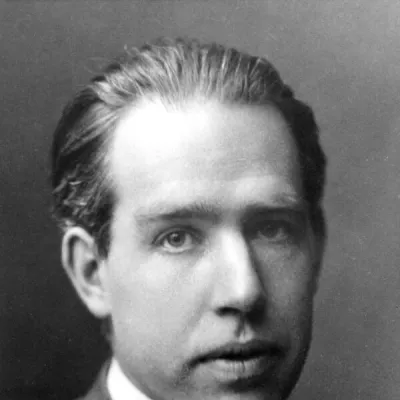
Niels Bohr
Human Design Chart
Biography
Bohr developed the Bohr model of the atom, in which he proposed that energy levels of electrons are discrete and that the electrons revolve in stable orbits around the atomic nucleus but can jump from one energy level (or orbit) to another. Although the Bohr model has been supplanted by other models, its underlying principles remain valid. He conceived the principle of complementarity: that items could be separately analysed in terms of contradictory properties, like behaving as a wave or a stream of particles. The notion of complementarity dominated Bohr's thinking in both science and philosophy.
Bohr founded the Institute of Theoretical Physics at the University of Copenhagen, now known as the Niels Bohr Institute, which opened in 1920. Bohr mentored and collaborated with physicists including Hans Kramers, Oskar Klein, George de Hevesy, and Werner Heisenberg. He predicted the properties of a new zirconium-like element, which was named hafnium, after the Latin name for Copenhagen, where it was discovered. Later, the synthetic element bohrium was named after him because of his groundbreaking work on the structure of atoms.
What does Manifesting Generator 6/2 mean for Niels Bohr?
Manifesting Generator 6/2 — Design at a Glance
Niels Bohr's Design featured a tendency towards hybrid energy: constant sacral power combined with the ability to skip steps and act swiftly. As an Manifesting Generator, he had the endurance of a Generator but also possessed Manifestor qualities through his active connection between Motor Centers and Throat Center. This allowed him to bring things into his life without having to go through each linear step.
However, this speed carried risks. Niels Bohr tended to skip important steps, which required him to return later and make up for the missing parts. Such interruptions quickly led to frustration, a theme of not being himself that was part of his type. Additionally, he responded to many impulses simultaneously and started several projects in parallel. If strategy and inner authority did not keep pace, his enthusiasm for creation turned into frustration.
To meet this dynamic, it was crucial for Niels Bohr not to initiate things himself but rather to react to life. He had to wait until his sacral center gave a clear "yes" – even after an initial test. Regular checks to see if ongoing projects still had inner approval were necessary. When applied correctly, Niels Bohr drew deep satisfaction from his creations. The advice to finish one thing before starting another did not suit him; instead, he needed variety and a "play mode" to maintain his energy.
Emotional Authority
Niels Bohr's design indicated a tendency towards patient decision-making where emotional distance precedes final steps. He was someone who consciously took the time to verify the validity of his feelings rather than reacting to initial impulses.
This approach stemmed from his emotional authority, carried by the defined Solar Plexus Center. In Human Design mechanics, this authority always takes precedence over other defined centers regardless of further configurations in the chart. Niels Bohr was constantly under an emotional wave that colored his perception: at one moment he saw situations enthusiastically positively, and shortly after negatively shaded. His immediate feeling was merely a snapshot, not the final truth. Quick, spontaneous reactions to these fleeting moods would have led to poor decisions.
Instead, Niels Bohr used time as a filter. He let decisions mature and slept on them multiple times to gain emotional distance. This conscious hesitation was not a lack of determination but a strategic process. Only when intense feelings subsided and clarity and calmness set in did he know what his deeper truth was. This mechanism secured him a solid foundation for long-term, life-defining choices, free from the distortion of passing moods.
The 6/2 Profile — Role Model / Hermit
Niels Bohr's Design was characterized by a bipolar development line that divided his life into two clearly distinguishable phases. In his younger years, before the age of 30, the aspect of experimental learning dominated. Here, the principle of trial and error prevailed: Niels Bohr accumulated numerous personal experiences, where setbacks often led to temporary retreats in order to test new paths. This phase was marked by a search for momentum and the impulse to start anew, yet without preconceived expectations of success.
With the return of Saturn, around his 30th year of life, a fundamental change occurred. Line 6 became active, leading Niels Bohr into a period of intense reflection and self-discovery. He metaphorically retreated to his "cave on the mountain" to look back at earlier experiments in his life with great distance. This time served for healing and deepening inner clarity. It was no longer about external experimentation but rather integrating the accumulated wisdom.
From this profound introspection, Niels Bohr later emerged as a wise mentor. His role was to show others how they could partake in this depth and learn the ability of self-reflection. He did not just impart knowledge but enabled his surroundings to recognize their own patterns and confirm their value. His life illustrated the path from the impetuous experimenting of a natural talent to the calm, instructive presence of a role model.
Single Definition — Defined & Open Centers
Niels Bohr's design laid a foundation of constant mental conception and reliable expression ability. His defined Ajna Center ensured a continuous, specific thought process; he was always engaged in a mental process that processed data and created concepts. This mental stability flowed directly into his defined Throat Center, which served as a pivot point to bring these thoughts into clear communication and action in the world. His voice was a constant yet limited form of expression that reliably articulated what the mind conceptualized.
The energy for this work came from his defined Sacral Center. As custodian of an immense power source, Niels Bohr had a true vitality that felt like a constant hum. His strategy involved waiting and reacting to stimuli; only then did full sacral power become available for decisions and actions. Initiating steps without prior questioning would have interrupted this connection and led to frustration.
As inner authority, his defined Solar Plexus Center functioned. Truth revealed itself to him not in the moment but over time. He was designed to wait out the ups and downs of his emotional wave before making a decision. This emotional depth allowed him to view situations from many angles and only act when clarity was achieved, giving him a strategic advantage in negotiations or relationships.
Simultaneously, Niels Bohr was strongly influenced by his open centers. His open Head Center lacked consistent inspiration; it tended to absorb mental pressure from the environment and identify with others' doubts rather than generate its own answers. His open G Center meant a lack of fixed identity; he adapted to people and places to find direction and love through reflection of his surroundings. The open Heart Center made him vulnerable to the pressure of needing to prove his worth, despite lacking consistent willpower for it. His open Spleen Center made him sensitive to others' well-being, leading to conditioning by the health or illness of those around him. Finally, his open Root Center absorbed the stress and adrenaline surge of people around him, often putting him under pressure that was not his own.
Channels for intimacy, insight and emotional change.
Niels Bohr's design set a tendency for deep emotional intimacy alongside a mind that often thought years ahead of its time. This configuration required patience: both in relationships and in communicating complex ideas.
The Channel of Union 59-6 connected his sacral energy with the emotional wave of Solar Plexus. This created a strong drive towards merging and intimacy, yet it was dependent on emotional maturity. Clarity in interpersonal dynamics emerged only through waiting out the wave cycle; spontaneous actions without this inner confirmation led to confusion or misunderstandings. True connection arose here through patiently nurturing friendships before they deepened.
Parallel to this, the Channel of Structuring 43-23 worked. It connected Ajna Center with Throat Center and enabled mutative insights felt as spontaneous breakthroughs. His challenge was letting go of control over his mind and waiting for the right timing to express them. When his innovative perspectives were expressed at the wrong time, he met resistance; but at the right moment, they changed others' thinking sustainably.
Additionally, the Channel of Transience 35-36 propelled him forward. He sought new experiences and emotional depth often through awareness of feelings' impermanence. This mechanism fostered wisdom arising from lived crises and changes. By accepting his own emotional oscillations, he gained insights that he could later offer as advice.
Together, these channels shaped a person whose intimacy, innovative thinking, and emotional maturity were closely tied to waiting for inner clarity. His strength did not lie in quick action but in the deep processing of experience and insight before expression.
Individual Circuitry — Circuit Signature
Niels Bohr's design linked mind and expression directly. The Knowledge Circuit created pulsating acoustic energy between Ajna and Throat Centers. This promoted structuring flashes of insight into clear communication. New identity emerged through formulating unique insights.
Parallel, the Meaning Circuit worked. It connected Throat with Solar Plexus Center via Transience Channel. Here emotional waves from the past flowed into expression. Niels Bohr shared felt understandings to learn together. The energy was cyclical and visually marked.
The Protector Circuit linked Sacral with Solar Plexus Center through Union Channel. This primal power served genetic and family protection. Life force and emotions united in themes of care, nutrition, and defense.
Simplifying, these three circuits formed a cohesive group: Sacral, Solar Plexus, Throat Center, and Ajna were energetically connected. This created an unbroken flow from instinctive life force through emotional processing to structural mind to spoken expression. Niels Bohr used this integrated energy to transform knowledge and express his individuality.
Left Angle Cross of Endeavour 2
Niels Bohr's identity was defined by the principle of effort and striving. There was no predetermined, static essence; his existence emerged through the act of doing and overcoming obstacles. This structure, known as the left cross of effort, suggested that his life was not a static state but rather a process of continuous effort.
The dynamic between his inner drive for progress and the necessary force to realize it shaped his attitude. For him, this meant that identity did not simply exist but had to be actively worked on. Each achievement resulted from the conscious application of energy against resistance. This mechanism described a life task where selfhood only manifested through action and struggle towards goals.
Thus, Niels Bohr lived in a constant state of becoming. The necessity to prove himself and overcome obstacles was not coincidental but the fundamental law of his design. His personality formed in the friction between the desire for development and the real work required to achieve it. As such, his essence was inseparable from the concept of effort – an ongoing performance that constituted his reality.
Saturn Return · Uranus Opposition · Chiron Return · 2nd Saturn Return — Life Cycles
Niels Bohr's life followed a clear rhythm of intense creative phases and existential breaks. His first Saturn return in 1913 marked the transition into maturity: at age 28, he established the Bohr model of the atom, a fundamental career achievement that solidified his intellectual authority. The Uranus opposition in 1924 was followed by a phase of change; together with Kramers and Slater, he published 'The quantum theory of radiation,' underscoring his ability to reorder established structures.
His Chiron return in 1936 ushered in the phase of fulfillment. At age 51, Bohr developed the drip and liquid drop models of the atomic nucleus. This was not a moment of healing but rather a bloom: his life task unfolded concretely into new theoretical models that made clear the purpose of his work.
However, his second Saturn return in 1943 did not bring further consolidation but an acute crisis. At age 58, Bohr fled with his family to Sweden, supported by British and Danish intelligence services. This event highlights the harsh reality of cyclical patterns: where earlier cycles led to scientific breakthroughs, this cycle challenged survival itself. Bohr's design thus revealed no linear progression but recurring tensions between creative construction and the need to withdraw or reposition oneself from external threats.
Manifesting Generator · Emotional Authority — Synthesis
Niels Bohr lived a way of life marked by a deep inner rhythm – a constant reaction to life rather than forcing it (sacral center, Manifesting Generator). This responsiveness combined with an acute ability to process complex information into novel concepts (defined Ajna Center, Channel 43/23), which he then communicated (defined Throat Center). His design seemed to challenge him to continually open himself up to new experiences from which to gain wisdom and share it with others (undefined Root and Heart Centers, Channel 36/35), giving him a unique perspective. This combination of inner responsiveness and intellectual depth led him through phases of intense research and creative progress that showed in tangible successes (Saturn return, Uranus opposition).
Central for Niels Bohr was the tension between the drive for innovation and the necessity of emotional clarity. His design pointed to quick comprehension and the ability to take new paths (Manifesting Generator), yet his emotional center (emotional authority) required waiting and maturing ideas to make truly grounded decisions. This dynamic led to a dance between impulsive breakthroughs and phases of reflection, forcing him continually to realign himself and refine his insights (Cross, Cycles).
3 Defined Channels
Incarnation Cross - Left Angle Cross of Endeavour 2
Solar Return
The Solar Return shows the moment when the sun returns to its exact birth position - your personal solar year.
Life Cycles
Discover the life cycles with a detailed triple view (birth chart, cycle chart, composite).
Human Design Profile
- Strategy
- To respond - wait for something to respond to
- Authority
- Emotional Authority
- Profile
- 6/2 - Role Model / Hermit
- Definition
- Single Definition
- Incarnation Cross
- Left Angle Cross of Endeavour 2
- Date of Birth
- 07.10.1885 13:15
- Place of Birth
- Copenhagen, Denmark
Frequently Asked Questions
What was Niels Bohr's Human Design type?
What profile did Niels Bohr have in Human Design?
What authority guided Niels Bohr?
What incarnation cross did Niels Bohr have?
When was Niels Bohr born?
Discover your own Human Design
Are you also a Manifesting Generator? Find out in a personal reading how to unfold your multi-talents and direct your energy wisely.
More Personalities
Back to overviewAldair

Alizée

Angeli

Arletty

Artus
Balthus