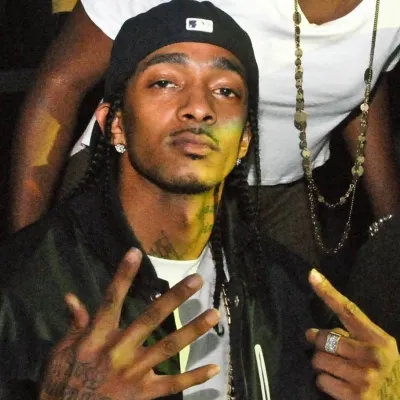
Nipsey Hussle
Human Design Chart
Biography
At about 3:25 PM on 31 March 2019, Hussle was shot several times outside his store, Marathon Clothing, in South Los Angeles. Hussle was transported to a hospital, where he was pronounced dead at 3:55 PM. He was 33. Eric Holder, a 29-year-old man who had confronted Hussle earlier in the day, was arrested and charged with murder on 2 April 2019.
Nipsey Hussle as a Manifesting Generator 5/1 in Human Design
Manifesting Generator 5/1 — Design at a Glance
Nipsey Hussle was someone who quickly set his hand to the world and often pursued multiple paths simultaneously. His design as an Manifesting Generator combined the constant energy source of the sacral center with the ability to skip steps. This allowed him to draw things into his life that would require lengthy processes for others. However, this speed carried risks: He tended to overlook important intermediate steps or follow too many impulses at once, which could lead to frustration if his inner system was out of sync.
The strategy was to not initiate himself but to react to life. Only when the sacral center gave a clear 'yes' did he apply his energy. This feedback loop was crucial to channel his natural speed constructively. Instead of focusing on a single task, he found his creative power in variety and a playful mode. Parallel projects were not a distraction for him but the source of deep satisfaction, as long as his inner authority agreed. Through regular checks of his projects, he ensured that he was not working against his own rhythm. Thus, the potential source of frustration was transformed into a powerful driving force that allowed him to work efficiently and joyfully without neglecting the necessary foundations.
Emotional Authority
Nipsey Hussle showed a basic attitude that was characterized by emotional wave movements. His design carried emotional authority, meaning that his defined emotional center formed his inner decision-making instance – regardless of which other centers were also defined. This configuration was subject to permanent ups and downs of feelings. The world appeared to him always colored by the current mood: in one moment totally enthusiastic, in the next the same situation negatively evaluated.
However, this immediate emotional impulse only represented a snapshot, not necessarily the deeper truth. Quick, spontaneous decisions that directly emerged from such an emotion carried the risk of having negative repercussions. Instead, his design required patience and time to let decisions mature. Sleeping on important questions and rethinking them multiple times served to smooth out the intense initial feelings. Only with this emotional distance did clarity and calmness set in. This process was particularly crucial for long-term decisions, as they could have a significant impact on the life course. Nipsey Hussle used this mechanism to ensure that his choice was not guided by a passing mood but by a well-considered, emotionally stable insight.
The 5/1 Profile — Heretic / Investigator
Nipsey Hussle was someone who gathered deep, individual knowledge to offer it to others for problem-solving. His design as a Hero/Researcher (Profile 5/1) laid a tendency to build expertise through intensive research (Line 1) that was magnetic to outsiders. Others often sought him out for solutions, which optimally utilized his gifts but also carried the risk of him being drained without clear boundaries.
This dynamic arose from the interaction of his lines. The fifth line tempted others to give energy to advance the logical process; it allowed him to delegate responsibility and give answers from the throat center, which led to recognition. At the same time, this line carried the potential for cynicism, as he constantly had to acknowledge the understanding of others. The first line emphasized honesty and sharing of knowledge in the context of group goals. Here it was about communal insight and acceptance in the community. Nipsey Hussle lived the balance between seeking hidden truths for himself and providing these insights for others. When he learned to set boundaries, he could maintain the beneficial balance between research and problem-solving. His design described a life task of uncovering hidden connections and conveying them in a way that others could take up without endangering his own energy base.
Split Definition — Defined & Open Centers
Nipsey Hussle was characterized by a reliable and established way of self-expression and identity. His defined G Center gave him a clear sense of direction and the feeling of being lovable without being dependent on others. This inner security allowed him to guide others based on his personal truth.
His energy source came from his defined Sacral Center, a motor that generated daily vital energy. This energy was only available upon affirmative responses; initiating actions without prior invitation often led to resistance and exhaustion. His strategy was to wait and listen to the sacral reaction to ensure he had the necessary endurance for his ventures.
Communication occurred through his defined Throat Center, serving as a pivot point to translate messages from the body into words and actions. It spoke from a constant source, making his statements clear and honest as long as he did not act impulsively.
Emotionally, Nipsey Hussle was marked by his defined Solar Plexus Center, which formed his inner authority. He was designed to wait for the emotional wave before making decisions. Immediate reactions in emotional highs or lows were often misleading; true clarity emerged only after going through the emotional cycle. Additionally, his defined Root Center provided a constant pressure for forward movement and dealing with stress.
In contrast, his Head, Ajna, and Heart Centers were open. The open Head Center made him vulnerable to mental confusion and the pressure to find answers to questions that were not his own. He tended to get caught up in intellectual pursuits that distracted him from the actual decision-making process. The open Ajna Center meant that his mental consciousness was flexible but also prone to conditioning, giving assurance where none existed.
The open Heart Center led to him not being designed to show willpower in the sense of competition or promises. He was vulnerable to the pressure to prove his worth through performance, which could lead to a cycle of self-doubt if he did not trust his inner authority. Instead, he had to learn that he did not need to prove anything and that promises that came from the mind were often not kept.
His open Spleen Center made him sensitive to well-being and fears. He was vulnerable to clinging to people or situations that gave a sense of security, even if they were not healthy for him. Spontaneous decisions were risky, as they were often driven by conditioned fears rather than true intuition. The challenge was to recognize these fears and not act impulsively, but to trust his strategy and authority to make healthy relationships and decisions.
Channels for synthesis, inspired expression and rhythmic beat.
Nipsey Hussle was someone who worked through authentic presence and rhythmic energy. His design tended to open new directions through creative expression and inner resonance.
The Channel of Inspiration 1-8 connected the G Center with the Throat Center. It allowed a mutative perspective through the individual entrance of self-expression (Gate 1) and the Gate of Contribution (8) to be creatively expressed. This was the public outlet for the potential of creativity and leadership. Nipsey Hussle did not work through explanations but by living and demonstrating his unique identity. As an individual, he drew public attention and inspired others to express their own uniqueness, similar to a pianist who encourages listeners to play the piano. This effect required patience and waiting for the right timing, as there was no built-in social adaptability.
The Channel of the Beat 14-2 connected the Sacral Center with the G Center. Through the Gate, skillfully handling power (14), he focused on material resources to drive mutation, while the Gate of Higher Knowledge (2) directed movement through space and time. This tantric channel brought innovation and novelty. Nipsey Hussle could lead new directions through trust in the reaction from his Sacral Center. He was capable of maintaining his creative efforts or supporting others materially. Through his healthy aura, people might find their own direction by being seized by a new perspective.
The Channel of Synthesis 19-49 connected the Root Center with the Solar Plexus Center. The Gate of Claims (19) pressed for tribal belonging, while the Gate of Principles (49) rejected anything incompatible with the highest ideals. This formed the emotional glue for belonging and loyalty. Nipsey Hussle was sensitive to his position in the whole and sought balance between feasibility and fairness. His family was his business, and he was willing to do the necessary work for their success.
Additionally, Gates like the Gate of Formulation (4) for logical processes and future security, as well as the Gate of Freedom (53) for new developmental cycles, were active. The Gate of Care (27) improved activities through warm altruism, while the Gate of Change (35) promoted progress through interaction.
Individual Circuitry — Circuit Signature
Nipsey Hussle's design tended towards impulsive creativity and emotional synthesis. As a person with split definition, his inner self consisted of two separate, parallel existing power fields that did not flow directly into each other.
The first field included the Throat, Identity, and Sacral Centers. Here the Knowledge Circuit worked. Through the Channel of Inspiration (Gates 8-1), he received sudden mental sparks that transformed into rhythmic, pulsating expression forms in the Channel of the Beat (Gates 2-14). This energy connected his unique identity directly with his life force and linguistic expression. It was about creating new knowledge and transformation through individual expression, carried by an acoustic, now-oriented energy.
The second, completely separate field connected the Solar Plexus and the Root Centers. Here the Ego Circuit worked. The Channel of Synthesis (Gates 49-19) linked emotional waves with the drive energy of the Root. This created a capacity for emotional processing and the communal creation of resources based on mutual support. Since this field did not connect to the Sacral Center, it required rest periods for regeneration. Emotional impulses from the Solar Plexus were translated into concrete, often traditional or conservative actions by Root energy, aimed at cooperation.
These two systems – the creative, identity-forming expression field and the emotional, cooperative resource field – existed in Nipsey Hussle as independent, non-directly connected energies. His character was shown through the interplay of these separate poles: on the one hand, the pulsating, innovative creation, on the other hand, the rhythmic, emotional synthesis in the community.
Left Angle Cross of Revolution 2
Nipsey Hussle carried the left cross of the Revolution 2. This configuration established a foundational stance characterized by a deep connection to one's origin and a revolutionary force. It was not about sudden rebellion but rather a persistent, inner-driven energy aimed at changing structures perceived as unjust or limiting.
In Human Design, this cross describes a specific life task: the connection of personal intuition with a broader, often societal or collective vision. Nipsey Hussle demonstrated this by using his individual experiences and perceptions to set impulses for change. The energy of this cross often works quietly and steadily, like an underground stream slowly shaping the surrounding terrain.
It was about living one's own truth and inspiring others to follow their inner voice. The revolution symbolized by this cross is less a loud uprising than a fundamental shift in perspective. Nipsey Hussle embodied this dynamic by bringing his unique insights into the world and bridging the personal with the collective. His presence served as a catalyst for others to recognize and activate their own revolutionary potentials. This was not a conscious act of leadership but a natural emanation of his inner constellation.
Saturn Return — Life Cycles
Nipsey Hussle's design showed a tendency towards structural anchoring, which became particularly evident in phases of maturation. He lived as a Generator, whose energy was directed by inner resonance, requiring a deep connection to his environment and projects. This configuration promoted a lifestyle based on continuous development and the creation of solid foundations.
The first Saturn Return occurred when he was 28 years old. At this age, years of groundwork often condensed into a stable foundation. For Nipsey Hussle, this phase marked a turning point where inner clarity was translated into external structures. In 2013, the mixtape 'Crenshaw' was released. This event was no coincidence but the expression of a mature energetic alignment. The Saturn Return acted here as a catalyst, transforming his previous work into tangible form. It showed how his design was geared towards achieving lasting results through patience and consistency. The release marked a new stage of self-determination and professional identity. His chart described a path not based on quick success but on the gradual establishment of his own space. This cycle confirmed the necessity of relying on his own authority to achieve long-term goals.
Manifesting Generator · Emotional Authority — Synthesis
He lived as an Emotional Authority Manifesting Generator with the Profile Hero/Researcher. A central red thread in his life was the dynamic connection between inner maturity and rapid implementation. The defined sacral center provided a constant energy source, which, through the Manifestor component in his design, enabled quick action – a capability that allowed him to tackle projects and bring ideas to the world (Channel 1-8). However, this energy was modulated by the emotional authority, which required time for decisions to ripen to avoid hasty action. He was a knowledge circuit, who through exploring and refining insights, pointed out new paths and inspired others.
A central paradox lay in the tension between the need for rapid progress and the necessity of emotional clarity. He could initiate things swiftly, but the defined emotional center required him to not make decisions out of the moment but to let them ripen in the emotional wave. This led to an inner dynamic where he acted both as an initiator and needed time to fully grasp the consequences of his actions. A documented event showed how this process took shape in his career with a creative work in 2013 (Saturn Return).
3 Defined Channels
Incarnation Cross - Left Angle Cross of Revolution 2
Solar Return
The Solar Return shows the moment when the sun returns to its exact birth position - your personal solar year.
Life Cycles
Discover the life cycles with a detailed triple view (birth chart, cycle chart, composite).
Human Design Profile
- Strategy
- To respond - wait for something to respond to
- Authority
- Emotional Authority
- Profile
- 5/1 - Heretic / Investigator
- Definition
- Split Definition
- Incarnation Cross
- Left Angle Cross of Revolution 2
- Date of Birth
- 15.08.1985 20:39
- Place of Birth
- Gardena, CA, United States
Frequently Asked Questions
What was Nipsey Hussle's Human Design type?
What Profile did Nipsey Hussle have in Human Design?
What Authority did Nipsey Hussle have?
What incarnation cross did Nipsey Hussle have?
When was Nipsey Hussle born?
Discover your own Human Design
Are you also a Manifesting Generator? Find out in a personal reading how to unfold your multi-talents and direct your energy wisely.
More Personalities
Back to overviewAldair

Alizée

Angeli

Arletty

Artus
Balthus