
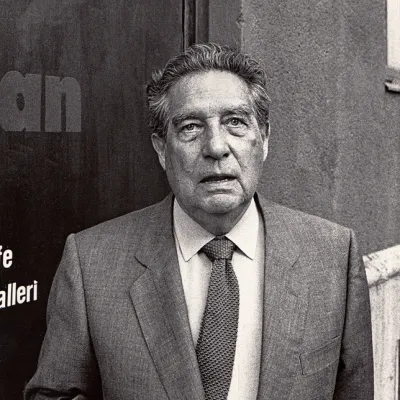
Octavio Paz
Human Design Chart
Biography
Paz’s family was ruined financially by the Mexican Civil War, and he grew up in straitened circumstances. Nonetheless, he had access to the excellent library that had been stocked by his grandfather, a politically active liberal intellectual who had himself been a writer. Paz was educated at a Roman Catholic school and at the University of Mexico. He published his first book of poetry, Luna silvestre (“Wild Moon”), in 1933 at age 19. In 1937 the young poet visited Spain, where he identified strongly with the Republican cause in the Spanish Civil War. His reflection on that experience, Bajo tu clara sombra y otros poemas (“Beneath Your Clear Shadow and Other Poems”), was published in Spain in 1937 and revealed him as a writer of real promise. Before returning home Paz visited Paris, where Surrealism and its adherents exerted a profound influence on him.
In 1937 he married Elena Garro, who is considered one of Mexico's finest writers. They had met in 1935. They had one daughter, Helena, and were divorced in 1959. He died on 19 April 1998 at age 84 in Mexico City.
Octavio Paz — Generator with Profile 2/4
Generator 2/4 — Design at a Glance
Octavio Paz's Human Design created a foundational disposition of endurance and reactive creation. As a Generator, he had plenty of sacral energy that made him an extremely strong and enduring 'workhorse'—provided his task aligned with his inner drive. His life force was primarily released when he responded to impulses from his environment rather than initiating independently. Therefore, the motto of his design was: don't start, but respond.
This mechanism held two specific pitfalls for him. On one hand, he tended to waste energy and fall into burnout if he persistently worked on things that did not intrinsically interest him. On the other hand, he suffered from frustration when prevented from working on his heart project, even though his inner self was still full of power and wanted to continue.
The most successful strategy for Octavio Paz involved waiting for signals from life and then responding through action only when his sacral center gave a clear 'yes'. Living in harmony with this reactive nature rewarded him with a deep sense of fulfillment, making him almost unstoppable. Initiating against his design or ignoring inner signals led to persistent frustration as well as a noticeable lack of energy. His path to contentment therefore always went through reacting from the gut.
Sacral Authority
Octavio Paz showed himself to be a Generator whose decision-making was marked by sacral authority. This internal guidance is unique to this type and simplified his process, since strategy and authority were identical: waiting for stimuli and then responding. His answers did not come from the head but from a physical reaction—often perceived as gut feelings or sudden bursts of energy.
This mechanism manifested in characteristic bodily sounds like grunting, humming, or simple 'mm' or 'hm-hm'. Such signals marked the moment when his sacral motor responded to an external impulse. In these states, he felt vital and alive, with access to an inexhaustible source of energy. This allowed him to perform tasks with great enthusiasm, fully immersed in work without obsessive purposefulness. His design contributed to shaping life with joy and contentment, driven by this immediate physical confirmation. The sacral authority served as a reliable compass guiding him directly into his natural energy source, provided he listened to these inner signals.
The 2/4 Profile — Hermit / Opportunist
Octavio Paz lived in a constant tension between the deep need for withdrawal and the desire to connect with his closest community. His design as Profile 2/4, known as 'Natural Talent' or 'Networker', fundamentally shaped this dynamic. Line 2, the Hermit, demanded isolated time to go inward, find peace, and gain inner clarity. Without these phases of withdrawal, his internal balance would have been disturbed. Once this need was fulfilled, Line 4, the Community Line, urged him to exchange with familiar people, test alliances, and weave collected knowledge into social contexts.
This interaction required clear communication of his boundaries: he had to make it clear when he sought company and when he wanted solitude. Only then could he use the analytical ability of Line 4 to evaluate relationships without falling into conflicts through aggressive defense mechanisms of Line 2. Line 2 tended to react extremely and intimidatingly if interfered with, often followed by regret. In contrast, Line 4 sought trust and compatible partners. Octavio Paz used his alone time to reflect on impressions from his network. From this emerged brilliant ideas that he then reintroduced into exchanges with his favorite people. His life was a rhythm of cave and community, where each phase was necessary to enrich the other and develop his unique insights.
Split Definition — Defined & Open Centers
Octavio Paz lived in a constant state of mental tension. His defined Head and Ajna Centers created a perpetual pressure to question and form concepts, yet he lacked the energy for direct implementation of these thoughts. This often led to inner anxiety or feelings of incompleteness when he tried to use his mind as the sole guide for action. Nevertheless, his communication was precise: His defined Throat Center clearly conveyed these mental processes into the world, reflecting what his mind conceived—a reliable but limited form of expression.
This intellectual intensity contrasts with his physical nature as a Generator. His defined Sacral Center possessed an enormous vital energy source that could only be activated through reaction. Paz tended to make mental decisions for which his sacrum did not provide energy, leading to frustration and exhaustion. The challenge lay in not taking the first step but waiting until life prompted him so that his sacral response would be “Yes.” Only then was he supplied with the endurance needed to complete tasks satisfactorily.
At the same time, he was flexible regarding identity and direction due to his open G Center, yet also vulnerable. He had no fixed self-image but absorbed the energy of his environment. This could lead him to question who he really was or where his true direction lay, especially when in the wrong places. Instead of actively seeking a firm identity, he needed to learn to trust that correct environments and relationships would provide the necessary clarity.
Emotionally, Paz was through his open Solar Plexus Center a mirror of his surroundings. He absorbed foreign moods, making him susceptible to emotional waves not originating from himself. This sometimes led to feelings of being emotionally out of control or feeling guilty for things he did not cause. The solution lay in not personalizing these emotions and regularly withdrawing into solitude to restore his own emotional neutrality. His open Heart Center also meant that he lacked a consistent energy for willpower or competition; making promises merely to prove his worth inevitably led to failure and self-doubt. Instead, he found strength in not needing to prove himself.
Channels for intuition, logic, maturation and abstract comprehension.
Octavio Paz was distinguished by a deep, intuitive intelligence that he translated into precise refined skills. This occurred through the Channel of Wave Length 48-16: Gate 48 sought out vital information while Gate 16 experimented and perfected new possibilities. This combination transformed mere dexterity through repeated practice into genuine talent that required recognition and resources to flourish.
His mind was driven to logically order complex patterns and articulate them verbally. The Channel of Accepting 17-62 connected the visual perception of patterns (Gate 17) with the ability to translate details into words (Gate 62). This created an internal process of organization; only what he could mentally categorize was understood. This channel promoted teaching and the clear presentation of theories, provided the timing was right.
Life experiences Octavio Paz underwent as cyclical processes of maturation. The Channel of Maturing 42-53 propelled him to begin new cycles (Gate 53) and complete them fully in order to gain wisdom from growth (Gate 42). Premature termination led to repetition; only reflection on completed experiences allowed the building of new insights for the collective.
At the same time, his mind was under pressure to filter sense out of confusion. The Channel of Abstracting 64-47 connected mental restlessness and searching for possibilities (Gate 64) with the drive to understand perspectives (Gate 47). This active mind constantly played with images until a clear, inspiring story emerged in patient waiting, which he could then share.
Additionally, individual Gates were at work: Gate 21 directed material things and sought respect within the community. Gate 38 set boundaries to defend individual integrity under pressure. Gate 39 used provocation as fuel for mutations. Gate 63 pushed the mental process forward through doubt in order to gain security. Gate 19 searched for resources and spiritual connection in the territory. Gate 61 fought for inner truth and stillness amidst mental noise. Gate 41 focused on emotional development through crises. Gate 56 abstracted mental processes into pictorial narratives. Gate 35 sought satisfaction through change and interaction.
Collective Circuitry — Circuit Signature
Octavio Paz revealed himself through a split definition, which meant two independent energetic systems in his design. These parallel forces worked alongside each other without directly flowing into one another.
His Understanding Circuit connected Ajna, Throat, and Spleen Centers. This promoted a tendency towards logical, emotion-free reasoning with an eye on the future. The energy of this connection served to share rational insights to improve structures or advance societies.
At the same time, the Meaning-Finding Circuit existed as a separate system. It consisted of two unconnected segments: one including Head and Ajna Centers, the other comprising Sacral and Root Centers. While the first pair provided visual impulses, the second involved cyclical emotional waves from the past. This configuration directed attention to reflecting on past events in order to grasp their meaning. The resulting felt insights were meant to be shared with the collective so that lessons could be learned together from history.
Through this specific arrangement, Octavio Paz's experience was shaped by cool future-oriented logic and emotional processing of the past as two distinct yet simultaneous streams. The separation of these systems prevented a single continuous flow; instead, separate areas of perception and expression emerged, each following its own logical or emotional cycles.
Right Angle Cross of Tension 1
Octavio Paz's design indicated a tendency towards intense inner tension arising from the interplay of deep spiritual striving and a strong will for self-assertion. This configuration, known as the right cross of tension 1, described a characteristic trait: The desire for absolute freedom and authenticity was in constant, often painful dialogue with the drive to consistently assert one's path.
In Human Design mechanics, this orientation does not simply mean 'tension' in everyday terms but rather a specific energy dynamics. It combined the search for transcendent meaning – grasping the whole beyond material boundaries – with an unrelenting focus on the self and its limits. Octavio Paz was someone who could not separate these two poles; his will was always shaped by his spiritual vision, and his vision sharpened through his will.
This resulted in a lifestyle that was neither purely ascetic nor purely egoistic but lived in the friction between these extremes. The energy of this configuration created a constant pressure towards integrity: Every action had to correspond both to higher meaning as well as respect personal limits. This led to an attitude often perceived as distant or strict because it did not allow compromises that would dissolve this inner tension. Octavio Paz lived in this permanent balance between devotion to the divine and assertion of self, which shaped his entire aura.
Saturn Return · Uranus Opposition · Chiron Return · 2nd Saturn Return — Life Cycles
Octavio Paz's design indicated a tendency towards structural stability and the ability to remain form-stable under pressure. This characteristic was particularly evident during his second Saturn return. During this life stage, years-long inner processes often crystallized into a new, sustainable attitude toward the outside world. It was a phase of maturation in which one’s structure became reinforced and learned to draw clearer boundaries as well as take responsibility for their own creation. This cycle did not mark a fresh start in terms of lightness but rather a deepening of one's substance. Octavio Paz was elected into the American Academy of Arts and Letters in 1972 at age 58. This recognition coincided precisely with his second Saturn return. The event served as concrete evidence of how internal fortification manifested externally as increased authority and institutional appreciation. His election not only confirmed his ability but also reflected that his personal development had reached a point where his structure was stable enough to carry and integrate such external validations sustainably.
Generator · Sacral Authority — Synthesis
Octavio Paz lived a life marked by a deep inner drive to generate energy and channel it into creative work. As a Generator with sacral authority (and an open emotional center), he responded to external stimuli with an immediate, physical impulse – a vital readiness to engage as long as the task nourished his internal energy. This principle of responsive creativity, combined with the Natural Talent/Networker profile, suggests that he experienced phases of intense self-reflection and exchange with others to find inspiration and fuel his work. The defined mental circuitry further reinforced this process by creating a constant pressure towards analysis and understanding – an unceasing questioning and comprehension that shaped his work.
A central paradox in his design lay in the interplay between deep inner depth (Channel of Wavelength) and the need for connection (Line 4). While he instinctively sought life-critical information and perfected skills, he oscillated simultaneously between withdrawing into his own world and wanting to exchange with others. This tension was evident in his strong internal judgment (Spleen Center), which he constantly sharpened and validated through engagement with the outside world – a search for confirmation and resonance that propelled his creative work.
4 Defined Channels
Incarnation Cross - Right Angle Cross of Tension 1
Solar Return
The Solar Return shows the moment when the sun returns to its exact birth position - your personal solar year.
Life Cycles
Discover the life cycles with a detailed triple view (birth chart, cycle chart, composite).
Human Design Profile
- Type
- Generator
- Strategy
- To respond - wait for something to respond to
- Authority
- Sacral Authority
- Profile
- 2/4 - Hermit / Opportunist
- Definition
- Split Definition
- Incarnation Cross
- Right Angle Cross of Tension 1
- Date of Birth
- 31.03.1914 23:40
- Place of Birth
- Mexico City, MEX
Frequently Asked Questions
What is Octavio Paz's Human Design type?
Which Profile did Octavio Paz have in Human Design?
What Authority guided Octavio Paz?
What incarnation cross did Octavio Paz have?
When was Octavio Paz born?
Discover your own Human Design
Are you also a Generator? Find out in a personal reading how to use your sacral energy correctly and discover deep satisfaction.
More Personalities
Back to overviewAaliyah

Alexia

Angèle

Anne-Marie

Arcángel

Arno
