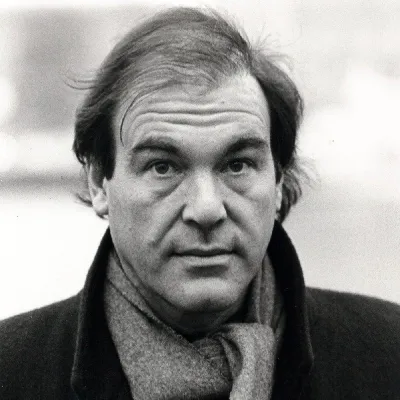
Oliver Stone
Human Design Chart
Biography
Stone won an Oscar for Best Screenplay in 1978 for "Midnight Express" and has written the noted screenplays for, "Conan the Barbarian" in 1982 and "Scarface" in 1983. He was nominated for eight Academy Awards and four Oscars for the war drama "Platoon" in 1986.
The only child of stockbroker Louis Stone and his socialite wife Jacqueline, Stone spent his privileged but emotionally lacking childhood in New York City. In 1960 he was sent to The Hill School in Pennsylvania where he "never fit in," and received the shocking news in his second year that his parents were divorcing and that his allegedly successful father was deeply in debt. Accepted to Yale in 1965, he dropped out after his freshman year to teach English as a civilian in Vietnam. Needing to experience the "bottom of life," Stone enlisted in the Army back in the US and was shipped back to Vietnam where he served 15 months in the 25th Infantry division where he was wounded in the neck, receiving the Bronze Star and the Purple Heart for Service. After his discharge, Stone returned to the US in 1968 and enrolled in New York University's film program under the tutelage of filmmaker Martin Scorcese. Graduating in 1971, he made his directorial debut with the Canadian horror film "Seizure" in 1973.
Human Design Analysis: Oliver Stone as Manifestor 6/2
Manifestor 6/2 — Design at a Glance
Oliver Stone revealed himself as someone who moved forward with a clear vision and often encountered resistance or misunderstanding. His design as a Manifestor set a fundamental attitude: he was not just a passive participant in the background but an initiator setting new directions – similar to an Emperor who implements his goals through others. This role meant that he was not understood by everyone; some followed him enthusiastically, while others rejected him precisely because his ideas were so far-reaching and polarizing.
This conflict between being a pioneer and facing rejection is typical for this type. The human reaction to such strong impulses is often divided: love or hate, approval or defense. To minimize these frictions and attract the right people, it was crucial that he communicated his intentions clearly. This strategy of informing others before acting served to reduce misunderstandings and build a genuine following.
If Oliver Stone followed this principle, i.e., did not simply impose himself but informed others, his system rewarded him with an inner sense of peace. If he acted against this nature, without informing or going against his own drive, it often resulted in deep feelings of anger and frustration. His path was thus characterized by the balancing act between the urge to lead the world into a new future and the necessity of making this process understandable for others.
Emotional Authority
Oliver Stone showed a decision-making stance that did not follow immediate impulsiveness but developed within the rhythm of emotional waves. His inner authority is Emotional Authority, carried by the defined Emotional Center. In Human Design mechanics: once this center is defined, it always takes the lead in decisions – regardless of which other centers are also active. This priority means that Oliver Stone was subject to a permanent fluctuation between enthusiasm and skepticism. The current mood strongly colored his perception; what shone in one moment could appear negative in the next. Since this first impression was only a snapshot and not the deeper truth, spontaneous judgments often led to wrong decisions. Instead, his design required patience: decisions had to mature ideally overnight. Only when the initial emotional heat subsided and clarity and calm set in, was the inner process complete. This waiting for an emotional distance was not a sign of hesitation but the necessary strategy to recognize the true nature of his feelings – especially regarding long-term steps with significant influence on his life path.
The 6/2 Profile — Role Model / Hermit
Oliver Stone's design laid out a tendency towards intense experimental enthusiasm in youth, followed by a phase of deep withdrawal and reflection. As a 6/2 profile, energy before the age of thirty resembled a 3-line: trial and error characterized this period, with failures often leading to temporary retreats to start anew. This corresponded to the natural dynamics of the profile, which initially learns through personal experiences.
After his thirtieth birthday, the orientation fundamentally changed. The sixth line became active, promoting a desire for distance to soberly review past experiments. In this phase, Oliver Stone showed himself as someone who withdrew to distinguish sense from nonsense. This isolation was not an escape but a necessary cleansing of unclear emotions, as described by Gate 12 Line 2. Through this discipline and withdrawal, space emerged for deep self-awareness and healing.
From the cave of introspection, a wise stance eventually developed. Oliver Stone could recognize the cyclical nature of his processes and endure challenges with more calm. Others sought him out to partake in this life wisdom and learn the ability for deep self-reflection. Initial uncertainty and complaining transformed through Saturn's influence into a clear, distanced perspective that allowed him to penetrate complex connections and pass them on.
Split Definition — Defined & Open Centers
Oliver Stone revealed himself as someone whose design carried a constant, specific mental function: He was constantly in the process of thinking and conceptualizing. His defined Ajna Center created this trustworthy, independent tendency to process data and creativity without being easily influenced by others. This intellectual energy found its expression in his defined Throat Center, which served as a pivot point to transform inner information into communication and action. He did not just speak from the mind but had a reliable way of expressing himself, where the source of his voice – whether emotional or intuitive – shaped his statement.
Parallel to this, his defined Heart Center determined his access to the material world and willpower. He tended to control his life, keep promises, and stand up for recognition of his contribution. However, this ego strength was coupled with the necessity to heed his inner guidance to avoid falling into unrealistic expectations of others. His emotional landscape was shaped by a defined Solar Plexus Center that acted as an internal authority. For him, truth revealed itself only over time. He had to learn to wait for the up and down movement of his emotional wave before making decisions to avoid impulsiveness and achieve emotional clarity.
His defined Spleen Center provided spontaneous intuition and well-being in the present moment, while his defined Root Center offered a set way of dealing with stress that propelled him forward in the world. In contrast, he was vulnerable through his open centers: His open Head Center could draw him into mental monologues and doubts when trying to answer questions that were not his own. His open G Center meant he did not carry a fixed identity but blended with his environment and waited for initiation by others to find direction. Finally, lacking in the open Sacral Center was a consistent generative energy; he tended to absorb and amplify other people's life force, which could exhaust him if he had not learned to set boundaries and rest.
Channels for seeking, mood, logic and devotion.
Oliver Stone revealed himself as someone who did not just collect information but transformed it into narrative parables to teach or entertain others. This inclination rooted in the Channel of Curiosity 11-56, connecting Ajna Center with Throat Center. Instead of seeking isolated facts, this configuration filled abstract gaps and presented insights as stories that engaged imagination and feelings – a process of re-telling for current and future generations.
Simultaneously, the Channel of Openness 22-12 between Solar Plexus and Throat Centers gave Oliver Stone a mercurial, emotional articulation guided by his inner wave. His words could be catalytic and move others to change, but only if his timing was right and he was in the mood; otherwise misunderstandings or abruptness were likely.
In the background, the Channel of Judgment 58-18 between Root and Spleen Centers drove an insatiable need to correct and perfect patterns. This logic questioned everything that was not balanced to restore collective satisfaction – provided Oliver Stone was invited to offer his solutions.
Additionally, the Channel of Devotion 26-44 between Spleen and Heart Center formed a business sense. He used instinctive awareness to recognize what the tribe needed before it knew itself and sold these insights with willpower. Individual Gates like Gate 47 (Clarity from Confusion) or Gate 35 (Change through Interaction) supported this: They helped him draw meaningful connections from chaotic experiences and open new perspectives through change, while Gate 6 provided emotional friction for this growth.
Collective Circuitry — Circuit Signature
Oliver Stone's design laid a tendency towards a divided, parallel experience: two independent energetic streams existed side by side without directly communicating with each other. This is characteristic of the 'Split Definition', where different groups of centers do not appear as an integrated whole but rather as separate forces.
The first stream connected Throat to Solar Plexus Center through the Channel of Openness (Gates 12–22). This allowed him to express emotional waves directly and authentically without previously filtering them intellectually. The Knowledge Circuit supported this pulsating, acoustic expression of his individual identity.
Parallel to this existed a second stream connecting Spleen, Root, and Heart Centers. Here two separate components worked: Judgment (Channel 18–58) in the Understanding Circuit connected intuitive Spleen with strategic Root Center, fostering focused, future-oriented reasoning without emotional influence. Simultaneously, Devotion (Gates 26–44) in the Ego Circuit linked Heart to Spleen Center. This supported cooperation and resource exchange within a group based on mutual support and traditional structure.
A third element, Curiosity (Channel 11–56), connected Meaning-making Circuit Ajna with Throat Center. This allowed reflecting past experiences and sharing these insights visually and cyclically with others. Although all these channels were active, the groups remained energetically isolated from each other: The emotional expression power did not directly exchange with strategic planning or cooperative resource building. Oliver Stone thus acted through these distinct, coexisting abilities.
Left Angle Cross of Informing 2
Oliver Stone demonstrated a fundamental attitude characterized by the need for clear and direct communication. His design was oriented towards formulating complex or hidden connections in such a way that they became understandable and accessible to others. This configuration describes a life task: not just collecting information, but actively conveying it to resolve misunderstandings and create clarity.
The left cross of Communication 2 shapes this orientation. It signals a focus on distilling the essence of topics and conveying them precisely. Oliver Stone did not act merely as an observer but contributed actively to understanding. His energy flowed into how he structured messages – always with the aim that the recipient could truly grasp the core of the matter.
This mechanism does not mean that Oliver Stone necessarily spoke loudly or dominantly, but rather that his communication had a clear intention: sharing knowledge as a means of connection and enlightenment. He sought ways to condense content so it would resonate without losing complexity. This characterized his approach to information and his drive for others to not just hear but understand the perspectives he conveyed.
Saturn Return · Uranus Opposition · Chiron Return · 2nd Saturn Return — Life Cycles
Oliver Stone showed himself to be someone whose creative phases were structured by clear planetary cycles. His design indicated a tendency to experience significant career turning points at certain age stages. In 1973, at the age of 27, he made his directorial debut with the horror film “Seizure.” This coincided precisely with his first Saturn Return, a cycle often marking the condensation of years of groundwork into a viable result and thus heralding a transition to a new life phase.
Later, in 1986 at age 40, he published “Salvador,” based on Rick Boyle’s experiences. This time corresponded with the Uranus Opposition, a period of intense inner upheaval and the urge for individual freedom, often manifesting as bold, socially critical stances in his work.
In 1992 at age 46, he wrote the screenplay for “JFK – The Scene in Dallas” based on Jim Garrison’s case. This was near his Chiron Return (around ages 49-51), a fulfillment cycle where one’s incarnation cross unfolds and meaning becomes experiential. Stone used this time to uncover deep societal connections.
In 2004, he released “Alexander,” which was a financial failure. This fell during his second Saturn Return (around age 58), a phase of reassessment and consolidation often fraught with challenges to question old structures and find new paths.
Manifestor · Emotional Authority — Synthesis
A central red thread runs through the chart: the dynamic tension between inner perception and outer expression. The defined Mental Center (Ajna) in conjunction with the Channel of Curiosity (Gate 11/56) points to an unceasing drive to develop concepts and convey them through stories – a continuous search for new perspectives and their communication. This process is reinforced by emotional authority, which requires deeply processing and maturing ideas before they can be expressed. The profile as Role Model/Natural Talent indicates that these experiences are not only relevant for the individual but also serve to inspire others and pass on wisdom.
The central paradox lies in the combination of the Manifesting Type with emotional authority and the cycle of Experimentation followed by Withdrawal (6/2 Profile). The Manifestor is destined to stimulate and set things in motion, yet the emotional wave requires time for decision-making. This creates a tension between the impulse towards initiative and the necessity to fully experience emotions before acting – an interplay of forward drive and introspective reflection, evident in career cycles (films) where creative impulses meet critical confrontation.
4 Defined Channels
Incarnation Cross - Left Angle Cross of Informing 2
Solar Return
The Solar Return shows the moment when the sun returns to its exact birth position - your personal solar year.
Life Cycles
Discover the life cycles with a detailed triple view (birth chart, cycle chart, composite).
Human Design Profile
- Type
- Manifestor
- Strategy
- To inform others before acting
- Authority
- Emotional Authority
- Profile
- 6/2 - Role Model / Hermit
- Definition
- Split Definition
- Incarnation Cross
- Left Angle Cross of Informing 2
- Date of Birth
- 15.09.1946 09:58
- Place of Birth
- Manhattan, NY, United States
Frequently Asked Questions
What is Oliver Stone's Human Design type?
What Profile does Oliver Stone have in Human Design?
What Authority does Oliver Stone possess?
What is Oliver Stone's incarnation cross?
Discover your own Human Design
Are you also a Manifestor? Find out in a personal reading how to use your initiation power peacefully and dissolve resistance.
More Personalities
Back to overviewChristian-Jaque
Kesha

Lucebert
Marilyn

Masaccio
Papus