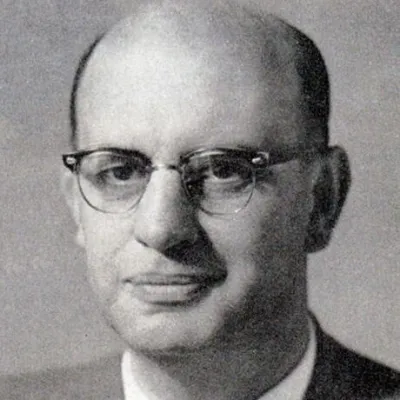
P. W. Botha
Human Design Chart
Biography
He entered politics in 1948 when he was elected to the Parliament. From 1966-1980 he served as minister of defense.In 1998, he was convicted of contempt of court when he refused to testify about apartheid-era crimes. His conviction was later overturned.
Botha died of a heart attack on 31 October 2006 at his home in South Africa at age 90.
Human Design Analysis: P. W. Botha as Generator 1/3
Generator 1/3 — Design at a Glance
P. W. Botha possessed enormous endurance and sacral power, making him an energy-charged figure. His design as a Generator suggested that this energy was most efficiently used not through self-initiated actions but rather in response to external impulses. He acted like a workhorse: strong and steady, provided he felt inner consent for the task.
The mechanics of his type warned against two specific dangers. On one hand, there was the risk of energy wastage and burnout if he threw himself into tasks that did not resonate internally. On the other hand, holding back on projects where his inner self said “yes” led to deep frustration. The key to his effectiveness lay in the principle "do not initiate but react." Instead of taking the first step himself, it was important to wait for signals from life and then act upon them with full force once the sacral center gave consent.
If P. W. Botha lived in harmony with this strategy, he intuitively reacted “from the gut” and found deep satisfaction as well as a sense of fulfillment. If he ignored this mechanism and instead tried to initiate through sheer willpower alone, he encountered persistent frustration and a lack of energy. His strength therefore lay in picking up impulses and responding to them with full force rather than fighting against the current of his own nature.
Emotional Authority
P. W. Botha exhibited decision-making that was strongly influenced by cyclical emotional waves. His design indicated that spontaneous impulses often proved deceptive and negative; true clarity emerged only after the initial intensity had dissipated over time. This resulted from his emotional authority: The defined Solar Plexus Center was subject to constant ups and downs of feelings. The world was always seen through the lens of current mood – one moment filled with enthusiasm, the next marked by negativity. However, this feeling was merely a snapshot, not necessarily his truth. Quick decisions based on emotion could therefore have very negative consequences.
The mechanics required patience and repeatedly "sleeping on" decisions to gain emotional distance. The more time P. W. Botha took, the deeper he could see. Over time, intense feelings subsided, clarity and calmness set in. This authority always took precedence over other defined centers, regardless of further configurations in his graph. He needed to be properly adorned to avoid confusing the momentary mood with truth. This process was particularly important for long-term decisions that could have a significant impact on his life course. By waiting, he gained emotional distance and thus reached true insight through the process.
The 1/3 Profile — Investigator / Martyr
P. W. Botha revealed himself as someone who oscillated between a deep retreat into isolated knowledge and the necessity of experimental action. His design established a fundamental tension: Line 1 of his Profile pushed for secrecy and theoretical perfection, while Line 3 demanded that these insights be practically tested through trial and error. This created an internal conflict; he often feared not knowing enough to move forward with implementation, leading to interruptions in the learning process. Line 1 brought occult, hidden knowledge that was under pressure and required isolation. At the same time, Line 3 highlighted a lack of continuity as well as indecision during times of change. This combination meant that P. W. Botha only considered his judgments absolutely trustworthy when they were both theoretically grounded and practically tested. His Profile defined itself through this dynamic: the retreat into secrecy had to be overcome so that innovative knowledge could become publicly effective. The strength lay in the fact that his conclusions did not remain mere speculations but were validated by personal experience. Nevertheless, the indecision of Line 3 could lead to valuable impulses from the past being lost or changes coming too late. P. W. Botha lived this balance between the researcher who wants to know everything and the experimenter who must act.
Split Definition — Defined & Open Centers
P. W. Botha was marked by a design that combined constant vital energy and emotional depth with a clear, stable identity. His defined Sacral Center provided an enormous source of energy, which did not serve for initiation but waited to be properly addressed in order to respond fully. This mechanism required patience: only through waiting and responding to life could he have the endurance needed for long-term engagement.
His defined G Center gave him a reliable sense of self-love and inner direction, while his defined Solar Plexus served as an emotional authority. Truth revealed itself to him not in the moment but after experiencing the emotional wave; hasty decisions were counterproductive here. His defined Root Center also provided a constant pressure for forward movement and stress management, stabilizing this energy.
In contrast to these firm pillars stood four open centers: Head, Ajna, Heart, and Spleen. This openness did not mean permanent mental clarity or willpower but situational receptivity. P. W. Botha was vulnerable to external conditioning in these areas. His open Head and Ajna Centers could lead him to identify with foreign questions or concepts rather than trusting his inner authority. His open Heart Center made him sensitive to the pressure of having to make promises and keep them to prove value – a trap, as he lacked the constant energy for this. Finally, his open Spleen Center led to the risk of spontaneous decisions out of uncertainty or clinging to unhealthy situations out of fear of losing well-being. His strength lay in not treating these open fields as personal deficits but navigating them through the reactions of his defined centers.
Channels for leadership, reflection, principles and growth.
P. W. Botha's Design points towards a tendency for logical, collective leadership based on pattern recognition and future security. This orientation was shown through the Alpha Animal Channel 7-31: Logical Collective Leadership. Here, Gate 7 (Role of Self) connects with Gate 31 (Leading), which required authority that arose not from coercion but from demonstrated competence and earning the trust of the majority. P. W. Botha had to be recognized as a leader to be effective; his voice held influence so long as it understood existing social patterns and trends.
Additionally, the Lost Son Channel 13-33: Reflection and Memory came into play. This channel connects Gate 13 (Listener) with Gate 33 (Withdrawal), which led P. W. Botha to gather information and withdraw to reflect on experiences before sharing them. It involved sorting life stories and secrets to create continuity, even if this made predicting the future more difficult.
The Channel of Synthesis 19-49: Tribal Bonding and Principles connects Gate 19 (Claims) with Gate 49 (Principles). This created an emotional frequency for belonging based on loyalty and resource protection. P. W. Botha sought balance between feasibility and fairness within his "tribe," where rejection or acceptance was determined by emotional waves.
The Channel of Maturation 42-53: Cyclical Experience connects Gate 42 (Growth) with Gate 53 (Beginnings). This propelled a process in which P. W. Botha went through experiences fully and reflected on them to gain wisdom. Each new experience built upon the previous one, fostering a deep connection to history and learning from empirical facts.
Individual Gates like Gate 61 (Inner Truth), Gate 62 (Logic/Details) and Gate 32 (Continuity) supported this structure by focusing on inner clarity, precise pattern recognition, and securing material success as well as stability.
Collective Circuitry — Circuit Signature
P. W. Botha's Design indicates a tendency towards structured logic and emotional reflection, flanked by pragmatic resource exchange. As a Split Definition, his chart consisted of two separate energetic groups: one connecting the Throat Center with the Identity Center, and another linking the Sacral, Root, and Solar Plexus Centers. This separation meant that cognitive processes were not directly fused with life force or emotions.
The Understanding Circuit connected his Throat Center to the Identity Center (Channel 31-7), promoting the sharing of strategic insights and future-oriented logic, free from emotional coloring. Parallel to this, the Meaning Circuit operated in two isolated segments: On one hand, it again linked the Throat with the Identity Center (Channel 33-13), enabling the processing of past experiences through language. On the other hand, it connected the Sacral and Root Centers (Channel 42-53), making cyclical energy available for maturation processes, yet without a direct connection to expressive ability.
The Ego Circuit bridged the gap between the two main groups by connecting the Solar Plexus Center with the Root Center (Channel 49-19). This supported cooperation and mutual aid in the tribe based on emotional exchange and stress management. Since this circuit did not have a direct link to the Sacral Center, it lacked constant life force; pauses were therefore necessary to regenerate resources for collective creation. The tension between the cool future logic of Understanding and the wave-like emotions of Meaning shaped his interactions, while the Ego Circuit ensured practical support in the community.
Right Angle Cross of Maya 4
P. W. Botha's Human Design profile featured the right cross of Maya 4, a configuration that established a specific life dynamics where inner clarity and outer alignment were intricately intertwined. This pattern pointed to a profound, often unconscious search for meaning and identity that had to be anchored through concrete actions in the world.
The right cross of Maya 4 described a process of becoming wherein experiences were not just passively received but actively integrated into a coherent whole. It was about creating personal order from the chaos of daily life, an order that was both stable and adaptable. This mechanism fostered a stance of persistence and endurance even when external circumstances seemed uncertain.
For P. W. Botha, this meant his actions were guided by an inner compass aligned with long-term vision and structure. He demonstrated someone who did not easily change their convictions but reinforced them through continuous practice. The energy of this cross supported clear alignment, enabling him to maintain a firm stance in complex situations. It was less about rapid transformation and more about deep rooting and gradual development. This fundamental approach shaped how he dealt with challenges by focusing on the essential and concentrated aspects rather than being swayed by superficial distractions.
Saturn Return · Uranus Opposition · Chiron Return · 2nd Saturn Return — Life Cycles
P. W. Botha's life unfolded through clear, structural phases marked by two Saturn return cycles. These cycles served as foundational structuring periods where inner maturity condensed into outer commitments.
The first Saturn return occurred in 1943 when Botha was 27 years old. During this period, he married Anna Elizabeth Rossouw. For his Human Design profile, this moment symbolized the anchoring of private bonds and the assumption of long-term responsibility in interpersonal relationships. The marriage stood for a transition into a more stable life order characterized by a need for stability and continuity.
Years later, in 1975 at age 59, the second Saturn return took place. Here, the mechanics were evident on another level: Botha signed the secret nuclear program between South Africa and Israel. This event illustrated the condensation of political power structures and strategic alliances. While the first cycle solidified the private sphere, the second cycle concerned institutional and geopolitical dimensions of his work. Both moments highlighted how Saturn cycles in Botha's design acted as catalysts for binding decisions—whether in partnership or state policy domains. They created new, enduring frameworks that shaped his further life path.
Generator · Emotional Authority — Synthesis
P. W. Botha lived a life marked by the tension between inner clarity and external expectations. The defined authority in the Solar Plexus Center required time for emotional maturation, while strong sacral energy signaled a natural readiness to react—a synergy amplified by the connection of G-Center and Throat Center. This constellation led to deep internal direction, yet it was always coupled with the necessity to act within a complex social environment and weigh decisions. Recurring cycles showed a tendency towards long-term commitments encompassing both personal relationships and strategic initiatives—supported by the link between Root and Solar Plexus Centers.
A central paradox in P. W. Botha's design lay in the conflict between the need for inner authenticity (Gate 61) and the ability to meet others' expectations (Channel 39). The open Heart Center indicated sensitivity to external influences, while the defined G-Center signaled a firm sense of identity and direction. This tension manifested as a tendency to both defend personal values and pragmatically compromise—a constant balancing act between principled integrity and adaptability.
4 Defined Channels
Incarnation Cross - Right Angle Cross of Maya 4
Solar Return
The Solar Return shows the moment when the sun returns to its exact birth position - your personal solar year.
Life Cycles
Discover the life cycles with a detailed triple view (birth chart, cycle chart, composite).
Human Design Profile
- Type
- Generator
- Strategy
- To respond - wait for something to respond to
- Authority
- Emotional Authority
- Profile
- 1/3 - Investigator / Martyr
- Definition
- Split Definition
- Incarnation Cross
- Right Angle Cross of Maya 4
- Date of Birth
- 12.01.1916 09:30
- Place of Birth
- Paul Roux, South Africa
Frequently Asked Questions
What is P. W. Botha's Human Design type?
What Profile did P. W. Botha have?
What Authority guided P. W. Botha?
What incarnation cross did P. W. Botha have?
When was P. W. Botha born?
Discover your own Human Design
Are you also a Generator? Find out in a personal reading how to use your sacral energy correctly and discover deep satisfaction.
More Personalities
Back to overviewAaliyah

Alexia

Angèle

Anne-Marie

Arcángel

Arno