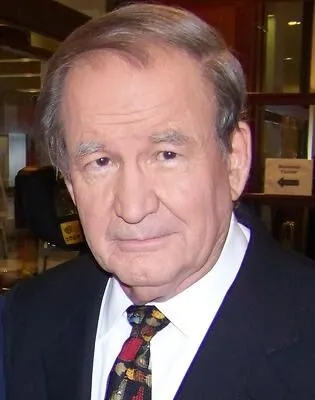
Pat Buchanan
Human Design Chart
Biography
Selecting specific enemies to match the state in which he's campaigning, he refers to a long list: Mexican immigrants, the U.N., the World Trade Organization, Supreme Court Justices Ruth Ginsburg and Stephen Breyer, Japanese Prime Minister Hashimoto, supply-side theorists, K Street lawyers and CEOs of Fortune 500 companies. In Arizona he denounced Mexican illegals and championed a law to make English the official language. In the Bible belt South, he stressed opposition to abortion, affirmative action and "corporate butchers" in the ranks of textile executives.
Buchanan apprenticed with Richard Nixon, traveling with him as an aide-de-camp and speechwriter during the '60s. He was at Spiro Agnew's side during the tumultuous midterm elections of 1970 and with Nixon again in 1972. He learned timing and tactics. The tag line in his ads summarizes his appeal: "He says what he means and he means what he says."
Raised in Washington, he has left the area only twice; first for a year at Columbia journalism school, then four years in the early '60s when he took nasty FBI leaks about the private life of Dr. Martin Luther King and turned them into incendiary editorials for the St. Louis Globe-Democrat paper.
What does Projector 2/4 mean for Pat Buchanan?
Projector 2/4 — Design at a Glance
Pat Buchanan appeared as someone with a dense, focused aura who quickly identified weaknesses in systems or other people. This design tends to recognize errors in the whole rapidly – comparable to a bright flashlight shining directly into darkness. Since he lacked a constant intrinsic energy source as a projector, his work was characterized by phases of high intensity followed by necessary rest periods for regeneration.
The challenge of this type lies in the fact that addressing these identified flaws directly is often perceived as unpleasant or aggressive, similar to a light beam directed straight at someone's face. The effective strategy did not consist of actively imposing solutions but rather attracting others through his own harmony and clarity. If Pat Buchanan waited for a respectful, honest invitation from his environment, he could convey his insights in such a way that they were accepted. Living by this strategy rewarded him with success; ignoring the necessity of invitations and pauses led to the typical non-self-experience of bitterness sooner or later. His influence thus relied less on constant action than on illuminating paths for others through his clear vision once invited.
Emotional Authority
Pat Buchanan exhibited a decision-making stance heavily influenced by his inner emotional wave: quick, spontaneous judgments from the moment often proved misleading or negative. His design featured emotional authority in the defined Solar Plexus Center. This mechanism means that his inner truth did not lie in the first reaction but became visible only after a phase of emotional rise and fall. The world appeared to him colored by his current mood – sometimes enthusiastic, sometimes negative – yet these feelings were mere snapshots, not final clarity.
For Buchanan, it was crucial to take time. Quick decisions based on highly active emotions often led to misjudgments since the first impression did not reflect deeper truth. His strategy involved letting decisions rest overnight and asking himself multiple times. Only when intense feelings subsided and emotional distance was gained did calmness set in. This process of 'ripening' was particularly important for long-term life decisions, as it allowed him to transcend the noise of immediate emotions to reach a clear, comprehensive understanding.
The 2/4 Profile — Hermit / Opportunist
Pat Buchanan displayed a fundamental stance that oscillated between a deep need for withdrawal and a desire for close connection. His design suggested he needed time alone to gain inner clarity before re-engaging with his closest circle. This dynamic of Profile 2/4 requires clear communication: when is social interaction called for, when is silence necessary? Only in this way could he reflect on the knowledge of his network in solitude and develop valuable insights.
This interplay is reinforced by specific energies. Gate 44 emphasized human orientation over pure goal pursuit. It was about integrating different forces to achieve quality rather than mere quantity. Success depended on whether he perceived deeper stakeholders and did not focus solely on superficial results. Simultaneously, Gate 33 called for transpersonal reflection. Here lay the potential for burnout if necessary withdrawal for regeneration was lacking. Silence was no luxury but a necessity for him to grasp meaning and recover. Without these phases of pausing, exhaustion loomed; with them, he could gain new perspectives and enrich his network.
Split Definition — Defined & Open Centers
Pat Buchanan's Human Design profile revealed a tendency towards consequent clarity of thought and concept, evident in his ability to transform ideas into clear communication. His defined Ajna Center ensured constant mental activity; he was always engaged in the process of thinking and processing data into specific theories. This mental energy flowed directly into his defined Throat Center, allowing him to articulate what he conceptualized reliably. Thus, his voice served as a dependable channel for his intellectual designs.
Simultaneously, his defined Solar Plexus contributed to emotional depth and authority. Pat Buchanan was someone who did not make decisions impulsively but took the time to navigate through emotional waves until clarity emerged. This process lent weight and longevity to his statements, which were grounded in emotional resonance that he himself had to explore first. The defined Root Center provided a steady, adrenalized drive to push these convictions forward – a constant impetus that needed to be channeled through his emotional authority to avoid slipping into obsessive stress.
In contrast, his design revealed vulnerable areas. His open Head Center made him susceptible to external inspiration or mental pressure he did not generate; he tended to perceive others' questions as urgent matters for himself. His open G Center meant that his identity and direction were strongly influenced by the environment – he could adopt various roles but lacked a firm internal compass for 'Who am I?'. The open Heart Center left him vulnerable to the need to prove his worth through promises or competitive behavior, despite lacking constant willpower for it. Finally, his open Sacral Center was sensitive to others' generative energy; he could easily overextend himself by taking on foreign work energy and forgetting when enough was enough.
Channels for mystical principles and insightful clarity.
Pat Buchanan exhibited a deep emotional bond with what he understood as his 'tribe' or community. For him, the question of belonging was existential: Who belongs here and who does not? This stance was shaped by Channel 19-49 (Synthesis), which connects the urgency of the Root Center with the emotional wave of the Solar Plexus. He sought principles that secure cohesion and rejected anything that threatened this loyalty. It wasn't about logical debates but an intuitive, almost mystical glue of love, honor, and obedience that protects resources and defines territories.
At the same time, he possessed a unique way of communicating that often appeared as an outsider before being understood. Channel 23-43 (Structuring) linked his spontaneous insight (Gate 43) with the ability to distill complex ideas into simple, efficient concepts (Gate 23). His mind worked mutatively: He often saw better ways faster than others. Yet this innovative knowledge needed time and the right timing to be accepted by his environment; without patience, he risked rejection; with it, he could change entire thought patterns.
Additionally, Gates like 44 (Awareness) and 55 (Emotional Awakening) shaped his interactions through a mix of strategic caution and intense mood swings. He reflected on experiences (Gate 33) to identify patterns and used vivid storytelling (Gate 56) to make his visions tangible. His design called for bringing order to the chaos of the past (Gate 47), always keeping biological limits and friction points in mind (Gate 6).
Individual Circuitry — Circuit Signature
Pat Buchanan's Human Design profile showed him carrying two distinct, not directly connected energetic focal points. As a Split Definition, he lacked an overarching connection between these areas; they existed side by side.
One area linked the Ajna and Throat Centers through the Knowledge Circuit. Here Channel 43-23 (Structuring) was active. This channel enabled clear organization of inner thoughts and concepts from the Ajna Center and their precise expression through the Throat Center. It involved the ability to distill complex ideas into understandable structures and verbalize them.
The second area linked the Solar Plexus and Root Centers through the Ego Circuit. Active here was Channel 49-19 (Synthesis). This channel connected emotional waves from the Solar Plexus with the urgency of the Root Center, creating a synchronous experience of feelings and action drive, often as sudden insights or intuitive reactions to external stimuli.
These two systems – structured communication in the Head-Throat area and emotional synthesis in the Solar Plexus-Root area – were energetically isolated from each other in Pat Buchanan. They did not work together but as separate forces: once clear articulation of thoughts, the other spontaneous emotional processing of situations.
Right Angle Cross of the Four Ways 3
Pat Buchanan was characterized by a configuration known as the 'Right Cross of Four Paths'. This design feature points to an internal tension: the drive to bring personal ideas and visions into the world, coupled with a deep need to first understand and adapt. It creates an inner conflict between the will to act and the necessity of waiting or observing.
This structure does not mean that Pat Buchanan was hesitant; rather, his greatest strength lay in integrating these seemingly contradictory energies. Instead of impulsively pushing forward or passively remaining still, he likely learned to wait for the right moment before acting with clear intention. The energy of this cross supports the ability to penetrate complex situations and find solutions that are both innovative and practically applicable.
This is not about a rigid personality but rather a dynamic process of learning and adapting. Pat Buchanan probably used this configuration to formulate his messages in such a way that they were accepted by various groups without compromising his own stance. The challenge was always to channel the inner unrest into constructive action, rather than getting lost in doubt or analysis.
Saturn Return · Uranus Opposition · Chiron Return · 2nd Saturn Return — Life Cycles
Pat Buchanan's life rhythm was marked by clear phases of consolidation and transformation. His design laid out a structure where internal maturity alternated with external upheavals. The first Saturn Return signified for him that years of groundwork had condensed into a solid result – a moment of serious self-commitment.
Following this, the Uranus opposition came, often experienced as a sudden jolt or liberation. Here, Pat Buchanan showed a tendency to question established structures and forge new paths, driven by a deep need for autonomy.
Around age 49 to 51, the Chiron Return occurred. This cycle is not about healing old wounds but rather a bloom phase: if Pat Buchanan had lived according to his strategy and authority before this point, his incarnation cross increasingly unfolded in everyday life. Meaning and purpose became tangible; it was the time of fulfillment.
Finally, the second Saturn Return brought another stage of wisdom and responsibility. This phase solidified achievements from earlier periods and provided a calmer, more mature perspective on his work. The sequence of these cycles painted a picture of someone who gradually fulfilled their life mission through discipline, transformation, and inner clarity.
Projector · Emotional Authority — Synthesis
A central red thread in this design is the dynamic interaction between the need for internal clarity and the ability to form connections with others. The defined Mental Center (Ajna) points to a consistent way of thinking, a deep understanding of concepts and principles – an inner world where ideas can mature. This process is reinforced by the emotional wave pattern, which requires time for decisions to ripen while simultaneously seeking both withdrawal and community through lines 2/4 of the profile. The Synthesis Channel (19/49) emphasizes this tendency to recognize needs and defend ideals, indicating a strong inner compass and a desire for authenticity.
The central paradox lies in the tension between the Projector type – designed to identify system errors and shed light on darkness – and emotional authority that requires time for decision-making. The ability to quickly grasp connections (Gate 19) collides with the necessity of allowing emotions to mature before they can be expressed. This creates a field of tension between the impulse to give immediate feedback and the need to withdraw and emotionally process the situation first.
2 Defined Channels
Incarnation Cross - Right Angle Cross of the Four Ways 3
Solar Return
The Solar Return shows the moment when the sun returns to its exact birth position - your personal solar year.
Life Cycles
Discover the life cycles with a detailed triple view (birth chart, cycle chart, composite).
Human Design Profile
- Type
- Projector
- Strategy
- Wait for the respectful invitation
- Authority
- Emotional Authority
- Profile
- 2/4 - Hermit / Opportunist
- Definition
- Split Definition
- Incarnation Cross
- Right Angle Cross of the Four Ways 3
- Date of Birth
- 02.11.1938 00:55
- Place of Birth
- Washington, DC, United States
Frequently Asked Questions
What is Pat Buchanan's Human Design type?
What Profile does Pat Buchanan have in Human Design?
Which authority governs Pat Buchanan's decisions?
What incarnation cross is assigned to Pat Buchanan?
When was Pat Buchanan born?
Discover your own Human Design
Are you also a Projector? Find out in a personal reading how to unfold your leadership qualities and recognize the right invitations.
More Personalities
Back to overviewSissy Spacek

Alain-Fournier

Anémone

Ann-Margret

Bourvil
Hergé