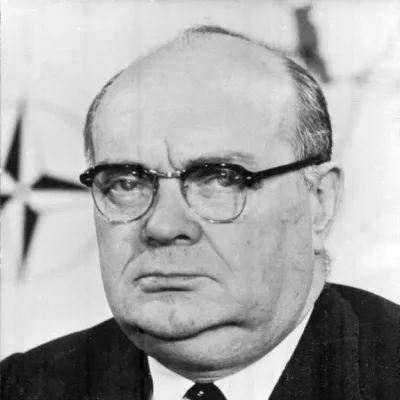
Paul-Henri Spaak
Human Design Chart
Biography
A member of an influential Belgian political family, Spaak, he served briefly in World War I and rose to prominence after the war as a tennis player and lawyer, becoming famous for his high-profile defence of an Italian student accused of attempting to assassinate Italy's Crown Prince in 1929. A convinced socialist, Spaak entered politics in 1932 for the Belgian Workers' Party (later the Belgian Socialist Party) and gained his first ministerial portfolio in the government of Paul Van Zeeland in 1935. He became Prime Minister of Belgium in 1938 and held the position until 1939. During World War II, he served as Foreign Minister in the Belgian government in exile under Hubert Pierlot, where he negotiated the foundation of the Benelux Customs Union with the governments of the Netherlands and Luxembourg. After the war, he twice regained the position of Prime Minister, first for under a month in March 1946 and again between 1947 and 1949. He held various further Belgian ministerial portfolios until 1966. He was Belgium's Foreign Minister for 18 years between 1939 and 1966.
He served as the first President of the Consultative Assembly of the Council of Europe between 1949 and 1950 and became the first President of the European Coal and Steel Community (ECSC) between 1952 and 1954. In 1955, he was appointed to the so-called Spaak Committee studying the possibility of a common market within Europe and played an influential role in preparing the 1957 Treaty of Rome which established the European Economic Community (EEC). He received the Charlemagne Prize the same year. Between 1957 and 1961, he served as the second Secretary-General of NATO.
He died 31 July 1972.
Human Design Analysis: Paul-Henri Spaak as Generator 4/6
Generator 4/6 — Design at a Glance
Paul-Henri Spaak revealed himself as someone whose decision-making process was based on direct physical resonance. As a Generator, he possessed sacral authority, an inner guidance unique to this type and identical to the strategy of inner authority. This simplified his process: He did not react through analytical planning but in response to external stimuli.
His reaction manifested as gut instinct or surge of energy – audible as grunting, humming, or a confirming "Mhm". When his sacral motor kicked in, he felt vital and energetic. He tackled tasks with great enthusiasm and immersed himself fully without seeking an external purpose. This energy was inexhaustible as long as it was triggered from within.
Additionally, his activated Spleen Center acted as supportive authority. Likely directly connected to the Sacral Center, this allowed for quick, spontaneous reactions. He had immediate access to his physical well-being and instinctive perception. These instincts were reliable; they guided him in moments when an instant decision was necessary. His strength lay in opening himself up to these inner signals rather than fighting against them or placing rational considerations above bodily truth.
Sacral Authority
Paul-Henri Spaak revealed himself as someone whose decision-making process was based on direct physical resonance. As a Generator, he possessed sacral authority, an inner guidance unique to this type and identical to the strategy of inner authority. This simplified his process: He did not react through analytical planning but in response to external stimuli.
His reaction manifested as gut instinct or surge of energy – audible as grunting, humming, or a confirming "Mhm". When his sacral motor kicked in, he felt vital and energetic. He tackled tasks with great enthusiasm and immersed himself fully without seeking an external purpose. This energy was inexhaustible as long as it was triggered from within.
Additionally, his activated Spleen Center acted as supportive authority. Likely directly connected to the Sacral Center, this allowed for quick, spontaneous reactions. He had immediate access to his physical well-being and instinctive perception. These instincts were reliable; they guided him in moments when an instant decision was necessary. His strength lay in opening himself up to these inner signals rather than fighting against them or placing rational considerations above bodily truth.
The 4/6 Profile — Opportunist / Role Model
Paul-Henri Spaak's design inclined towards social networking, which over time condensed into a role of soft leadership. In his first three decades, he acted with an experimental spirit and sought intense connections in friendships and relationships. This early phase was marked by a strong desire for exchange, as experiences only became truly valuable to him when shared and integrated into collective consciousness. His success depended largely on how well he could integrate himself into networks; yet, his Heart Center had to remain vigilant to avoid being hurt by false attentions.
Over time, an internal conflict emerged: The desire for belonging and cooperation stood in tension with the urge to withdraw and contemplate the deeper meaning of life. This contradiction between heart and head shaped his later development. He was prepared to take extreme risks to prove that life is worthwhile. It wasn't just about personal gain but also a kind of glory through sacrifice for the community. Paul-Henri Spaak lived this balancing act between the close circle of intimates and the broad perspective of role model, always striving to connect his fixation on social recognition with higher wisdom.
Single Definition — Defined & Open Centers
Paul-Henri Spaak showed himself to be someone who used his own willpower and resources self-determinedly. His defined Heart Center gave him a natural strength to keep promises and recognize his own worth. He enjoyed working but preferred to control his own pace, maintaining balance between effort and rest. This inner stability was supported by his defined Sacral Center, which provided him with a constant source of vital energy. As a Generator, his strategy was not to initiate himself but to react to questions or offers from the environment. Once he reacted, he could feel whether the necessary strength for a task was present; a clear 'yes' from the gut signaled availability, while a negative signal warned against overloading and set healthy boundaries.
Additionally, Spaak had a defined Spleen Center, which gave him sharp, spontaneous intuition. This instinct helped him judge in the moment what was correct for his well-being and health without lengthy rational deliberation. His defined Root Center provided the necessary physical pressure to move forward in the world and master challenges, allowing him to channel this stress in his own way.
At the same time, Spaak was marked by several open centers that made him vulnerable to external influences. His open Head Center meant he did not have a constant mental focus; he tended to engage with questions that were not of his own making and could become mentally confused when trying to find answers for others' problems. Similarly, his open Ajna Center led him to adopt concepts and opinions from the environment without identifying them as his own truth. His open Throat Center showed that he did not communicate consistently; he drew attention by waiting until an invitation to speak came rather than actively seeking it out. The open G Center made him appear without a fixed identity or direction; he adapted to people and places to feel where he truly belonged. Finally, his open Solar Plexus absorbed the emotions of his environment, leading him to handle emotional confrontations cautiously as he easily experienced foreign feelings as his own and amplified them.
Channels for devotion, focus and meaningful life struggle.
Paul-Henri Spaak's design tended towards precise logical analysis paired with the ability to intuitively sell complex structures. The Channel of Focus 52-9 connected the Root Center with the Sacral Center, generating a calm inner pressure to stay still and focus on details to challenge and perfect patterns. Spaak lived this energy by waiting for his Sacral Center to react before proceeding with clear logic.
Simultaneously, the Channel of Devotion 44-26 between Spleen and Heart Centers gave him an instinctive sense of what the tribe needed – often before people knew it themselves. This combination of vigilance (Gate 44) and ego strength (Gate 26) allowed him to convincingly convey ideas and mobilize resources as an entrepreneur or diplomat, using his willpower to offer improvements that kept the tribe viable.
The Channel of Life Struggle 38-28 connected Root and Spleen Centers through the Gate of the Fighter (38) and the Player (28). This gave him a stubborn determination to go his own way and find deeper meaning in struggles. He resisted external forces that diverted him from his integrity and actively sought values worth fighting for.
Additionally, Gates like 41 (evolutionary development through crises), 31 (leadership as energy transmission), and 27 (caring sustenance) contributed to the dynamics. Gate 58 in the Root Center promoted experiments towards perfection while Gate 53 initiated new cycles. Gates such as 39 (provocation for mutation), 5 (rhythm), 32 (continuity), and 34 (great power) rounded out the profile by placing pressure, stability, and individual strength at the service of collective development.
Tribal Circuitry — Circuit Signature
Paul-Henri Spaak's design combined strategic clarity with pragmatic endurance. As a simply defined type, his Sacral, Root, Spleen, and Heart Centers formed a single continuous energetic unit. This structure allowed for a direct flow of willpower through intuition to decision-making joy.
The Understanding Circuit worked here via the Channel of Focus (9-52), linking the Sacral with the Root Center. This gave him the ability to underpin rational strategies with constant action power – an 'emotionless ratio' aimed at logical improvement and future focus. Parallel to this, the Knowledge Circuit via the Channel of Life Struggle (28-38) connected Spleen and Root Centers. This translated intuitive perception ('Spleen') directly into survival energy and endurance, strengthening his individual identity through courage and adaptability.
In the Ego Circuit, the Channel of Devotion (26-44) linked Heart with Spleen Center, fostering a cooperative stance in the tribe: The ability to mediate and communicate served not only self-presentation but also communal resource building. Since this circuit does not include a Sacral Center, this social dynamic required necessary rest periods for regeneration. Overall, Paul-Henri Spaak was someone who united strategic vision (Sacral-Root) with intuitive pragmatism (Spleen-Root) and connecting communication (Heart-Spleen) in one coherent system.
Right Angle Cross of the Unexpected 4
Paul-Henri Spaak's design featured a specific structure: the right cross of Unexpectedness Four. This configuration described a life dynamics that was not characterized by linear planning or predictable patterns, but rather by spontaneous turns and unforeseen developments. For him, the element of surprise was not a disruptive factor, but an integral part of his path. The mechanics of this cross suggest that important insights or changes often occurred suddenly and without long prior announcements. It was an energy that required flexibility; rigid expectations would have contradicted the actual flow of life. Instead, Paul-Henri Spaak showed himself to be someone who could work with the unexpected, as his inner orientation was programmed for a life that did not follow a fixed script. This structure shaped his experiential world in such a way that openness towards sudden changes played a central role. Nothing was guaranteed, yet it was precisely this uncertainty that was the source of his dynamism. The design suggested that he could best unfold himself by learning to react to what presented itself unexpectedly rather than seeking predictable patterns.
Saturn Return · Uranus Opposition · Chiron Return · 2nd Saturn Return — Life Cycles
Paul-Henri Spaak's design featured a clear cyclical structure where career turning points were closely linked with planetary transits. His first Saturn return around the age of 30 marked his entry into the professional world; in 1929, he defended an Italian student and established himself professionally. This phase condensed years of groundwork into a solid foundation.
The Uranus opposition at the age of 39 brought about a sudden, unavoidable change. In 1938, Paul-Henri Spaak became Prime Minister of Belgium – a classic expression of this energy that breaks through established structures and imposes new responsibilities. It was not a gradual development but an abrupt shift in social role.
The Chiron return between the ages of 48 and 50 ushered in the phase of fulfillment. During this period, specifically from 1947 to 1949, he took up the office of Prime Minister again. Here his incarnation purpose unfolded increasingly; his life task became experiential and present itself as meaningful action in political reality.
The second Saturn return around age 58 crowned this development with lasting success. In 1957, he signed the Treaties of Rome for the establishment of the European Economic Community. This act represented maturity and stability that had resulted from consistent living according to his strategy – a lasting result built upon previous cycles.
Generator · Sacral Authority — Synthesis
Paul-Henri Spaak lived as a Generator whose life was deeply marked by his sacral energy. The ability to immerse oneself in work and create formats through focused attention (Channel 52-9) seemed to be a constant – especially when the inner reaction from the Sacral Center provided a powerful impulse. This showed repeatedly in career turns, from defending a student to signing significant treaties, indicating deep engagement with the here and now. The defined willpower supported the implementation of promises and intentions, helping him pursue goals and self-determinedly employ resources.
A central tension field arose from the interplay between the desire for community (Line 4 in Profile) and the inclination towards independent thinking (Line 6). This led to an inner conflict between heart and head, driving him both to seek connections as well as feel a need to withdraw and reflect on the meaning of life. This dynamic was evident during career phases where he took leadership roles but also went through periods of reflection and experimentation.
3 Defined Channels
Incarnation Cross - Right Angle Cross of the Unexpected 4
Solar Return
The Solar Return shows the moment when the sun returns to its exact birth position - your personal solar year.
Life Cycles
Discover the life cycles with a detailed triple view (birth chart, cycle chart, composite).
Human Design Profile
- Type
- Generator
- Strategy
- To respond - wait for something to respond to
- Authority
- Sacral Authority
- Profile
- 4/6 - Opportunist / Role Model
- Definition
- Single Definition
- Incarnation Cross
- Right Angle Cross of the Unexpected 4
- Date of Birth
- 25.01.1899 01:00
- Place of Birth
- Schaerbeek, BEL
Frequently Asked Questions
What is Paul-Henri Spaak's Human Design type?
What Profile did Paul-Henri Spaak have in Human Design?
What Authority guided Paul-Henri Spaak?
What incarnation cross did Paul-Henri Spaak have?
When was Paul-Henri Spaak born?
Discover your own Human Design
Are you also a Generator? Find out in a personal reading how to use your sacral energy correctly and discover deep satisfaction.
More Personalities
Back to overviewAaliyah

Alexia

Angèle

Anne-Marie

Arcángel

Arno