
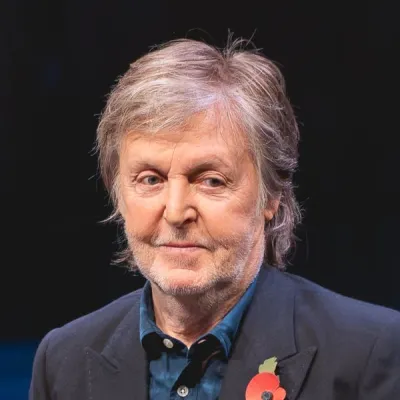
Paul McCartney
Human Design Chart
Biography
Human Design Analysis: Paul McCartney as Projector 5/1
Projector 5/1 — Design at a Glance
Paul McCartney's design featured a dense, focusing aura that immediately identified systematic errors in his environment. This setup had a tendency to highlight problems in other people's systems as if shining a bright flashlight on them. The challenge was that addressing these weak spots directly often met resistance, akin to shining a bright light straight into someone's face.
Instead, his optimal strategy involved passively glowing through a harmonious personal example. By radiating stability himself, he attracted others who would then seek out his insights. This underscores the necessity for Projectors to wait for a respectful and honest invitation rather than actively intervening to correct issues.
Furthermore, his undefined Sacral Center influenced his energy balance: there was no constant life force but rather a rhythm of intense activity followed by necessary rest periods. These pauses were essential to prevent burnout as societal structures often overlook this need. Living according to this design rewarded Paul McCartney with success; deviating from it led to the non-self theme of bitterness. His path involved sharing his leading perspective through invitation and respecting his natural energy flow.
Emotional Authority
Paul McCartney exhibited a decision-making stance characterized by cyclical emotional waves. His inner authority resided in the defined Solar Plexus Center, meaning he was subject to these emotional waves – an ongoing up-and-down cycle of feelings. The world appeared colored by his current mood: enthusiastic about something one moment and completely negative about it the next. This design suggested that his immediate feeling was just a snapshot, not necessarily the truth. Quick, spontaneous decisions based on such emotions were therefore risky and could have negative consequences.
The mechanics of his emotional authority required patience and temporal distance. The longer Paul McCartney let a decision mature, the deeper and more comprehensive he could see. This meant that he should hesitate to make hasty decisions, allowing intense feelings to subside over time. Only then did he gain emotional detachment; clarity and calmness set in. This process was essential for long-term decisions with significant influence on his life trajectory. Through this temporal delay, he could judge validly since his authority took precedence over other defined centers. The necessity of this distancing fundamentally shaped his inner navigation system.
The 5/1 Profile — Heretic / Investigator
Paul McCartney's fundamental disposition oscillated between the urge to help others with practical knowledge and the need to withdraw to deepen these resources. As a 5/1 profile – Hero and Explorer – he had almost magnetic appeal: people instinctively sought solutions from him for their problems. This social skill and the pragmatism of Line 5 enabled him to find quick, effective responses in crises through mutation. Yet this gift carried risks. Without clear boundaries, exhaustion loomed as others' expectations often projected onto him, emotionally taxing him.
Line 1 in the background called for selflessness and spontaneous action without hidden motives (Gate 25). This created an internal tension: while he appeared outwardly as a problem solver available to all, he needed the solitude of the Explorer to center himself and gain new insights. Experiencing human pain taught him caution and avoidance of certain interactions to protect his energy. Only by learning to say 'No' could he maintain balance – between doing good for others and necessary retreats for self-regeneration and knowledge deepening.
Split Definition — Defined & Open Centers
Paul McCartney revealed through his design as someone with a fixed, reliable self-identity and a clear inner compass. His defined G Center gave him a deep sense of direction and the ability to comfort others or show new paths without relying on them. This inner security was strengthened by his defined Heart Center, which granted access to constant willpower and ego strength. He could keep promises, recognize his own worth, and determine his resources.
This energy flowed into his defined Throat Center, which served as an expression organ. His voice did not speak from spontaneous intuition or generative response but rather from the combination of identity (G) and will (Heart). He communicated reliably what he wanted and had, with his statement power enriched by the emotional depth of his defined Solar Plexus Center. As an inner authority, however, this required patience: Paul McCartney had to learn to wait out the ups and downs of his emotional wave before acting or speaking. Emotional clarity only came after running through the wave cycle; impulsive action in the highs or lows of emotions would have created chaos.
In contrast, Head, Ajna, Sacral, Spleen, and Root were open. Without constant mental inspiration (open Head/Ajna), he tended to be influenced by others' doubts or seek answers that weren't his own. His open Sacral Center meant no steady energy flow; he was vulnerable to exhaustion from "borrowed" energy and had to learn to set boundaries and rest rather than insist on generative endurance. The open Spleen made him sensitive to external uncertainties and fears, while the open Root absorbed external stress. His strength did not lie in spontaneous intuition or restless activity but in rhythmic, will-driven action based on emotional clarity and firm identity.
Channels & Gates
Paul McCartney emerged as someone who exercises leadership not through authority but through trust and logical pattern recognition. This approach stems from the Alpha Animal Channel 7-31, which connects the G Center with the Throat Center. Here, Gate 7 acts as the "power behind the throne," occupying societal roles like manager or general, while Gate 31 functions as a collective leader who speaks to give others security. Crucial is the mechanism of invitation: this leadership must be recognized and elected by the majority to be effective. It represents the pattern, understands trends, and leads only so long as the community confirms its validity. Absolute rule does not fit here; instead, it's about showing the way from a powerful position without taking it away from others.
Parallel to this, Paul McCartney shaped the construction of harmonious group structures through the Community Channel 37-40. This connects the Solar Plexus Center with the Heart Center and secures tribal business through emotional clarity and willpower. Gate 37 seeks recognition and its place in the whole, while Gate 40 is ready to work but needs reward and breaks. A "good deal" cannot be made spontaneously here; it requires time for careful consideration so that the agreement benefits both sides. This channel builds bridges between individuals to ensure everyone has an honorable place in the group. The connection is guaranteed by the willpower behind the agreement, fostering cooperation without rigid hierarchy, where each person freely contributes.
Additionally, Gates like 12 (emotional mood, poetry), 11 (visual memory, collective ideas), and 46 (surrender in the present moment) were influential. Gate 15 supported collective behavior through adaptation to natural rhythms, while Gate 20 emphasized authentic self in the now. These configurations underscore the ability to navigate emotional waves and enable happiness and discovery through full participation in the process.
Circuit Signature
Paul McCartney exhibited a dual structured profile: on one hand, the clear sharing of rational insights for shaping the future, and on the other hand, the ability to cooperatively manage resources in social interactions. These two forces existed separately as his definition was split into two unconnected groups.
His Mental Circuit connected his Throat Center with the Identity Center through Channel "The Alpha Animal." This created a direct line for articulating logical, emotion-free strategies. It was about communicating structured visions clearly to contribute to societal improvement free from emotional conditioning.
Parallel to this, his Ego Circuit operated through Channel "Community," which linked the Heart Center with the Solar Plexus Center. This area regulated the dynamics of giving and taking within a group. Since this circuit did not connect to the Sacral Center, there was no constant life force for endless production. Instead, rhythmic rest was necessary to create resources sustainably and preserve traditional values of reciprocity.
The tension lay between the future-oriented, visual clarity of the Mental Circuit and the conservative, emotional wave movement in the Root context. Paul McCartney had to handle these two worlds—the rational transmission of structure and the intuitive care for social resources—as separate, parallel tasks without mixing their energies.
Left Angle Cross of Education 1
Paul McCartney revealed himself as someone whose inner foundation was strongly influenced by the patterns and values of his early environment. His design shows a tendency to unconsciously internalize childhood experiences and use them as central filters for later perceptions of the world. This corresponds to the mechanics of the left cross of Education 1, which describes the archetypal role of "The Imprint." It is not about conscious choice but rather a deep, often unconscious absorption of emotional reactions and behaviors from the family or culture of origin. This internalized past shaped his self-image as well as his reaction to authority and the need for security. Early influences acted like a filter through which he interpreted new situations; what was experienced in childhood as normal or necessary served later as a reference point for his own actions and relationships. Paul McCartney carried this imprint not as a burden but as a structural foundation of his personality. The dynamics of this cross show how the past continues to work: it offers orientation on one hand, but can also lead to unconscious repetition of old patterns until they are reflected upon and re-evaluated. His path was thus closely tied to recognizing these internalized guidelines and integrating them into his life context or distinguishing himself from them.
Saturn Return · Uranus Opposition · Chiron Return · 2nd Saturn Return — Life Cycles
Paul McCartney's Human Design shows a clear structure where recurring astrological cycles mark phases of identity discovery and transformation. This mechanism shapes his life as a series of pivotal moments, at which inner development becomes visible to the outside world.
In 1970, at age 28, he launched a successful solo career. This coincides with his first Saturn Return, a cycle often marking the crystallization of years of groundwork into a solid outcome and demanding new responsibility. Ten years later, in 1982 (age 40), he achieved global hit status with the duet "Ebony and Ivory" and reached number one in Germany, Britain, and the United States. This Uranus opposition signals a sudden change or breakthrough that breaks old structures and creates new freedoms.
The Chiron Return around age 49 is an achievement cycle where one's incarnation cross unfolds and purpose becomes experiential – not healing of past wounds but blossoming into one’s true purpose. In 1991 (age 49), Paul McCartney performed on the MTV Unplugged series and released the concert as his third live album. This moment reflects the deepening and authenticity that this cycle fosters.
Finally, the second Saturn Return in 1999 (age 57) marks another consolidation phase. In this year, he was inducted into the Rock and Roll Hall of Fame and released the album "Run Devil Run." This underscores how his design is continuously affirmed and reinforced through cyclic validation and recognition, solidifying his life's mission.
Projector · Emotional Authority — Synthesis
A central red thread runs through Paul McCartney's life: the ability to recognize patterns and make these logical solutions accessible to others (Understanding Circuit, Gate 7/31). He projects knowledge into his environment to shed light on darkness there – a natural tendency to identify errors in the system (Projector Type) and offer collective leadership through his voice (defined Throat Center). This gift is amplified by Line 5 of his Profile, making him magnetic for those seeking answers, while Line 1 underscores his deep thirst for knowledge and need for solid grounding.
A central paradox lies in the tension between the desire to lead (Alpha Animal Channel) and emotional authority. While he offers logical structures and future perspectives, it takes time to let decisions mature and distinguish one's inner truth from current moods. This can potentially lead to an internal conflict between the urge to quickly offer solutions and the necessity of emotional clarity – a back-and-forth that manifests in documented events (career, success) as cyclical phases.
2 Defined Channels
Incarnation Cross - Left Angle Cross of Education 1
Solar Return
The Solar Return shows the moment when the sun returns to its exact birth position - your personal solar year.
Life Cycles
Discover the life cycles with a detailed triple view (birth chart, cycle chart, composite).
Human Design Profile
- Type
- Projector
- Strategy
- Wait for the respectful invitation
- Authority
- Emotional Authority
- Profile
- 5/1 - Heretic / Investigator
- Definition
- Split Definition
- Incarnation Cross
- Left Angle Cross of Education 1
- Date of Birth
- 18.06.1942 14:00
- Place of Birth
- Liverpool, United Kingdom
Frequently Asked Questions
What is Paul McCartney's Human Design type?
What profile does Paul McCartney have in Human Design?
What authority determines Paul McCartney's decision-making?
Which incarnation cross is assigned to Paul McCartney?
When was Paul McCartney born?
Discover your own Human Design
Are you also a Projector? Find out in a personal reading how to unfold your leadership qualities and recognize the right invitations.
More Personalities
Back to overviewSissy Spacek

Aaliyah

Alain-Fournier

Alexia

Alizée

Anémone
