
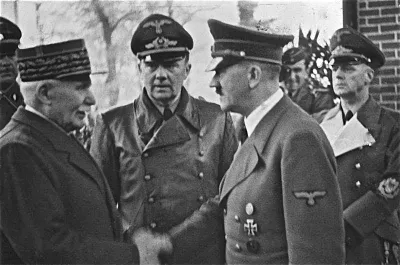
Paul-Otto Schmidt
Human Design Chart
Biography
In his memoirs, An Extra on the Diplomatic Stage, Schmidt never mentioned the genocidal plans discussed in the Hitler-Antonescu meetings, giving the misleading impression that German-Romanian talks during the war were entirely concerned with military and economic matters. After the 1942 Dieppe Raid resulted in thousands of Canadian soldiers captured, Schmidt was in charge of their interrogations. Schmidt joined the NSDAP (Nazi Party) in 1943.
Arrested in May 1945, Schmidt was freed by the Americans. In 1946 he testified at the Nuremberg Trials. In 1952 he founded the Sprachen & Dolmetscher Institut in Munich, a college where students could learn languages and become translators and interpreters. He retired in 1967, and died on 21 April 1970, aged 70, in Munich, West Germany.
Paul-Otto Schmidt — Generator with Profile 4/6
Generator 4/6 — Design at a Glance
Paul-Otto Schmidt revealed himself as someone with considerable inner endurance. His Human Design type was Generator, meaning he had an abundant supply of sacral energy. This power made him comparable to a workhorse: strong and dependable if used for appropriate tasks. His life force could not be forced by sheer will; it only unleashed itself in response to external impulses. Therefore, the motto of his design was clear: do not initiate but wait until life sends a signal, then respond from the gut.
This mechanism held two specific dangers for him. If he tried to act against his inner 'no' or did things that didn't resonate with his sacral center, he wasted his energy. This led to long-term exhaustion and burnout in the long run. Conversely, he suffered when prevented from doing his actual work even though his inner self was still full of drive. Such interruptions blocked the natural flow of his energy.
Living in harmony with this strategy – that is, responding to real incentives and then acting accordingly – rewarded him with a deep sense of fulfillment. Ignoring this internal guidance and instead trying to start things actively or work against his gut feeling led to persistent feelings of frustration and energy deficiency sooner or later. His path to contentment thus lay in patiently waiting for the right moment before taking powerful action.
Sacral Authority
Paul-Otto Schmidt lived as a Generator whose decision-making was shaped by sacral authority. This inner guidance did not represent an abstract reflection but rather a direct physical reaction to external stimuli. His design required an open emotional center, enabling him not to act impulsively but to listen to what his body signaled at the moment of encounter.
This 'gut feeling' manifested as immediate feedback: a surge of energy upon resonance or an internal hesitation in case of misalignment. Schmidt was born to perform tasks with enthusiasm and inexhaustible energy as long as they were supported by this sacral response. He found his contentment in the act itself, free from rigid purposefulness, fully immersing himself into the activity.
Additionally, his activated spleen center served as a supportive instance. It gave him quick, instinctive access to his physical well-being and enabled spontaneous reactions. This combination of sacral confirmation and spleen-based intuition allowed Schmidt to reliably orientate himself towards his inner signals. His strategy consisted in waiting for these responses before acting. Through this wait for bodily resonance, he could efficiently deploy his energy and go through life with joy without struggling against his own system. Sacral authority always took precedence over other defined centers, clearly determining his path.
The 4/6 Profile — Opportunist / Role Model
Paul-Otto Schmidt revealed himself as an adventurous youth actively exploring his environment. This behavior aligned with the influence of Profile Line 4, which often acts like a Line 3 in the first three decades before Saturn's return, fostering curiosity and a desire for connection. However, with increasing age, an internal conflict emerged: the wish to belong to a community (Line 4) clashed with the urge for spiritual distance and wise contemplation (Line 6). This tension between heart and head characterized his lifespan.
Moreover, Line 4 imparted him a certain humility as a protective mechanism against feelings of inadequacy. At the same time, he carried the potential of Line 6 marked by Uranus influences. This led to observing and judging others' actions often in contexts of ignorance or inappropriate behavior. The challenge was to accept these spiritual fractures without seeing them as failure. In his later years, it was expected that he would take on the role of a wise role model. His design called upon him to share his insights through cooperation with others while always keeping his heart cautious not to open up to the wrong people and expose himself to harm.
Split Definition — Defined & Open Centers
Paul-Otto Schmidt revealed himself as someone with a fixed, reliable self-identity and a clear sense of direction. His defined G Center gave him the ability to love others without becoming dependent on them, as well as an instinct to show others new paths. This inner security was in harmony with his available willpower: The defined Heart Center allowed him to keep promises and use resources autonomously, which strengthened his self-esteem. As a Generator, he also possessed a massive vital energy source in the defined Sacral Center; his satisfaction depended on responding to internal impulses rather than taking initiative.
At the same time, Paul-Otto Schmidt was marked by several open centers that made him vulnerable to conditioning. His open Head and Ajna Centers meant that he did not have consistent mental inspiration; he tended to identify with others' doubts or questions instead of remaining a detached observer of his thoughts. His open Throat Center led to an inability to communicate consistently; he was susceptible to the pressure to force attention through speaking, even though the right invitation only came after waiting. Especially his open Solar Plexus Center made him sensitive to other people's emotions: He absorbed and amplified the emotional climate of his surroundings, which could lead to feeling emotionally unstable or avoiding confrontation out of fear of rejection. This openness required him not to personalize emotions but to use them as information to maintain his own inner authority.
Channels for self-love, focus and instinctive devotion.
Paul-Otto Schmidts Design shows a tendency towards deepest, unwavering concentration. The Channel of Concentration 52-9 connects his Root Center with the Sacral Center and gives him the ability to filter out distractions by holding still. Gate 9 focuses on details and facts, while Gate 52 provides passive pressure to protect this focus. This format energy shaped his entire orientation: He sought logical patterns, checked them step-by-step and perfected them rather than engaging superficially.
Parallel to this, his design showed a strong individual note. The Channel of Exploration 34-10 connects the Sacral Center with the G Center. Here, Gate 10 drives behavior from the deepest inner self – self-acceptance and love – supported by the internal strength of Gate 34 to hold onto personal convictions. This configuration promoted an authentic way of life where he was not dependent on external validation but lived his own truth and thereby inspired others towards self-discovery.
In interpersonal relationships, the Channel of Devotion 44-26, which links Spleen Center with Heart Center, played a role. Gate 44 brought instinctive alertness and an intuition for what is needed, while Gate 26 provided the willpower to implement this. This combination allowed him to intuitively recognize what was useful to others and offer it with entrepreneurial zeal. He did not negotiate out of barter thoughts but sold solutions by anticipating his "tribe's" needs.
Additionally, prioritized Gates like Gate 15 (collective behavior) and Gate 25 (spiritual innocence) contributed to his orientation. Personality Gates such as Gate 39 (provocation/mutation) and Gate 50 (protective reflex/tradition) added analytical sharpness that questioned old structures while simultaneously protecting proven values. His energy was thus attuned to precise action, inner integrity, and instinctively grasping needs.
Individual Circuitry — Circuit Signature
Paul-Otto Schmidt revealed himself as a person with a clear, internally anchored identity. His design featured a split definition, meaning that two independent energy groups existed in parallel without directly flowing into each other. This created a tension between different life areas that did not automatically interconnect.
The first group connected the Sacral, Root, and G Centers. Here, the Understanding Circuit operated through the Channel Concentration (9-52). It linked the Sacral Center with the Root Center, giving him the ability to focus on strategic goals and develop logical structures for the future. At the same time, the Centering Circuit colored this group via the Channel Exploration (10-34). This connected the Sacral Center directly to the Identity Center, strengthening his self-worth and individual beliefs but often leaving him reticent in external communication of these firm stances due to a missing connection to the Throat Center.
The second, separate group included Heart and Spleen Centers. Here, the Ego Circuit was active, specifically through the Channel Devotion (26-44). This linked the Heart with the Spleen, fostering the ability for cooperation and resource exchange within a community. Since this group was not connected to the Sacral Center, there was a lack of constant life energy; Paul-Otto Schmidt therefore needed rest periods to build new strength in this area for mutual support. The separation of the groups meant that his strategic, individual identity and his cooperative social abilities worked as two parallel forces that did not automatically integrate.
Right Angle Cross of the Vessel of Love 2
Paul-Ottos Design carried the signature of the right cross of the Love Vessel. This configuration shaped a deeply rooted inclination to define himself through unconditional devotion and emotional openness. In Human-Design, this cross describes a specific energetic alignment where the center of emotions is connected with the Will Center, often experienced as a strong desire for intense, passionate connection. For Paul-Otto Schmidt, this meant that his life energy was largely determined by the quality of his interpersonal bonds and his ability to love.
The mechanics of this pattern show someone who not only receives love but actively serves as a vessel for it – a channel that connects emotional depth with the power of will. This created an inner dynamic in which Paul-Otto Schmidt tended to invest himself holistically and often very intensely into relationships or creative processes. The challenge of this configuration lay in maintaining his own emotional integrity while opening up to others. His design suggested that true fulfillment for him was not achieved through isolated achievements, but rather through experiencing and giving deep, authentic love. This energetic structure shaped his way of perceiving and acting in life sustainably.
Saturn Return · Uranus Opposition · Chiron Return · 2nd Saturn Return — Life Cycles
Paul-Otto Schmidt revealed himself as someone whose professional rise and later release were deeply connected to astrological cycles. His design indicated a tendency towards structural shifts triggered by planetary influences. In 1940, at the age of 41, he was promoted to Ministerial Director and received the rank of Ambassador I Class. This coincided with the phase of the Uranus Opposition, a time when sudden changes or promotions often occur as old structures need to be broken down. For Schmidt, this was no coincidence but a typical effect of this cycle, forcing new responsibilities and solidifying his position in the system.
Years later, in 1948 at age 49, he was released from prison. This marked the Chiron Return, a fulfillment cycle where one's incarnation cross unfolds. Instead of being understood as healing old wounds, this release was a moment of bloom and purpose finding. After years of restriction, Schmidt could now again fulfill his life mission. The Chiron Return not only confirmed his return to freedom but also the possibility to redefine his path. Both events – promotion and release – show how external circumstances were steered by inner mechanics. Schmidt's life was marked by these turning points that significantly influenced his career and personal development.
Generator · Sacral Authority — Synthesis
Paul-Otto Schmidt lived as a Generator, whose sacral energy and endurance defined him. He had a clear identity and direction (G Center), which gave him a strong internal compass – yet always connected with the necessity to trust his inner authority to avoid falling into the pitfalls of the Generator: aimless action or stagnation of heart projects. The Channel of Concentration (52/9) indicates that he possessed formative energy and could grasp details through focused attention, which helped him improve things and serve others. His profile as a Networker/Roles Model (4/6) showed in his search for belonging while simultaneously desiring reflection, a lifelong conflict between heart and head.
A central paradox in Paul-Otto Schmidt's design lay in the interplay of sacral energy and the Centering Circuit. While sacral authority propelled him to react with strength to external stimuli, the circuit amplified his individuality and strong convictions. This likely led to an internal tension between the desire for connection (Line 4) and the wish for independent thinking (Line 6), which manifested in documented career cycles – promotion as an expression of sacral reaction, release as a consequence of personal stance.
3 Defined Channels
Incarnation Cross - Right Angle Cross of the Vessel of Love 2
Solar Return
The Solar Return shows the moment when the sun returns to its exact birth position - your personal solar year.
Life Cycles
Discover the life cycles with a detailed triple view (birth chart, cycle chart, composite).
Human Design Profile
- Type
- Generator
- Strategy
- To respond - wait for something to respond to
- Authority
- Sacral Authority
- Profile
- 4/6 - Opportunist / Role Model
- Definition
- Split Definition
- Incarnation Cross
- Right Angle Cross of the Vessel of Love 2
- Date of Birth
- 23.06.1899 10:00
- Place of Birth
- Berlin, GER
Frequently Asked Questions
What was Paul-Otto Schmidt's Human Design type?
What profile did Paul-Otto Schmidt have in Human Design?
Which authority guided Paul-Otto Schmidt?
Which incarnation cross was decisive for Paul-Otto Schmidt?
When was Paul-Otto Schmidt born?
Discover your own Human Design
Are you also a Generator? Find out in a personal reading how to use your sacral energy correctly and discover deep satisfaction.
More Personalities
Back to overviewAaliyah

Alexia

Angèle

Anne-Marie

Arcángel

Arno
