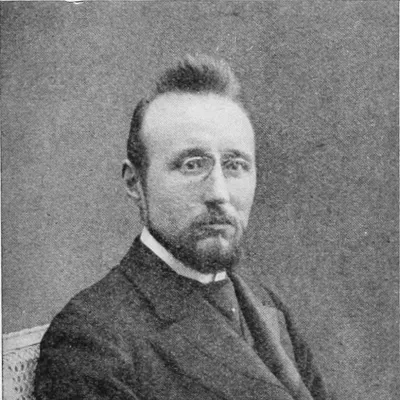
Paul Pelseneer
Human Design Chart
Biography
He died on 5 May 1945, aged 81, in Brussels.
What does Generator 1/3 mean for Paul Pelseneer?
Generator 1/3 — Design at a Glance
Paul Pelseneer's design indicated a tendency towards great endurance and inner strength. As a Generator, he had plenty of sacral energy, which made him seem like a strong workhorse – as long as his tasks aligned with his internal drive. However, his life force did not ignite through spontaneous initiation but solely by responding to signals from the environment. The strategy was to wait until life posed a question or invitation and then respond instinctively when his inner center gave a clear "yes".
Sacral Authority
Paul Pelseneer was a Generator whose decision-making was shaped by sacral authority. This internal guidance resided in his defined Sacral Center and served as his primary instance for life decisions. With the Emotional Center open, this body-based intuition could operate clearly without being hindered by delaying emotional waves. His strategy involved waiting for external stimuli and then following the immediate response of his body.
The 1/3 Profile — Investigator / Martyr
Paul Pelseneer's design was characterized by Profile 1/3: Explorer and Experimenter. His life task was to gather knowledge not just theoretically but through practical application and mistakes. This profile combined the curiosity of Line 1 with the learning-oriented action of Line 3.
The mechanics of his design emphasized the necessity of a pause before acting. Gate 52 in Line 1 demanded concentration and silence to focus energy and avoid hasty decisions. The pressure lay in committing oneself and foreseeing the consequences of one's steps. Without this thoroughness, time loss and energy waste were imminent.
At the same time, Gate 17 in Line 3 steered the principle of trial and error. Here it was about understanding through direct experience and detailed work. Shortcuts were seen as counterproductive since they neglected important details and diminished the value of judgment. Only by going all the way could true adaptability be developed.
For Paul Pelseneer, this resulted in a clear pattern: His authority rested on self-earned insights. When he gave an assessment, he had previously validated it both intellectually and practically. His judgment was trustworthy because it had passed through the filter of planning and real-world testing. This combination of thoughtful preparation and enthusiastic experimentation shaped his approach to complex issues.
Split Definition — Defined & Open Centers
Paul Pelseneer's design was characterized by a strong inner identity and a reliable energy base. His defined G Center gave him a clear sense of direction and the need to be loved without being dependent on others. This self-assurance allowed him to offer guidance to others as long as he trusted his inner authority and did not try to direct them against their own path.
This stability was fueled by his defined Sacral Center, which served as an engine providing a constant source of vital energy. For Paul Pelseneer, it was crucial to respond to questions or invitations from the environment rather than initiating things himself. Only through this reaction could he fully unleash his power and avoid frustration; mental decisions alone were not enough to ensure the necessary endurance. His defined Throat Center ensured that this expression remained consistent and clear, with communication flowing directly from his energy source or identity, rather than just reflecting superficial thoughts.
At the same time, Paul Pelseneer was open in certain areas to the influence of the environment. His open Head Center made him susceptible to mental confusion and the pressure to find answers to questions that were not his own. He tended to be influenced by others' doubts instead of remaining a neutral observer of his thoughts. Similarly, his open Ajna Center absorbed concepts and opinions from the surroundings, which could lead him to feign uncertainty or hold ideas as truths despite his flexible mind.
His open Heart Center lacked consistent willpower; he often found himself in the cycle of wanting to prove himself through promises, leading to disappointment because the energy for this was not sustainable. Finally, his open Solar Plexus absorbed the emotions of those around him. Paul Pelseneer had to learn to distinguish between his own feelings and those of others to avoid being pulled into emotional waves or avoiding conflicts out of fear of rejection. This openness required a conscious detachment from foreign emotional states to maintain his clarity.
Channels for leadership, focus and critical judgment.
Paul Pelseneer's design tended towards collective, logical leadership. The Alpha Animal Channel 7-31 connected the G Center with the Throat Center; this created the ability to lead through tested patterns and trends, provided he was invited by a majority. His voice acted as a valuable influence that guided societies into the future not through authority but through representative competence.
This leadership structure relied on deep concentration. The Concentration Channel 52-9 connected Root and Sacral Centers, creating a calm pressure to remain still and precisely assess details. This formative energy allowed him to keep distractions at bay and perfect patterns step-by-step before acting or speaking.
His judgment was crucial in this process. The Judgment Channel 58-18 linked the Root and Spleen Centers; Gate 58 drove a desire for vitality, while Gate 18 had a corrective effect. This gave him the art of mastery: he checked patterns for their health and correctness for the collective. He did not bring everything to light but waited to be asked before offering solutions to conserve energy and maintain peace.
Additional nuances shaped his profile. Gate 17 (Succession) promoted logical teaching for the future while preserving human rights. Gate 57 (Intuitive Clarity) offered awareness in the present moment, while Gate 15 (Collective Behavior) established natural rhythms in societies. Gate 3 (Mutation) helped create new orders from confusion, supported by Gate 25 (Innocence), which enabled mystical centering. Gate 16 (Experimentation) promoted mastery through experimentation, while Gate 32 (Continuity) sought stability and only made radical changes when necessary. Gate 45 (Tribe Level) gathered energy for material expression, and Gate 46 (Devotion) emphasized the care of the body as a temple through full participation in the process.
Collective Circuitry — Circuit Signature
Paul Pelseneer's design tended towards structured logical analysis, separate from emotional influence. His chart showed two parallel, non-interconnected blocks of energy due to Split Definition. The Understanding Circuit marked him by Channel 31/7 (Alpha Animal), which connected Throat and Identity Centers. This created a direct line between self-presentation and inner essence, often used for sharing rational insights to improve society. Parallel were Channels 9/52 (Concentration) and 18/58 (Judgment), connecting Sacral, Root, and Spleen Centers. These channels promoted focused energy, strategic planning, and instinctive judgment on the essentials. As these two groups of circuits existed energetically isolated from each other, Paul Pelseneer had two separate modes of operation: a communicative identity formation and an independent process of strategic resource management. Both strands worked alongside each other without direct exchange, resulting in a clear separation between sharing visions (future focus) and internal handling of challenges through logical structuring. The absence of Solar Plexus in this circuit underscored the sober, emotionless ratio as a key characteristic of his cognitive approach to complex interconnections.
Right Angle Cross of Service 2
Paul Pelseneers design pointed towards a specific kind of dedication that relied less on personal fame and more on the benefit for others. The configuration 'The Right Service Cross 2' described an active, structured readiness to take responsibility and perform tasks with reliability rather than passive submission. This mechanism acted as an inner compass aligning actions by the measure of usefulness to the community or environment.
In the context of Human Design, this cross marks an energy that finds its validation through service to others. It was not about a drive for self-fulfillment in isolation but about working towards providing structure and support. Paul Pelseneer emerged as someone who created stability through concrete assistance within this framework. The underlying dynamics fostered an attitude where the 'I' stepped back for the sake of the 'We', without dissolving his own identity. Instead, his identity was defined by the quality and continuity of giving.
This orientation shaped his actions with consistent reliability. It was about keeping promises and fulfilling duties not out of compulsion but because it aligned naturally with this design's energy. The strength lay in constancy; Paul Pelseneer acted as a stabilizing factor in his environment, doing what was necessary to ensure the cohesion or function of a system. This was no sacrifice but an expression of a deeply rooted life task: through service to others, he endowed his own existence with legitimacy and meaning.
Saturn Return · Uranus Opposition · Chiron Return · 2nd Saturn Return — Life Cycles
Paul Pelseneers design featured a structure that promoted long-term anchoring and structural authority. This configuration favored individuals who worked within established systems where influence grew over time rather than exploding in the short term. His chart's mechanics showed a tendency to gain recognition through institutional validation, with the second Saturn return (around 56-58 years) serving as a phase of consolidation where years of work often translated into formal positions.
In 1906 at age 43, Paul Pelseneer received an honorary doctorate in Leeds. This success fell during a Uranus opposition cycle, often bringing sudden recognition or unexpected turns when internal development meets external expectations. For his design, this was a moment where his professional expertise was publicly acknowledged before the full structural authority of later life took effect.
The pivotal point of his career unfolded in 1919 when he became Permanent Secretary of the Royal Belgian Academy of Sciences at age 56. This precisely coincided with the second Saturn return, a phase emphasizing integration of experience and responsibility in Human Design terms. Here, his internal structure met external power structures not through impulsive breakthrough but by accumulating trust and competence within an existing framework. His role as secretary underscored the function of connecting and maintaining knowledge in a formal context – exactly what this cyclical configuration enabled with proper alignment.
Generator · Sacral Authority — Synthesis
Paul Pelseneer lived as a Generator, driven by his sacral energy and endurance to delve deeply into subjects. His profile as a researcher and experimenter (Line 1/3) indicated a life path marked by an unceasing urge to gain knowledge through personal experience and then test it. The sacral authority challenged him to pay attention to the physical reaction – the inner 'yes' or 'no' impulse – before committing to tasks, optimizing energy use and avoiding burnout. The Alpha Animal Channel (Gate 7/31) indicated a natural ability to share logical insights and guide others from a deep internal conviction.
A central paradox in his design lay in the interplay between profound research interest and the need for practical application. Line 1 demanded thorough preparation and analysis, while Line 3 sought experimentation – creating tension between theoretical understanding and concrete experience. Simultaneously, the mind circuit with its focus on logic and future visions worked alongside physically oriented centers (Sacral, Root, Spleen), forming a dynamic between rational planning and instinctive reaction.
3 Defined Channels
Incarnation Cross - Right Angle Cross of Service 2
Solar Return
The Solar Return shows the moment when the sun returns to its exact birth position - your personal solar year.
Life Cycles
Discover the life cycles with a detailed triple view (birth chart, cycle chart, composite).
Human Design Profile
- Type
- Generator
- Strategy
- To respond - wait for something to respond to
- Authority
- Sacral Authority
- Profile
- 1/3 - Investigator / Martyr
- Definition
- Split Definition
- Incarnation Cross
- Right Angle Cross of Service 2
- Date of Birth
- 26.06.1863 01:00
- Place of Birth
- Brussels, BEL
Frequently Asked Questions
What was Paul Pelseneer's Human Design type?
What profile did Paul Pelseneer have?
Which authority guided Paul Pelseneer?
What incarnation cross did Paul Pelseneer have?
When was Paul Pelseneer born?
Discover your own Human Design
Are you also a Generator? Find out in a personal reading how to use your sacral energy correctly and discover deep satisfaction.
More Personalities
Back to overviewAaliyah

Alexia

Angèle

Anne-Marie

Arcángel

Arno