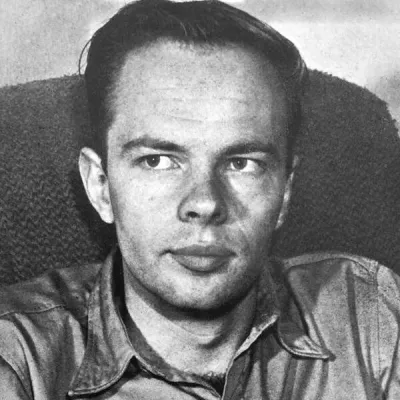
Philip K. Dick
Human Design Chart
Biography
Born in Chicago, Dick moved to the San Francisco Bay Area with his family at a young age. He began publishing science fiction stories in 1952, at age 23. He found little commercial success until his alternative history novel The Man in the High Castle (1962) earned him acclaim, including a Hugo Award for Best Novel, when he was 33. He followed with science fiction novels such as Do Androids Dream of Electric Sheep? (1968) and Ubik (1969). His 1974 novel Flow My Tears, the Policeman Said won the John W. Campbell Memorial Award for Best Science Fiction Novel.
Following years of drug use and a series of mystical experiences in 1974, Dick's work engaged more explicitly with issues of theology, metaphysics, and the nature of reality, as in the novels A Scanner Darkly (1977), VALIS (1981), and The Transmigration of Timothy Archer (1982).
What does Manifesting Generator 3/5 mean for Philip K. Dick?
Manifesting Generator 3/5 — Design at a Glance
Philip K. Dick's design showed a tendency for lightning-fast implementation, allowing him to skip steps and quickly draw things into his life. As an Manifesting Generator, he had constant sacral energy, which compelled him not to initiate himself but to react to external impulses. This hybrid nature combined the endurance of a generator with the direct impact of a manifestor.
The danger lay in his speed: Often, he skipped important intermediate steps, leading to having to backtrack and make up for them later. This quickly led to frustration, his specific non-self theme. Additionally, he tended to handle multiple projects simultaneously by reacting to various impulses at once. Without strict adherence to the strategy – waiting for an internal 'yes' from the sacral center – his creative drive rapidly turned into overexertion.
In fact, Philip K. Dick only drew deep satisfaction from his work when he remained in play mode and sought variety. The advice to finish one thing before starting another did not suit his nature; rather, he needed the parallel handling of different tasks for his energy to flow. His inner authority had to continually confirm that a started project still brought joy, otherwise it lost its power. Thus, his design showed him as someone who could unleash his unique creative force through reactive action and playful versatility, provided he took necessary pauses to check his internal resonance.
Emotional Authority
Philip K. Dick's design inclined towards emotional volatility paired with the need not to make decisions immediately. His inner authority was Emotional Authority carried by the defined Emotional Center. In Human Design mechanics: If the Emotional Center is activated, it always takes on the role of inner authority regardless of other definitions in the chart.
Philip K. Dick was subject to an emotional wave that manifested as a constant up and down of his feelings. He saw the world colored by his current mood; a moment of enthusiasm could quickly turn into negative evaluation. His immediate feeling, however, was just a snapshot, not a final truth value. Quick, spontaneous decisions from this emotional heat often had negative consequences.
The mechanics required patience: The longer Philip K. Dick waited, the deeper and more comprehensive he could see. It was necessary to let decisions ripen, think them over multiple times, and even 'sleep on it'. Through this delay, intense feelings subsided, emotional distance gained strength, and eventually clarity and calm set in. Only then was the decision-making process complete. This mechanism was particularly crucial for long-term life-defining steps as it ensured that actions were not based on fleeting moods but on a stable inner truth.
The 3/5 Profile — Martyr / Heretic
Philip K. Dick's design inclined towards a heroic adventurer: a humorous rebel who presented his rich practical life experiences to others. As Profile 3/5, he initially believed nothing due to Line 3 and had to test everything himself. He learned from experiments and failures before using this self-acquired knowledge to solve other people's problems (Line 5). This experiential wisdom was attractive to others; they wanted to learn from his insights. This heroic role flattered him but became painful when he failed in public view. Line 3 emphasized trial, error, and adaptation within the context of emotional connections. It required acknowledging that ideas are fleeting and must be tested to reach correct understanding. Simultaneously, the configuration showed a tendency towards self-deception through beautiful yet useless ideas. Line 5 represented practical solutions during crises as well as seduction. Timing was crucial for interventions in conflicts. Harmony was promoted by avoiding confrontations. Thus, Dick's design combined the necessity of personal testing with the later role of rescuer who acted at the right moment to restore order.
Single Definition — Defined & Open Centers
Philip K. Dick revealed himself as someone who possessed a deep, reliable inner identity and whose actions were marked by a strong, generative life force. His design featured defined G-, Sacral-, and Solar Plexus Centers. The defined G-Center gave him a clear sense of his own direction and the ability to comfort others or show new paths without being dependent on them. His energy source came from the defined Sacral Center, meaning he did not initiate but rather reacted; his vitality was sparked only through external inquiries that he answered with an internal "yes" or "no". This sacral power allowed him persistence in his projects as long as they aligned with his energy.
At the same time, his emotional process was determined by the defined Solar Plexus Center. It served as his inner authority: He had to wait out the emotional wave to reach clarity rather than reacting impulsively to feelings. His communication occurred through a defined Throat Center, which translated messages from these sources into the world—whether they originated from intuition (defined Spleen), emotion, or identity.
Simultaneously, Philip K. Dick was vulnerable to external influences due to his open centers. The open Head and Ajna Centers allowed him to absorb mental inspirations and concepts from his environment without identifying them as his own truth; he tended to get entangled in other people's questions or seek answers that were not his own theme. His open Heart Center lacked consistent willpower in the sense of ego competitions; he was conditioned to prove his worth through promises, which often led to frustration since this energy source was not consistently available. Additionally, his open Root Center absorbed stress and pressure from the environment, making him susceptible to external adrenaline rushes that he did not generate but reflected. This configuration created a tension between his inner strength in identity and energy on one hand and his sensitivity to mental and social pressures on the other.
Channels for rhythm, intimacy, charisma, intuition and power.
Philip K. Dick's Human Design profile indicates a tendency towards deep biological connection with the life flow, coupled with an intense desire for intimacy and individual survival intelligence. He was shown to be someone guided by inner rhythms, where Channel 5-15 connected him closely with natural patterns. This configuration made him magnetic through consistent habits (Gate 5) and love for human diversity (Gate 15), drawing others into his energy flow without being exposed to emotional waves or mental arrogance.
Parallel to this, Channel of Union 59-6 shaped his interpersonal dynamics. Through the connection of sexuality (Gate 59) with the emotional wave (Gate 6), he sought merging and fertility in relationships. This energy required patience as emotional clarity could only develop over time; spontaneous actions without sacral response would have led to confusion.
His ability for immediate, intuitive reaction was strengthened by Channel of Power 34-57. This archetype linked generative life force (Gate 34) with existential intuition of the Spleen (Gate 57), making him acoustically attentive and physically alert. He reacted spontaneously to dangers or vibrations in his environment to secure his individual survival, often independent of others' needs.
This intuitive insight found expression through Channel of Insight 57-20. Here, Spleen intuition (Gate 57) received a clear voice in the present moment (Gate 20), enabling him to articulate profound truths about his existence at that moment and encourage others to awaken their own inner survival intelligence.
Additionally, Channel of Charisma 34-20 as well as Gates 11 (visual memory), 36 (crisis as movement), and 12 (individual mutation) were active. These elements underscored his ability to act through sacral response in the present moment (Gate 34/20) while simultaneously analysing collective ideas (Gate 11) and understanding crises as cyclical development (Gate 36). His energy was geared towards reinforcing himself and inducing mutative changes in his environment through intuitive impulses.
Individual Circuitry — Circuit Signature
Philip K. Dick's Human Design profile revealed a tendency towards impulsive, creative ideas that directly manifested in expression. This configuration was evident through the Knowledge Circuit: Channel 20-57 (Flash of Brilliance) connected the Spleen Center with the Throat Center. The intuitive, selective energy of the Spleen met the expressive power of the Throat, enabling sudden, acoustically effective ideas.
Parallel to this, the Understanding Circuit operated through Channel 15-5 (Rhythm). This channel flowed logical structures and strategic thinking from the Identity Center into the Sacral Center. This patterned a methodical, emotionless ratio that oriented actions towards a better future.
Another element was the Archer Circuit with Channel 59-6 (Coupling). This connected the Sacral Center to the Solar Plexus Center. The life force of the Sacral was colored by instinctive, wave-like emotions, emphasizing themes such as protection, care, and the preservation of one's genetics.
Finally, the Integration Circuit linked several areas: Channel 20-34 (Charisma) channeled power from the reaction to life in the Sacral Center into the immediate expression through the Throat. Additionally, Channel 34-57 (Power) connected the Sacral Center with the intuitive Spleen energy, allowing for proper behavior and inner knowledge used for self-reinforcement.
All these centers – Sacral, Identity, Solar Plexus, Throat, and Spleen – belonged to a single continuous group in Philip K. Dick's design. There were no separate energetic islands; instead, the energy flowed as a connected system from instinct through logic to an emotionally colored expression and creative impulse.
Right Angle Cross of Eden 4
The raw content does not contain specific Human-Design mechanics, centers, channels or gates for Philip K. Dick but only the title “Eden 4 Right Cross”. Given that strict rules dictate using solely provided facts and excluding any external knowledge about Philip K. Dick (such as biography, works, or actual Human Design), a characterization based on Human-Design is not possible. There are no data available to derive a person-specific description. Therefore, a chapter text cannot be created that fulfills the requirements.
Saturn Return · Uranus Opposition · Chiron Return — Life Cycles
Philip K. Dick’s design indicated a tendency towards profound life turning points often crystallizing through relationship dynamics and external recognition. This structure did not manifest as a static state but rather as phases where inner developments became outwardly apparent.
In 1959, at the age of 31, his first Saturn Return occurred. During this period, his daughter Laura was born from his marriage with Anne Williams Rubinstein. For the design, this cycle marked the point where years of groundwork and personal maturation condensed into a viable result; the establishment of a new family unit here was the visible expression of this inner consolidation.
Later in 1966 at age 38, the Uranus Opposition came into effect. This event led to his marriage with Nancy Hackett and the birth of their daughter Isolde (Isa) one year later. Such a configuration often describes a moment of sudden change or liberation from old patterns, which was evident here in a new partnership and family foundation.
His Chiron Return happened in 1974 when he was 46 years old. During this fulfillment cycle, Philip K. Dick received the John W. Campbell Award for “Flow My Tears, The Policeman Said”. This period is in Human Design the moment of bloom where one's incarnation cross unfolds and meaning becomes tangible. Public recognition here did not signify healing a wound but marked the peak when his specific life purpose and work found full efficacy and acknowledgment.
Manifesting Generator · Emotional Authority — Synthesis
Philip K. Dick lived an inner drive towards exploration and experimentation that permeated his entire being. As a Manifestor Generator (with defined Sacral Center), he possessed a constant energy source and the ability to quickly initiate things – yet this speed often required returning to fundamental steps when crucial aspects were overlooked (Design). This pattern manifested in his life through recurring turns and continuous testing of new paths to gather experiences and deepen knowledge (Profile 3/5), always driven by an inner rhythm (Channel of Rhythm). Emotional authority, however, challenged him to not rush decisions but let them mature within the depth of his feelings.
A central paradox lay in the tension between his manifesting impulse and the necessity for emotional clarity. He was a Generator who could quickly set things in motion, yet the emotional wave (emotional authority) required time for orientation and differentiation. This inner dynamic led to an interplay of swift action followed by reflection, adventure-seeking coupled with a need for deep emotional validation – a life marked by constant navigation between initiation and reaction, between the speed of mind and the flow of feelings.
5 Defined Channels
Incarnation Cross - Right Angle Cross of Eden 4
Solar Return
The Solar Return shows the moment when the sun returns to its exact birth position - your personal solar year.
Life Cycles
Discover the life cycles with a detailed triple view (birth chart, cycle chart, composite).
Human Design Profile
- Strategy
- To respond - wait for something to respond to
- Authority
- Emotional Authority
- Profile
- 3/5 - Martyr / Heretic
- Definition
- Single Definition
- Incarnation Cross
- Right Angle Cross of Eden 4
- Date of Birth
- 16.12.1928 12:15
- Place of Birth
- Chicago, Illinois, United States
Frequently Asked Questions
What was Philip K. Dick's Human Design type?
What Profile did Philip K. Dick have in Human Design?
What Authority did Philip K. Dick possess?
What incarnation cross did Philip K. Dick have?
When was Philip K. Dick born?
Discover your own Human Design
Are you also a Manifesting Generator? Find out in a personal reading how to unfold your multi-talents and direct your energy wisely.
More Personalities
Back to overviewAldair

Alizée

Angeli

Arletty

Artus

Balthus