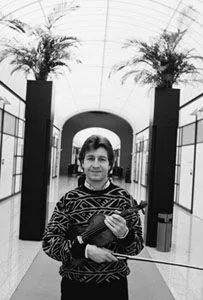
Photo: Wikimedia Commons
Pierre Amoyal
Human Design Chart
Biography
He owns the "Kochanski" Stradivarius of 1717. It was stolen from him in 1987 and recovered in 1991.
Human Design Analysis: Pierre Amoyal as Generator 3/5
Generator 3/5 — Design at a Glance
Pierre Amoyal's design shows a tendency towards great endurance and work capacity, comparable to a strong 'workhorse'. However, this energy was not available through his own initiative but became effective when he responded to external impulses. The mechanics of his Generator type show: initiation often leads to frustration or lack of energy in this configuration because the sacral power is only released through reaction.
Two specific risks characterized this profile. First, the danger of wasting energy on tasks without inner resonance, which could lead to long-term exhaustion. Second, the risk of being distracted from his heart project despite an internal readiness for continuation.
The functional strategy was to wait for signals from the environment and only act when a clear confirmation came from the gut – an inner 'Yes!'. If Pierre Amoyal followed this reaction instead of acting independently, it resulted in deep satisfaction. Living against this nature and trying to force or initiate things led to persistent frustration. His design therefore demanded patience in waiting for the right moment and courage to react consistently.
Sacral Authority
Pierre Amoyal's decision-making was based on inner, bodily resonance. His inner authority was sacral authority carried by his defined Sacral Center. This is the only type where strategy and authority are identical: he waited for external stimuli to respond. He did not sense the truth of a moment in his head but as somatic signals – a grunt, a hum or a clear 'Mhm' versus 'Hmm'. This gut feeling was his direct access to the right answer.
When this sacral motor responded to a stimulus, vitality entered. Pierre Amoyal had seemingly inexhaustible energy and tackled tasks with great enthusiasm. His design promoted a life full of joy and satisfaction, fully immersed in activities without rigid purposefulness. The distinction between genuine activation and mere reaction was crucial; only true resonance provided the necessary power. Through this mechanism, he could reliably guide himself from his physical well-being, giving him spontaneous and instinctive access to his action possibilities.
The 3/5 Profile — Martyr / Heretic
Pierre Amoyal's design was characterized by a fundamental skepticism towards pre-fabricated truths. He did not learn through theory but exclusively through personal experimentation and the resulting errors. This process of 'trial and error' was indispensable for generating practical knowledge. Only after this personal experience collection did he step into the role of solving others' problems with his acquired know-how.
This dynamics stemmed from Profile 3/5, the experimenter and hero. Line 3 (Gate 15) dictated a stance of self-inflation and active testing of extreme strategies to find out what works. Humility played no role here; recognition was often the fuel or result of this learning process. Simultaneously, line 5 (Gate 25) acted as a projection field: others saw potential healers or saviors in him. This projected expectation created strong attraction because his knowledge was based on authentic, experienced reality.
The central tension lay however in the contrast between this heroic perception and the reality of failure. While the environment expected solutions, Pierre Amoyal had to publicly test things that could fail. These painful moments were not a sign of incompetence but an integral part of his development line. Through withdrawal after such experiences and processing the suffering, he could heal himself and strengthen his authority independent of external conditioning. His essence thus showed someone who went through their own storms to guide others later.
Split Definition — Defined & Open Centers
Pierre Amoyal's design points towards a tendency for reliable expression and intuitive presence. His defined Throat, Sacral, and Spleen centers form the mechanical basis: The throat acts as a pivot point for manifestation, transforming inner information into clear communication and action. The Sacral center generates vital energy through reaction rather than initiation; it has a constant power source that unfolds in response to affirming queries. The Spleen provides spontaneous survival intelligence in the present moment, an irrational recognition of what is healthy and correct. Additionally, the defined Root Center ensures consistent internal pressure, promoting material prosperity and existential well-being.
In contrast, Head, Ajna, G-, Heart, and Solar Plexus centers are open. These centers function as sensitive antennas for external influences. The open Head Center is susceptible to mental stress and confusion when it internalizes foreign questions. The open Ajna Center absorbs mental concepts from the environment without continuously possessing them. Particularly distinctive is the open G Center: It has no fixed identity or direction, but mirrors the energy of its surroundings and people. Pierre Amoyal tends to feel lost in uncertain environments as he derives his identity from context. The open Heart Center lacks consistent willpower; making promises often leads to frustration due to an inconsistent energy supply. Finally, the open Solar Plexus Center absorbs emotional currents from the environment, leading to identification with foreign moods rather than having one's own feelings.
The challenge lies in distinguishing between stable internal mechanics – responding to the Sacral, Spleen intuition, and manifesting through the Throat – and situational influences from open centers. By waiting for his sacral response and trusting his spleen-intuitive security, Pierre Amoyal could bridge the gap between 'I can' (defined motors) and the question of identity (open G). He learned that he automatically finds the right direction at the right place without having to seek it.
Channels for intuitive search, mastery and cyclical maturation.
Pierre Amoyals design points towards a tendency for perfecting specific skills driven by cyclical experience absorption. This configuration shows someone who transforms intuitive depth into technical talent through repeated and refined patterns.
The mechanics behind this are the Channel of Wavelength 48-16, connecting inner intelligence at Gate 48 (Depth) with Gate 16 (Skill). While one gate seeks life-critical information, experiments, and perfects it. Through constant experimentation precision emerges; repeated practice turns into a talent accessible to others. However, this process requires recognition and resources to continue as the energy for mastery often comes from outside.
Simultaneously, the Channel of Maturation 53-42 operates. It links Gate 53 (Beginnings) with Gate 42 (Growth). This mechanism forces a complete experience before reflection can occur. Only then does wisdom emerge from the cycle; an early termination leads to repetition while a full run allows learned information to be passed on.
Together, these channels create a life dedicated to refinement: Deep intuition is transformed into communicable excellence through hard work and cyclical learning. Individual gates 15, 10, 25, 46, 12, 32, 60, and 59 reinforce this by themes like collective behavior, genetic strategies, and the necessity to accept limitations for transformation. Pierre Amoyal thus showed himself as someone who could only unfold his talent through consistent cycle completion and continuous refinement.
Collective Circuitry — Circuit Signature
Pierre Amoyals design sets a clear dichotomy in perception: on one side cool, future-oriented logic; on the other wave-like processing of past emotions. These separate poles arise from his Split Definition, forming two independent energetic strands that do not directly interweave.
The Understand Circuit connects his Throat with Spleen Center through the Channel 'Wavelength'. Here a rational energy aims to improve things and steer society towards a better future. This strand focuses on structure and strategy – an almost emotionless ratio as Solar Plexus is not involved. The task here was to communicate logical insights free from conditioning.
Parallel, the Find Meaning Circuit connects his Sacral with Root Center through the Channel 'Maturation'. Here a cyclical processing of past experiences occurs. Unlike the clear logic of the other pole, this energy flows in waves: Emotions and feelings go through a natural rhythm with beginning, middle, and end. The task of this strand was to reflect on old events to find their meaning and learn collectively.
The challenge in Pierre Amoyals design lies in integrating these two different formats of gaining insight. While one pole develops clear strategies for the future, the other must first go through emotional maturation from the past. Both strands exist side by side as independent forces each with its own language and timeframe – one rational and direct, the other intuitive and rhythmic.
Right Angle Cross of the Vessel of Love 2
Pierre Amoyals design established a foundational disposition rooted in deep emotional resonance and empathy. He demonstrated the ability to exert a healing influence on himself and others through this connection. This stemmed from his Love Sacral 2 Incarnation Cross, which symbolizes the capacity not only to feel unconditional love but also to use it as transformative power.
The core of this mechanism lies in trusting the divine plan as a source of healing and change. It is less about actively guiding or controlling life events, and more about surrendering to the natural flow. Pierre Amoyal was inclined by his design to let go of control and instead trust the spiritual dimension of love. This commitment allowed him to undergo inner transformations and radiate this energy into his environment. The structure of his design emphasized the importance of empathy as a tool for personal well-being and that of others, without going against the current of life. Instead, he worked through presence and emotional depth, which is typical of this specific cross configuration.
Saturn Return · Uranus Opposition · Chiron Return · 2nd Saturn Return — Life Cycles
In 1987, at age 38, Pierre Amoyal experienced the theft of his Stradivari violin. For his design, this event marked a typical Uranus Opposition cycle: a phase of sudden external breaks that destroy established security structures.
The Uranus Opposition acts in Human Design as a mechanism for unexpected upheaval. It brings about external events not initiated by the person and often experienced as shock or loss. This process breaks down old certainties to make way for new realities. This cycle forces confrontation with the impermanence of material or structural anchors.
In Pierre Amoyals case, this effect was manifested through the concrete loss of his instrument. The Stradivari was not just a tool but part of his identity and security. Its sudden disappearance perfectly matched the Uranus dynamics: an external factor intervened to disrupt the existing order. Such events serve in the design to break dependencies on external structures and enforce deeper inner alignment. The pain of loss is integral to this process, dissolving old securities so new paths can open.
Generator · Sacral Authority — Synthesis
Pierre Amoyals design reveals a central thread of deep, cyclical engagement with experience and refinement. The combination of defined Sacral, Spleen, and Root Centers, coupled with the Channels of Wavelength (Gate 16/48) and Maturation (Gate 42/53), points to someone whose energy source lies in reacting to the world – continuously absorbing impulses, processing through intuition and bodily knowledge, then refining and mastering skills. This process is not linear but cyclical; it requires time, engagement, and completing full cycles to generate wisdom. The open definition of Heart, Ajna, and Solar Plexus enhances this ability to absorb and reflect on experiences without becoming fixed or conditioned.
A central paradox lies in the tension between the need for refinement (Gate 16/48) and inherent openness to emotional influences (open Solar Plexus). While energy exists through reaction to develop profound skills, there is simultaneously the challenge of not getting lost in others' emotions or driven by expectations. This requires constant self-regulation and trust in the inner authority of the Sacral Center to remain authentic and maintain one's direction – a dance between engagement and letting go, depth and flexibility.
2 Defined Channels
Incarnation Cross - Right Angle Cross of the Vessel of Love 2
Solar Return
The Solar Return shows the moment when the sun returns to its exact birth position - your personal solar year.
Life Cycles
Discover the life cycles with a detailed triple view (birth chart, cycle chart, composite).
Human Design Profile
- Type
- Generator
- Strategy
- To respond - wait for something to respond to
- Authority
- Sacral Authority
- Profile
- 3/5 - Martyr / Heretic
- Definition
- Split Definition
- Incarnation Cross
- Right Angle Cross of the Vessel of Love 2
- Date of Birth
- 22.06.1949 14:30
- Place of Birth
- Paris, France
Frequently Asked Questions
What is Pierre Amoyal's Human Design type?
What Profile does Pierre Amoyal have?
What authority does Pierre Amoyal possess?
What incarnation cross does Pierre Amoyal have?
When was Pierre Amoyal born?
Discover your own Human Design
Are you also a Generator? Find out in a personal reading how to use your sacral energy correctly and discover deep satisfaction.
More Personalities
Back to overviewAaliyah

Alexia

Alizée

Angèle

Anne-Marie

Arcángel