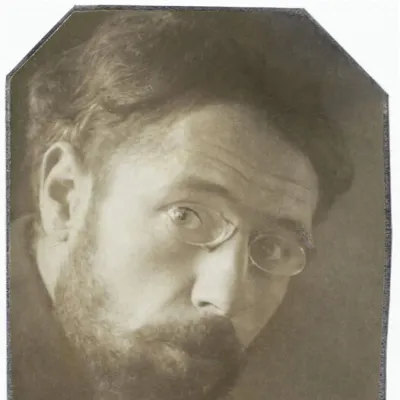
Pierre Bonnard
Human Design Chart
Biography
Pierre Bonnard — Manifestor with Profile 1/3
Manifestor 1/3 — Design at a Glance
Pierre Bonnard revealed himself as a pioneer with clear visions, whose nature it was to lead the world into a new future. His design matched the metaphor of an emperor in ancient Rome: He possessed the big picture but did not wage the necessary wars himself; instead, he delegated this task to others, much like a ruler sending soldiers to conquer lands for him. This role brought with it a specific conflict. As he often thought further ahead than his surroundings, Pierre Bonnard was frequently misunderstood and polarized by his great dreams. While some people loved his visions and followed him, others rejected or even hated him precisely because of this forward-thinking perspective. To find the right followers and minimize misunderstandings, it was crucial for him to inform others about his intentions in a timely and precise manner. This strategy of informing served to create resonance before he acted. If Pierre Bonnard followed this path and oriented himself according to his inner authority, he rewarded himself with a sense of inner peace. Conversely, if he lived against his design without sharing the necessary information or acknowledging his nature, it resulted in deep, lasting anger. His life was thus marked by the tension between the power of his visions and the necessity to communicate them clearly to interact harmoniously with his environment.
Emotional Authority
Pierre Bonnard showed an internal decision-making structure that required time and distance from the current mood wave. Immediate reactions were often misleading in his design; true clarity only set in after the emotional intensity had subsided. This resulted from his defined Emotional Authority: The Solar Plexus Center was filled, making it the leading instance, independent of other defined centers in the chart.
This mechanism subjected him to a constant wave of ups and downs in feelings. The world appeared to him always colored through the lens of his current mood – enthusiastic about something one moment, deeply skeptical the next. His immediate feeling was merely a snapshot, an initial impression that did not yet represent his deeper truth. Quick, spontaneous decisions from this emotional heat carried the risk of negative consequences.
Instead, his design required patience and the conscious process of 'sleeping on it.' The more time Pierre Bonnard took, the deeper he could see into the situation. Intense feelings faded with distance, emotional detachment gained weight, and calmness set in. This maturation process was particularly crucial for long-term life decisions, as only then did the emotional coloring fade away to allow a clear, sustainable orientation.
The 1/3 Profile — Investigator / Martyr
Pierre Bonnard's design laid out a specific tension: between the deep need for theoretical foundation and the insatiable drive to learn through practical action. As a 1/3 Profile, the Researcher and Experimenter, he was someone who did not just accumulate knowledge but rigorously tested it on his heart and gut. Line 1 demanded depth and meaning; it often created hesitation as the feeling prevailed that there was still too much to learn before acting with certainty. Yet, Line 3 pushed him to resolve this uncertainty through trial and error. Herein lay his true strength: His judgment was of extraordinary authenticity. When Pierre Bonnard deemed something good, he had understood it intellectually and experienced it practically. He transformed truisms into deep insight by questioning clichés and validating them through personal experience. This process was not passive learning but an active self-sacrifice for the mutation process. He sacrificed himself to the experiment to take responsibility and gain insights that went beyond mere theory. His design described a cyclical path: first seeking the foundation, then boldly leaping into implementation, making mistakes, and distilling a trustworthy truth from them. This synthesis of scientist thoroughness and adventurer courage shaped his way of appropriating the world – always searching, always testing, never satisfied with superficial answers.
Split Definition — Defined & Open Centers
Pierre Bonnard's design established a tendency towards constant expression strength and willful presence, paired with deep emotional intelligence. His defined Throat Center guaranteed a reliable voice; he not only expressed thoughts but transmuted information into clear communication. This aligned with his defined Heart Center, which gave him permanent access to willpower and ego. He tended to determine his own life, keep promises, and actively assert his worth, while being mindful of recognition for his contribution.
This consistent inner structure starkly contrasted with his open mental and identity-forming nature. His open Head Center meant he did not have a permanent mental inspiration; instead, he tended to question whether he had to find the right answers or seek external impulses for focus when mental pressure increased. Similarly, his open Ajna Center was flexible: He took on concepts without holding them as personal truth, making him susceptible to temporarily identifying with foreign opinions to appear intelligent.
Especially defining was his open G Center. Without a fixed identity or direction, he adapted to the environment; his personality crystallized only in stable relationships. He tended to ask the question 'Who am I?' and sought security through reflected identities of others. His open Sacral Center amplified this: His vital energy was situation-dependent. He absorbed life force from his surroundings, making him vulnerable to exhaustion if he did not learn to set boundaries and rest rather than chase borrowed energy.
Yet his defined centers provided stability: The Solar Plexus as inner authority taught him to wait out emotional waves before acting. The Spleen delivered spontaneous intuitive warnings in the present moment, and the Root supplied the necessary pressure for survival and correction. So Pierre Bonnard moved between the stability of his will and the sensitivity of his open centers, depending on context and environment.
Channels for money, life purpose and community.
Pierre Bonnard's design established a tendency towards stubborn determination, paired with a deep inner drive to resist external forces. This configuration created tension between authoritarian will energy for control and an emotional need for community connection.
The 21-45 Money Line connected the Heart Center with the Throat Center. This generated the energy to take on material responsibility and master hierarchies. Gate 21 of the Hunter sought control to protect his own heart, while Gate 45 of the Gatherer acted as an authoritative voice deciding over resources. Pierre Bonnard was willing to work hard but needed independence to follow his natural rhythm without being controlled.
Simultaneously, the Life Struggle Channel 38-28 between Root and Spleen Centers worked. It drove the adrenaline-driven search for individual meaning. Gate 38 of the Fighter exerted pressure to maintain personal integrity against distracting forces. Gate 28 of the Player intuitively recognized which struggles had value and engagement was worthwhile. This channel endowed Pierre Bonnard with the ability to find significance in the challenges of his path and stubbornly follow his own course, even against poor odds.
The Community Channel 37-40 connected Solar Plexus with Heart Center. It fostered an emotional need for belonging and loyal bonds. Gate 37 of Friendship sought recognition as a whole, while Gate 40 of Solitude was willing to serve but also needed breaks and rewards. This created dynamics where Pierre Bonnard built bridges between individuals to find an honorable place in a community without sacrificing his own integrity. The combination of these channels marked him as someone who linked material power with emotional connection and fighter individuality.
Tribal Circuitry — Circuit Signature
Pierre Bonnard was shaped by two separate, parallel operating energy fields. His design established tension between the urge for individual deviation and the necessity of social resource conservation. The Knowledge Circuit connected his Spleen and Root Centers via Channel 28-38 (Life Struggle). This promoted a pulsating, acoustic impulse to seek new knowledge and individual identity through creative mutations. Simultaneously, the Ego Circuit worked, connecting Throat, Heart, and Solar Plexus Centers. Here Channels 21-45 (The Money Line) and 37-40 (Community) determined events. This configuration focused on clan cooperation, resource management, and the rhythm of giving and taking. As there was no connection to his Sacral Center, constant life force was lacking; instead, rest pauses for resource generation for the clan were necessary. The conservative, traditional energies of this circuit contrasted with the innovative dynamics of the Knowledge Circuit. Pierre Bonnard lived in balancing these forces: on one hand, the emotional wave towards transformation and personal individuality, on the other hand, timeless, probing support within the community. This divided definition created no continuous line but two independent areas each following its own logic – innovation versus conservation.
Right Angle Cross of Tension 3
Pierre Bonnard's Human Design featured the 'Right Cross of Tension 3' as an archetypal background. This configuration did not manifest through specific behavioral dynamics derived from gate or channel assignments, since the underlying mechanical description is missing in the available data. Instead, this structure appeared as a general energetic imprint on his chart.
In Human Design, such cross configurations often indicate deeper, fateful patterns or themes that frame a person's life. For Pierre Bonnard, however, it remained unclear how this tension specifically manifested in everyday actions, decisions, or interpersonal dynamics. Without detailed information about the involved gates or channels, no precise interpretation of resulting challenges or resources could be derived. Thus, the cross served more as a symbolic marker for an existing tension line in his design, whose practical implications could not be specified. It was a structural hint to a certain kind of internal dynamic that remained undefined without further mechanical classification within the overall picture. Pierre Bonnard's chart bore this archetypal signature, but its specific expression in life could not be deduced from the provided facts.
Saturn Return · Uranus Opposition · Chiron Return · 2nd Saturn Return — Life Cycles
Pierre Bonnard's design showed a tendency to define identity and life phases through structured milestones. Saturn cycles acted as a framework for solidifying self-understanding. This mechanism was evident in his nine- to eleven-year rhythms, during which inner maturity became visible externally.
In 1896, at the age of 29, he experienced his first Saturn return. During this phase, Pierre Bonnard held his first exhibition with Paul Durand-Ruel. This success marked a crucial moment of validation: years of groundwork coalesced into a viable result that stabilized his position in the artistic field. It was less a sudden breakthrough than a structural anchoring of his previous development.
The second significant point followed in 1925, at his 58th Saturn return. Here he purchased a house in Le Cannet. This step represented a new level of life structuring. While the first return solidified professional recognition, this cycle served to create a permanent, protected space. The purchase was an expression of a mature decision for stability and environment that aligned with his inner state. Both events illustrate how Saturn cycles in his design not only functioned as time markers but also active phases of identity formation and life organization, where abstract maturity took concrete form.
Manifestor · Emotional Authority — Synthesis
Pierre Bonnard lived a creative process driven by a deep internal urge to explore and experiment with new forms of expression (Profile 1/3). This spirit of inquiry combined with a strong ability to perceive the subtle nuances of emotional states (Emotional Authority), which distinguished his art through unique sensitivity. The connection between Heart Center and Throat Center suggests that he had a strong desire to authentically express his inner world and find his own, unmistakable voice. However, this expression was not impulsive but matured through the emotional wave to culminate in clarity and depth.
A central tension field in Pierre Bonnard's design lay between the desire for individuality and the necessity of connecting with a community or tribe (Ego Circuit). His open Sacral Center indicated susceptibility to external influences, while his defined Heart Center propelled him towards finding his own direction. This dynamic led to an ongoing interplay between absorbing inspiration from the environment and the need to distance himself from it to realize his artistic vision – a process continually renegotiated through the Life Force (Channel 38-28).
3 Defined Channels
Incarnation Cross - Right Angle Cross of Tension 3
Solar Return
The Solar Return shows the moment when the sun returns to its exact birth position - your personal solar year.
Life Cycles
Discover the life cycles with a detailed triple view (birth chart, cycle chart, composite).
Human Design Profile
- Type
- Manifestor
- Strategy
- To inform others before acting
- Authority
- Emotional Authority
- Profile
- 1/3 - Investigator / Martyr
- Definition
- Split Definition
- Incarnation Cross
- Right Angle Cross of Tension 3
- Date of Birth
- 03.10.1867 10:00
- Place of Birth
- Fontenay-aux-Roses, France
Frequently Asked Questions
What was Pierre Bonnard's Human Design type?
Which Profile did Pierre Bonnard have?
What Authority guided Pierre Bonnard's decisions?
What incarnation cross did Pierre Bonnard have?
When was Pierre Bonnard born?
Discover your own Human Design
Are you also a Manifestor? Find out in a personal reading how to use your initiation power peacefully and dissolve resistance.
More Personalities
Back to overviewBaekhyun

Balthus
Beyoncé

Christian-Jaque
Fergie

Halston