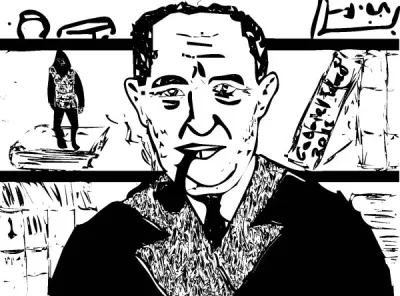
Pierre Boulle
Human Design Chart
Biography
He joined the French army in Indochina in 1939. After the fall of France, he fled to Singapore and joined the Free French as a secret agent. Posing as an Englishman, he helped organize resistance to the Japanese in China, Burma and Indochina. Boulle was captured by the Vichy French in 1943 while trying to float down the Mekong River on a raft, and was sentenced to a life of hard labor. While in prison, he began keeping a diary. After he escaped in 1944, he made his career as a writer.
His novels include "Planet of the Apes," 1963, which was made into a movie in 1968. He also wrote two books of memoirs, 1967 and 1990.
Died on 30 January 1994, Paris.
Pierre Boulle as a Manifesting Generator 1/3 in Human Design
Manifesting Generator 1/3 — Design at a Glance
Pierre Boulle's Design featured a tendency towards hybrid energy: He had the constant power of a Generator but also possessed through his configuration the ability for lightning-fast action. This manifested as someone who did not initiate actions but rather reacted to impulses, yet could skip steps and quickly bring things into his life. His nature was to wait for the "Yes" of his sacral center before acting. Only this inner consent guaranteed him deep satisfaction; without it, his enormous speed often led him to miss important phases and return later, causing frustration. Additionally, his design tended towards pursuing multiple projects simultaneously. Rather than focusing on one thing, Pierre Boulle found his true "play mode" in this parallel work. As long as his inner authority consented and he sought variety, this multitasking ability was not a source of exhaustion but rather creativity. The necessity to listen to the signal of the sacral center despite high speed significantly shaped his approach. He lived in a state where reacting to life – and not initiating actions – formed the key to productive expression. His energy served only when he allowed himself to dwell in this rhythmic shift between different tasks, instead of fighting against his nature.
Sacral Authority
Pierre Boulle's Design inclined towards instinctive, physical decision-making. He was someone who did not act based on intellectual analysis but responded directly to signals from his body. This approach stemmed from his sacral authority, a trait exclusive to the Generator type, and its strategy – waiting for an answer – also served as his inner guidance. This simplified his process: he didn't need complex deliberation but listened to his "gut feeling."
These signals manifested as grunts, hums, or a noticeable surge of energy whenever an external stimulus reached him. When he felt this resonance, he became vital and energetic; without it, the energy was lacking. His authenticity unfolded exclusively within this resonant space with the outside world. Additionally, his active Spleen Center supported this ability by giving him quick, spontaneous reaction speed and immediate access to his instinctive perception. Pierre Boulle could therefore reliably guide himself from these physical impulses, enabling him to undertake tasks with great enthusiasm and without obsessive purposefulness. He lived this mechanism by waiting for confirmation from his Sacral Centre before investing energy.
The 1/3 Profile — Investigator / Martyr
Pierre Boulle's Design established a tendency to not only collect knowledge theoretically but also to validate it through practical application and experience with mistakes. As Profile 1/3 (Researcher/Experimentor), he demonstrated someone who oscillated between the need for comprehensive information and the urge to act. Line 1 brought a drive towards principle orientation and cooperation with strong forces – an attitude that fostered mental growth through harmony. Yet, this theoretical foundation alone was not enough; it had to be tested in reality.
Line 3 demanded this engagement. Here, trial and error were means to authenticity and power manifestation. Pierre Boulle learned by acting and experiencing the consequences. This process was essential: Only through practical testing "on heart and kidneys" did insights arise that earned absolute trustworthiness. When his judgment fell, it was based on a synthesis of studied theory and lived experience. The inner conflict lay in the fear of ignorance, which could delay the step into action, yet only acting resolved this tension. His design marked him as someone who worked out his truth himself – not merely through reading but by experimenting with the world. This combination of research spirit and experimental courage created a unique way of knowledge generation that was valid only through personal proof.
Single Definition — Defined & Open Centers
Pierre Boulle's Design established a tendency towards clear, identity-truthful communication. His defined Throat Centre functioned as a reliable anchor point that transformed messages from the body into the world. This was not an arbitrary expression but rather an articulation of his inner structure. His defined G-Centre gave him a firm sense of self-identity and direction; he knew who he was and where he was going. This internal security allowed him to comfort others or offer new perspectives without being dependent on their approval.
The energy source for this came from his defined Sacral Centre. As a Generator, Pierre Boulle possessed immense vital force that was only activated through reaction. He did not initiate arbitrarily but waited for life to present questions or situations to which his Sacral would respond with a "Yes" or "No". This sacral confirmation was the key to his satisfaction and endurance; without it, any effort would have ended in frustration. Supporting this ability to act was his defined Spleen Centre, which gave him spontaneous intuition and an awareness of the "now". He could recognise in the moment what was healthy or correct, a knowledge he did not need to rationalise but simply trust. Added to this was the constant life pressure of his defined Root Centre, which propelled him forward and helped him deal with stress by nurturing existential awareness.
In contrast, Head, Ajna, Heart, and Solar Plexus were open. These centres did not form part of his constant identity but acted as mirrors for the environment. Pierre Boulle tended to absorb mental inspiration or doubts from others (open Head/Ajna) without these forming his own truth. He was vulnerable to being drawn into the cycle of proving worth (open Heart) or absorbing and amplifying emotional waves in his surroundings (open Solar Plexus). This openness made him sensitive to the climate around him, but it also required mindfulness not to personalise foreign emotions or mental pressures as his own reality. His strength lay in remaining true to his own sacral response and intuitive spleen wisdom despite this sensitivity.
Channels for intuitive rhythm, change and powerful manifestation.
Pierre Boulles Design established a tendency towards emotional awakening that served as a catalyst for inner development. This energy manifested in daily life through extreme instability and mood swings; it required a specific lifestyle, such as eating only when hungry, rather than suppressing emotions.
This dynamic was amplified by the Channel of Mutation 60-3. It connects the Root Center with the Sacral Center and brings a pulsating, often melancholic impulse for evolutionary change. Pierre Boulle had to learn to accept limitations and move beyond the confusion of starting anew in order to give space to this mutative force.
The Channel of Beat 14-2 connected his Sacral with the G Center. It gave him the ability to chart new courses through skillful handling of material resources (Gate 14) and higher knowledge (Gate 2). This tantric channel promoted innovation and uniqueness by translating creative life force into material forms.
Additionally, the Channel of Rhythm 5-15 linked fixed habits (Gate 5) with a love for extremes (Gate 15). It bound Pierre Boulle to the natural flow of life and provided intuitive timing that propelled him forward.
The Channel of Charisma 34-20 endowed him with the strength for self-affirmation and manifesting activity in the present, guided by sacral reaction. This was complemented by the Channel of Brainwave 57-20, which translated intuitive insight directly into communication, as well as the Channel of Power 34-57, which sharpened his survival intelligence and vigilance.
Individual Circuitry — Circuit Signature
Pierre Boulles Design shows a tendency towards impulsive, creative expression. His chart reveals someone who immediately puts new ideas into words. This stems from the Knowledge Circuit: Channel 20-57 (Flash of Insight) connects the Throat Center with the Spleen. Here intuitive insights meet the ability for immediate articulation. Parallel to this, Channel 3-60 (Mutation) links Identity and Sacral Center, promoting deviations from the known, supported by the vital energy of the Sacral Center. The emotional wave from the Solar Plexus is missing directly in this circuit, yet the connection between Identity and Root Center (via other channels of the same circuit) ensures a deep existential grounding of these creative impulses.
Another aspect was the Understanding Circuit. Channel 15-5 (Rhythm) also connects Identity and Sacral Center. This brings logical structure and strategic thinking, free from emotional coloring. It’s about sharing rational insights to improve the future.
Additionally, the Integration Circuit played a role. Channels 20-34 (Charisma) and 34-57 (Power) connect Throat, Sacral, and Spleen. This allowed Pierre Boulle to draw strength from reacting to life (Gate 34) and express it through intuition (Gate 57) as well as in the present moment (Gate 20). Since all centers lie in a single group ("Simple Definition"), these energies – creativity, logic, and survival instinct – flow as one coherent stream. Pierre Boulle did not live separate experiences but an integrated force that transformed new knowledge and brought it into the world through his unique identity.
Right Angle Cross of the Sleeping Phoenix 1
Pierre Boulle had the configuration of the right cross of the sleeping phoenix. Since the specific mechanical description of this pattern is not specified in the given data, no concrete behavioral traits or energetic patterns can be derived from it. The design here does not show any derived character emphasis that would result from a detailed Human Design mechanics.
In Human Design analysis, this means that this particular cross configuration remains thematically empty regarding specific mechanical explanations in the current context. There is no descriptive basis to explain how this pattern affected Pierre Boulle's life or which internal dynamics it shaped. Without an underlying definition of the mechanics—such as through certain channels or centers forming the cross—any assumption about its effect is speculative and contradicts the strict rules of analysis.
Therefore, the consideration is limited to merely noting the pattern. Pierre Boulle’s chart contained this structure, but without further mechanical details, its influence on his personality or destiny remains undetermined. No event is drawn upon to establish a connection to this specific, undefined pattern since there is no basis for such an interpretation. The analysis remains at the observation of the presence of this configuration without further elaboration.
Saturn Return · Uranus Opposition · Chiron Return · 2nd Saturn Return — Life Cycles
Pierre Boulle's life path followed a clear architectural rhythm, in which inner maturity became visible through external milestones. His design structured the development over four central cycles, each marking new phases of self-realization.
The first Saturn return around age 26 often demanded the establishment of fundamental structures. Pierre Boulle began working as a rubber planter in Malaya in 1938. This step anchored him in a new reality and created the material basis for future creative phases, a typical moment of condensing years of groundwork.
With the Uranus return around age 40, there often came a phase of breakthrough or liberation from old patterns. In 1952, Pierre Boulle published "The Bridge on the River Kwai". This success demonstrated the effectiveness of his creative energy, now capable of surpassing established boundaries and gaining broad recognition.
The Chiron return around age 50 marked the peak of the incarnation purpose if one had followed their own strategy. It was not healing in a medical sense but rather the bloom of personal potential. In 1963, Pierre Boulle published "Planet of the Apes". This work represented the full unfolding of his unique perspective and the pinnacle of his creative expression.
Finally, the second Saturn return at about age 58 brought a phase of consolidation and legacy. The publication of a German original collection of his short stories in 1970 underscored the durability of his work. This structure illustrates how Pierre Boulle's design translated inner developmental steps into concrete, visible successes that shaped his life rhythm.
Manifesting Generator · Sacral Authority — Synthesis
Pierre Boulle lived a life deeply marked by the dynamic interplay between inner drive and external stimuli. His design as an Manifesting Generator with Sacral Authority points to someone who generates and manifests energy through reacting to impulses – a constant flow between absorbing information from the environment (Sacral) and expressing this energy through the Throat Center. This combination, reinforced by his defined G-Center identity, suggests a person with a strong inner compass and a natural ability to forge new paths and adapt to changing circumstances. The connection between Root and Sacral Centers (Channel 34-60) indicates powerful, transformative energy that is channeled through accepting limitations.
A central paradox in Pierre Boulle’s chart lies in the tension between the urge for rapid manifestation – typical of his manifesting aspect – and the necessity to wait for sacral reactions. The activation of the Throat Center by the Sacral Center suggests that while he possessed the ability to express his visions, it was most effective when this expression resulted from an authentic, physically felt reaction. This is evident in documented events: professional steps and successes followed concrete external stimuli, which were then amplified by sacral energy.
6 Defined Channels
Incarnation Cross - Right Angle Cross of the Sleeping Phoenix 1
Solar Return
The Solar Return shows the moment when the sun returns to its exact birth position - your personal solar year.
Life Cycles
Discover the life cycles with a detailed triple view (birth chart, cycle chart, composite).
Human Design Profile
- Strategy
- To respond - wait for something to respond to
- Authority
- Sacral Authority
- Profile
- 1/3 - Investigator / Martyr
- Definition
- Single Definition
- Incarnation Cross
- Right Angle Cross of the Sleeping Phoenix 1
- Date of Birth
- 20.02.1912 15:00
- Place of Birth
- Avignon, France
Frequently Asked Questions
What is Pierre Boulle's Human Design type?
What Profile did Pierre Boulle have in Human Design?
What Authority did Pierre Boulle have?
What incarnation cross did Pierre Boulle have?
When was Pierre Boulle born?
Discover your own Human Design
Are you also a Manifesting Generator? Find out in a personal reading how to unfold your multi-talents and direct your energy wisely.
More Personalities
Back to overviewAlain-Fournier

Aldair

Alizée

Angeli

Arletty

Artus