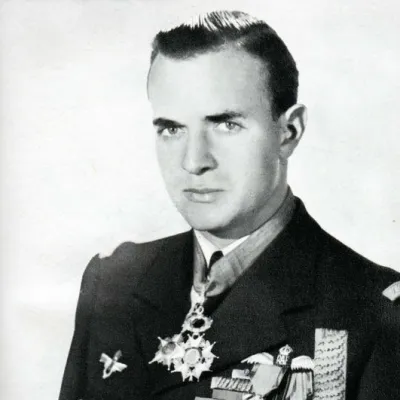
Pierre Clostermann
Human Design Chart
Biography
Over his flying career he was awarded the Grand-Croix of the French Légion d'Honneur, French Croix de Guerre, DFC and bar, Distinguished Service Cross (USA), Silver Star (USA), and the Air Medal (USA).
He died on 22 March 2006.
What does Generator 5/1 mean for Pierre Clostermann?
Generator 5/1 — Design at a Glance
Pierre Clostermann's design pointed towards great endurance and inner strength. As a Generator, he had plenty of sacral energy, which made him extremely strong and resilient – provided this energy found the right outlet. His life force was mainly released when he responded to impulses from his environment rather than initiating on his own. The motto 'not initiate but react' defined his optimal path: He acted upon signals from life as soon as his inner self confirmed: 'Yes! Let's go!'
Living in harmony with this strategy, the design rewarded him with a deep sense of fulfillment. If he tried to work against his natural rhythm or do things without internal motivation, it quickly led to frustration and energy loss. Two stumbling blocks were particularly relevant: Persistently doing tasks without inner resonance could lead to burnout. Second was holding back from heart projects despite still having full power available. His strength did not lie in planned forward movement but in the ability to respond spontaneously to life's offers and thus effectively use his immense endurance.
Emotional Authority
Pierre Clostermann's design pointed towards emotional wave motion. His inner authority was the defined Emotions Center. This meant that he didn't make decisions based on the first moment of feeling, but gave himself time to gain clarity. The emotional wave showed as a constant up and down: In one moment he could be enthusiastic about something, in the next see it negatively. His immediate feeling was only a snapshot, not yet his truth. Quick, spontaneous decisions from an emotion could therefore have negative consequences. Instead, he used the strategy of waiting. The more time he took, the deeper and broader he could perceive. He let decisions mature, often over several nights. Through this patience, intense feelings subsided. An emotional distance set in, followed by calmness and clarity. Only then was the process complete. This mechanism particularly shaped long-term decisions with significant influence on his life path. Pierre Clostermann thus showed himself as someone who found his intuitive truth only after the initial emotional flow had subsided.
The 5/1 Profile — Heretic / Investigator
Pierre Clostermann's design was characterized by Profile 5/1 – the Investigator acting as a Hero. This configuration combined deep, methodical research for knowledge (Line 1) with the ability to offer these insights to others for problem-solving (Line 5). He had almost magnetic charisma that made others actively seek his solutions. However, this created a tension field: While he loved the process of learning and tackling new challenges, he was quickly drained by constant requests from others if clear boundaries were not set.
His inner compass oriented towards persistence and maintaining personal rhythms. Gate 5, Line 1, challenged him to hold steady in his own rhythm even in difficult situations and prove courage. At the same time, Gate 37, Line 5, dealt with themes like natural devotion and emotional waves. Here lay the risk that projections onto lasting commitments or harmony could break down due to emotional fluctuations, leading in extreme cases to dependence or even hatred if the measure was lost.
The challenge for Pierre Clostermann lay in balancing introspective research for himself and external problem-solving for others. By learning to say 'No' occasionally, he could optimally utilize his gifts without being overwhelmed by expectations from his environment. His design thus showed a path from isolated researcher to available expert who used his knowledge gently and with clear awareness of personal limits.
Triple Split Definition — Defined & Open Centers
Pierre Clostermann was someone who constantly felt mental pressure to ask questions and understand connections. His defined Head Center and Ajna Center created a constant stream of inspiration but lacked the direct energy needed for implementation; he relied on others to be spurred into action by his ideas rather than executing them himself. This mental process required patience, as hasty decisions often ended in frustration.
At the same time, Pierre Clostermann possessed immense vital force through his defined Sacral Center. As a Generator, his strategy was to wait and react to stimuli to use his energy efficiently. His defined Heart Center also gave him willpower and the drive to keep promises as well as control over his resources. His inner authority lay in the emotional Solar Plexus: He had to ride out waves of emotion until emotional clarity emerged before acting. His defined Spleen Center provided spontaneous intuition and protection in the present moment.
In contrast, his Throat Center was open, making him vulnerable to the pressure to force attention through constant speaking rather than waiting for invitations to speak. His open G Center meant that he did not have a fixed identity or direction; he tended to orient himself according to his environment and often searched in vain for a firm 'Who am I?'. Furthermore, his open Root Center absorbed external stress, which could lead to feelings of unbearable pressure that he did not generate himself. This combination shaped his life: a powerful reactive base challenged by mental restlessness and emotional waiting periods as well as the search for identity.
Channels for community, caring preservation and abstract comprehension.
Pierre Clostermann's design inclined towards deep care and defense of collective values. The Channel of Preservation 27-50 connected his Sacral Center with his Spleen Center, merging spontaneous survival instinct with the need to protect and nourish what was created. This configuration attracted trust automatically; he was called upon to take responsibility for those who could not provide for themselves, whether through direct support or by preserving traditional order. Simultaneously, his character showed a strong desire for community and emotional connection. The Channel of Community 37-40 linked Solar Plexus with Heart Center and demanded carefully balanced fair agreements. He did not seek spontaneous bonds but rather those strengthened over time through willpower and mutual respect to find an honorable place in a larger structure.
Mentally, Pierre Clostermann was marked by an insatiable desire to understand experiences and derive meaning from them. The Channel of Abstraction 64-47 connected Head with Ajna Center and generated a constant stream of mental imagery. This process could initially be confusing, but through patience the impressions condensed into clear, inspiring stories or new perspectives that he could share. His energy base was further shaped by the rhythm of Gate 5, which fostered firm habits and trust in his life flow. This was complemented by the transformative power of Gate 34, linking individual power with general welfare, as well as Gate 28, driving him to take risk-taking decisions here and now. Through this combination of preserving care, communal pact, and abstract meaning-making emerged a profile that created stability by connecting emotional depth with mental clarity while always seeking the balance between individual expression and collective good.
Tribal Circuitry — Circuit Signature
Pierre Clostermann's design presented itself as a Triple Definition, consisting of three separate energetic groups working in parallel. The first group connected Sacral with Spleen Center through the Channel of Preservation (27-50). This generated an instinctive life force aimed at protection and preservation of genetics – an ancient need for care and defense of one's tribe.
A second, completely independent connection existed between Heart and Solar Plexus Centers via the Channel of Community (37-40). Here the dynamics of giving and taking as well as mutual support in the collective were shown. Since this energy was not fed by the Sacral Center, it required necessary rest periods for regeneration to build resources for interaction.
The third group connected Head with Ajna Center through the Channel of Abstraction (64-47). This area of the Perceiving Circuit referred to emotions and experiences from the past. The insights flowed in wave-like patterns, with clear structure from beginning to end, serving to find meaning behind events to share these emotionally colored insights later with others. These three areas – instinctive protection, social cooperation, and emotional sense-making – formed separate, not directly connected experience fields for Pierre Clostermann.
Left Angle Cross of Migration 1
Pierre Clostermann's design carried the signature of the left crossing of the Pulling Through. This configuration shaped a fundamental attitude of endurance and methodical approach to long-term processes. Instead of impulsive, immediate actions, there was a tendency towards persistence: holding onto a path or task over extended periods, even if immediate results were lacking.
In Human Design, this cross describes the ability to see resistance not as obstacles but as necessary parts of a developmental path. It is about the art of "pulling through" – that is, consistently continuing along a line until a solution or result emerges on its own. This energy does not support quick turns but fosters stability and continuity in life.
For Pierre Clostermann, this meant that his actions were often characterized by patience and strategic long-term planning. He tended to not prematurely abandon projects or commitments but carried them through to their natural conclusion. This inner structure provided him with the necessary resilience to navigate phases of uncertainty or waiting without losing direction. The left cross thus underscored a way of life based on persistent effort and trust in his own path, independent of external affirmations.
Saturn Return · Uranus Opposition · Chiron Return · 2nd Saturn Return — Life Cycles
Pierre Clostermann's design indicated a tendency towards structured and binding life phases. His first Saturn return around the age of 28 often marked the transition from exploratory years to the consolidation of personal structures and responsibilities. During this phase, years of experience condensed into solid foundations for the future.
In 1947, at the age of 26 – just before his typical Saturn return entry – Pierre Clostermann married Jacqueline Renaudat. This event fit into the pattern of his chart dynamics: The establishment of a stable partnership served as an anchor point that created inner stability and bundled energy for upcoming life phases. For his design, this connection was not only personally significant but also represented the beginning of a phase in which external commitments and internal values increasingly harmonized.
Saturn's energy promoted discipline and long-term thinking. Instead of impulsive decisions, he chose paths that promised consistency. This attitude shaped his further development: He sought stability in relationships and projects that had lasting value beyond the moment. The marriage was thus not an isolated date but an expression of a deeper architectural necessity of his design – the creation of permanence amidst changing circumstances. Thus, a foundation was created that allowed him to face later challenges with greater composure.
Generator · Emotional Authority — Synthesis
Pierre Clostermann was a Generator whose life was marked by a deep rhythm of engagement and emotional processing. His sacral energy (Generator type) created a stamina that drove him to immerse himself in projects – especially when they aligned with the value system defined by the Preservation Channel (Gate 27/50). However, his ability to mobilize resources for what he deemed important was inseparable from the emotional wave (Emotional Authority), which compelled him to let decisions mature over time and weigh various perspectives. The Hero/Researcher Profile (5/1) amplified this process by creating a desire for deep knowledge that he wanted to share with others – a task that fulfilled him but also made him vulnerable to burnout.
A central paradox in his design lay in the interplay of defined mental activity (Head Center) and emotional authority. On one hand, there was an ongoing internal pressure to ask questions, understand, and pass on inspirations; on the other hand, his decision-making required time and experiencing emotional cycles (Perception Circuit). This led to a tension between the need for immediate understanding and the necessity of feeling things out before communicating or internalizing them. A documented event suggests that even in the realm of personal relationships (Relationship at Saturn Return), this dynamic was active.
3 Defined Channels
Incarnation Cross - Left Angle Cross of Migration 1
Solar Return
The Solar Return shows the moment when the sun returns to its exact birth position - your personal solar year.
Life Cycles
Discover the life cycles with a detailed triple view (birth chart, cycle chart, composite).
Human Design Profile
- Type
- Generator
- Strategy
- To respond - wait for something to respond to
- Authority
- Emotional Authority
- Profile
- 5/1 - Heretic / Investigator
- Definition
- Triple Split
- Incarnation Cross
- Left Angle Cross of Migration 1
- Date of Birth
- 28.02.1921 20:45
- Place of Birth
- Curitiba (Paraná), Brazil
Frequently Asked Questions
What is Pierre Clostermann's Human Design type?
Which Profile did Pierre Clostermann have?
What Authority did Pierre Clostermann have?
What incarnation cross did Pierre Clostermann have?
When was Pierre Clostermann born?
Discover your own Human Design
Are you also a Generator? Find out in a personal reading how to use your sacral energy correctly and discover deep satisfaction.
More Personalities
Back to overviewAaliyah

Alexia

Angèle

Anne-Marie

Arcángel
Arno