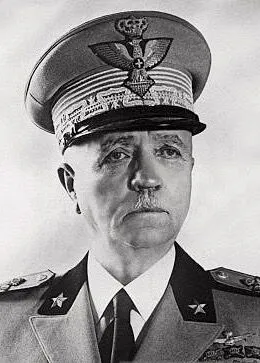
Pietro Badoglio
Human Design Chart
Biography
He became the Premier of Italy on 25 July 1943 and signed the armistice on 3 September 1943. He resigned as Premier on 5 June 1944 and spent his last years bitter and obscure. Died on 31 October 1956, Grazzano.
Human Design Analysis: Pietro Badoglio as Generator 1/3
Generator 1/3 — Design at a Glance
Pietro Badoglio had a high, enduring sacral energy that enabled him to materialize things. His design determined that he did not act as an Initiator but rather made his power effective primarily by reacting to impulses from the environment. As a Generator, he possessed the potential of a workhorse: extremely strong and steady, provided he had energy for the task at hand. This energy was released, however, not through mere will or planning, but only when his Sacral Center gave a clear signal.
The fundamental strategy consisted in waiting for life impulses and acting only when the inner center responded with a clear "yes." When Pietro Badoglio acted in harmony with this gut feeling, it led to deep fulfillment and satisfaction. If he ignored this signal or compulsively initiated things without being prompted, it resulted in frustration and energy depletion. Two specific pitfalls shaped his dynamics: either he squandered his power on tasks that did not resonate internally, leading over time to burnout, or he was held back from his heart project even though he still had plenty of power left. His success thus depended on reacting rather than initiating and being guided by the inner rhythm.
Sacral Authority
Pietro Badoglio revealed himself as someone whose ability to act was closely linked to an inner, physical resonance. His design established that he is the only type – the Generator – where strategy and inner authority are identical: waiting for the impulse. This sacral authority did not manifest as intellectual deliberation but rather as a direct reaction to external stimuli through a surge of energy or a "gut feeling". Pietro Badoglio learned to pay attention to his own bodily signals like grunting, humming, or an affirming "mm-hm". When his sacral motor engaged, he had inexhaustible energy and tackled tasks with great enthusiasm, completely free from aimlessness. This authenticity emerged only through waiting for physical confirmation; actions without this impulse led him to frustration. Supporting this was his activated Spleen Center, which acted as additional authority. It allowed Pietro Badoglio quick, spontaneous, and instinctive reactions as well as direct access to his physical wellbeing. This combination underscored his ability to adapt quickly and protect his vitality. His decision-making process thus became one of listening to his own body, reliably showing him where he could act vibrantly and powerfully rather than being led by external expectations.
The 1/3 Profile — Investigator / Martyr
Pietro Badoglio showed himself to be someone who connected theoretical foundations with practical validation. His design indicated a tendency to hold judgments as trustworthy only when they were both intellectually scrutinized and confirmed through experience. This attitude stemmed from his Profile 1/3, the Researcher and Experimenter. Line 1 established conservative principles and stable structures; it sought to correct traditional patterns while preserving the essential elements. Here, authority and gradual adaptation of inheritance without risking abrupt upheavals were at play.
At the same time, Line 3 propelled the learning process through trial and error. This component required concentration and often responded to external pressure that forced practice. For Pietro Badoglio, this meant that pure planning was not enough; the energy of Line 3 demanded action to gain insights. When a decision was made, it was based on this double-checking: derived theoretically and tested practically. The result was a judgment grounded in self-discovered truth. The integration of both lines kept his foundation alive as Line 3 validated the rigid theory of Line 1 through real experience. His path involved learning from mistakes while adapting traditional structures rather than blindly following them or arbitrarily rejecting them.
Triple Split Definition — Defined & Open Centers
Pietro Badoglio was characterized by a massive internal structure and energy capacity. Six defined centers created a constant presence: consistent mental conceptualization (Ajna), reliable communication (Throat), firm identity (G Center), high vital endurance through reaction (Sacral), spontaneous intuition (Spleen) and specific stress pressure (Root). This shaped a person with enormous inner stability.
At the same time, three open centers revealed situational vulnerabilities. The open Head Center indicated missing consistent mental pressure or inspiration; Badoglio tended to be influenced by others' doubts rather than generating his own questions. The open Heart Center signaled no personal willpower or ego energy. Here there was a risk of making promises to prove worth, although the energy for this was not consistently present – a typical trap of an open heart that he had to avoid. Additionally, the open Solar Plexus Center absorbed foreign emotions without its own emotional constant. He amplified the moods of his environment, which made him vulnerable to emotional conditioning rather than having a stable personal feeling life.
This mechanism described a person with enormous internal structure through the six defined centers but was open in areas of inspiration, willpower and emotional independence. She responded to environmental impulses or absorbed them instead of generating them herself. The defined Sacral energy required reaction over initiation, while the open heart warned against overpromising. The open Solar Plexus Center made him a mirror of the emotional climate rather than its source. Badoglio lived this dynamic: strong in execution and intuition but dependent on external inspiration and emotional clarity from his environment.
Channels for curious mind, self-acceptance and clear logic.
Pietro Badoglio was characterized by a fundamental tension between the need for individual affirmation and an inner corrective drive. His design anchored this dynamics in two defined channels. The Channel of Inquiry 34-10 connected the Sacral Center with the G Center. Through Gate 34, the source of personal strength, and Gate 10, the behavior initiated from deepest self-acceptance, he possessed a constant energy for self-love and trust in his own convictions. This power only worked harmoniously when reacting to external stimuli; without this interaction, the energy could appear rigid or self-centered.
Simultaneously, the Channel of Judgment 58-18 shaped his essence through an insatiable drive for pattern correction. This channel connected the Root Center with the Spleen Center. Gate 58 drove the instinctive will to life and stability, while Gate 18, the correcting gate, constantly searched for errors and logically assessed what was deemed unhealthy or inefficient. This created a permanent inner critic that questioned and sought to perfect patterns, often aiming to restore joy in the collective through order.
In addition to these energetic constants, mental strategies from his personality were at work. The Channel of Curiosity 11-56 promoted storytelling to inspire new ideas, while the Channel of Acceptance 17-62 served to logically organize information and translate it into language to maintain a coherent worldview. These mental abilities supported his ability to analyze and communicate complex connections but stood in the background of deeper, instinctive forces of self-affirmation and perfectionist judgment.
Collective Circuitry — Circuit Signature
Pietro Badoglio was shown as a person with deep inner firmness and strong individual convictions. His design connected the Sacral with the Identity Center (Channel 10-34), creating pulsating energy of personal identity: “I am who I am”. This connection strengthened his self-esteem and courage. However, since this part of the Centering Circuit did not connect to the Throat Center, this inner stability often remained unspoken and hard to articulate verbally; the convictions were there but the expression was lacking.
Parallel to this, two further separate energetic strands worked. The Understanding Circuit connected Pietro Badoglio's Ajna with his Throat Center (Channels 17-62 and 18-58). This allowed him to clearly communicate rational structures and future-oriented logic. Here it was an emotionless ratio aimed at strategically passing on insights and planning improvements for society.
A third, independent strand came from the Meaning Circuit. Through Channel 11-56, it also connected his Ajna with his Throat Center. However, this part of his design was not committed to the future but to the past. It processed emotional waves and experiences from earlier times. Pietro Badoglio reflected these feelings in a wave-like manner – with beginning, middle, and end – to find meaning behind past events and then share these emotional insights with others.
These three groups – silent inner firmness, rational future planning, and emotional past processing – existed alongside each other as separate forces at Pietro Badoglio. They were not directly connected but shaped his actions as parallel, different impulses: once through silent individuality, once through clear logic, and once by sharing emotional lessons from history.
Right Angle Cross of Service 3
Pietro Badoglio's energetic alignment was marked by the right service cross 3. This created a deep, often unconscious motivation to realize himself through serving others or supporting a greater whole. His design suggested that this attitude should not be understood as active and dominant action but rather as receptive and supportive.
The right cross implies a connection to material or physical aspects of service. It was a kind of support rooted firmly in everyday life and concrete reality. Pietro Badoglio thus showed himself to be someone whose nature was oriented towards providing practical help or maintaining structures without necessarily having to stand in the foreground. The quality of this service stood at the center: it was less about profiling oneself than being a stabilizing force for others. This configuration described a life task that consisted of contributing through tangible, graspable contributions to the well-being or functionality of a community. Energy flowed towards the needs of others, characterizing Pietro Badoglios actions as serving and supportive rather than self-centered or controlling. His design promoted an attitude of dedication to what was necessary to support a greater whole.
Saturn Return · Uranus Opposition · Chiron Return · 2nd Saturn Return — Life Cycles
Pietro Badoglio's design indicated a tendency toward structural consolidation, especially during phases of life transitions. He showed himself to be someone who, after crises or uncertainties, deliberately established long-term power structures and reviewed his authority. This attitude corresponded to the mechanics of his second Saturn return. This cycle typically marks a phase of maturation in which previous experiences are condensed into stable, supportive forms. It was less about spontaneous action than establishing order and clear hierarchies that should endure. Pietro Badoglio used this energetic situation to solidify his position within existing systems.
This process became visible in 1925 when he was appointed Chief of Staff of the Royal Italian Army at age 54. This event was no coincidence but an expression of a deep inner necessity to create structure and exercise authority. The appointment signaled the culmination of a long process of self-positioning within his societal role. Through this position, he could carry out the stability demanded by his design outwardly. It was a confirmation of his path: bringing order into complex situations and taking responsibility at a high level. The second Saturn return acted here as a catalyst for professional and personal consolidation by synchronizing inner readiness to take on long-term responsibilities with external opportunities. Pietro Badoglio lived exactly the impulse of his design: building a lasting structure out of testing.
Generator · Sacral Authority — Synthesis
Pietro Badoglios life was marked by deep, sacral-driven energy (Generator), manifesting in a constant urge to react and act. His design challenged him to respond to impulses from life rather than initiate them himself – an attitude reinforced by the connection between his Sacral Center and G Center, suggesting strong self-awareness and clear direction. This combination led to a capacity for deep engagement with tasks and pursuing them with endurance as long as the sacral response signaled
4 Defined Channels
Incarnation Cross - Right Angle Cross of Service 3
Solar Return
The Solar Return shows the moment when the sun returns to its exact birth position - your personal solar year.
Life Cycles
Discover the life cycles with a detailed triple view (birth chart, cycle chart, composite).
Human Design Profile
- Type
- Generator
- Strategy
- To respond - wait for something to respond to
- Authority
- Sacral Authority
- Profile
- 1/3 - Investigator / Martyr
- Definition
- Triple Split
- Incarnation Cross
- Right Angle Cross of Service 3
- Date of Birth
- 28.09.1871 01:00
- Place of Birth
- Grazzano Badoglio, Italy
Frequently Asked Questions
What was Pietro Badoglio's Human Design type?
What profile did Pietro Badoglio have?
Which authority guided Pietro Badoglio?
What incarnation cross did Pietro Badoglio have?
When was Pietro Badoglio born?
Discover your own Human Design
Are you also a Generator? Find out in a personal reading how to use your sacral energy correctly and discover deep satisfaction.
More Personalities
Back to overviewAaliyah

Alexia

Angèle

Anne-Marie

Arcángel

Arno