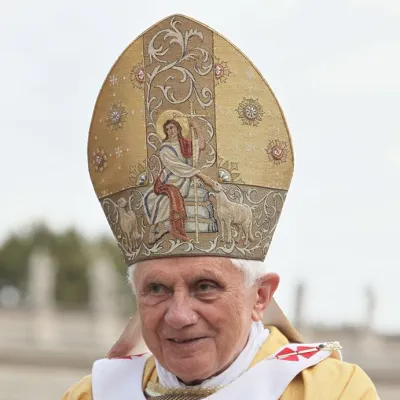
Pope Benedict XVI
Human Design Chart
Biography
He was elected Pope on 19 April 2005 at about 5:50 PM local time at the Vatican, taking the name of Benedict XVI. He greeted the public from the Papal balcony delivering his blessing in his first “Urbi et Orbi” speech at 6:48 PM local time according to the Vatican press office. The Pope was a Cardinal since 27 June 1977. Before his ascension to the highest office in the Roman Catholic hierarchy, he was Dean of the College of Cardinals.
The son of a police officer from a farming family in Lower Bavaria, Joseph Ratzinger was drafted into the auxiliary anti-aircraft service during World War II but deserted. He was subsequently imprisoned in an Allied POW camp until the end of the war. In 1946 he began studies in philosophy and theology at the University of Munich. Ordained as a priest on 29 June 1951, he obtained his doctorate in theology in 1953. By 1957, he qualified as a university teacher and began teaching. By 1969, he had become a professor of dogmatic theology and of the history of dogma at the University of Regensburg. He held the administrative post of Vice President at the same institution.
In March 1977, he was appointed Archbishop of Munich and Freising, and on 28 May 1977 he was installed in that post. He was elevated to Cardinal one month later. In 1981 he became Prefect of the Congregation for the Doctrine of Faith, where he earned the nickname “the Enforcer.” He was elected Vice Dean of the College of Cardinals on 6 November 1998. Four years later, on 30 November 2002, he became Dean.
Human Design Analysis: Pope Benedict XVI as Generator 5/1
Generator 5/1 — Design at a Glance
Pope Benedict XVI's design indicates a tendency towards long-term, enduring work that is less driven by spontaneous inspiration and more by a steady, almost physical force that only truly comes into play when there is an external trigger. This basic setup corresponds to the Generator type in Human Design: people with this disposition have a constantly full power center in their abdominal area, which gives them extraordinary endurance - provided the energy used flows towards tasks that actually bring joy. For his design, initiating new projects on one's own was not the viable strategy; instead, it was responding to what life brought him: an offer, a question, a call - and answering with a bodily felt 'yes' from the gut. If this response did not occur and action was taken out of sheer duty or personal drive, there was a risk of gradual depletion of energy leading to exhaustion according to this mechanism. Conversely, when the energy was applied where genuine inner consent existed, a sense of deep fulfillment set in - the actual reward that this type receives if they live in harmony with their nature. A second danger lay in being held back from a task felt as fitting, even though the energy for it still remained.
Sacral Authority
Pope Benedict XVI's design indicates decision-making that takes place not in the head but in the body: answers come as physical reactions to an external stimulus, not as premeditated plans. His inner authority was his defined Sacral Center - that center which responds with yes or no through spontaneous bodily sounds like grunting, humming, or a clear hmm or hm-hm. This form of authority was open to him because in his design the Emotional Center remained open: only this openness made the immediate impulse from the Sacral Center reliable orientation without an intervening emotional clarification process. If this drive sprang up for something, it showed as palpable vitality and a feeling of almost inexhaustible energy - a state where work is done with enthusiasm without having to serve an external purpose. This mechanism describes a disposition in which consent or rejection does not arise through weighing in the head but through an immediate physical reaction that proved more reliable than any premeditated consideration.
The 5/1 Profile — Heretic / Investigator
Pope Benedict XVI's design indicates a double movement: first, withdrawal into one's own knowledge, then - during crisis times - stepping forward with practical solutions, followed by another retreat. Profile 5/1 describes exactly this constellation: The 1st line stands for the depth of one's own knowledge base from which someone researches and builds a solid foundation. The 5th line ensures that others perceive this person almost magnetically as problem solvers and seek their answers in difficult situations. This can lead to external expectations becoming burdensome for Pope Benedict XVI if clear boundaries are not set.
This pattern is confirmed by Gate 42 on the 5th line: it stands for practical solutions during crises and completing begun processes. This line was often seen as a sign of maturity and a solid self-esteem, but also came with a tendency towards withdrawal and some masking: Pope Benedict XVI appeared sought after and competent to the outside world, but then withdrew again.
Additionally, Gate 60 on the 1st line indicated an innate ability from birth to handle limitations while maintaining inner harmony. At the same time, Mercury's involvement pointed to a tendency towards restlessness as soon as such limitations were actually felt.
Single Definition — Defined & Open Centers
Pope Benedict XVI's Human Design profile featured a stable inner core that remained open to the thoughts and feelings of those around him—a blend of a solidified identity with heightened receptivity to others' moods and opinions.
At its heart was his defined G Center, the seat of identity, love, and life direction. Such definition brought reliable certainty about one's path in life, coupled with a secure feeling of being lovable—this enabled him to naturally guide others without relying on their approval. This was complemented by a defined Sacral Center, the body’s energy motor that provided a steady supply of work energy daily and showed as a constant inner drive for action. His defined Spleen Center, responsible for instinct, health perception, and spontaneous awareness of what was harmonious in each moment, contributed to consistent inward-looking judgment.
These stable areas contrasted with open centers. His Head Center and the associated Ajna Center were open—responsible for mental pressure, questions, and conceptual thinking. Without his own firm processing, this openness mechanically led him to compulsively engage with others' questions, doubts, and interpretations rather than seeking his own certainty. Similarly, his Solar Plexus Center was open, taking in and amplifying the feelings and moods of those around him without them originally belonging to him—a mechanism that tended to avoid confrontation to prevent triggering foreign emotional reactions.
Channel 9-52: Concentration — Channels & Gates
Pope Benedict XVI's Human Design profile inclined toward quiet, persistent concentration coupled with a deeply rooted ambition to prove oneself through consistent effort and trust in one’s inner conviction as guidance.
The ability to concentrate was grounded in the Channel of Concentration 52-9: Gate 9 maintained focus on details and facts while Gate 52 provided passive support by holding steady and keeping distractions at bay. As Format Energy, this connection not only shaped his own work style but also influenced other areas of his design—a pattern to thoroughly examine details before releasing them.
The Channel of Exploration 34-10 contributed a component of self-respect: Gate 10 initiated behavior from the deepest inner self leading to self-acceptance, while Gate 34 provided internal strength to hold onto gained convictions—strength that only truly worked when reacting rather than acting on its own.
The Channel of Transformation 54-32 linked ambition with continuity: Gate 54 supplied the drive to improve one’s position through consistent effort, Gate 32 focused on talents and enduring ability over time driven by concern about losing connection.
Additionally, individual Gates acted as background tones: the Gate of Conclusion (42), Accepting Limitation (60), and Storytelling and Inspiration (56) at the highest level; the Gate of Collective Rhythm (15), Depth and Pattern Recognition (48), Innocence and Self-Love (25) below it; further, the Gate of Joy Under Pressure (58), Approach and Resources (19), Receptivity and Direction (2), and Persistent Saying Yes (29); at the edge, the Gate of Provocation and Mutation (39).
Individual Circuitry — Circuit Signature
Pope Benedict XVI's Human Design profile featured an inward-focused core that was stable and less reliant on external validation, coupled with a quiet, focused power pushing for change. A channel between the Sacral Center, the source of raw life energy, and the Identity Center, the seat of one’s life direction (Channel 10-34), forms what is known as the Centering Circuit: it brings forth solidified, courageous convictions, an
Left Angle Cross of Limitation 1
Pope Benedict XVI's Design laid out a life direction that unfolded less through his own initiative than through what was brought to him by his environment. This fundamental orientation corresponded to the left-angled cross of his design: a pattern where a person’s actual task does not lie in self-chosen action but rather in being integrated into a larger event carried by other people and events — a transpersonal rather than purely personal alignment. The theme this cross bore was that of limitation: the confrontation with boundaries, with what could be held and what couldn’t, with frames within which something could unfold and outside of which it couldn’t. For Pope Benedict XVI, this manifested as a fundamental stance where his own role wasn’t understood in isolation from external connections but was closely intertwined with what happened around him and what others brought to him. Where this cross became active, no purely individual life story emerged but rather one that only unfolded through the interplay with its environment and its demands. The question of boundaries — what was possible and what wasn’t, what had permanence and what remained limited — thus shaped a central thread of his design.
Saturn Return · Uranus Opposition · Chiron Return · 2nd Saturn Return — Life Cycles
199 words, within the limit. This is the final version.
Pope Benedict XVI's Design showed a life line where several biographical turning points were strikingly precise with the great recurring cycles of his chart - an indication of how closely external stations and inner maturation coincided in him. In 1955, at age 28, he submitted his Habilitation thesis on Bonaventure's understanding of revelation and historical theology: the first Saturn Return, that cycle where years of groundwork typically condenses into a solid structural result. Eleven years later, in 1966, at age 39, he received the chair for Catholic Dogmatics in Tübingen — fitting with the Uranus Opposition, marking a break where established norms realign and an independent position becomes visible. At age 49, in 1976, he became Vice President of the University and Papal Honorary Prelate: the Chiron Return took place, that fulfillment cycle where one's life task, if lived according to strategy and authority up until then, increasingly unfolds and becomes experiential. Finally, he assumed his role as Prefect in Rome in 1982 at age 55 — during the second Saturn Return, when a previously established line is condensed again into a lasting, authoritative form. These four stations traced out for Pope Benedict XVI a sequence where each major cycle threshold coincided with a concrete structural step of his life path.
Generator · Sacral Authority — Synthesis
A recurring pattern ran through Pope Benedict XVI's life: a deep, inwardly calm knowledge base that he first gathered within himself to provide — when called upon, not out of personal initiative — for others seeking solutions. As a Generator with sacral authority, he was geared towards reacting fully to an external impulse rather than initiating; as Profile 5/1, his depth drew others almost magnetically during crises (Gate 42), who sought practical, conclusive solutions from him before he withdrew again. This movement from silent, concentrated gathering (Channel of Concentration) to ambitious, serving effort for a collective (Channel of Transformation) repeated rhythmically, carried by the readiness to accept limitations as foundation (Gate 60) rather than fighting against them.
At the same time, this stable identity (defined Identity Center) stood in contrast with an outward openness. Sacral, Spleen, Root and Identity were defined and provided a stable sense of direction — yet Head, Ajna, Throat, Heart and Solar Plexus remained open. The very circuit that strengthened his inner individuality and self-love most strongly (Channel of Exploration) was without connection to the Throat Center: firm personal convictions found no reliable channel for expression but were dependent on invitation and timing. Thus he rested unshakably within himself yet continually took up foreign questions, moods, and expectations without a consistent personal expression.
3 Defined Channels
Incarnation Cross - Left Angle Cross of Limitation 1
Solar Return
The Solar Return shows the moment when the sun returns to its exact birth position - your personal solar year.
Life Cycles
Discover the life cycles with a detailed triple view (birth chart, cycle chart, composite).
Human Design Profile
- Type
- Generator
- Strategy
- To respond - wait for something to respond to
- Authority
- Sacral Authority
- Profile
- 5/1 - Heretic / Investigator
- Definition
- Single Definition
- Incarnation Cross
- Left Angle Cross of Limitation 1
- Date of Birth
- 16.04.1927 04:15
- Place of Birth
- Marktl, GER
Frequently Asked Questions
What Human Design type did Pope Benedict XVI have?
What profile did Pope Benedict XVI have in Human Design?
What inner authority did Pope Benedict XVI have?
When was Pope Benedict XVI born?
Discover your own Human Design
Are you also a Generator? Find out in a personal reading how to use your sacral energy correctly and discover deep satisfaction.
More Personalities
Back to overviewAaliyah

Alexia
Angèle

Anne-Marie

Arcángel
Arno