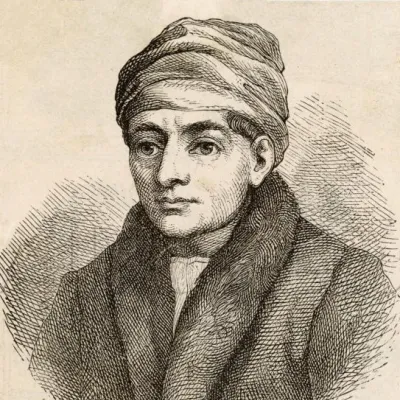
Regiomontanus
Human Design Chart
Biography
He died of pestilence, 6 July 1476, Rome.
Human Design Analysis: Regiomontanus as Manifestor 5/1
Manifestor 5/1 — Design at a Glance
Regiomontanus revealed himself as someone with a leading, visionary orientation that placed him in the role of a pioneer. His design corresponds to the Manifestor type, which is not primarily geared towards completing daily work tasks but rather initiating others and setting them into motion – comparable to a king sending his soldiers out to expand his realm. This configuration brought an advanced way of thinking with it, yet it was polarizing: While some people loved his visions and followed him, he encountered misunderstanding or even rejection from others due to his often faster-than-average thinking.
The key for Regiomontanus lay in the strategy of informing. By timely and clearly communicating his intentions and plans to others, he could generate the right resonance and minimize resistance. This communication served to enable those who resonated with him to find him. When a Manifestor lives by this strategy, they are rewarded with an inner sense of peace. However, deviating from this design and acting without prior information leads to friction and generates deep, lasting anger within them. For Regiomontanus, it was crucial to adopt this informing stance in order to maintain his natural flow and experience the emotional consequence of peace rather than frustration.
Emotional Authority
Regiomontanus showed an inner orientation that required temporal distance from emotional waves. Spontaneous impulses often appeared deceptive in his design; true clarity only set in after the emotion wave subsided. This resulted from his Emotional Authority. Whenever the Emotional Center is activated, it functions as internal authority, independent of other defined centers in the chart. Regiomontanus was subject to an emotional wave with permanent ups and downs. The world appeared colored by the current mood: one moment totally excited, the next negative. However, this feeling was merely a snapshot, a first impression, not yet his truth. Quick decisions based on emotion could therefore have negative consequences. The more time he took, the deeper he could see. This required patience and multiple nights to sleep over decisions. He should be reluctant. Over time, intense feelings subsided, emotional distance gained strength, clarity and calmness emerged. This process was crucial for long-term life decisions. Emotional Authority had precedence over other defined centers, which constituted a central mechanism. Regiomontanus needed to learn not to value his mood as final judgment but rather as a fleeting state that made room for deeper insight once the wave subsided.
The 5/1 Profile — Heretic / Investigator
Regiomontanus revealed himself through his design as someone with profound knowledge who offered it to others for problem-solving. As a person with the 5/1 profile – Hero/Researcher – he had a magnetic effect on his surroundings. Others sought him out for solutions, sensing the wealth of knowledge he could offer. This attraction resulted from Line 5, emphasizing crisis resolution and sharing experience.
Simultaneously, Line 1 anchored him in private research and self-discovery. He loved the process of learning new challenges. However, this configuration carried a risk: Without clear boundaries, exhaustion threatened due to constant inquiries costing energy. His design required the ability to say “No” to maintain balance between altruistic help and personal recovery.
Gate 35 promoted selflessness in the context of sharing experience. It was about offering practical solutions during crises without clinging to them. Gate 22 complemented this through attention and courtesy. This gate enabled self-discovery and the transmission of mutations into society, often without direct reward. The ability to accept a subordinate position was crucial here; if Regiomontanus assumed an inappropriate role, it led to social humiliation.
His path lay in optimally utilizing these gifts: by using his deep knowledge base to serve others but also setting necessary boundaries to avoid burnout. Thus, he could maintain the beneficial balance between research for himself and problem-solving for others.
Single Definition — Defined & Open Centers
Regiomontanus had a design characterized by constant internal sources: defined Ajna, Throat, Solar Plexus, and Spleen centers. This created a stable foundation of clear mental conceptualization, reliable expression ability, emotional depth, as well as intuitive moment-to-moment decision-making capability. His mind worked continuously, his voice conveyed these inner processes outward while he made decisions by waiting for the emotional wave and spontaneous intuitive impulses. These defined centers formed his unchanging foundation, independent of external influences.
In contrast, Head, G, Heart, Sacral, and Root centers were open. These areas functioned as interfaces to the environment that did not have their own constant energy but absorbed and reflected environmental energies. Regiomontanus was vulnerable in these fields to conditioning: he tended to identify with foreign mental pressure or doubts (open Head Center), let his identity and direction be determined by the environment rather than knowing them from within himself (open G Center) as well as felt a need to prove his worth through promises or willpower (open Heart Center). Additionally, he took on vital energy and stress from the environment, which could lead to overloading since he did not have his own constant source for generative power (open Sacral Center) or adrenergic pressure (open Root Center).
The mechanics of his design suggested that his strength lay in utilizing his defined inner authorities – trusting his mind, emotional clarity, and intuition – while learning not to accept external influences as his truth. His open G Center meant he was initiated by the right places and people to find his direction rather than actively forcing it. The distinction between his stable internal mechanics and situational dependency in the open centers defined his challenge: maintaining inner stability while allowing the reflection of the world within him without losing his own identity or energy.
Channels for intuitive clarity, structured insight and emotional change.
Regiomontanus was characterized by a tension between impulsive emotional experience-seeking and the need to communicate intuitive truths in the moment. His design tended towards innovative mental structures often encountering resistance or being perceived as foreign when timing did not align.
The Ephemeral Channel 36-35 connected Solar Plexus with Throat Center. This connection drove him to seek new experiences motivated by the attitude of 'I've already been there'. The emotional wave from Gate 36 often felt unexperienced as inadequacy and occasionally initiated crises to initiate movement. In contrast, the Flash of Insight Channel 57-20 connected Spleen with Throat Center. Here intuitive insight flowed directly out of Gate 57 into communication through Gate 20. This mechanism allowed spontaneous verbal outbursts that found the core of a matter faster than reflective analysis. It served to encourage others to awaken their own inner survival intelligence by speaking in the moment of presence.
Simultaneously, the Structuring Channel 43-23 connected Ajna Center with Throat Center. Gate 43 received spontaneous breakthroughs of individual mind while Gate 23 assimilated and metaphorically efficiently expressed them. This configuration created a unique perspective that promoted efficiency but only found acceptance when timing was right. Otherwise, it led to the feeling of being an outsider.
Additionally, further gates shaped his inner workings: Gate 5 demanded holding in one's own rhythm and habits for energy building-up. Gate 22 brought openness for mutations through calm listening. Gate 47 sought sense-making from past experiences while Gate 48 offered deep pattern recognition but caused frustration at lack of implementation. Gate 49 reacted sensitively to principles and required sacrifice for the tribe. Gate 24 processed mental mutations in the rhythm of the pulse, filtering new knowledge. This combination formed a person navigating between emotional urgency, intuitive clarity, and innovative yet often premature thinking structures.
Individual Circuitry — Circuit Signature
Regiomontanus was someone who structured and impulsively generated new insights while simultaneously emotionally reflecting on past experiences. This dual orientation arose from his simple definition: all four defined centers – Ajna, Spleen, Throat Center, and Solar Plexus – formed a single, continuous energetic flow.
This stream manifested through two circuits. The Knowledge Circuit connected Regiomontanus' Ajna (Mind), Spleen (Intuition) and Throat Center (Expression). Here the pulsing, acoustic energy of Channel 20-57 ('Flash of Insight'), which linked innovative impulses from mind with intuitive selection, was at work. This was complemented by Channel 43-23 ('Structuring'), which formed these ideas. The result was the ability to express one's identity and new knowledge through speech.
Parallel to this, the Meaning-Making Circuit connected Solar Plexus Center (Emotion) with Throat Center. Through Channel 35-36 ('Ephemeral'), a cyclical visual energy flowed focusing on past and emotional waves. This stream served to reflect past events and express their meaning for the collective.
Both streams converged in Throat Center. Regiomontanus' design thus connected active creation of new with deep emotional processing of the past. The mechanics described a person who both initiated innovative transformation and enabled collective learning through sharing emotional experiences. This connection of intuition, mind, and emotion in expression shaped his way of structuring knowledge and instilling meaning.
Left Angle Cross of Separation 1
Regiomontanus carried the design of the left separation cross. This configuration sets a foundational structure characterized by a focus on delineation and differentiation. In Human Design, this cross represents a process of distinction: it is about separating what is one's own from what is foreign to gain clarity about one's identity and position in the world. The term 'left' points towards an internal, subjective orientation. The impulse was less about external, active enforcement of boundaries than about internal processing and understanding what distinguishes itself.
This mechanism shaped Regiomontanus’ approach to his environment. Instead of immediately seeking connection, his design tended to first recognize and name differences. This created an inner distance that allowed situations and relationships to be viewed from a clear, analytical perspective. The separation here was not an act of rejection but rather a tool for sharpening the self. Through awareness of what he was not or did not fit into, Regiomontanus could refine his own essence.
The left separation cross thus acted as a filter. It helped delineate the essential from the non-essential by focusing attention on nuances and differences. This process of internal sorting promoted deep self-reflection. Through this orientation, Regiomontanus was able to penetrate complex connections by breaking them down into their components and distinguishing them from each other. The strength of this design lay in its ability to create clarity out of confusion not through external action but through inner differentiation. It was a path to self-discovery through the recognition of boundaries and differences.
Saturn Return · Uranus Opposition — Life Cycles
Regiomontanus’ design set a tendency towards structural turning points marked by planetary cycles. The first Saturn return around age 25 marks in Human Design the beginning of independent responsibility and building up. In this phase, Regiomontanus showed himself to be someone who broke away from previous structures to create his own foundation. This was evident when he went alone to Rome at the age of 25 in 1461 to continue work on the Almagest. This step marked the transition into an independent career and taking responsibility for his field.
The Uranus opposition around age 40 describes in Human Design a phase of dissolving old structures or sudden end of physical existence. It stands for liberation and ending cycles. For Regiomontanus, this cycle came as a final event: In 1476 at the age of 40, Johannes Regiomontanus died in Rome. This time corresponds to the archetypal quality of the Uranus opposition, often associated with an abrupt end or profound transformation. The mechanics of these cycles framed his life: building and self-discovery in young adulthood, followed by dissolution of physical existence mid-life.
Manifestor · Emotional Authority — Synthesis
Regiomontanus lived a life marked by a deep inner drive for renewal and desire for authentic expression. His emotional authority (Solar Plexus) required time to gain clarity while his defined Throat Center pushed him to express these insights – an interplay strengthened by the connection between Gate 43 and 23 in Channel of Structuring. He was not merely a knower (Ajna), but someone who shaped and transformed this knowledge to make it accessible to others. This ability to recognize patterns and open new perspectives fueled his journey, marked by the left separation cross 1 – a path of individual progress and delineation.
Central for Regiomontanus, however, was an inner paradox: His open Sacral and Root Centers made him receptive to other people's energy while he simultaneously sought new experiences through Channel 36-35 and initiated changes. Thus, he was both recipient and initiator of energies, leading to a life rich in insights but also marked by constant search for his own rhythm and delineation – a dance between adaptation and authenticity.
3 Defined Channels
Incarnation Cross - Left Angle Cross of Separation 1
Solar Return
The Solar Return shows the moment when the sun returns to its exact birth position - your personal solar year.
Life Cycles
Discover the life cycles with a detailed triple view (birth chart, cycle chart, composite).
Human Design Profile
- Type
- Manifestor
- Strategy
- To inform others before acting
- Authority
- Emotional Authority
- Profile
- 5/1 - Heretic / Investigator
- Definition
- Single Definition
- Incarnation Cross
- Left Angle Cross of Separation 1
- Date of Birth
- 06.06.1436 16:40
- Place of Birth
- Unfinden (Königsberg/Bayern), GER
Frequently Asked Questions
What was Regiomontanus' Human Design type?
Which Profile did Regiomontanus have in Human Design?
What authority did Regiomontanus possess?
What incarnation cross did Regiomontanus have?
When was Regiomontanus born?
Discover your own Human Design
Are you also a Manifestor? Find out in a personal reading how to use your initiation power peacefully and dissolve resistance.
More Personalities
Back to overviewChristian-Jaque

Kesha

Lucebert

Masaccio

Papus
Petrarch