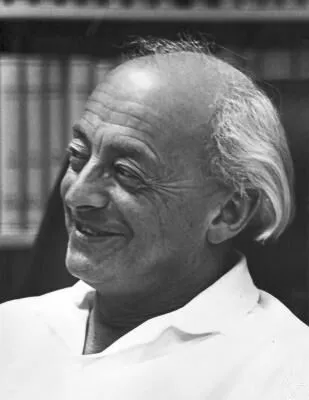
Reinhold Baer
Human Design Chart
Biography
Baer stayed at Princeton University and was a visiting scholar at the nearby Institute for Advanced Study from 1935 to 1937. For a short while he lived in North Carolina. From 1938 to 1956 he worked at the University of Illinois at Urbana-Champaign. He returned to Germany in 1956.
He died of heart failure on 22 October 1979 at age 77 in Zurich, Switzerland. In 2016 the Reinhold Baer Prize for the best PhD thesis in group theory was set up in his honour.
Reinhold Baer as a Generator 2/5 in Human Design
Generator 2/5 — Design at a Glance
Reinhold Baer's design showed a tendency towards high endurance and inner strength, which required specific conditions to be effective. As a Generator, he had a large reservoir of sacral energy that made him extremely strong and resilient – provided this power was used correctly. The central mechanics of his design lay in reacting rather than initiating. His energy unfolded most effectively when he responded to external impulses from his environment and gave a clear 'yes' signal from his Sacral Center.
This strategy of responding was the source of his deeper satisfaction and fulfillment. If Reinhold Baer, on the other hand, tried to constantly take initiatives himself or do things that he did not have an inner desire for, it inevitably led to frustration and a feeling of energy depletion. Another risk lay in being prevented from working on his heart project despite having the internal drive. Living in harmony with this dynamic – reacting instinctively to life impulses – made him unstoppable. Deviating from this and acting against his inner resonance eventually led to exhaustion. His strength, therefore, was not just the mere presence of energy but the ability to channel it through correct reactions.
Sacral Authority
Reinhold Baer showed a decision-making structure based on physical resonance. As a Generator, his strategy 'waiting for the trigger' was identical with his internal authority: sacral authority. This simplified his process as he did not have to weigh between head and body but trusted directly in inner signals.
This mechanism worked through a clear reaction to external impulses. When an impulse hit, his body responded with a surge of energy or what is called the 'gut feeling'. These signals appeared as grunts, hums, groans, or sounds like 'mmh' and 'hm-hm'. Baer learned to observe these physical noises. They were proof whether something was engaging his energy.
Once his sacral motor was activated, a noticeable vitality set in. He had inexhaustible energy and tackled tasks with great enthusiasm. Crucial here was the absence of purposefulness; he immersed himself in work driven by joy and satisfaction rather than external goals.
A key factor for this function was his open emotional center. As it was undefined, emotional confusion could not cloud his sacral clarity. This protected the integrity of his gut decisions from impulsive mood swings. Baer thus avoided hasty head calculations and instead let himself be guided by this reliable inner compass that enabled him to move through life efficiently and vibrantly.
The 2/5 Profile — Hermit / Heretic
Reinhold Baer's design created a tension between a deep need for isolated development and the projection of a hero status externally. As someone with Profile 2/5, he radiated inspiration while simultaneously needing withdrawal to gain inner clarity. Others instinctively sought immediate solutions from him for their problems as they projected him as a rescuer. This expectation conflicted with his necessity to spend time alone to figure out what he truly wanted to commit himself to.
His Sun Gate 56, the Gate of Connection and Genius, dominated this dynamic. It conveyed inspiring insights but needed support to transform isolated inspirations into continuous development. Without targeted collaboration, especially with energies like Gate 11, there was a risk that he would be drained by constant expectations for solutions from others. The mechanics of his fifth line required him to create order out of confusion, yet mutation follows its own timing. Expected immediate help often led to aversion or the feeling of being a victim of other people's opinions. Baer had to learn to strategically use his 'alone time' to make conscious yes and no decisions rather than blindly reacting to projections. This way, he could avoid forgetting himself while helping others.
Single Definition — Defined & Open Centers
Reinhold Baer's design indicated a tendency towards constant, enduring vitality that was only activated through reaction. As a Generator, he had a defined Sacral Center, his energy source. This power did not become available for initiated actions but responded to external questions with a clear yes or no. Only upon agreement would the full energy flow; ignoring this signal led to frustration and exhaustion.
This physical foundation was complemented by a defined Spleen Center, which acted as an inner authority. It provided intuitive judgments in the present moment, independent of rational deliberation. Baer tended to trust this spontaneous instinct for health and well-being rather than allowing decisions to mature in his mind. His defined Root Center also ensured a constant internal pressure that propelled him forward and helped him cope with stress as long as he followed his strategy.
At the same time, a high susceptibility to external influences was revealed through several open centers. The open G Center meant no fixed identity; Baer took on situational qualities from his environment. He tended to question who he really was or which direction was correct rather than determining this himself. His open Heart Center lacked consistent willpower; he avoided making promises to prevent falling into the cycle of failure and self-doubt.
The open Solar Plexus Center absorbed foreign emotions like a sponge. Baer risked personalizing these moods as his own, feeling emotionally unstable if he did not let them go. The open Head and Ajna Centers lacked consistent inspiration; he could be overwhelmed by others' doubts or try to find answers that were none of his business. His open Throat Center naturally drew attention without him actively seeking it out. Speaking from mental necessity often led to unpredictable results; true communication arose spontaneously when the invitation came.
Channels for evolutionary change, care and traditional values.
Reinhold Baer's design set a tendency towards evolutionary change paired with the ability to care for others. The Channel of Mutation 60-3 connected the Root Center with the Sacral Center through Gate of Limitation (60) and Gate of Order (3). This created potential for innovation, which however depended on accepting limitation. The associated melancholy was not a defect but rather a sign of underground work; it arose from the pressure of the Root Center during phases without active pulse. Baer showed himself to be someone who endured this unpredictable rhythm instead of rationalizing moods and waited patiently until new mutations passed through him.
At the same time, the Channel of Preservation 27-50 connected the Sacral Center with the Spleen Center. Through Gate of Caring (27) and Gate of Values (50), an energy of nurturing and preserving emerged. This configuration promoted tribal values and responsibility for others. However, this care was based on "enlightened self-interest": Baer only cared when he was asked to do so and his own sacral energy allowed it. This protected against overextension and ensured that he gave only what he could actually carry.
The tension field between the chaotic pulse of mutation and the stabilizing order of preservation shaped his essence. While mutation pushed him towards change, preservation demanded stability and care for others. Individual gates like Gate 56 (Inspiration), Gate 19 (Resources) or Gate 28 (Risks in the Here and Now) complemented this picture by supporting mental processes, territorial security, and momentary decisions. Baer's design required him to accept melancholy as part of the process and only offer care upon request, which helped him balance both change and preservation.
Individual Circuitry — Circuit Signature
Reinhold Baer's design presented a tension between the drive for individual novelty and the primordial impulse to preserve. As a simply defined being, he appeared coherent, with his Sacral, Root, and Spleen Centers energetically connected. The Knowledge Circuit linked his Sacral with Root Center via Channel 3-60 (Mutation), fostering the expression of a unique identity through deviation from the known. New paths emerged, supported by the life force of the Sacral and the impulsivity of the Root. Parallel to this, the Archer Circuit connected his Sacral with Spleen Center via Channel 27-50 (Conservation). Here, instinctive protection of genetics and family dominated. Topics like nutrition, care, and preservation of the existing were central. The Spleen provided intuitive perception for what was needed, while the Sacral Center supplied the energy for nurturing. Baer thus moved between the pulsating creativity of Mutation – creating something new – and the timeless, cautious security of Conservation. This configuration described a life task: to realize his own individuality while simultaneously ensuring the foundation of survival for his lineage. No solar influences or external events were documented in the raw content; the analysis is based solely on these internal circuits and their specific connection of the mentioned centers within his simple definition.
Right Angle Cross of Laws 2
Reinhold Baer's design featured the right cross of laws as a structural background. It was a pure structural principle without energetic manifestation. This aspect did not act as an active driver for his actions or identity, but rather formed an abstract framework of lawfulness. The mechanics describe here a static order that lies in the background and dictates the form of processes without providing energy or impulses itself. For Reinhold Baer, this meant that this specific configuration did not function as a motor for his deeds. It presented more like a fixed scaffolding within which other dynamically active elements of his design operated. The right cross of laws symbolizes a certain kind of logical or causal connection, but remains passive in this case. There was no inner urgency or energetic push from this position. Instead, it offered a neutral, abstract basis that served as a reference point. Reinhold Baer lived with this background framework that structured his experiences without initiating them. The emphasis clearly lay on the form and not on the power behind it. It was a principle of order that worked silently, far removed from emotional or will-driven dynamics. This distinction between structuring framework and active drive is central to understanding this part of his design.
Saturn Return · Uranus Opposition · Chiron Return · 2nd Saturn Return — Life Cycles
Reinhold Baer's design showed a clear tendency towards structural consolidation, with his professional development closely tied to the phases of Saturn returns. In 1928, at age 26, he moved to Halle under Helmut Hasse and republished Steinitz' classical article. This first Saturn return marked a turning point for his design: years of groundwork condensed into a solid result that strengthened his professional position.
This architectural ability to integrate showed again later on. In 1941, during the Uranus opposition at age 39, he introduced the concept of injective modules. This configuration often promoted sudden insights or innovative breaks with established patterns, yet resting upon the stable foundation he had previously created. The success of this year underscored his competence in redefining complex structures.
The second major maturation phase occurred in 1956 during his second Saturn return at age 54 when he became a professor in Frankfurt am Main. For his design, this cycle meant the final institutional anchoring and recognition of his life's work. Career development thus followed a typical pattern: first laying the foundation, then setting innovative impulses, and finally establishing structural authority that secured his work sustainably.
Generator · Sacral Authority — Synthesis
Reinhold Baer lived deeply rooted in his sacral center, an inexhaustible source of energy driving him to react to impulses from life. This responsiveness, coupled with the inner authority of the sacral center, shaped his path leading to deep fulfillment as long as he followed his energy. His profile as a natural talent and hero suggests that others often sought his solutions, yet the necessity for retreat was equally central to his well-being. The shift between engagement and isolation seems to form a red thread in his life – an ongoing balance between giving to others and nurturing one's own inner space. The connection of root and sacral center through the mutation channel points to dynamic, pulsating energy that constantly reinvented him.
At the same time, a paradox revealed itself in his design: openness in various centers – head, ajna, heart, and solar plexus – confronted him with a constant flood of external influences and emotions. While his sacral authority provided a clear inner compass, he also had to learn not to lose himself in others' energies or be conditioned by them. This tension between the need for connection and the necessity of separation seems to have been a central theme of his life – a search for authenticity amidst a world full of voices and expectations.
2 Defined Channels
Incarnation Cross - Right Angle Cross of Laws 2
Solar Return
The Solar Return shows the moment when the sun returns to its exact birth position - your personal solar year.
Life Cycles
Discover the life cycles with a detailed triple view (birth chart, cycle chart, composite).
Human Design Profile
- Type
- Generator
- Strategy
- To respond - wait for something to respond to
- Authority
- Sacral Authority
- Profile
- 2/5 - Hermit / Heretic
- Definition
- Single Definition
- Incarnation Cross
- Right Angle Cross of Laws 2
- Date of Birth
- 22.07.1902 01:00
- Place of Birth
- Berlin, Germany
Frequently Asked Questions
What was Reinhold Baer's Human Design type?
Which Profile did Reinhold Baer have?
What was Reinhold Baer's Authority?
What incarnation cross was assigned to Reinhold Baer?
When was Reinhold Baer born?
Discover your own Human Design
Are you also a Generator? Find out in a personal reading how to use your sacral energy correctly and discover deep satisfaction.
More Personalities
Back to overviewAaliyah

Alexia
Angèle

Anne-Marie

Arcángel

Arno