
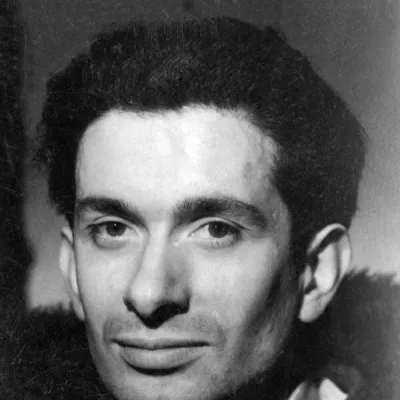
René Barjavel
Human Design Chart
Biography
He died November 24, 1985
René Barjavel — Generator with Profile 2/4
Generator 2/4 — Design at a Glance
René Barjavel as a Generator had enormous sacral endurance comparable to that of a workhorse. His strength was not shown through self-initiative but exclusively in reacting to external impulses. This mechanism shaped his life: Only when he responded to signals from his environment and gave an inner clear “Yes!” could he effectively utilize his energy.
This path led to deep satisfaction and fulfillment. Deviations, such as constantly taking the initiative or completing unwanted tasks, resulted in frustration and energy depletion instead. Two specific pitfalls characterized his design. First, the risk of energy waste in activities without inner resonance, which over time tended towards burnout. Second, the blockage through external pressure that kept him from his heart projects despite still being full of power.
For René Barjavel, successful living meant trusting this inner compass. By reacting to impulses and acting from the gut rather than swimming against the current or letting time constraints limit him, he secured his energy flow. His design required this alignment with genuine desire to transform his immense strength into sustainable results without breaking out.
Sacral Authority
René Barjavel demonstrated decision-making based firmly on physical resonance. His inner authority was sacral authority carried by a defined Sacral Center. This is the only type whose strategy and inner authority are identical, simplifying his process: He reacted to external stimuli with an internal response rather than planning or analyzing.
This reaction manifested as gut feeling or surge of energy. Barjavel learned to pay attention to specific bodily sounds like grunts, hums, groans, or a nodding “Mhm”. These signals marked the energetic activation of his sacral motor. When this motor kicked in, he felt vital and alive. He had seemingly inexhaustible energy and tackled his work with great enthusiasm. His design foresaw him going through life with joy and satisfaction, fully immersed in his tasks without needing an external purpose.
Additionally, his Spleen Center acted as a supporting authority. As it was activated and possibly directly connected to the Sacral Center, Barjavel could react particularly quickly and spontaneously. He had immediate access to his physical well-being and instinctive perception. This combination allowed him to reliably guide himself by these inner signals, making his actions authentic and energy-charged.
The 2/4 Profile — Hermit / Opportunist
René Barjavels design indicated a tendency towards internal tension work, characterized by Profile 2/4. He was someone who oscillated between the need for isolated processing and the urge to network. This configuration described not a static trait but a cyclical rhythm: The withdrawal served internal clarity, allowing him to return to social structures with renewed energy.
The mechanics of Line 2 emphasized caution and a conservative nature that did not endanger its own security. Here Saturn played a role, leading to some contradiction; René Barjavel had to learn to see through projections from the outside without losing himself. At the same time, Mars brought a desire for recognition which often conflicted with necessary restraint.
In contrast, Line 4 demanded persistence and the ability to build networks. This energy went beyond the personal in search of unexpected connections. Jupiter promoted using knowledge for higher good while Mercury tended towards selfish holding on when boundaries were unclear.
For René Barjavel, it was crucial to create a safe environment where this shift could happen without guilt. He had to learn to communicate clearly: When he sought company and when he wanted solitude. Only then could he reflect the knowledge of his network in isolation and develop brilliant ideas that integrated both aspects of his design.
Split Definition — Defined & Open Centers
René Barjavel was characterized by a stable, independent presence in thought and action. His defined Ajna Center provided consistent, trustworthy conceptual thinking that he articulated clearly through his also defined Throat Center. This connection allowed him to express mental processes directly into words without being distracted by external opinions. His ability to act stemmed from his defined Sacral Center, a source of constant vitality that responded to questions with yes or no tones. This created a reliable foundation for work and engagement, supported by the intuitive warning system of his defined Spleen Center, which protected him in the moment. The pressure of his defined Root drove him continuously forward.
At the same time, René Barjavel was open and receptive in four areas. His open Head Center lacked consistent inspiration; he tended to be overwhelmed by doubts or questions from others rather than forcing his own mental solutions. His open G Center meant no fixed identity; he did not actively seek a life direction but waited for it to be initiated through environment and relationships. His open Heart Center lacked persistent willpower, making him vulnerable to the pressure of proving himself or giving promises to demonstrate value. Finally, his open Solar Plexus absorbed foreign emotions like a barometer; he had to learn not to personalize these received feelings as personal truths but rather see them as transient information from the environment and let go to maintain emotional clarity.
Channels for insight, care and meaningful struggle.
René Barjavel was characterized by a strong drive for evolutionary change, driven by the energy of Gate 41 in his personality. This gate focused on crises as drivers for development and connected feeling with going through specific experiences. His inner dynamics were shaped by the tension between this mutative impulse and the need to communicate innovative insights at the right time.
The Channel of Structuring 43-23 linked his Ajna Center with his Throat Center. Here he received spontaneous breakthroughs (Gate 43) and processed them through assimilation (Gate 23), expressing a unique perspective. His challenge was to wait for timing; without strategy and inner authority, his often forward-thinking knowledge rarely understood or accepted. He had to learn to let go of control so that his clear explanations could naturally come across.
Simultaneously, the Channel of Life Struggle 38-28 shaped his attitude. The connection between Root Center (Gate 38) and Spleen Center (Gate 28) gave him a stubborn determination to fight for his individual meaning. He sought significance in resistance and resisted external forces that wanted to distract him from his integrity. This struggle served the purpose of individuation, driving him through even poor opportunities.
Balancing this was the Channel of Preservation 27-50 between Sacral Center and Spleen Center. Through care (Gate 27) and the preservation of values (Gate 50), he took responsibility for his community. His aura attracted trust, but he had to ensure that he properly cared for himself to nourish others. This combination of evolutionary drive, structured communication, combative sense-making, and clan-based care formed his characteristic pattern.
Individual Circuitry — Circuit Signature
René Barjavel was characterized by two separate, parallel operating energy fields. His design featured a Split Definition: The centers were not connected in one continuous flow but formed isolated groups. This created a tension field between the drive for individual transformation and the instinctive need for security.
The Knowledge Circuit linked René Barjavel's Ajna with his Throat Center. Here, the Channel 43-23 (Structuring) translated logical analysis into concrete expression, as well as the Channel 28-38 (Life Struggle), which articulated the will to overcome obstacles through words. This connection promoted the articulation of a unique identity and the sharing of new insights.
Completely separate from this operated the Archer Circuit, connecting his Sacral with his Spleen Center. The active Channel 27-50 (Preservation) here drove the instinctive impulse to preserve resources and genetic heritage. This energy focused on protection, care, and family survival, independent of intellectual expression in the other field.
René Barjavel thus lived with these two poles: on one side, the pulsating, creative power of Knowledge, stepping out onto new paths; on the other side, the timeless, primordial energy of the Archer, preserving what exists. Since no energetic bridge existed between these groups, these forces existed as separate, parallel realities in his design without directly mixing or forming a common flow.
Right Angle Cross of the Unexpected 4
René Barjavel was marked by the right cross of Unexpected 4. This configuration described an archetypal dynamic characterized by unexpected turns and sudden insights. His design carried an energy that did not follow a linear path but often revealed surprising patterns. The term “Unexpected” indicated that his life journey or inner disposition was marked by moments where the obvious was broken through. It was a structure requiring flexibility and adaptability, as it did not adhere to predictable developments. René Barjavel showed himself to be someone who confronted these unforeseen aspects or even actively integrated them into his experiential world. The energy of this cross acted as a driving force behind such situations, though they were not always controllable. It created space for spontaneous insights and changed perspectives that could not be planned in advance. For René Barjavel, this meant that his inner self was characterized by a quality that accepted the surprising as a natural part of his existence. This was not about chaos but rather a specific openness to the new and unexpected, symbolized by this cross configuration in Human Design. This trait shaped how he dealt with life and change, helping him orient himself in unpredictable moments.
Saturn Return · Uranus Opposition · Chiron Return · 2nd Saturn Return — Life Cycles
René Barjavels design indicated a tendency towards a late yet intense unfolding of his life purpose. This was concretely evident in 1962, at the age of 51, when he marked his return as a science fiction author with the novel “Colomb de la lune”. For his Human Design, this was the Chiron Return, a fulfillment cycle between the ages of 49 and 51. During this phase, his own incarnation cross increasingly came to the forefront. If René Barjavel had previously lived according to his strategy and authority, his purpose now became experiential. This was not about healing old wounds or confronting sources of pain but rather a bloom period in which the essence of his design fully unfolded. The publication of this work served as evidence for how this cycle worked: A long-accumulated inner clarity found its outward expression. Thus, the Chiron Return functioned as a catalyst for the visible realization of what René Barjavel was at his core. The mechanics of this point emphasized maturity and the peak of individual expression without referring to past injuries. Instead, pure potential unfolding stood in focus, now becoming visible in the world.
Generator · Sacral Authority — Synthesis
René Barjavel lived deeply rooted in reacting to the present moment. His Sacral Center, as a defined Generator, provided energy for sustained activity so long as external impulses engaged him and he responded with enthusiasm. This reactivity was strengthened by a strong Spleen Center – an immediate, instinctive perception of what was healthy or necessary in the now. The connection of these centers shaped a person who engaged in the world not through planning or initiative but through readiness to respond to life and align his energy accordingly. His profile as a natural talent and networker suggests that he oscillated between the need for inner reflection and the desire to exchange with others – an interplay allowing him to develop ideas and refine them in the network.
A central paradox in Barjavels design lies in the tension between his defined Throat Center and open centers for Identity (G) as well as Emotions (Solar Plexus). While he possessed a clear expression power, he was also susceptible to influences from others and their emotional states. This led to a dynamic interaction: He could communicate his thoughts clearly, yet the source of these thoughts was not always purely independent but also influenced by the environment. This openness in conjunction with his ability to structure (Channel 43-23) points to someone who arrived at new insights through exchange and confrontation while simultaneously trying to maintain their own inner direction.
3 Defined Channels
Incarnation Cross - Right Angle Cross of the Unexpected 4
Solar Return
The Solar Return shows the moment when the sun returns to its exact birth position - your personal solar year.
Life Cycles
Discover the life cycles with a detailed triple view (birth chart, cycle chart, composite).
Human Design Profile
- Type
- Generator
- Strategy
- To respond - wait for something to respond to
- Authority
- Sacral Authority
- Profile
- 2/4 - Hermit / Opportunist
- Definition
- Split Definition
- Incarnation Cross
- Right Angle Cross of the Unexpected 4
- Date of Birth
- 24.01.1911 03:30
- Place of Birth
- Nyons, France
Frequently Asked Questions
What was René Barjavel's Human Design type?
What Profile did René Barjavel have in Human Design?
Which Authority guided René Barjavel?
What incarnation cross was assigned to René Barjavel?
When was René Barjavel born?
Discover your own Human Design
Are you also a Generator? Find out in a personal reading how to use your sacral energy correctly and discover deep satisfaction.
More Personalities
Back to overviewAaliyah

Alain-Fournier

Alexia

Angèle

Angeli

Anne-Marie
