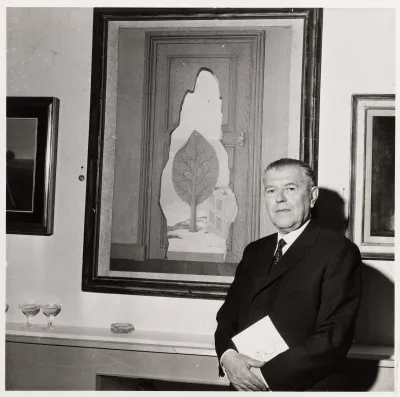
René Magritte
Human Design Chart
Biography
Prior to devoting himself to art, he worked as a civil servant.
His childhood was heavily traumatic with the death of his mother when he was 12; she drowned herself with no explanation.
In 1913, Magritte met his wife-to-be for the first time. The couple drifted apart, but eventually re-met in the early '20s and married. In 1927, they moved to Paris but three years later returned to Brussels where they spent the rest of their lives.
Magritte died on 15 August 1967 in Brussels, Belgium.
What does Generator 5/1 mean for René Magritte?
Generator 5/1 — Design at a Glance
René Magritte's design inclined towards great endurance if he followed his inner impulses. As a Generator, he had plenty of sacral energy, which made him extremely strong and resilient - provided this power was used for tasks that truly mattered to him. His fundamental life strategy involved not initiating but responding to signals from life. Only through this reaction could he unleash his full potential.
This mechanism held two crucial pitfalls. If René Magritte continuously did things he disliked, he wasted his strength and tended towards exhaustion. Conversely, he suffered frustration when prevented from working on his heart project despite still being full of power. Unlike other types, his effectiveness didn't stem from independently initiating processes but rather by responding to external stimuli.
The most successful approach for him was waiting until the sacral center gave a clear 'yes' signal and then acting upon it with concrete action. Living in harmony with this strategy rewarded him with deep fulfillment and made him unstoppable. However, if he constantly initiated himself or suppressed his impulses, sooner or later he faced persistent frustration and a noticeable lack of energy. His design thus manifested not through creating new paths but by powerfully meeting what came his way.
Sacral Authority
René Magritte did not make decisions through cognitive analysis but followed an inner resonance. His inner authority was the Sacral Authority, a mechanism exclusive to the Generator type and identical to its strategy. This fundamentally simplified his decision-making process: instead of pondering, he responded to external stimuli with physical reactions - often as a 'gut feeling', surge of energy or sounds like grunts or hums.
This reaction was the signal for the right direction. When his Sacral Center kicked in, René Magritte felt vital and alive; he had inexhaustible energy and tackled tasks with great enthusiasm. He moved through life with joy and satisfaction without being bound to a purpose.
This spontaneous nature was supported by the connection to the Spleen Center. The active Spleen Center served as an authoritative support, giving him immediate access to instinctive perception and physical well-being. This allowed René Magritte to react particularly quickly and spontaneously. He let himself be guided by this reliable inner compass that enabled him to act in the moment rather than getting stuck in lengthy deliberations. His life energy thus showed not as planned projects but as a direct, enthusiastic response to life itself.
The 5/1 Profile — Heretic / Investigator
René Magritte's design inclined towards duality: he had the magnetic presence of a Hero (Line 5), attracting others to solutions, yet needed the deep withdrawal of the Researcher (Line 1) for his own knowledge accumulation. This configuration created an inherent tension between his innate dignity and environmental pressure. Others projected competence onto him and expected answers, which without clear boundaries quickly led to exhaustion. The mechanics describe this as managing projection: His strength lay in removing obstacles (Gate 59), yet Line 1 required time for observation and safety before engaging. Magritte had to learn to say no to protect his resources from over-demanding use. Only by doing so could he maintain the balance between private research and availability for others. Perceived arrogance often served as a protective mechanism to preserve this necessary distance and prevent his strength from being drained by uninvited inquiries. His success depended on setting these boundaries and using his gifts purposefully rather than being depleted by external expectations.
Single Definition — Defined & Open Centers
René Magritte's design showed a tendency towards a strong somatic foundation, paired with high mental and emotional permeability. His foundation was the defined triad of Sacral, Spleen, and Root Centers. The defined Sacral Center generated constant vital energy that was activated through reaction; its truth lay in the immediate yes/no response of the gut, not in rational planning. Parallel to this, the defined Spleen Center functioned as an intuitive authority making momentary judgments about health and well-being – knowledge valid only in the present moment. The also defined Root Center provided a specific pressure towards material existence and survival, propelling him forward in the world.
In contrast, Head, Ajna, and G Centers were open. René Magritte did not have consistent mental inspiration or fixed identity. His open Head Center tended to absorb external mental pressure; he risked getting entangled in questions that weren't his own rather than trusting his inner authority. The open Ajna Center made him receptive to foreign concepts and theories without possessing them as personal truth. His open G Center meant that identity and direction were situational, shaped by the environment; he relied on being initiated through the right place and people instead of prescribing a fixed life path.
Heart and Solar Plexus Centers were also open. The open Heart Center lacked consistent willpower; he tended to want to prove his worth through promises or performance, often ending in frustration as the structural energy for this was not present. The open Solar Plexus Center absorbed and amplified emotional moods of the environment. He risked personalizing foreign emotions as his own and losing himself in others' emotional waves rather than having a stable emotional life of his own. The challenge lay in using inner somatic authority to protect himself from being overwhelmed by external influences.
Channels for focused intuition and individual power.
René Magritte's design inclined towards quiet, focused detail evaluation paired with intuitive awareness of the environment. This configuration created an internal rhythm of concentrated attention and spontaneous responsiveness.
The Channel of Concentration 52-9 connected the Root Center to the Sacral Center through the Gate of Non-action (52) and the Gate of Focusing (9). This formative energy generated a permanent, calm pressure towards stillness. The body was held still to use energy precisely; distractions or multitasking were rejected. René Magritte continuously evaluated details of his engagement, physically and sensorially holding in place like a yoga pose until the Sacral Center reacted. This allowed him to correct and perfect patterns by applying logic step-by-step to confirm or refute formulas.
Parallelly, the Channel of Power 34-57 acted as an archetype of individual survival. It connected the Spleen Center via the Gate of Intuitive Insight (57) to the Sacral Center and there to the Gate of Power (34). This energy strengthened intuitive capacity through sacral reaction for survival. It kept René Magritte alive by alerting him to danger and tuning him into vibrations in his environment. The combination of spleen intuition and sacral power enabled quick, spontaneous decisions in fractions of a second, independent of others' needs. This was a defensive, intuitive intelligence based on mammalian memories that helped him navigate safely through each moment.
Additionally, Gates like Gate 8 (Contribution), Gate 59 (Genetic Strategy), and Gate 14 (Power Handling) contributed to the expression of his identity. Gate 58 in the Root Center promoted experiments and perfectionism, while Gate 5 represented the fundamental rhythm of all life processes. These elements shaped a stance of selective perception and focused energy application that enabled René Magritte to focus on essential aspects of his creation while using his intuitive survival intelligence.
Individual Circuitry — Circuit Signature
René Magritte's design inclined towards rational structure and logical strategy aimed at improving societal conditions through focused thinking. His cognitive orientation was characterized by visual thinking and future orientation, sharing insights free from emotional conditioning. This 'emotionless ratio' arose because the Solar Plexus Center was not included in his active circuits; its energy remained purely rational.
The Understanding Circuit shaped this attitude. In René Magritte, it connected the Sacral to the Root Center (Group 1). This generated constant focused energy on logical connections and clear strategy transmission for a better future. Parallel to this, the Integration Circuit acted. Here, it linked the Sacral with the Spleen Center (Group 2). This separate connection ensured he drew strength from reacting to life through intuitive knowledge and proper behavior to realize it in the present moment. As René Magritte was a Simple Definition, Sacral, Root, and Spleen Centers formed one directly connected energetic group. This allowed seamless flow between the rational strategy of Understanding and the intuitive self-reinforcement of Integration without these areas being perceived as contradictory.
Left Angle Cross of Uncertainty 2
René Magritte's design created an existence that operated in the tension between the familiar and the unfamiliar. His fundamental approach was characterized by navigating situations where certainties crumbled or were never fully graspable. This corresponded to the mechanics of the left cross of Uncertainty 2.
This configuration did not define a search for final answers but accepted uncertainty as necessary space for new perspectives. Magritte did not present himself as someone who wanted to immediately close these gaps, but rather as one who knew how to dance with uncertainty. A stance of open questions instead of closed results emerged.
The programming of his design promoted behavior that did not value doubts and uncertainties as deficits. Instead, they became the starting point for a different kind of seeing. Magritte lived in a reality that refused to be static; it constantly changed through the lack of absolute certainty. This dynamism shaped his entire orientation: he remained in the state of possibility rather than coming to rest in knowledge. The left cross of Uncertainty 2 thus created an inner compass oriented not towards stability but towards penetrating the enigmatic. Magritte used this space to make the visible questionably interrogable without having to explain it.
Saturn Return · Uranus Opposition · Chiron Return · 2nd Saturn Return — Life Cycles
René Magritte's artistic development followed a clear cyclical structure marked by four distinct astrological phases. These cycles served as a framework for his productive periods and the building of his reputation.
In 1926, at age 28, the first Saturn return occurred. This cycle condensed years of groundwork into a solid result: Magritte created his first surrealist painting, “The Lost Jockey”. It marked the transition to a new phase in his career.
Ten years later, in 1938 at age 40, the Uranus opposition took effect. This time often brings sudden changes or public visibility. Magritte was represented at the Exposition Internationale du Surréalisme in Paris, solidifying his success within the surrealist circle.
The Chiron return around age 49 is a fulfillment cycle where one's life purpose unfolds if they follow their strategy. In 1947, Magritte had his first exhibition in New York City. This showed international recognition and the flourishing of his work.
Finally, the second Saturn return occurred at age 58. This cycle often confirms achieved status and mastery. In 1956, Magritte won the Guggenheim Prize for Belgium, a recognition that cemented his position as a significant artist. These four points form the backbone of his documented artistic career.
Generator · Sacral Authority — Synthesis
He was a Generator with sacral authority whose life was marked by a deep drive towards activity and the need to invest energy in tasks that brought him satisfaction. The connection between Sacral Center and Root Center (Channel of Concentration) indicates an ability to focus intensely on details and use format energy for improvements - a process reinforced by the Hero/Researcher Profile. He sought profound knowledge and offered it to others to solve problems, with Line 5 placing him in a position where he constantly had to answer inquiries.
A central paradox lay in the interplay between his immense, vital energy source (Sacral Center) and the necessity of selectively deploying this energy. The sacral authority demanded that he listen to his inner voice and only say “Yes” when a real surge of power was felt; simultaneously, the 5/1 Profile suggests that he found himself in the role of problem solver, thus potentially risking wasting energy on issues that did not truly fulfill him. The documented events - from his first surrealist works to winning the Guggenheim Prize - showed how he continually balanced this tension by focusing on projects that activated his inner energy and allowed him to share his knowledge.
2 Defined Channels
Incarnation Cross - Left Angle Cross of Uncertainty 2
Solar Return
The Solar Return shows the moment when the sun returns to its exact birth position - your personal solar year.
Life Cycles
Discover the life cycles with a detailed triple view (birth chart, cycle chart, composite).
Human Design Profile
- Type
- Generator
- Strategy
- To respond - wait for something to respond to
- Authority
- Sacral Authority
- Profile
- 5/1 - Heretic / Investigator
- Definition
- Single Definition
- Incarnation Cross
- Left Angle Cross of Uncertainty 2
- Date of Birth
- 21.11.1898 07:30
- Place of Birth
- Lessines, Belgium
Frequently Asked Questions
What was René Magritte's Human Design type?
Which Profile did René Magritte have?
What was René Magritte's Authority?
What incarnation cross did René Magritte have?
When was René Magritte born?
Discover your own Human Design
Are you also a Generator? Find out in a personal reading how to use your sacral energy correctly and discover deep satisfaction.
More Personalities
Back to overviewAaliyah

Alexia

Angèle

Anne-Marie

Arcángel

Arno