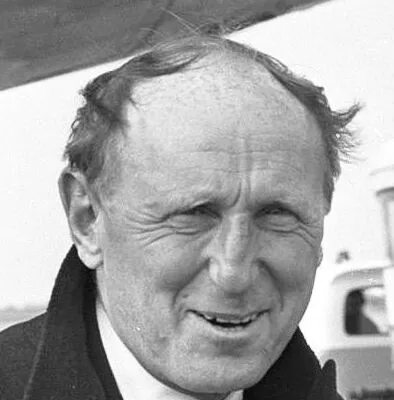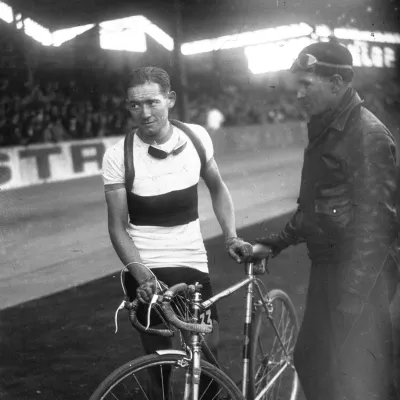
René Vietto
Human Design Chart
Biography
He died on 14 October 1988 in Orange, Vaucluse, France.
Human Design Analysis: René Vietto as Projector 4/6
Projector 4/6 — Design at a Glance
René Vietto appeared as someone with a dense, focused aura that directly engaged his surroundings. His Projector design indicated that he could immediately spot errors in systems or relationships of others, much like a bright flashlight shining into dark corners. However, this ability to identify what wasn’t working was coupled with a specific challenge: when he expressed these observations without being asked or too directly, it could cause resistance or discomfort in others, as if he was shining the light too brightly in their faces.
The mechanics of his design suggested that his true strength lay not in direct correction but in shining through his own harmonious light. By walking his own path and maintaining a healthy radiance, he naturally drew others to him. People would then come to him voluntarily seeking advice, rather than feeling lectured. This underscored the central strategy for Projectors: waiting for an honest, appreciative invitation before offering leadership.
Furthermore, René Vietto lacked a defined Sacral Center, meaning he did not have a constant, intrinsic life force. Instead, he experienced phases of high productivity followed by necessary rest periods for regeneration. Without these pauses, there was a risk of burnout. Living in harmony with this structure rewarded him with success; ignoring it risked bitterness as an expression of not being true to himself. His design thus demanded a balance between sharp observational skills and the patience to act only when invited.
Emotional Authority
René Vietto was someone who did not make decisions immediately but let them mature within him. His design featured Emotional Authority, meaning his defined Emotional Center was his inner voice. This configuration was subject to natural waves of emotional ups and downs. The world appeared to him colored by his current mood: the same thing could seem totally exciting at one moment and completely negative the next.
This constant emotional seesaw was not a flaw but a mechanism. The feeling in the immediate moment was merely a snapshot, a first impression that did not necessarily reflect the deeper truth. Decisions made spontaneously based on current emotions could often have negative consequences, as they were based on passing waves.
The strategy of his design was to allow time. The longer René Vietto let a decision rest, the deeper and more comprehensive he could understand the situation. This required patience and the conscious overnighting of important questions. Through this delay, intense feelings subsided, he gained emotional distance, and clarity and calm eventually set in. Only then, after the emotional process was complete, did the true answer lie. This mechanism was particularly crucial for long-term, life-defining decisions, ensuring that the choice was based on a stable, clear understanding and not a passing mood.
The 4/6 Profile — Opportunist / Role Model
René Vietto was seen in his first half of life as an experimental networker who learned through diverse relationships and friendships. This behavior matched the effect of Line 4 in Profile 4/6, which often acts like Line 3 before the age of 30, promoting curiosity and social exploration. Later, an internal conflict emerged: the desire for community (Line 4) was in tension with the need for distance and spiritual reflection (Line 6). This conflict between heart and head shaped his development.
Line 4, associated with Gate 30 “Burnout,” pushed him to be influential in the network but also carried the risk of an emotional breakdown from excessive energy output. Analytical thinking helped him channel this intensity. Simultaneously, Line 6 with Gate 14, which touches on themes like wealth, power, and humility, revealed the insight that material success can be understood as divine will. René Vietto did not involve himself lightly but primarily responded to mutations or events of great significance. In his later years, he was expected to serve as a wise role model, always careful not to open his heart to the wrong people to avoid being hurt.
Split Definition — Defined & Open Centers
René Vietto was characterized by a persistent internal pressure to ask questions and understand connections. His defined Head and Ajna Centers created a specific mental structure that drove him to process inspirations, yet he was unable to directly translate these into action. This mental process was a source of concern for him when he tried to resolve unanswered thoughts immediately. Instead, he acted as a catalyst, encouraging others to think, while he himself had to practice patience, waiting for clarity.
This inner dynamic was deepened by his defined Solar Plexus Center. His emotional wave served as an inner authority; truth revealed itself to him only over time. He tended to postpone decisions until the emotional charge had subsided, to avoid impulsiveness. At the same time, his defined Root Center provided the physical pressure to move forward in the world, which often came with stress when this was not channeled through his emotional clarity.
In contrast, his undefined G Center revealed a flexibility of identity. René Vietto did not seek a fixed role but allowed himself to be initiated by his environment and relationships. He reflected the directions of others, making him susceptible to “borrowed” identities when he was not in the right place. His open Heart Center protected him from having to prove his worth through sheer willpower, although he was under pressure to make promises he could not keep.
His undefined Sacral Center meant that he did not have constant vital energy. He absorbed the energy of his surroundings and risked overloading if he ignored his limits. His open Throat Center led to him not speaking consistently, but waiting for invitations to express himself, thereby avoiding the need to force attention. Finally, his undefined Spleen Center showed a tendency to fear survival, causing him to cling to things that were not good for him, rather than acting spontaneously.
Channels for inner restlessness and mental patterns.
René Vietto was marked by a deep, often restless drive for new experiences, filtered through a complex, constantly shifting mental process. This configuration created a tension between the immediate emotional hunger for life and the need to distill meaning from the flood of impressions.
The Channel of Perception 41-30 connected the Root pressure with the emotions of the Solar Plexus. The urge for change fueled the imagination, while the emotional wave strengthened the desire to embrace new situations. This impulse required patience to gain clarity before acting. Parallel to this, the Channel of Abstraction 64-47, connecting the Head and Ajna Centers, drove a mind that filtered every experience through a kaleidoscope of mental images in search of an underlying story or perspective. The mental confusion of this channel, however, could, if endured patiently, lead to moments of deep insight that René Vietto could pass on.
Additional tones set Tone 29, emphasizing the art of saying the right “yes” and persistence in the face of challenges, as well as Tone 8, focusing on individual contribution and leadership. Tone 14 added the ability to handle power and resources with grace, while Tone 63 propelled the mental process through doubt and the pursuit of security. Tone 52 called for a concentrated pause and pattern correction, and Tone 19 anchored the search for security, resources, and spiritual connection in the community. Tone 22 enabled a calm, open attitude in the social space, and Tone 54 linked the drive for worldly success with the search for mystical knowledge. Together, these elements formed a design that oscillated between intense experience and reflective understanding.
Collective Circuitry — Circuit Signature
René Vietto's design tended to emotionally process past experiences and draw meaning from them. This attitude arose from the structure of his Perceiver Circuit, which focused on feelings and memories rather than cool, future-oriented logic. The energy flowed in wave-like patterns: each emotional cycle had a clear beginning, middle, and end, leading to a cyclical, often inexplicable way of experiencing.
Due to his split definition, this energy consisted of two separate, not directly connected strands. The first strand connected the Head with the Ajna Center (Channel Abstraction). This created an inner, visual clarity and the ability to abstractly organize complex ideas. The second, independent strand connected the Solar Plexus with the Root Center (Channel Perception). Here lay the emotional wave driven by internal tensions.
Although both parts were defined, they did not flow together. Thus, René Vietto carried a parallel intellectual structure for abstraction and a separate emotional intensity. The central theme of this circuit was sharing these felt insights with the collective to learn together from the past. Visual and emotional impulses served to extract hidden connections from one's own history and make them accessible to others. This configuration marked him as someone who found meaning not through rational planning, but through reflective living and the passing on of emotional truths.
Right Angle Cross of Contagion 1
René Vietto was characterized by a specific energetic alignment known as the 'Right Cross of Contagion 1'. This configuration shaped his way of interacting with the environment. It indicated a tendency to unconsciously transmit his impulses or attitudes to others, without always intending to influence them consciously.
In Human Design mechanics, this cross describes a dynamic force that works from the inside out. It's not about negative manipulation, but rather a natural radiation of energy that can touch or activate people nearby. René Vietto lived with this characteristic, which allowed him to quickly draw attention or change moods, often even before he spoke.
This mechanism meant that his mere presence could already have an effect. Other people might have reacted to his energy before understanding the content of his words. This created a special dynamic in interpersonal encounters, where the emotional or energetic level took precedence over rational communication. For René Vietto, this was an integral part of his design, which significantly shaped his interactions with the world and gave him a certain magnetic quality that he could not control but could accept.
Saturn Return · Uranus Opposition · Chiron Return · 2nd Saturn Return — Life Cycles
René Vietto showed himself to be someone who could unfold his true strengths under pressure and in challenging environments. His Human Design chart indicated a tendency towards structured endurance and the ability to produce clear results from difficult situations. This was particularly evident during his first Saturn Return, a life phase often associated with consolidating earlier experiences and building a stable foundation.
In 1941, at the age of 27, René Vietto won the French road championship in the unoccupied zone. This success was no coincidence but aligned with the mechanics of his design: the Saturn Return marked a point where years of hard work and discipline condensed into a solid result. In a time marked by uncertainty and restrictions, Vietto demonstrated how his design enabled him to focus on the essentials and deliver top performances despite external adversities.
His design promoted a stance of resilience and perseverance. While others might have been overwhelmed by the turbulent circumstances, Vietto used these challenges to sharpen his skills and prove himself. The championship victory was thus a concrete example of how his Human Design layout allowed him to not only survive but thrive and find recognition during critical phases of his life. This ability to draw strength from pressure shaped his career and underscored the importance of the Saturn Return as a phase of maturation and success.
Projector · Emotional Authority — Synthesis
René Vietto lived a path marked by a profound ability to recognize patterns and make them understandable for others. His Projector design, combined with emotional authority and a defined Head Center, points to a person who perceived the world through a fine filter of feelings and an unceasing search for understanding. He was destined to bring light to the dark (Projector), by being fueled by mental pressure (defined Head Center) to recognize the unspoken dynamics and potential stumbling blocks in relationships and systems (Channel of Recognition). This gift, coupled with the cyclical nature of his emotional wave (Sensing Circuit), shaped his ability to learn from experiences and share these insights.
A central tension in his design lay in the conflict between the need for recognition and belonging (Line 4 in Profile) and the drive to act as an independent thinker and observer (Line 6). He sought connections with others to share his insights, yet simultaneously needed withdrawal to grasp the deeper connections. This internal contradiction, evident in his life – exemplified by his success in the race (Saturn Return) – revealed a personality seeking its place both within the collective and in isolation.
2 Defined Channels
Incarnation Cross - Right Angle Cross of Contagion 1
Solar Return
The Solar Return shows the moment when the sun returns to its exact birth position - your personal solar year.
Life Cycles
Discover the life cycles with a detailed triple view (birth chart, cycle chart, composite).
Human Design Profile
- Type
- Projector
- Strategy
- Wait for the respectful invitation
- Authority
- Emotional Authority
- Profile
- 4/6 - Opportunist / Role Model
- Definition
- Split Definition
- Incarnation Cross
- Right Angle Cross of Contagion 1
- Date of Birth
- 17.02.1914 06:00
- Place of Birth
- Le Cannet, France
Frequently Asked Questions
What was René Vietto's Human Design type?
What profile did René Vietto have?
What authority did René Vietto have?
What incarnation cross did René Vietto have?
When was René Vietto born?
Discover your own Human Design
Are you also a Projector? Find out in a personal reading how to unfold your leadership qualities and recognize the right invitations.
More Personalities
Back to overviewSissy Spacek
Alain-Fournier
Aldair

Anémone
Ann-Margret

Bourvil