
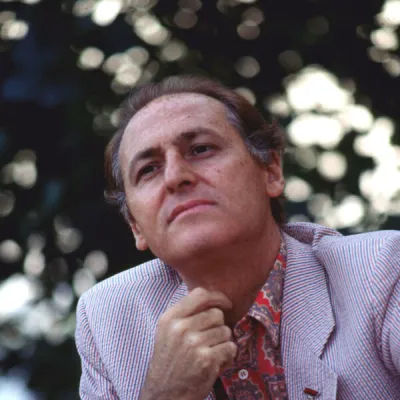
Renzo Arbore
Human Design Chart
Biography
Arbore became nationally recognized as a radio anchor, together with Gianni Boncompagni, in the late 1960s, with shows such as "Bandiera gialla" (1965), "Per voi giovani" (1967), and "Alto Gradimento" (1970), increasingly marked by their ironical approach which later became one of their brands.
He debuted in Italian television with "Speciale per voi" (1969–1970), which included debates about singers of that period. His first great TV success was the surreal "L'altra domenica" ("The Other Sunday", 1976–1979), in which he launched numerous comedians including Mario Marenco, Isabella Rossellini and Roberto Benigni. Also very successful were "Quelli della notte" (1985), with Nino Frassica, Riccardo Pazzaglia, Maurizio Ferrini, and Roberto D'Agostino, and "Indietro tutta!" (1988), again with Frassica, which established Arbore as one of the most intelligent cult figures of Italian television.
In the meantime Arbore wrote and directed the movies "Il pap'occhio" (1980) and "FF.SS. – Cioè: ...che mi hai portato a fare sopra a Posillipo se non mi vuoi più bene?" (1983), both surreal stories featuring numerous actors launched by him and others friends, set in his adoptive city of Naples. Arbore also played and sang in numerous shows, notably in "Quelli della Notte" and "Indietro tutta!," whose music albums sold hundreds of thousands of copies in Italy.
An accomplished amateur clarinet player, in 1991 Arbore founded the Orchestra Italiana, a group of 15 artists with the aim to popularize Neapolitan music worldwide. The orchestra has toured in Europe, Asia, and the Americas. He was also director of the Umbria Jazz festival. His latest TV show is "Speciale per me - Meno siamo, meglio stiamo!" on Rai Uno.
Recently, he received the 2010 America Award from the Italy-USA Foundation.
Human Design Analysis: Renzo Arbore as Manifesting Generator 5/1
Manifesting Generator 5/1 — Design at a Glance
Renzo Arbore revealed himself as someone who possessed a constant, sacral energy source combined with a unique ability to accelerate processes and achieve results swiftly. His design tended towards handling multiple projects simultaneously, rooted in what is called a 'play mode' - a state of pure creative joy amidst variety.
As an Manifesting Generator, he had the endurance of a generator through his defined Sacral Center, which led him to react to external impulses rather than initiate himself. At the same time, he differed from pure generators by being able to skip steps in action. This speed came with risks: often skipping necessary intermediate steps meant having to return later and make up for them - a potential source of frustration. Additionally, he tended to start many things at once. If his inner authority or Sacral Center did not clearly agree ("Yes!"), the initial enthusiasm quickly turned into exhaustion.
Therefore, the mechanics of his design required strict self-examination: only when he was sure that his inner self continued to approve of parallel activities could he use his speed without overtaxing himself. In this correct mode - react, agree, play - he found deep satisfaction in creation while the compulsion to focus on one thing alone felt more hindering than beneficial.
Emotional Authority
Renzo Arbore showed an internal decision-making structure that did not rely on immediate clarity but moved through wave-like emotional currents. His design indicated that his defined Solar Plexus Center carried his authority, meaning he could only trust in the truth of his feelings after going through the natural rhythm of highs and lows. A first impression was often misleading; what appeared overwhelmingly positive or negative at a moment was merely a passing mood state, not the final truth.
Quick, spontaneous decisions from this emotional heat would have destabilized his design and led to misjudgments. Instead, his mechanics required patience. Waiting became the central instrument: he had to give himself time, ideally 'sleeping on' a decision, for the initial brightness or darkness of emotion to fade away. Only when these waves subsided and an emotional distance was gained did calmness set in. This process of waiting served as a protective mechanism against impulsive action. Through this delay, he could discern what truly held merit and what was merely a passing reaction to a stimulus. His authority thus lay not in the speed of response but in the depth of clarity that emerged only after the subsiding emotions.
The 5/1 Profile — Heretic / Investigator
Renzo Arbore was marked by a paradoxical dynamic: a deep internal need for withdrawal to research stood in contrast to an almost compulsive external attractiveness to others. His design as Profile 5/1 (Hero/Researcher) suggested that he not only gathered knowledge but offered it to others for problem-solving. Line 1 in Gate 17 promoted openness and introspection; it allowed him to integrate various opinions and better grasp reality through a broad spectrum of perspectives. This formed the foundation of his intellectual depth.
Simultaneously, Line 5 was magnetic. Others often sought Renzo Arbore for solutions to their own problems, drawn by the knowledge he had to offer. However, this constellation brought a specific risk: without clear boundaries, exhaustion through excessive demand threatened. The image of an expert answering questions in conferences and then being drained illustrated this danger of depletion.
The challenge lay in maintaining balance between private research (Line 1) and public availability (Line 5). Renzo Arbore had to learn to say no to use his gifts optimally without sacrificing himself. Only through this demarcation could he avoid overcompensating as an authority figure and instead act sustainably.
Quadruple Split Definition — Defined & Open Centers
Renzo Arbore was characterized by a design with immense internal structure and constant energy availability. His system was almost entirely defined, leading to a persistent presence in mental inspiration, conceptual thinking, communication, identity, sacral energy, emotional depth, intuitive health, and stress management.
This complete system provided him with a reliable foundation: The defined Head and Ajna Centers generated a permanent mental pressure to question and understand, while the G Center ensured clear self-identity and direction. His energy source was in the defined Sacral Center, which functioned as a motor and supplied vital power through reaction rather than initiation. Emotional decisions were guided by the Solar Plexus, requiring him to wait for emotional clarity before gaining insight. Intuition and health were perceived in the moment by the defined Spleen Center, while the Root Center provided the necessary pressure for survival.
The only gap in this dense structure was the open Heart Center. Here, a consistent willpower or ego energy was missing. Instead, Renzo Arbore tended to adopt foreign patterns of will and possibly compensate through promises or competition to prove his worth – a typical pattern for this open center. The challenge was not to fall into the trap of wanting to do more than necessary or making promises that lacked sacral confirmation.
His strategy was to wait for reaction (Sacral) combined with waiting for emotional clarity (Solar Plexus). Rather than forcing it willfully, he used his constant mental and energetic presence to react to life when it called upon him. This protected him from exhaustion through excessive willpower exertion and allowed him to effectively and sustainably utilize his immense internal structure without getting lost in the spiral of self-worthlessness.
Channels for rhythm, self-acceptance, logic, clarity, change and vision.
Renzo Arbore was marked by a natural, magnetic attraction that shaped his life flow. His design tended to unconsciously draw others into his own rhythm without actively trying to do so. This quality came from Channel Rhythm 5-15, which connects the Sacral Center with the G Center. Gate 5 holds onto fixed habits and rituals, while Gate 15 playfully integrates the diversity of society into life flow. This channel is a cornerstone of biological processes, guiding Renzo Arbore by a universal vital pulse. His reactions from the Sacral Center determined an intuitive timing that worked effortlessly for him and helped others find their own rhythm.
In addition to this constant stream, other mechanisms were at work. Channel Exploration 10-34 promoted deep self-acceptance and the ability to live one's convictions independently of external expectations, creating an aura of individual strength based on inner truth. Simultaneously, Channel Judgment 18-58 brought a drive for perfectionism and correction of patterns, with Gate 58 driving life will and Gate 18 providing a sense of imbalance.
Mentally, he was marked by Channel Awareness 24-61 and Channel Abstraction 47-64. The first allowed spontaneous insights and knowledge that revealed itself at his own pace, often associated with a love for silence. The second processed experiences through kaleidoscopic mental images, seeking stories and meaning connections, even if this sometimes caused confusion.
Channel Transience 35-36 drove him to collect new emotional experiences to gain wisdom, using Gate 36 as a catalyst for crises and Gate 35 manifesting the desire for change. Individual gates like Gate 17 (Succession and logical teaching), Gate 2 (Sensitivity to evolutionary directions), and Gate 43 (Breakthrough of individual insights) underscored his role in communicating new knowledge while also knowing the fear of rejection. Gate 45 in the Throat Center bound him through willpower to the stem, while Gate 27 radiated genetic care. Finally, Gate 56 allowed him to translate mental processes into figurative narratives that shaped collective stories.
Collective Circuitry — Circuit Signature
Renzo Arbore showed a tension between rational future orientation and emotional past resolution. With Quadruple Definition, there are four separate energy groups that do not flow directly but work parallel. One group connected the Identity with the Sacral Center (Centering Circuit), creating firm internal convictions that were hard to verbalize due to no connection to the Throat Center. Parallel to this worked an isolated Head-Ajna connection (Knowledge Circuit) as a source of individual creativity and awareness. A third group linked Spleen and Root Centers (Understanding Circuit), enabling strategic logic and focus without emotional coloring. The fourth group included Throat and Solar Plexus Centers (Purpose Finding Circuit) along with Head-Ajna, separate from the first Ajna group. This allowed for cyclical reflection of past experiences and their emotional expression in the collective while rational analysis proceeded separately. Thus, energy was not integrated: rigid internal principles stood alongside creative impulses, strategic distance, and wave-like emotionality. Renzo Arbore navigated through these isolated fields of power, each group retaining its own dynamics – from unspoken identity to abstract processing of the past – without forming a single, continuous flow.
Left Angle Cross of Prevention 1
Renzo Arbores Human-Design reveals a tendency towards strategic foresight, characterized by the desire to avoid mistakes through proactive action. This attitude stems from the configuration of the 'left cross of prevention 1'. It is a specific energetic structure in Human Design that does not rely on spontaneous impulses but rather on careful planning and anticipation of potential risks.
The mechanics of this cross describe a process where the individual learns to recognize obstacles before they become problems. It is less about reactive crisis management than proactive creation of security through clear structures and preparatory measures. In this context, Renzo Arbore demonstrated an emphasis on reliability and stability by predefining action spaces in advance.
This energy promotes a sober assessment of one's own possibilities and limitations. Instead of blind trust, conditions are checked to see if they are conducive to successful endeavors. The goal is to keep the path clear of unnecessary stumbling blocks. Through this kind of foresight, decisions do not have to be made out of panic or pressure but rather on a solid foundation of preparation. It is an energy of responsibility towards oneself and one's projects that works through discipline and clarity.
Saturn Return · Uranus Opposition · Chiron Return · 2nd Saturn Return — Life Cycles
Renzo Arbore showed in his professional career as someone whose development was marked by clear structural turning points. His design indicated a tendency towards significant phase changes, each opening new dimensions in his career. This became visible in 1965 at the age of 28 with his debut in shows like 'Bandiera gialla' – marking the start of his first Saturn return cycle, where years of groundwork often condense into a solid public result.
A decade later, in 1976 at the age of 39, he launched the format 'L’altra Domenica'. This fell during the Uranus opposition phase, a time when internal tensions push for resolution and new freedom; here Renzo Arbore was ready to break established structures and take innovative paths.
The third significant event occurred in 1986. At age 49, he reached second place at the Sanremo Festival with 'Il clarinetto'. This corresponded with his Chiron return cycle between ages 49 and 51, a fulfillment period where one's incarnation cross increasingly unfolds in life; if lived according to personal strategy, meaning and purpose become experiential. Renzo Arbore did not use this time for healing old wounds but rather for the blossoming of his artistic identity, which now resonated with a broad public.
Manifesting Generator · Emotional Authority — Synthesis
Renzo Arbores Human-Design reveals a central thread of dynamic adaptability fueled by the combination of an Manifesting Generator type, emotional authority, and strong connections between Sacral Center, G Center, and Head Center. This constellation points to someone who has constant energy available (Sacral), but only after internal maturation and consideration (emotional authority) can translate this into concrete steps. The connection to the G Center gives this dynamic a clear direction and sense of identity, while the activated Head Center continuously provides new inspirations – a cycle of reaction, reflection, and manifestation marked by the ability to adapt to changing circumstances.
A central paradox in Renzo Arbores chart lies in the tension between the urge for rapid initiation (Manifesting Generator) and the necessity of emotional clarity (emotional authority). The design shows someone who potentially acts quickly but is compelled through the defined Solar Plexus Center to first emotionally digest these impulses. This tension between speed and maturity leads to an internal rhythm marked by phases of intense activity followed by times of reflection – a dynamic that both releases creative energy and contributes to avoiding hasty decisions.
6 Defined Channels
Incarnation Cross - Left Angle Cross of Prevention 1
Solar Return
The Solar Return shows the moment when the sun returns to its exact birth position - your personal solar year.
Life Cycles
Discover the life cycles with a detailed triple view (birth chart, cycle chart, composite).
Human Design Profile
- Strategy
- To respond - wait for something to respond to
- Authority
- Emotional Authority
- Profile
- 5/1 - Heretic / Investigator
- Definition
- Quadruple Split
- Incarnation Cross
- Left Angle Cross of Prevention 1
- Date of Birth
- 24.06.1937 06:00
- Place of Birth
- Foggia, Italy
Frequently Asked Questions
What is Renzo Arbore's Human Design type?
What Profile does Renzo Arbore have in Human Design?
What Authority does Renzo Arbore have?
Which incarnation cross is active for Renzo Arbore?
When was Renzo Arbore born?
Discover your own Human Design
Are you also a Manifesting Generator? Find out in a personal reading how to unfold your multi-talents and direct your energy wisely.
More Personalities
Back to overviewSissy Spacek

Aldair

Alizée

Anémone

Angeli

Ann-Margret
