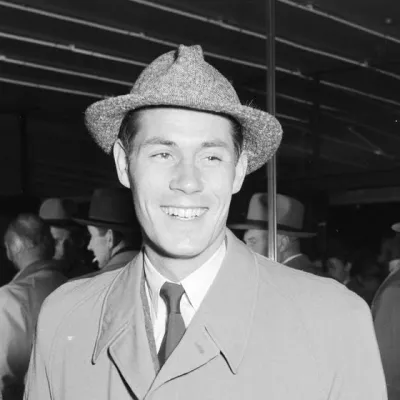
Roald Aas
Human Design Chart
Biography
Aas also was a successful cyclist, winning the 1956 Norwegian Championships in both road cycling and track cycling. For his achievements as both a speed skater and a cyclist, Aas was awarded the prestigious Egebergs Ærespris in 1956. After his retirement, he worked as a stock manager for Jordan Dental.
Aas died on 18 February 2012, aged 83.
Roald Aas as a Manifestor 1/3 in Human Design
Manifestor 1/3 — Design at a Glance
Roald Aas was configured as a Manifestor in Human Design, which shaped him into the role of a trailblazer and visionary. His design laid out an imperial dynamism: He had the power to steer the world in new directions but did not fight the necessary battles himself; instead, he delegated their execution to others. This superior, often forward-thinking perspective inevitably led to polarization; he was loved and followed by some for his great dreams while being misunderstood or even hated by others. This conflict was not a personal failure but a structural characteristic of his type. To minimize these tensions and attract the right followers, his design required the strategy of informing. By enlightening others about his intentions and visions in advance, he filtered out those who could follow him from those who resisted. If Roald Aas followed this strategy of informing, he was rewarded with a deep sense of inner peace. Conversely, if he acted against this design without prior information, it led to lasting, profound anger. Thus, his path involved creating the right environment for his visions through clear communication and receiving inner peace as a reward for living according to his nature.
Emotional Authority
Roald Aas showed himself to be someone who did not base his decisions on the first emotional wave but waited for its natural rhythm. His design featured an emotional authority carried by the defined Solar Plexus Center, subject to constant waves of mood swings. Perception was always colored by the current emotional state: What appeared inspiring in one moment could seem negative in the next.
This mechanism meant that immediate feelings were merely snapshots – first impressions not yet containing the final truth. Quick, spontaneous reactions to these transient emotions would often lead to misjudgments. Instead, his inner logic required patience and strategic delay. Roald Aas used time to let decisions mature by repeatedly “sleeping on them.” Through this process of distancing, initial intense emotional responses gradually subsided.
Only when the emotional wave had died down and clarity and calmness set in did he make his final decision. This method of multiple reflections served to gain deeper insights that went beyond surface-level mood swings. Especially for long-term, life-defining questions, this path of waiting and letting things settle was crucial to ensure that the choice rested on a stable inner foundation rather than fleeting impulses.
The 1/3 Profile — Investigator / Martyr
Roald Aas showed himself as someone whose judgments were based on double testing: theoretical openness and practical experimentation. His design inclined him towards validating knowledge not just by consuming it but through personal action. This attitude stemmed from his Profile 1/3, the Researcher/Experimenter. The Line 1, marked by Gate 17 of Openness, allowed him to take in various opinions and theories without immediately settling on them. This created a broad foundation for perceptive thinking and future perspectives. Simultaneously, the energy of Line 3 drove him to stimulate himself and act independently from others. Here lay the urge to experiment, often coupled with awareness of his own inexperience.
The tension in his design arose from the interplay between these two forces. Sometimes fear of insufficient knowledge (Line 1) took control and hindered action. Yet the inner impulse for experience (Line 3) demanded testing, even at the cost of mistakes. The result was self-earned insights that had been both theoretically and practically vetted. If Roald Aas deemed something valuable, it had passed through both hurdles. His judgment was therefore considered absolutely trustworthy as it did not rest on mere assumption but on lived integration of theory and practice. The value lay never in the perfect first attempt but in the learning correction through personal experience.
Split Definition — Defined & Open Centers
Roald Aas presented himself through his design as someone with an extremely dense, constant inner structure. Six defined centers – Ajna (mental consciousness), Throat (communication), Heart (willpower), Solar Plexus (emotional authority), Spleen (intuition) and Root (stress management) – created a steady mental, emotional, and existential presence. This configuration gave him a highly consistent, trustworthy aura; he was not dependent on external conditions for his identity or energy base. His thinking was specific and reliable, his expression clear, his willpower self-determined. He possessed a deep emotional intelligence that required time to gain clarity, as well as a strong intuitive instinct in the here and now. The constant inner pressure of the Root Center drove him forward, while he managed stress in his own, defined way.
At the same time, his chart revealed three open centers: Head (inspiration), G-Center (identity/direction) and Sacral (generative energy). This openness meant that inspiration, life direction, and work energy were situational and influenced by the environment. The open Head Center made him vulnerable to mental overload from foreign questions or the pressure to find answers that weren’t his own. He tended to get caught up in intellectual whirlpools of others rather than trusting his inner authority. The open G-Center meant that identity and direction depended on the right environment and the right people; he reflected the energy of his surroundings instead of having a firm internal orientation. If he was at the wrong place, he felt lost or misunderstood. The open Sacral Center indicated that his generative work energy wasn’t consistently available. He was vulnerable to absorbing “borrowed” energy from others, which could lead to overexertion and exhaustion if he didn’t set clear boundaries. The challenge of his design lay in integrating this strong inner mechanism with the necessary awareness against conditioning by the outside world. He had to learn not to see his open nature as a lack but rather as space for initiation and adaptation while using his defined centers as a stable core.
Channels for judgment, structure, change and resources.
Roald Aas showed himself to be someone who recognized logical errors in patterns and corrected them through unique, often forward-thinking insights. His design combined analytical sharpness with innovative structuring, offering efficient solutions once invited.
The channel of Judgment 58-18 drove this process: Gate 58 (Vitality) demanded “better and more,” while Gate 18 (Correction) checked what was in balance. This created an insatiable urge to perfect patterns. Roald Aas did not use this energy as a critical perfectionist but rather as a sentinel who assessed whether the perceived reality served the collective. His ability to understand complex connections through Gate 17 (Following/Logic) flowed into the channel of Structuring 23-43. Here, Gate 43 (Insight) combined spontaneous breakthroughs with Gate 23 (Assimilation), which translated these innovative perspectives into understandable, transformative forms. This allowed him to strengthen efficiency and change thought patterns without being dismissed as an outsider – provided he waited for the right invitation.
In addition to this clarifying intelligence, the channel of Transience 36-35 worked: Gate 36 (Crisis) drove him to gain emotional depth through life experiences while Gate 35 (Change) manifested a desire for newness. This combination of logical correction, structural innovation, and experience-based change characterized Roald Aas as someone who not only analyzed patterns but actively transformed them into functioning, living realities.
Collective Circuitry — Circuit Signature
Roald Aas' design tended towards structured expression and pragmatic resource building. His split definition showed two parallel, non-directly connected energy groups: on one side, Spleen and Root Center; on the other side, Heart, Throat-, Ajna- and Solar Plexus Centers. This meant no continuous energetic connection between all defined areas but separate functional blocks.
In the realm of identity, the Knowledge Switch Circuit worked through the channel Structuring (43-23). It connected the Ajna Center with the Throat Center, enhancing the ability to articulate individual insights clearly and structurally. This served in finding an expression for his unique identity through logical order. Parallel to this, the same energetic block saw the Purpose Switch Circuit via channel Transience (35-36), which linked the Throat Center with the Solar Plexus. Here it was about expressing past experiences emotionally colored and reflecting meaning in wave movements.
Independently as a second separate group, the Ego Switch Circuit worked through The Money Line (45-21). This channel connected the Heart Center with the Throat Center and steered dynamic processes of giving and taking as well as the generation of material resources. It was a traditional cooperative energy for securing in social contexts.
Additionally, the Understanding Switch Circuit worked over the channel Judgment (18-58) between Spleen and Root Centers. This block focused on strategic analysis and sharing rational insights, separate from the emotional or identity-forming processes of other switch circuits. Roald Aas thus showed himself through this split structure as someone who experienced inner transformation and outer cooperation as parallel but not merging forces.
Right Angle Cross of Service 1
Roald Aas revealed himself through an inner orientation that understood serving others as the central purpose of life. His design pointed to an archetypal energy of devotion where selflessness and giving without expecting direct reciprocity or recognition were at the forefront. This configuration, known as the right cross of service 1, did not describe specific actions but rather a fundamental attitude: identifying with the well-being of others as a source of inner fulfillment.
The driving force behind this energy was joy in helping itself. Roald Aas lived in a dynamic where contributing to the general welfare was not seen as sacrifice but as a natural expression of his core identity. It was a deeply rooted motivation that worked independently of external validation. His Human Design contained this specific cross-configuration, which set the course for selflessness. This did not mean he had no personal needs, but rather that his deepest satisfaction came from being available to others. The mechanics of this design promoted an attitude of unconditional giving, where the focus was always on benefiting the environment and not on personal gain or fame. This structure shaped him as someone whose right to exist was closely tied to his ability to serve others and do them good through his presence and support without claiming gratitude.
Saturn Return · Uranus Opposition · Chiron Return · 2nd Saturn Return — Life Cycles
Roald Aas’ design indicated a tendency towards structural maturation and clear establishment of identity, especially during life phases marked by the assumption of concrete responsibility. This mechanical orientation became evident during his first Saturn Return, a cycle in Human Design that marks the transition from young, searching self to established, responsible adult. During this time, years of groundwork often condensed into tangible results that made his inner structure visible externally.
In 1956 at age 28, Roald Aas crowned himself as Norwegian Master in speed skating and cycling. This double success was no coincidence but a typical sign of the Saturn Return’s effectiveness: The clarity about his abilities and limits found its external confirmation in peak athletic performance. The design described this moment when potential was translated into recognized reality through discipline and focus. It was a phase of identity consolidation, where Roald Aas not only explored physical boundaries but also took on his role in societal context as an established figure. The Saturn Return acted as a catalyst that linked his inner order with external success and confirmed to him that he had consistently followed his path.
Manifestor · Emotional Authority — Synthesis
Roald Aas’ life was marked by deep, internal logic and the drive to recognize and correct patterns (Channel 58-18). This analytical ability combined with a defined Ajna Center allowed him an understanding of complex systems and development of efficient solutions. The channel of structuring (23-43) further amplified this impulse by transforming innovative thinking into clear, communicable forms – a gift that also showed in his success as a master. This tendency towards perfection and the need for control manifested not in isolation but was closely tied to a strong emotional center (Solar Plexus), which gave him deep understanding of the impact of his decisions on others.
A central paradox in Roald Aas’ design lay in the interplay between his defined Heart Center and open Sacral Center. The heart demanded willpower, control, and self-determination, while the open sacral made him vulnerable to the energy of others and brought constant absorption of foreign life force with it. This tension led to an internal dynamic between the need for independence and the ability to empathize – a combination that both propelled and left him vulnerable.
4 Defined Channels
Incarnation Cross - Right Angle Cross of Service 1
Solar Return
The Solar Return shows the moment when the sun returns to its exact birth position - your personal solar year.
Life Cycles
Discover the life cycles with a detailed triple view (birth chart, cycle chart, composite).
Human Design Profile
- Type
- Manifestor
- Strategy
- To inform others before acting
- Authority
- Emotional Authority
- Profile
- 1/3 - Investigator / Martyr
- Definition
- Split Definition
- Incarnation Cross
- Right Angle Cross of Service 1
- Date of Birth
- 25.03.1928 10:00
- Place of Birth
- Oslo, Norway
Frequently Asked Questions
What was Roald Aas' Human Design type?
What profile did Roald Aas have?
What authority did Roald Aas have?
What incarnation cross did Roald Aas have?
When was Roald Aas born?
Discover your own Human Design
Are you also a Manifestor? Find out in a personal reading how to use your initiation power peacefully and dissolve resistance.
More Personalities
Back to overviewChristian-Jaque
Kesha

Lucebert
Marilyn

Masaccio

Papus