
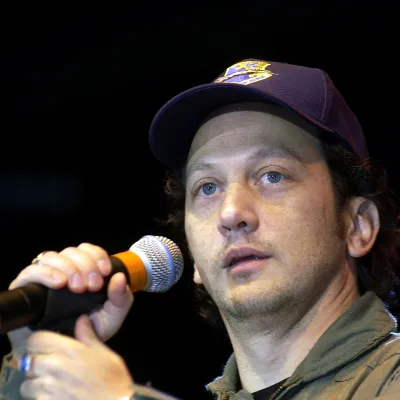
Rob Schneider
Human Design Chart
Biography
What does Manifesting Generator 6/3 mean for Rob Schneider?
Manifesting Generator 6/3 — Design at a Glance
Rob Schneider's design featured a tendency towards hybrid energy: he had the constant power of a Generator but also the ability to skip steps and produce results quickly. This configuration described someone who not only reacted to impulses but also translated these reactions at a speed that often set multiple projects in motion simultaneously.
The underlying mechanics of the manifesting Generator meant that while Rob Schneider had the strategy to react to life rather than initiate himself, he possessed a direct connection from motor centers to throat at the moment of reaction. This allowed him to draw things into his life without going through the usual slow process of manifestation. When his inner authority and sacral center were in alignment, this speed led to deep satisfaction and a playful mode of creation. He could enjoy variety and work in parallel without becoming frustrated, as long as he listened to the "yes" of his body. If strategy and authority did not align, however, his joy in creating quickly turned to frustration, as he would then skip important steps or pursue too many impulses at once. His path involved channeling this hybrid energy through conscious reaction and regular checks of inner consent to maintain the natural joy of play and creation.
Emotional Authority
Rob Schneider's design set a tendency towards emotional wave movements that significantly shaped his perception and decision-making. As a person with Emotional Authority, carried by the defined Solar Plexus Center, he was subject to a constant up and down of feelings. This inner authority always takes precedence in Human Design mechanics over all other defined centers, regardless of further configurations. Rob Schneider always saw the world colored by his current mood: At one moment he could be totally enthusiastic about something, and in the next moment he could negatively evaluate the same thing. However, his immediate feeling was only a snapshot, a first impression that did not necessarily represent his truth. Quick, spontaneous decisions based on such emotions often had negative consequences for him. The mechanics of his design required patience: The more time he took to let a decision mature, the deeper and more comprehensive his understanding became. This meant reconsidering decisions multiple times and taking the time until intense feelings subsided. Only then did he gain emotional distance, and clarity and calmness set in. This process was particularly important for long-term decisions that had a significant impact on his life course. Thus, Rob Schneider showed himself to be someone who found his true direction by waiting for emotional clarity, rather than being led by passing moods.
The 6/3 Profile — Role Model / Martyr
Rob Schneider's design points towards a life full of experiments that continues beyond the youth phase. As a 6/3 Profile – the Role Model/Experimentor – he went through a period of intense self-experimentation in the first thirty years, typical of the Adventurer's line. Unlike other profiles, his experimenting never fully slows down; the constant search for the extraordinary remains a core characteristic. Internally, there was restlessness, driven by the desire to live far from standards and find something perfect, which often proved unattainable.
This attitude is shaped by specific lines. The sixth line from Gate 28 brings fame and the willingness to take extreme risks to win. For him, it was about sacrificing himself and breaking boundaries, where every risk was seen as great. Simultaneously, the third line from Gate 33, which requires retreat and adaptation, came into play. Here, development was the focus: coming out of withdrawal to share insights. The combination of risk-taking knowledge and reflective retreat shaped him into someone who uses his unusual experiences to later become a far-sighted and humorous role model, who connects responsibility with a love of adventure.
Single Definition — Defined & Open Centers
Rob Schneider's Human Design profile points towards a tendency for clear, authentic communication that stems from a deep inner security and a strong sense of personal identity. His defined G Center endowed him with reliable self-love and the ability to show others new directions without being dependent on their confirmation. This inner compass worked in tandem with his defined Sacral Center, providing him with a massive, constant energy source. Instead of acting impulsively, he responded to life, efficiently using his vital energy and finding satisfaction in activities that suited his nature.
His defined Throat Center served as a pivot point, translating these energies into the world. It allowed him to express his truth with ease and honesty, as his voice was directly fed by his inner sources – identity and vitality. Additionally, his defined Solar Plexus Center contributed to the fact that he did not make decisions in the emotional moment but waited out the emotional wave to reach clarity. This gave his statements and actions a certain depth and thoughtfulness that only emerged after navigating emotional fluctuations.
At the same time, Rob Schneider was vulnerable to certain conditioning due to his open centers. His open Head and Ajna Centers meant that he did not have a steady mental inspiration. He tended to engage with the thoughts and questions of others, which sometimes led him into a whirlpool of confusion or the attempt to solve problems that were not his. Furthermore, his open Heart Center lacked the steady energy for willpower in the sense of competition or commitment. He was not designed to prove himself through sheer will or take on commitments to demonstrate his worth to others. Instead, he learned not to fill these empty spaces with false pride or exaggerated promises, but to rely on his reactive energy and inner direction. His defined Spleen Center supported him in living in the moment and listening to his intuition, which helped him protect himself from unhealthy mental or willful pressure.
Channels for finding meaning, reflection, principles, resolve and maturation.
Rob Schneider's Human Design profile points towards a tendency for deep reflection and the accumulation of life experiences before sharing them. This attitude was shaped by the Lost Son Channel 13-33, which connects the G Center with the Throat Center. Here, Gate 13 gathered information and secrets, while Gate 33 withdrew to contemplate these experiences and reveal deeper truths. This process required patience, as the revelation only came after full maturation.
Parallel to this, there was a strong emotional sensitivity for belonging and tribal connection. The Synthesis Channel 19-49 connected the Root Center with the Solar Plexus Center. Gate 19 pushed for closeness and belonging, while Gate 49 established principles that strengthened or rejected the connection to the tribe. This created an emotional frequency that acted as glue for familial or social bonds based on loyalty and mutual support.
Another central aspect was the search for life's meaning through active engagement. The Life Struggle Channel 28-38 connected the Root Center with the Spleen Center. Gate 38 exerted pressure to maintain individual integrity, while Gate 28 intuitively recognized which struggles had value. This gave a stubborn determination to engage in something felt personally significant, often against external resistance.
Additionally, the Discovery Channel 29-46 between the Sacral and G Centers promoted a persistent dedication to experiences. Gate 29 allowed a positive yes to new paths, while Gate 46 strengthened the connection to the right direction in life. This allowed him to immerse himself fully in processes without exercising control, ultimately leading to significant insights.
The Ripe Fruit Channel 42-53 between the Root and Sacral Centers supported this cycle by ensuring that experiences were run through to the end to gain wisdom from them. The combination of these channels shaped Rob Schneider as someone who collected, reflected on, and ultimately passed on experiences as part of a larger story.
Collective Circuitry — Circuit Signature
Rob Schneider's Human Design profile points towards a tendency for a penetrating, often combative expression rooted deep in the past. As a Simple Defined, he had a coherent energetic flow connecting all his defined centers – Spleen, Root, Sacral, Identity, Throat, Solar Plexus, and G Center. This created a coherent, if complex, inner logic.
The Knowledge Circuit worked through him via Channel 28-38 ("Life Struggle"), which connected the Spleen Center with the Root Center. This shaped an instinctive, acoustic perception of danger and safety, directly translated into action impulses. Parallel to this, the Sense of Purpose Circuit dominated his emotional experience. With Channels 33-13 ("The Lost Son"), 46-29 ("Discovery"), and 42-53 ("Ripe Fruit"), he connected Throat, Identity, Sacral, and Root Centers. This configuration demanded cyclical emotional waves to reflect on past experiences, understand them, and share these insights through the Throat. It was about learning from history and collectively finding meaning.
The Ego Circuit contributed through Channel 49-19 ("Synthesis"), which linked the Solar Plexus Center with the Root Center. This supported the ability to create resources in groups and provide mutual support, with emotional intuition forming the basis for cooperative structures. Since there was no connection to the Sacral Center in this specific circuit, rest periods were necessary to maintain the energy for these social dynamics. Overall, Rob Schneider was someone who expressed his unique identity through sharing emotional truths and navigating interpersonal conflicts, always driven by a deep need to find meaning in the past and carry it into the present.
Left Angle Cross of Alignment 2
Rob Schneider's Human Design profile indicated a tendency towards inner clarity and precise focus. This disposition did not manifest as external dominance but rather as a quiet, yet persistent alignment with the essential. The left cross of Alignment 2 describes an energy characterized by consistent self-determination and the ability to distill complex situations to their core. It is a configuration that creates inner order by filtering distractions and directing attention to the central truth. Rob Schneider often appeared as someone who clearly defined his own standards and was not swayed by external expectations. This inner structure allowed him to find a stable point of reference in moments of uncertainty. The energy of this cross supports a lifestyle based on authenticity and direct perception without falling into rigid dogmas. Instead, it remains flexible enough to integrate new insights as long as they align with his inner truth. Rob Schneider's approach was marked by this balance between firm conviction and open perception, enabling him to stay true to his path without rebelling against the world. This quality fostered a deep trust in his own process and the ability to make decisions from a place of inner security.
Saturn Return · Uranus Opposition · Chiron Return · 2nd Saturn Return — Life Cycles
Rob Schneider's design was characterized by phases of deep structural review, often coinciding with personal or professional upheavals. In 1990, at the age of 27, his marriage to London King ended. This fell during his first Saturn Return, a cycle in which the Human Design system reviews long-term commitments and one's life structure for stability and meaning. What no longer aligned with his inner truth was often released during this phase to make way for a more authentic alignment.
Decades later, in 2000 at the age of 37, another critical constellation followed: the Uranus Opposition. During this period, he received a nomination for worst supporting actor for “Big Daddy”. This astrological mechanism often brings a crisis of identity or status, serving to break free from rigid role models. Public criticism here acted as a catalyst to break free from external expectations and redefine his artistic integrity, rather than measuring success by conventional standards.
In 2021, at the age of 58, he participated in “The Masked Singer” during his second Saturn Return. This cycle marks the maturation of the foundations laid during the first Saturn Return. Here, the previously established inner structure now manifests in a new, often more playful or altered form in public life. It is a moment of affirmation, where the person applies their acquired wisdom and stability in a new context, far from earlier tensions.
Manifesting Generator · Emotional Authority — Synthesis
A central thread runs through the design: the dynamic connection between initiation and reaction. As a Manifesting Generator (MG), he possesses the ability to quickly initiate and transform things (defined Throat and Sacral Centers), yet emotional authority requires the maturation of decisions, waiting out the emotional wave. This interplay of swift action and inner reflection, reinforced by the channel of the Lost Son (13/33) – which emphasizes the accumulation of experiences and their deep penetration – shapes a personality that can be both impulsive and wise. The profile as a Role Model/Experimentator (6/3) underscores this cycle of experimentation and refinement, a constant search for authentic expressions.
The central paradox lies in the tension between the drive to express one's individuality (Knowledge Circuit) and the necessity to submit to emotional clarity. While the energy to create and transform is strongly pronounced, patience is required to avoid making hasty decisions. The documented events – the end of a relationship, a professional crisis, a later career participation – seem to illustrate this dynamic: phases of action followed by times of reflection and realignment, a constant oscillation between the desire for rapid progress and the need for inner certainty.
5 Defined Channels
Incarnation Cross - Left Angle Cross of Alignment 2
Solar Return
The Solar Return shows the moment when the sun returns to its exact birth position - your personal solar year.
Life Cycles
Discover the life cycles with a detailed triple view (birth chart, cycle chart, composite).
Human Design Profile
- Strategy
- To respond - wait for something to respond to
- Authority
- Emotional Authority
- Profile
- 6/3 - Role Model / Martyr
- Definition
- Single Definition
- Incarnation Cross
- Left Angle Cross of Alignment 2
- Date of Birth
- 31.10.1963 08:23
- Place of Birth
- San Francisco, CA, United States
Frequently Asked Questions
What is Rob Schneider's Human Design type?
What Profile does Rob Schneider have in Human Design?
What Authority does Rob Schneider have?
Which incarnation cross is active for Rob Schneider?
When was Rob Schneider born?
Discover your own Human Design
Are you also a Manifesting Generator? Find out in a personal reading how to unfold your multi-talents and direct your energy wisely.
More Personalities
Back to overviewSissy Spacek

Aldair

Alizée

Anémone

Angeli

Ann-Margret
