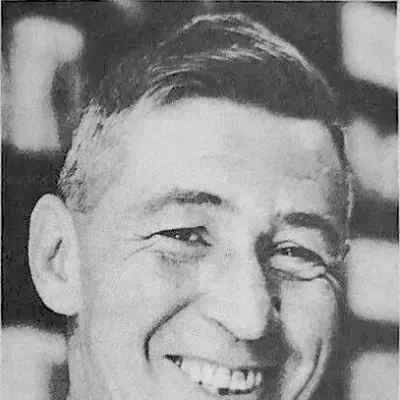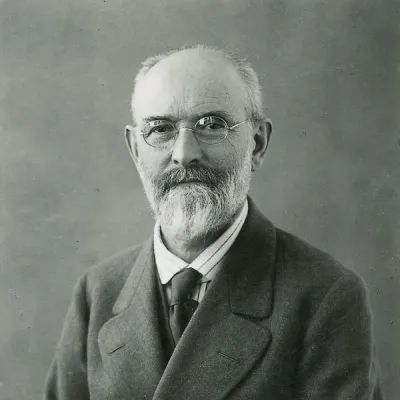
Robert Bosch
Human Design Chart
Biography
Robert Bosch as a Projector 2/5 in Human Design
Projector 2/5 — Design at a Glance
Robert Bosch appeared with a dense, focusing aura that made systemic weaknesses immediately apparent. His design was like a bright flashlight shining directly on areas in the dark or not functioning properly. However, this ability to recognize errors in systems instantly presented a dilemma: Directly addressing others' deficiencies often led to rejection, akin to blinding someone with light.
Instead, his more effective approach was an elegant presence. By embodying harmonious structures himself, he became attractive to those around him. Others then sought out his advice actively rather than having it imposed upon them. This underscored the strategic necessity of waiting for a respectful and sincerely intended invitation. Through this patience, he protected his resources from unnecessary depletion and avoided feelings of bitterness that arise when acting without permission.
Furthermore, due to his undefined Sacral Center, Robert Bosch lacked constant intrinsic life energy. His energy flow followed waves: Phases of intense productivity had to be balanced by rest periods to prevent burnout. This rhythmic pattern required conscious break structuring since continuous effort contradicted his natural need for recovery. Living according to the principle of invitation and rhythm rewarded him with success; ignoring this mechanism led to frustration.
Splenic Authority
Robert Bosch oriented himself towards the Spleen as an inner authority, which demanded spontaneous survival intelligence. His design specified that the defined Spleen Center carried the basis for decision-making while Emotional and Sacral Centers remained open – a configuration only Projectors or Manifestors possess. This structure created a fine alarm system for health and well-being.
The first intuitive impulse in the present moment was truth to him. His instinct signaled immediately whether a situation or society was right. Decisions therefore had to be made instantly; spontaneous impulses served directly his protection, allowing him to rigorously distance himself from harmful influences.
This Spleen voice was however a very fine impulse that only came once and could easily be drowned out. Robert Bosch needed radical attentiveness to hear this signal tone. Retreats often helped him find the quiet for decision-making. Long-term planning proved counterproductive as correctness changed short-term. His design required flexibility and freedom rather than firm commitments. He lived in adaptation to the current moment, with his inner authority always taking precedence to secure his physical well-being.
The 2/5 Profile — Hermit / Heretic
Robert Bosch navigated between a pressing need for isolated self-discovery and external expectations to act immediately as a problem solver. His design tended towards strategically using withdrawal times to gain internal clarity about his own value and limits of helpfulness before responding to external requests. This aligned with Profile 2/5, 'Natural Talent / Hero and Savior'. Line 5 caused others to seek solutions and expect immediate help while line 2 simultaneously required much time for himself. The image of a monk in a cave constantly asked for advice fit here well. Bosch used his alone-time to look inward and figure out what he wanted to commit to. Line 5 also brought extreme stances in crisis times along with the ability to adapt and grow through extreme experiences. A tendency towards overcompensation could disrupt the flow. Therefore, it was important to consciously decide on energy use to avoid being depleted by the role of 'Hero'. Unrealistic self-expectations should be avoided as obligations often stood before actual success. Bosch selectively said yes or no to not forget himself and to target his natural talents without being overwhelmed by external demands.
Split Definition — Defined & Open Centers
Robert Bosch possessed a stable internal architecture characterized by defined Head, Ajna, Spleen, and Root Centers. This created a constant, trustworthy mental pressure for inspiration and concept formation as well as spontaneous intuition for health and survival. The defined Root Center provided consistent adrenalized life force and stress resistance. This configuration formed the constant "I" framework: steady thinking, intuitive security, and vital drive.
This contrasted with his open centers – Throat, G, Heart, Sacral, and Solar Plexus – which reacted situationally to their environment. The open Throat Center waited for an invitation to speak; the open G Center sought identity and direction through places and relationships rather than generating them itself. The open Heart Center avoided promises and competitive pressure since it was not designed for consistent willpower. The open Sacral Center respected the fluctuating energy flow; Bosch tended to rest when energy was lacking, rather than overexerting himself with borrowed energy. The open Solar Plexus used emotions as a barometer without identification, as it could take on and amplify foreign feelings but did not generate them itself.
This mechanism required an attitude of waiting and non-identification with external stimuli such as voices, identities, or emotions. By accepting the mental pressure from his defined centers without dissipating it through hasty actions, and simultaneously utilizing the openness of his other centers to wait for appropriate invitations, Bosch conserved energy and sustained his health. His design was not about controlling everything but rather in the ability to use inner drive and respond to external initiations without confusing himself with foreign energies or emotions.
Channels for mental clarity and meaningful life struggle.
Robert Bosch revealed himself through a tension between an adrenalized drive to push his own path against resistance (Design) and the intellectual necessity of mentally sorting experiences and constructing meaning from them (Personality). The Channel of Life Struggle 38-28 in his Design gave him a stubborn determination. Through the Warrior Gate (38), there was pressure to defend individual integrity against external forces, while the Player Gate (28) created awareness of which struggles had value and were worthwhile. This configuration drove him to find meaning in resistance and to live out his unique individuation process. Parallel to this, the Channel of Abstraction 64-47 in his Personality compelled constant mental processing. The Confusion Gate (64) in the Head Center filtered every experience through a kaleidoscope of mental images, while the Understanding Gate (47) in the Ajna Center promoted the search for an overarching narrative. This led to an active mind engaging with all possibilities until something mysterious emerged and made sense. The challenge was to not lead battles with the intellect but to use inner authority for the fight while patiently waiting for mental clarity. Additional facets shaped his Profile: Gate 46 emphasized devotion and presence in the here and now; Gate 15 connected him to collective rhythms and humility; Gate 10 steered complex integration and genetically predetermined behaviors. Gate 25 fostered a mystical stance of innocence and centeredness. On the Personality level, Gate 48 helped with pattern recognition although it could cause frustration in the collective. In his Design, Gate 54 worked as a connection between worldly success and spirituality, while Gate 4 represented the formulator of logical processes for future security. Gate 39 provided adrenaline through provocation for mutative processes, while Gate 24 embodied the rhythm of mental renewal and the law of knowledge. These mechanisms worked together to determine his way of dealing with resistance and constructing meaning.
Collective Circuitry — Circuit Signature
Robert Bosch was marked by two separate, parallel operating energy fields. His knowledge circuit connected the Spleen and Root Centers. This connection generated a pulsating, acoustic energy of life struggle (Channel 28-38). It propelled his unique path: acquiring new knowledge, using mutations as deviations from the known to bring about change in the world. This current emphasized his own individuality and the expression of unique identity through emotional waves.
Completely independently of this, the meaning-finding circuit connected the Head with the Ajna Center (Channel 64-47). Here a cyclical, visual energy ran its course. It served to reflect emotions and experiences from the past and find the meaning behind past events. These insights were not for his own future but intended to be shared with the collective to learn together from history.
Since no Sun was activated, there was no dominant focus. Instead, these two systems operated situatively. The tension lay between the pulsating energy of his unique path and the cyclical processing of past meaning questions. Robert Bosch lived in this alternation: sometimes driven by the acoustic power to transform new things, other times caught in visual cycles that helped understand and share the past. The Shared Definition ensured these forces existed side by side without directly overlapping each other.
Right Angle Cross of the Vessel of Love 3
Robert Bosch's design carried the signature of the right cross of the Love Vessel 3. This configuration established a specific energetic alignment characterized by deep engagement with life and its expression. The right cross of the Love Vessel 3 symbolizes the power to gather life energy and channel it in a way that touches and inspires others. It is a structure that not only represents individual passion but places this within a larger context of care and connection.
For Robert Bosch, this meant his inner drive was strongly linked with the desire to create something sustaining and supportive. The mechanics of this cross promoted an attitude that understands life as a precious vessel that must be filled and passed on. It wasn't about superficial affection but rather a substantial, stabilizing force that strengthens relationships and projects. This energetic foundation shaped how he worked: through a constant, loving presence that created space for growth. The impact of this configuration was seen in his natural ability to strengthen others through authentic engagement and foster cohesion. It was an energy that not only accepted life but actively nurtured it, leaving a lasting impression.
Saturn Return · Uranus Opposition · Chiron Return · 2nd Saturn Return — Life Cycles
Robert Bosch's life journey was marked by two decisive turning points that structured his leadership role and career. The first Saturn Return signified the transition from preparation to concrete implementation. In 1886, at age 25, he opened the workshop for fine mechanics and electrotechnology in Stuttgart. This step condensed years of groundwork into a solid result and laid the foundation for his later work.
Later came the Chiron Return, a cycle of fulfillment and bloom where one's life mission deepens – provided one lives according to their strategy. In 1913, at age 52, Bosch faced a severe crisis: a strike by employees in June/July. His response was to shut down the factory. This event underscores the intensity of this phase, where inner values and external reality collide. Instead of being seen as a healing process for old wounds, this period is revealed as a moment of clear demarcation and affirmation of his path. The cyclical structure of his design led him from founding through consolidation to proving himself in deep conflicts, with each phase presenting a specific challenge to his authority.
Projector · Splenic Authority — Synthesis
Robert Bosch was a Generator whose life was marked by a profound drive to identify problems and offer solutions (Channel 38-28). This ability to recognize the deficient aspects of systems fueled his tireless search for innovation and improvement – a quality evident in both technological development and social engagement. He always acted from an inner knowing (Spleen Center), which allowed him instinctively to discern what was right and the direction that should be taken. This internal guidance enabled him to rely on his own truth and follow his path independently of external influences.
At the same time, Robert Bosch lived in a constant tension between the need for individuality and responsibility towards the collective (Cross). His defined Head and Ajna Centers created an unrelenting mental pressure to develop and communicate new ideas, while his open G Center made him vulnerable to others' expectations. This dynamic led him repeatedly to grapple with how he could realize his own vision without neglecting the needs of his fellow humans – a paradox that shaped his life path and drove him to always seek harmony between personal development and social engagement.
2 Defined Channels
Incarnation Cross - Right Angle Cross of the Vessel of Love 3
Solar Return
The Solar Return shows the moment when the sun returns to its exact birth position - your personal solar year.
Life Cycles
Discover the life cycles with a detailed triple view (birth chart, cycle chart, composite).
Human Design Profile
- Type
- Projector
- Strategy
- Wait for the respectful invitation
- Authority
- Splenic Authority
- Profile
- 2/5 - Hermit / Heretic
- Definition
- Split Definition
- Incarnation Cross
- Right Angle Cross of the Vessel of Love 3
- Date of Birth
- 23.09.1861 05:00
- Place of Birth
- Ulm, Germany
Frequently Asked Questions
What is Robert Bosch's Human Design type?
Which Profile did Robert Bosch have according to Human Design?
What Authority guided Robert Bosch?
What incarnation cross did Robert Bosch have?
When was Robert Bosch born?
Discover your own Human Design
Are you also a Projector? Find out in a personal reading how to unfold your leadership qualities and recognize the right invitations.
More Personalities
Back to overviewSissy Spacek

Alain-Fournier

Anémone

Ann-Margret

Bourvil

Hergé