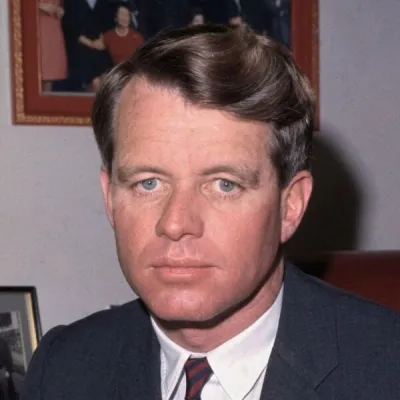
Robert F. Kennedy
Human Design Chart
Biography
Born into the prominent Kennedy family in Brookline, Massachusetts, Kennedy attended Harvard University, and later received his law degree from the University of Virginia. He began his career as a correspondent for The Boston Post and as a lawyer at the Justice Department, but later resigned to manage his brother John's successful campaign for the U.S. Senate in 1952. The following year, Kennedy worked as an assistant counsel to the Senate committee chaired by Senator Joseph McCarthy. He gained national attention as the chief counsel of the Senate Labor Rackets Committee from 1957 to 1959, where he publicly challenged Teamsters president Jimmy Hoffa over the union's corrupt practices. Kennedy resigned from the committee to conduct his brother's successful campaign in the 1960 presidential election. He was appointed United States attorney general at the age of 35, one of the youngest cabinet members in American history. Kennedy served as John's closest advisor until the latter's assassination in 1963.
Human Design Analysis: Robert F. Kennedy as Manifesting Generator 4/6
Manifesting Generator 4/6 — Design at a Glance
Robert F. Kennedy was someone who could achieve results quickly but lived in a constant tension between this natural speed and the need for inner validation. His Manifesting Generator design combined the constant energy of a generator with the direct action of a manifestor, allowing him to skip steps and draw things into his life rapidly, yet also risking overlooking important stages or becoming frustrated by juggling too many projects at once.
The mechanics of his type required a clear strategy: not initiating himself but responding to impulses. Only when his Sacral Center – his inner authority – gave a clear “yes” could he effectively use his power. Without this confirmation, his creative drive quickly turned into frustration, especially if he tried to push too many things simultaneously or ignored intermediate steps.
Deep satisfaction came only when he found himself in a “play mode” and sought variety. For him, it was counterproductive to finish one thing before starting the next; rather, he needed constant variation to keep his energy flowing. His success depended on whether he learned to respond to life instead of fighting against it and used his inner approval as a compass to channel and sustainably apply his impressive speed.
Emotional Authority
Robert F. Kennedy showed a decision-making stance that did not rely on spontaneous impulses but rather the waiting period until emotional clarity emerged. His design carried emotional authority, meaning his defined Solar Plexus Center always took over internal guidance – regardless of other defined centers in his chart. This configuration subjected him to a permanent emotional wave, a constant up and down of feelings. The world appeared colored by his current mood: A topic could seem totally inspiring one moment and deeply negative the next.
This immediate impression was only a snapshot, not yet his truth. Quick judgments based on transient emotions could therefore have negative consequences. Instead of acting immediately, his system required patience and conscious reflection before decisions. Over time, intense feelings subsided; an emotional distance set in. In this state of calmness, true clarity emerged. This process was particularly relevant for long-term steps that significantly influenced the course of his life. Through hesitation and repeated questioning, he gained the necessary depth to gain comprehensive insights rather than sinking into the flood of initial reactions.
The 4/6 Profile — Opportunist / Role Model
Robert F. Kennedy's design laid a tendency towards a deep inner conflict between heart desire for belonging and head need for meaningful distance. In the first three decades of his life, he experimented intensely, especially in relationships and friendships, driven by Line 4 of Profile 4/6 (Networker/Roles Model). Here, Line 6 still acted somewhat like a Line 3, leading to opportunistic behavior. Gate 14 on Line 4 sought security through power and control as well as practical intelligence; he waited for the right moment to use these resources, as without appropriate skill, security remained an empty promise.
With the activation of Line 6 came confusion in choosing commitments. Gate 29 marked the transition towards meaning-making: it was about whether experiences contributed to development or if he persisted despite a lack of sense. This tension field shaped his second half of life, where he was expected to act as a wise role model and stand out through cooperation. His big heart remained cautious throughout, to avoid opening up to the wrong people and getting hurt. The mechanics thus described the balance between the desire for community and the need for reflective distance, learning to hold steady even when the sense wasn’t immediately apparent.
Split Definition — Defined & Open Centers
Robert F. Kennedy demonstrated a constant presence in his core areas: Communication, Identity, Will, Vitality, Emotions, Intuition, and Stress were firmly anchored traits for him. His defined Throat Center gave his voice reliability; he spoke from a clear source, whether through the willpower of the Heart Center or the emotional depth of the Solar Plexus. This shaped his way of carrying messages into the world – not as mere thoughts but as transformed energy that linked action and expression.
At the same time, he had a stable self-identity through his defined G Center. He knew who he was and where his direction lay without being dependent on others. His Heart Center gave him willpower and the desire to determine resources for himself; he kept promises and sought recognition for his contribution. The vital energy of his Sacral Center drove him to be active and respond with yes or no – a mechanical answer that showed when energy was available. His emotions, guided by his defined Solar Plexus, formed his inner authority: He learned to trust the emotional wave and wait for clarity instead of acting impulsively.
In contrast, Head and Ajna Centers remained open. Here there was no constant mental structure; instead, he was receptive to inspiration and confusion from the environment. He tended to engage with others' questions or seek answers that were not his own. This open mental field allowed flexibility and curiosity but also vulnerability to external pressure. Rather than following fixed concepts, he followed the flow of thoughts – a mirror for what surrounded him without losing himself in it.
The combination of defined energy in body and emotion alongside an open mentality created a person who acted, felt, and spoke with clarity while his mind remained open to new and unknown things.
Channels for inspired visions, devotion, struggle, discovery and recognition.
Robert F. Kennedy showed himself as someone who handled power with remarkable grace and self-control. This skilled leader emerged from his Sun in Gate 14, which shaped the preservation of influence and the initiation of clear direction finding. This mutative impulse served as a central motor for his defined channels by giving them an elegant quality.
The Channel of Inspiration 1-8 functioned as a public vent here. Through Gate 1 he expressed his individual perspective creatively and used Gate 8 to act through example, inspiring others not primarily with words but by vividly demonstrating his unique identity and thus drawing attention to himself.
Parallel to this, the Channel of Devotion 44-26 was at work. Here the instinctive vigilance of Gate 44 combined with the ego strength of Gate 26. This configuration gave him a sense for selling or offering exactly what the tribe intuitively needed often before the need was consciously recognized. It was a skill based on deep tribal memories to persuasively convey.
The necessary assertiveness character was provided by the Channel of Life Struggle 38-28. Driven by the adrenalized pressure of Gate 38, he maintained his individual integrity and fought against external resistance. Gate 28 helped him recognize which struggles were worth it and made sense to pursue. This stubborn determination allowed him to consistently follow his path despite poor odds and find meaning in challenges.
Together these mechanisms formed a system that linked inner grace with outer effectiveness: Inspiration drew the gaze, devotion convinced through instinctive intelligence, and life struggle ensured the assertion of one's purpose.
Individual Circuitry — Circuit Signature
Robert F. Kennedy operated in three parallel, not directly connected energetic streams. This Split Definition created a tension between individual expression strength and tribal responsibility, requiring an integration of impulsive innovation, emotional reflection, and cooperative structure.
In the Knowledge Circuit two separate segments worked: The Throat with Identity Center linked Inspiration (Channel 1-8) for expressing one's individuality. Parallel to this, the Spleen with Root Center connected Life Struggle (Channel 28-38), generating acoustic pulsating energy.
The Meaning-Finding Circuit also consisted of two isolated groups. The Identity with Sacral Center enabled Discovery (Channel 46-29) and sharing insights about the past. Separately, the Solar Plexus with Root Center connected Recognition (Channel 30-41), causing emotional waves to cyclically fall away to learn from past experiences.
In the Ego Circuit only one segment was active: The Heart with Spleen Center conveyed Devotion (Channel 26-44). This promoted tribal-oriented cooperation and resource management without direct Sacral drive, necessitating rhythmic pauses for regeneration. Since there was no direct connection between these three circuits, they existed as parallel forces that Robert F. Kennedy had to integrate to align his unique identity with collective support.
Right Angle Cross of Contagion 4
Robert F. Kennedy's Human Design profile featured the configuration of the right Infection Cross, which marked a profound and often unconscious receptivity to his environment. He was someone who not only perceived but also internally absorbed and integrated the energies, moods, and convictions of others. This mechanism described an automatic process rather than a conscious act of listening: The external world directly influenced his system, exposing him constantly to foreign influences.
For him, life became a continuous process of filtering and processing these absorbed energies. What came from outside—whether joy, aggression, or uncertainty—became part of his inner reality. This could be both a source of deep connection with others as well as significant internal strain due to the fluid boundary between personal experience and external influence. His experiential world was thus significantly shaped by this constant transformation, where he had to digest and incorporate foreign impulses without always relying on rational decision-making.
Saturn Return · Uranus Opposition — Life Cycles
Robert F. Kennedy demonstrated clear integrity decisions during critical life phases that formed the basis for later political authority. His Human Design indicated structural turning points marked by planetary transits linking internal boundaries with external responsibility.
In 1953, at age 28, his first Saturn Return occurred. This cycle demanded a reevaluation of personal values against external structures. Kennedy resigned from his position in July of the same year because he disagreed with his superior's controversial methods. This crisis served as a moment of differentiation: He prioritized his personal integrity over mere positioning within a system.
Thirteen years later, in 1965 at age 40, the Uranus Opposition took effect. This transit often signifies breaking free from existing patterns toward new freedom and visibility. Kennedy became a U.S. Senator for New York. This marked the transition from internal clarification to an outwardly active role. The arc between these two transits illustrated how his early decision for ethical clarity (Saturn) created the foundation to later occupy a higher political level (Uranus) with authentic authority, rather than merely following prescribed paths.
Manifesting Generator · Emotional Authority — Synthesis
Robert F. Kennedy lived a life path marked by dynamic interaction between inner perception and external expression. His profile as an Manifesting Generator with emotional authority points to a being capable of swift action and setting things in motion (Sacral Center, defined Throat), yet also deeply felt the need for decisions to mature over time. This combination of impulsive energy and emotional depth created a personality that was both inspiring and marked by inner conflicts—particularly regarding finding an authentic voice (Channel 1-8).
A central paradox in his design lay in the interplay between individual expression and the desire for belonging. The profile as Networker/Role Model indicates a longing to connect with others and serve them (Line 4), while Line 6 suggested a tendency toward withdrawal and reflection on life's meaning. This led to tension between the need to be present in the community and an inner drive to differentiate from it and chart his own course—a conflict that manifested repeatedly throughout his life (Infection Cross 4).
5 Defined Channels
Incarnation Cross - Right Angle Cross of Contagion 4
Solar Return
The Solar Return shows the moment when the sun returns to its exact birth position - your personal solar year.
Life Cycles
Discover the life cycles with a detailed triple view (birth chart, cycle chart, composite).
Human Design Profile
- Strategy
- To respond - wait for something to respond to
- Authority
- Emotional Authority
- Profile
- 4/6 - Opportunist / Role Model
- Definition
- Split Definition
- Incarnation Cross
- Right Angle Cross of Contagion 4
- Date of Birth
- 20.11.1925 15:11
- Place of Birth
- Brookline, Massachusetts, United States
Frequently Asked Questions
What was Robert F. Kennedy's Human Design type?
What Profile did Robert F. Kennedy have in Human Design?
What Authority did Robert F. Kennedy have?
What incarnation cross did Robert F. Kennedy have?
When was Robert F. Kennedy born?
Discover your own Human Design
Are you also a Manifesting Generator? Find out in a personal reading how to unfold your multi-talents and direct your energy wisely.
More Personalities
Back to overviewAldair

Alizée

Angeli

Arletty
Artus
Balthus