
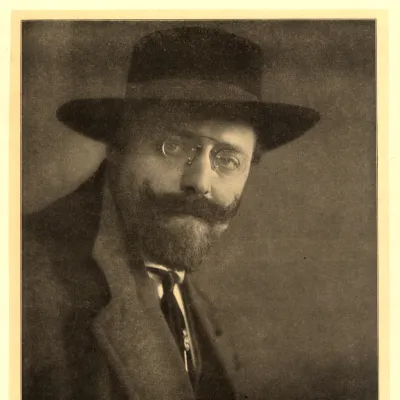
Robert Stolz
Human Design Chart
Biography
Stolz died 27 June 1975.
What does Manifesting Generator 3/5 mean for Robert Stolz?
Manifesting Generator 3/5 — Design at a Glance
Robert Stolz was revealed as a person with a hybrid energy configuration: He possessed the constant power of a Generator but also had a direct connection to his Throat Center that enabled him to swiftly implement actions. This design combined enduring life energy with the ability to skip steps in action and quickly draw things into his life.
As an Manifesting Generator, he ideally responded to inner impulses from his Sacral Center before acting. This strategy was aimed at preventing frustration that often arose when he moved too fast or skipped important stages. His design also promoted parallel processing of multiple projects; as long as his internal authority consented and a playful mode prevailed, he drew deep satisfaction from this variety. The need to focus on a single point went against his nature rather than serving it.
The challenge lay in balancing his natural speed with the patience required not to bypass necessary processes. When he waited for the clear 'yes' of his body before initiating or embarking on new paths, his creative power could work optimally. Thus, potential overburdening through multitasking transformed into a productive dynamic driven by inner consent that allowed him to work efficiently and contentedly without struggling against his own rhythm.
Sacral Authority
Robert Stolz was a Generator whose decision-making was shaped by sacral authority. This internal guidance did not manifest as intellectual deliberation but rather as an immediate physical reaction to external stimuli. His design required waiting for this response: a grunt, a hum or a spontaneous 'mmh', signaling whether an opportunity stirred energy or not. With his Emotional Center open, the sacral authority remained his sole and clear source of decisions, simplifying his process. Once the sacral motor engaged, he had vital energy and inexhaustible enthusiasm. He lived to dissolve himself in activities driven by joy and contentment rather than purposefulness. The activation of the Spleen Center further supported this authority; it enabled quick, spontaneous reactions and a reliable access to his instinctive perception as well as physical wellbeing. Robert Stolz could trust these inner signals. His strategy was to wait for the world's invitation and then act from this sacral energy, thereby filling his work with great vitality.
The 3/5 Profile — Martyr / Heretic
Robert Stolz revealed himself through Profile 3/5 as someone who gained knowledge not from books but by personal experimentation. He initially believed nothing prescribed and had to experience everything firsthand to develop practical life wisdom. This attitude of the experimenter shaped how he approached the world: through trial and error, he gathered a rich trove of experiences that he then presented as heroic storytelling.
The third line of his design emphasized the process of binding and intimacy within the context of experience. Self-confidence arose for him only through personal action and the setbacks associated with it. Failure was not an end but part of the learning process in relationships and projects. At the same time, he attracted others because they wanted to learn from his accumulated insights. This projection of a heroic role flattered him but could also be painful when experiments before an audience failed.
The fifth line added that he wanted to recognize the true spectrum of here and now – beauty as well as ugliness. This was less about aesthetic preferences than practical survival knowledge. He helped others see this duality by sharing his own experiences. His design thus described a path from uncertain experimentation towards authoritative transmission of practical wisdom filtered through personal mistakes and successes.
Split Definition — Defined & Open Centers
Robert Stolz demonstrated a persistent mental pressure to ask questions and expand consciousness. His defined Head and Ajna Centers created a trustworthy form of conceptual thinking; he was always in the process of inspiration, even if this often included unresolved doubts. This pressure did not serve to act directly – as no energy comes from these centers – but rather to encourage others to think. His defined Throat Center allowed him to reliably communicate these mental concepts and answers, with his voice acting as a pivot point for transformation through interaction.
As a Generator with a defined Sacral Center, he possessed an enormous source of vital energy. His design required reaction instead of initiation: He found satisfaction by waiting for what spoke to him and then using his sacral power. This energy was only available for correctly answered questions; mental decisions alone could not activate it.
At the same time, Robert Stolz was strongly exposed to his environment through several open centers. His open G Center meant that he did not have a fixed identity but rather took on identities from those around him. He tended to question whether he was in the right place, as false environments impaired his well-being. The open Heart Center made him vulnerable to the pressure of proving his worth, which could lead to promises he energetically could not keep. His open Solar Plexus absorbed foreign emotions; he had to learn to distinguish between his own feelings and the emotional waves of others to avoid confrontations or emotional instability. Additionally, his open Spleen Center was marked by a fundamental survival anxiety that made him cling to things that seemed to offer security rather than trust in his intuitive wisdom. Finally, he took on external stress and adrenaline through his open Root Center, which could put pressure on him to do more than energetically possible.
Channels for abstract comprehension and charismatic manifestation.
Robert Stolz showed an intense, often restless life energy that pushed him to be active in the here and now. This dynamism came from Channel 34-20 of Charisma, directly transforming his physiological power into expression. He had the potential to inspire others simply through presence and spontaneous action but needed to learn to use this energy only where he internally consented rather than being led by external expectations.
Parallel to this, his mind constantly processed experiences. Channel 64-47 of Abstraction connected his mental impulses with the understanding mind, trying to construct coherent stories or patterns from the chaos of everyday life. This process was often marked by inner restlessness as his mind sought meaning without the intellect alone leading to final clarity. The reward for this patient search was finding unique perspectives that he could then communicate.
Additionally, further influences worked on him: Gate 55 brought emotional waves and mood swings, while Gate 59 promoted a genetic strategy of bonding without personal preferences. Gate 3 drove him towards adaptation through mutation, supported by the visual assessment position of Gate 11 and the empathetic communication of Gate 23. The logical detail work of Gate 62 helped him to order facts, while Gate 42 emphasized the need to complete processes before taking on new commitments. Gate 24 challenged him towards mental renewal, and Gate 8 encouraged him to stand individually for group goals. Together these elements formed a complex picture of a person swinging between impulsive action and reflective sense-making.
Collective Circuitry — Circuit Signature
Robert Stolz showed through his design as someone who combined inner clarity with vital radiance. His split definition created two parallel, not directly connected energy flows: one in the cognitive realm and one in the existential. In Head and Ajna Centers, the Meaning Maker Circuit worked over Channel 64-47 of Abstraction. This shaped a tendency to emotionally reflect on past experiences and derive abstract patterns or visual connections from them to share later with others. The energy here flowed in waves, driven by the need to find meaning in the past.
Parallel to this, the Integration Circuit connected Throat and Sacral Centers over Channel 34-20 of Charisma. Here it was about securing survival through immediate power in the present moment. Robert Stolz drew energy from reacting to life, channeled it through intuitive knowledge, and directed it outward in a self-reinforcing radiance. This connection allowed for high individuality where inner resonance translated directly into visible or audible effect. The two systems – abstract meaning-making in the head and vital charisma in the body – existed side by side as separate forces without energetically merging, promoting a clear distinction between thinking about the past and acting in the present.
Right Angle Cross of the Sleeping Phoenix 3
Robert Stolz had the Human-Design profile "The Right Phoenix's Resting Cross 3". This configuration was characterized by a specific tension between the need for security and the drive towards transformation. As a type with the Three-One-Two-Three structure, he relied on learning and making mistakes initially to later find his own truth and share it authentically. The "resting" component pointed to potential that did not always remain active in the foreground but was latent during rest periods or under pressure.
The right cross implied an internal dynamics often awakened by external events. Robert Stolz defined himself through cyclical phases of challenge and awakening, rather than a linear identity and life path. The mechanics of this profile emphasized the necessity to collect personal experiences before serving or leading others. It was a process of maturation where earlier uncertainties melted into later self-confidence. This design suggested that his greatest strength lay in drawing wisdom from past difficulties and sharing it with others without losing his own integrity. The energy of the Phoenix symbolized here the ability to renew after setbacks, which marked his life by profound resilience.
Saturn Return · Uranus Opposition · Chiron Return · 2nd Saturn Return — Life Cycles
Robert Stolz lived through clearly structured phases of maturation and reorientation throughout his life. His design was characterized by cyclical turning points marked by Saturn and Uranus. The first Saturn Return appeared as a moment of condensation; years of groundwork solidified into sustainable results, giving him stability in his life structure.
Subsequently, the opposition to Uranus brought often unexpected changes or a drive for freedom and release from old bonds. For Robert Stolz, this meant a phase of upheaval where new things found space by letting go of old ones. It was a process of adapting to changed living conditions.
The Chiron Return followed as a fulfillment cycle around the age of 50. Here, the bloom of his incarnation purpose became evident. If he lived according to his strategy and authority, his sense was experienced; it was not about healing wounds but unfolding what he was there for. This period brought clarity about his life's mission.
The second Saturn Return rounded off this development. It stood for another stage of mastery and responsibility. Robert Stolz integrated the experiences of previous cycles into a mature self-understanding. This sequence of condensation, upheaval, fulfillment, and further maturation shaped his path towards a stable, purpose-driven life.
Manifesting Generator · Sacral Authority — Synthesis
Robert Stolz lived a life marked by a dynamic interplay between initiation and reaction. His design as an Manifesting Generator (MG) pointed to someone who had the ability to quickly initiate and shape things but was primarily driven by sacral energy – a constant flow of life force waiting for external stimuli (sacral authority). This interaction showed in a tendency to actively seek experiences (3/5 Profile), then share what was learned, inspiring others. The defined mental pressure (Head-Ajna Center) intensified this drive to understand the world and formulate personal insights, while the Channel of Charisma endowed him with a natural talent for powerful expression.
Central to Robert Stolz's design was a paradox between the desire for control and the necessity to let go. As an MG, he possessed elements of both types – Manifestor and Generator – leading to internal tension manifesting in skipping steps or feeling compelled to force things. At the same time, his sacral authority called him to listen to his body and act only when a genuine impulse came from the Sacral Center. This field of tension between quick action and patient waiting shaped his life path and revealed a search for authentic unfolding in harmony with his inner wisdom.
2 Defined Channels
Incarnation Cross - Right Angle Cross of the Sleeping Phoenix 3
Solar Return
The Solar Return shows the moment when the sun returns to its exact birth position - your personal solar year.
Life Cycles
Discover the life cycles with a detailed triple view (birth chart, cycle chart, composite).
Human Design Profile
- Strategy
- To respond - wait for something to respond to
- Authority
- Sacral Authority
- Profile
- 3/5 - Martyr / Heretic
- Definition
- Split Definition
- Incarnation Cross
- Right Angle Cross of the Sleeping Phoenix 3
- Date of Birth
- 25.08.1880 16:15
- Place of Birth
- Graz, AUS
Frequently Asked Questions
What was Robert Stolz's Human Design type?
What Profile did Robert Stolz have in Human Design?
What Authority did Robert Stolz have?
What incarnation cross did Robert Stolz have?
When was Robert Stolz born?
Discover your own Human Design
Are you also a Manifesting Generator? Find out in a personal reading how to unfold your multi-talents and direct your energy wisely.
More Personalities
Back to overviewAaliyah

Aldair

Alexia

Alizée

Angèle

Angeli
