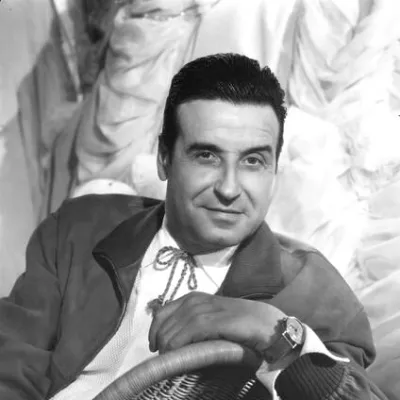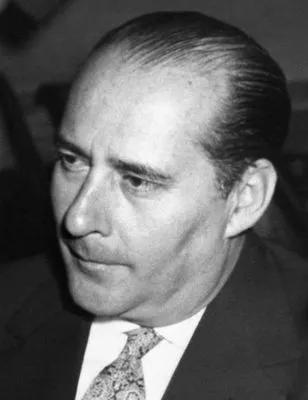
Roberto Rossellini
Human Design Chart
Biography
The son of a wealthy architect, Rossellini had been brought up in a great Roman house with nannies and tutors. Money was for spending and he squandered his inheritance disdainfully. Disinterested in university, he went into film work for Mussolini and the Fascists.
By his 40s, he was a plump Italian of medium height, with a beaked mouth and thinning black hair, Rossellini nonetheless was a man of great seductiveness, enveloping a woman with such attention, such romantic fantasy, such drama, that he would mesmerize her. His life was filled with women. He and his wife were amiably separated and he had a series of high profile lovers, most notably his mistress for several years, Anna Magnani.
In 1948, Ingrid Bergman wrote to Rossellini, "If you ever need a Swedish actress..." He received the letter on his birthday, 8 May, and he responded eagerly. They arranged a meeting on 26 September 1948 in Paris. The Lindstroms' and Rossellini met at the Hotel George V and discussed the film they would make together, a story of love on the barren island of Stromboli, a great work of art.
Bergman was coming from a confining marriage and a career that was limited to virtuous, two-dimensional roles and he offered her artistic truth, creative vision, danger and excitement. He offered more than that, bragging to his friends that he intended to cuckold Dr. Lindstrom, "Swedish women are easy to impress as they have such cold husbands.
Human Design Analysis: Roberto Rossellini as Projector 4/1
Projector 4/1 — Design at a Glance
Roberto Rossellini was someone who interacted with his environment through a dense, focused aura. His design inclined him to immediately recognize where other systems had flaws or processes were in the dark. As a projector, he did not have a constant intrinsic energy source from the undefined sacral center. Instead, he experienced phases of high productivity that needed to be followed by necessary rest periods to prevent burnout.
His strategy was to wait for respectful and sincerely meant invitations rather than unasked-for observations. If he addressed these flaws directly, he risked rejection because his intense gaze could shine like a bright light into the face of others. It was more effective for him to attract through his own harmony so that others would ask for his advice on their own. If he did not follow this strategy, the theme of non-self bitterness emerged. However, if he followed his design and waited for an invitation, he was rewarded with success. This mechanism determined his interaction with the world: He was there to illuminate paths for others by bringing light into darkness, but only when invited to take on that role.
Emotional Authority
Roberto Rossellini showed an internal decision-making structure that did not orient itself towards immediate impulses but followed a deep emotional wave. His design carried Emotional Authority, meaning his defined Emotional Center always took precedence over all other defined centers – regardless of which additional mechanisms were active in his chart. This configuration marked him by a permanent up and down of feelings; he saw the world colored through his current mood. What appeared inspiring at one moment could seem negative the next. For Roberto Rossellini, however, this immediate feeling was only a snapshot, not necessarily his truth yet. Quick, spontaneous decisions from such an emotional state often risked negative consequences. His strategy was to take time. He used the duration of feelings to gain clarity. By hesitating and reconsidering decisions multiple times, intense emotions subsided. Only with this distance did calmness set in. This process was especially crucial for long-term steps that significantly influenced his life path. Through waiting for emotional waves to subside, he reached a deeper, more comprehensive understanding beyond the first often misleading impression.
The 4/1 Profile — Opportunist / Investigator
Roberto Rossellini appeared as someone whose essence was deeply rooted and hardly deviated from an individual path. As a 4/1 profile, the only fixed profile marking the transition from
Triple Split Definition — Defined & Open Centers
Roberto Rossellini revealed himself as someone whose inner drive primarily stemmed from the mental space. His design indicated a tendency towards constant intellectual pressure: raising questions and forming concepts without necessarily having to physically implement them himself. With defined Head and Ajna Centers, he was an inspiration for others; his thinking influenced his surroundings while he learned to exercise patience with unanswered questions rather than falling into hasty actions.
This mental activity flowed directly into his communication as well. His defined Throat Center connected with the Ajna, meaning that he spoke what his mind conceptualized. His voice was the instrument to carry thoughts into the world – not impulsively, but as an expression of his conceptual clarity. Parallel to this, Roberto Rossellini had a firm identity and direction through his defined G Center. He knew who he was and where he was heading without needing to force others to follow him. This self-assurance allowed him to show new perspectives without denying his own love and alignment.
Emotionally, he moved in waves. His defined Solar Plexus served as an inner authority: truth revealed itself to him over time. He tended to delay decisions until the emotional charge had subsided and clarity emerged. This process required patience since spontaneous reactions to emotional highs or lows often led to regret later on. The constant stress pressure of his defined Root Center propelled him forward, especially in dealing with new and desirable situations, which nourished his emotional intelligence.
At the same time, he was vulnerable to conditioning in areas without his own energy. His open Heart Center meant that he wasn’t designed to prove willpower or keep promises to demonstrate value. He tended to question whether he was doing enough and risked exhausting himself through excessive effort rather than trusting his inner authority. His open Sacral Center allowed him to absorb foreign energies; he did not always know when it was “enough” and had to learn to set boundaries to avoid exhaustion. Additionally, his open Spleen Center carried fears of survival. He unconsciously sought security through others and tended to cling to unhealthy situations because they provided a false sense of well-being rather than trusting spontaneous intuition.
Channels for inspiration, logic, reflection and synthesis.
Roberto Rossellini showed himself to be someone who through his mere existence and individual expression had an inspiring effect on those around him. This tendency stemmed from the Channel of Inspiration 1-8, which connected the G Center with the Throat Center. Through Gate 1, the personal entrance for mutative perspectives, and Gate 8, the Gateway of Contribution, he was designed to gain public attention by living his unique identity. His leadership did not consist in giving instructions but rather in setting an example by presenting a new perspective on truth and beauty, thereby encouraging others to live out their own creativity.
Parallel to this, Roberto Rossellini possessed an active, logical mind shaped by the Channel of Logic 63-4. This channel connected the Head Center with the Ajna Center and integrated Gate 63 of Doubt as well as Gate 4 of Formulation. His skepticism served to continuously filter patterns and test their consistency. Only when a response proved consistent and verifiable did he accept it; unfounded belief found no place in this mechanism. This doubting mind always sought practical evidence to offer the collective useful predictions or solutions.
Another essential aspect of his design was the ability for reflection and memory, carried by the Channel of the Lost Son 13-33. Here too, the G Center connected with the Throat Center, this time through Gate 13 of Listener and Gate 33 of Withdrawal. He collected life stories and secrets, listened, and stored information to process it later in peace. This process required patience; he withdrew to recognize the deeper truths behind the gathered experiences before communicating his insights. In doing so, he contributed to continuity by placing individual lessons into a larger historical or collective context.
Furthermore, the Channel of Synthesis 19-49 influenced him, connecting the Root Center with the Solar Plexus Center. Through Gate 19 of Claims and Gate 49 of Principles, he was sensitive to the emotional frequency of belonging and tribal connection. This mechanism determined who was admitted into his inner sphere and who was rejected based on loyalty and the protection of shared resources. His emotional waves served to strengthen or sever relationships while always seeking a balance between feasibility and fairness within his social community.
Collective Circuitry — Circuit Signature
Roberto Rossellini was shaped by three separate, parallel operating energetic streams. In the Knowledge Circuit, Channel 1-8 connected the Throat Center with the Identity Center. This allowed him to translate inspired impulses directly into unique expression, making his individual voice audible.
Parallel to this, in the Understanding Circuit, Channel 63-4 formed a bridge between Head and Ajna Centers. Here focused logic and strategic clarity emerged, enabling him to structure rational insights and project them into the future, free from emotional influence.
A third independent stream flowed through the Meaning Circuit via Channel 33-13, which also connected Throat and Identity Centers. This channel promoted sharing felt experiences from the past. Through this connection, he could reflect on emotional waves and process them together with others to initiate collective learning processes.
Finally, in the Ego Circuit, Channel 49-19 operated between Solar Plexus and Root Centers. This synthesis linked emotional rhythms with a drive for security and resources. As this energy was timeless, it required pauses for regeneration to balance giving and taking in social contexts. These four circuits did not form a cohesive unit but rather four distinct areas of his experiential world: inspired individuality, cool strategy, emotional reflection, and resource-oriented cooperation.
Juxtaposition Cross of the Driver
Roberto Rossellini carried the Juxtaposition Cross of the Driver. This configuration created a specific inner tension arising from the simultaneous presence of conflicting forces. It was a dynamic interplay of impulse and resistance that kept his inner world constantly in motion.
In Human Design mechanics, this cross describes a polarity between the drive to move forward and the necessity to wait or pause. For Roberto Rossellini, this meant he often faced a strong urge to push ahead, which was frequently hindered by internal blocks or external circumstances. This state generated productive friction. Instead of following a smooth path, his journey followed a wave-like motion of acceleration and delay.
This structure shaped his life energy as something that did not flow linearly but worked in cycles. The energy of 'driving' demanded progress and goal orientation. At the same time, the juxtaposition – the coexistence of opposites – required constant adaptation to unexpected obstacles. Roberto Rossellini had to learn to see these tensions not as errors but as driving forces. His design showed that true forward movement for him was often only possible through enduring these internal contradictions. The energy remained alive and reacted flexibly to changes, rather than rigidly following a single path.
Saturn Return · Uranus Opposition · Chiron Return · 2nd Saturn Return — Life Cycles
Roberto Rossellini emerged as someone who went through an intense phase of self-examination and orientation in his middle age. His design pointed to an inner rhythm where long-term currents condensed into concrete life decisions. This became visible in 1936, at the age of 30: Rossellini married Marcella De Marchis and had two sons with her. This first Saturn Return marked often the point where years of internal groundwork manifested as a stable, sustainable structure – here through the founding of a family.
Later, another central cycle emerged: the Chiron Return. In Human Design mechanics, this is not a moment of healing old wounds but a phase of blooming and fulfilling one's incarnation purpose if lived according to strategy and authority. For Roberto Rossellini, this period fell around 1953 when he was 47 years old. That year, he participated in the Mille Miglia on a privately entered Ferrari and withdrew from it. This event underscores the characteristic feature of this cycle: a confrontational encounter with one's essence and the limits of personal expression that leads to deeper self-understanding. The mechanics show that this phase is not seen as failure but as necessary testing on the path towards full realization of individual purpose.
Projector · Emotional Authority — Synthesis
Roberto Rossellini lived a profound inner conflict between the urge to inspire others and the need to protect himself from injury. His profile as Networker/Researcher (4/1) points to a firm internal core identity, yet simultaneously produced a cautious heart – he excluded people who did not fully accept his authenticity. This tendency was reinforced by emotional authority that allowed decisions to mature and protected him from impulsive reactions while the defined Head Center generated constant mental pressure for inspiration and understanding (Channel 1-8). Thus, a life emerged where the desire to share knowledge and spark change was always coupled with a need for self-protection.
This tension field also manifested in limited accounts of his life events: an early relationship (1936) and the end of racing (1953) reflect processes where he faced situations but could not fully control them. The Projector 'projected' his understanding onto the world, recognized flaws in the system – yet the path there was marked by an internal struggle between expressing his creative vision and defending against potential injuries from an environment that did not always share his unique perspective.
4 Defined Channels
Incarnation Cross - Juxtaposition Cross of the Driver
Solar Return
The Solar Return shows the moment when the sun returns to its exact birth position - your personal solar year.
Life Cycles
Discover the life cycles with a detailed triple view (birth chart, cycle chart, composite).
Human Design Profile
- Type
- Projector
- Strategy
- Wait for the respectful invitation
- Authority
- Emotional Authority
- Profile
- 4/1 - Opportunist / Investigator
- Definition
- Triple Split
- Incarnation Cross
- Juxtaposition Cross of the Driver
- Date of Birth
- 08.05.1906 12:50
- Place of Birth
- Rome, Italy
Frequently Asked Questions
What was Roberto Rossellini's Human Design type?
What Profile did Roberto Rossellini have?
What Authority did Roberto Rossellini possess?
What incarnation cross was active for Roberto Rossellini?
When was Roberto Rossellini born?
Discover your own Human Design
Are you also a Projector? Find out in a personal reading how to unfold your leadership qualities and recognize the right invitations.
More Personalities
Back to overviewSissy Spacek

Alain-Fournier

Anémone

Ann-Margret

Bourvil
Christian-Jaque