
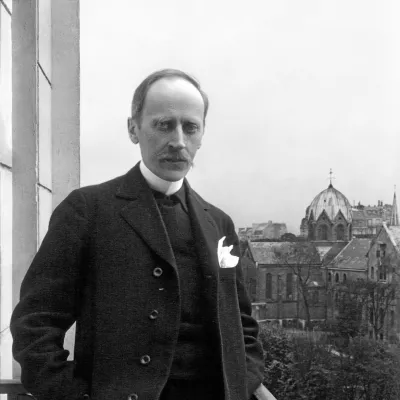
Romain Rolland
Human Design Chart
Biography
He died on 30 December 1944, Vezelay, France.
Human Design Analysis: Romain Rolland as Generator 2/4
Generator 2/4 — Design at a Glance
Romain Rolland revealed himself as someone with immense endurance and an almost inexhaustible source of energy. As a Generator, he had plenty of sacral power that could drive him like a strong workhorse – provided he found tasks that resonated deeply within him. His design suggested that his greatest strength lay in not initiating things on his own but responding to signals from the environment. When his Sacral Center gave a clear “yes,” he could act with full force and materialize projects.
This reactive strategy was crucial for his well-being. Living in harmony with it rewarded him with a deep sense of fulfillment. If, however, he initiated things out of personal drive or engaged continuously with issues that did not resonate internally, he fell into a typical stumbling block: energy waste quickly led to frustration and exhaustion. Another critical point arose when external circumstances prevented him from continuing work on his heart project while his inner driving force was still fully active. Such interruptions had negative effects as they blocked the natural flow of his generated energy. His path therefore consisted in patiently waiting for impulses and then consistently responding to them, thereby experiencing the deep satisfaction that his design promised when used correctly.
Sacral Authority
Romain Rolland showed himself as someone whose decision-making did not stem from intellectual deliberation or emotional moods but was based on direct physical resonance. As a Generator, he possessed sacral authority, an inner guidance unique to this type and identical in strategy to the inner authority. This simplified his process: He did not actively react to stimuli but responded according to how his body concluded.
His inner voice manifested as gut feeling or sudden surge of energy – audible as grunting, humming, or a confirming “Mhm.” These physical signals were reliable indicators whether something stirred his energy. When his sacral motor kicked in, he felt vital and alive; the available energy was seemingly inexhaustible. He tackled tasks with great enthusiasm and immersed himself fully without needing an external goal or purpose. The joy of the activity itself sufficed.
Moreover, his activated Spleen Center worked as a supportive authority alongside the Sacral Center. This configuration allowed him quick, spontaneous reactions and decisions. He had direct access to his instinctive well-being and bodily perception. These instincts could be reliably used to find his way through life, always guided by what made him feel most alive at any moment.
The 2/4 Profile — Hermit / Opportunist
Romain Rolland revealed himself as someone who oscillated between a deep need for withdrawal and the urge towards community. His design indicated a tendency to reflect knowledge from his environment in solitude to develop clear insights. This dynamic stemmed from his Profile 2/4: Line 2 demanded isolated “me-time” to order internal processes and gain clarity. Only when this need was met did line 4 come into play, seeking time with chosen intimates. For Romain Rolland, it was crucial to clearly communicate these phases – when he needed company and when he wanted solitude. In his seclusion, he utilized the selective service readiness of Gate 19 (line 2) to target resources effectively and maintain high-level exchanges. Simultaneously, line 4 at Gate 44 marked him with direct, unvarnished honesty. This stance was single-mindedly focused on truth without hypocrisy, oriented towards the trunk rather than individual whims. In extreme situations, this neutral position yielded to secure necessary support, underscoring his ability to switch between isolated analysis and binding communication without compromising his integrity.
Single Definition — Defined & Open Centers
Romain Rolland's design inclined towards a deep, physical rooting, driven by a constant inner energy source. His defined Sacral Center generated daily vital force that urged him to activity and could produce restlessness if he did not respond to internal signals – a mechanical process of agreement or disagreement that required no rational justification. Simultaneously, his defined Spleen Center acted as an instance of survival awareness: it delivered spontaneous, intuitive warning signs in the present moment that protected health and well-being but were not repeatable. The pressure from his defined Root Center propelled him forward to master existential challenges and rise materially; however, this stress factor had to be channeled through his strategy to avoid becoming obsessive.
At the same time, Romain Rolland was exposed to several open centers, making him susceptible to external influences. His open Head Center received mental inspirations and doubts from outside; if he tended to interpret these foreign questions as personal pressure situations, he became confused. The open Ajna Center allowed intellectual flexibility but also led to the danger of holding other people's concepts as his own truths or feeling uncertain. His open Throat Center naturally attracted attention, yet attempting to actively seek approval often resulted in unpredictable expression and frustration. Furthermore, his open G Center reflected identities from his environment rather than a firm personal direction, while his open Heart Center made him prone to wanting to prove value through promises – a cycle of self-doubt since he lacked the constant willpower for this. Finally, his open Solar Plexus absorbed emotions from others, which could make him appear emotionally unstable if he did not recognize and let go of these foreign moods.
Channels for ambition, continuity and mature growth.
Romain Rolland's design indicated a tendency towards sustained, ambition-driven development. He was shown to be someone motivated by persistent effort to improve his position and felt the desire to be seen and recognized. This attitude drew from the Transformation Channel 54-32, which connected the Root Center with the Spleen. This channel pushed him to use talents to rise above his social origins, where the fear of failure or the fragility of his "tribe" fueled a drive for change. His instincts helped him recognize support, yet he often worked harder than others to prove his worth and establish a healthy dependence on the community.
Parallel to this, Channel 53-42, which linked the Root Center with the Sacral Center, shaped him. This mechanism required that he go through experiences fully before reflecting and starting new cycles. It was not about goal-oriented action but rather gaining wisdom from every process and making it useful for future generations. Early termination of projects led to repetition; only a complete conclusion allowed true depth.
Additionally, Gates like 19 (Resources, Territory, Community Spirituality) and 33 (Reflection, Withdrawal) prompted him to withdraw to process experiences before sharing them. Gate 44 promoted awareness and transformation through proper interaction, while Gate 24 sought inner stillness free from old mental patterns. Gate 41 propelled him evolutionarily from one experience to the next, often accompanied by emotional fluctuations that he balanced with appropriate desire. Gate 28 demanded decisions in the here and now, whether or not to take risks based on his authority. Finally, Gate 48 enabled the recognition of deeper connections and patterns, though this sometimes led to frustration as implementation was complex.
Collective Circuitry — Circuit Signature
Romain Rolland's Human Design suggests a tendency towards cyclical, emotionally driven processes of maturation. His Definition Circuit connected the Sacral Center with the Root Center through Channel 42-53 (Maturity). This created not linear logic but wavelike emotional cycles from the past: a beginning, a middle, and an end. The insights gained, often inexplicable, were meant to be shared with the collective in order to learn collectively from past experiences.
Parallel to this existed his Ego Circuit, which however was not directly connected to the first one as both centers belonged to different groups – despite the common definition of the Root Center. Here Channel 32-54 (Transformation) linked the Spleen Center with the Root Center. This circuit belonged to the Family Level and focused on cooperation and the joint creation of resources. Since there was no connection to the Sacral Center, pauses were necessary here to regenerate energy for the family. It was about a fair balance between giving and taking, supported by the transformative power of the Spleen.
Together these two separate parts shaped his essence: on one hand emotional reflection and sharing of past meaning-making, on the other pragmatic, resource-oriented interaction within the family based on transformation and mutual support. Both aspects worked alongside each other without forming a continuous energetic flow.
Right Angle Cross of the Four Ways 4
Romain Rolland's Human Design profile indicated a tendency towards inner conflict and the pursuit of reconciliation. He emerged as someone striving to integrate seemingly irreconcilable opposites into a harmonious whole. This stance stemmed from the configuration of the right cross of the four pathways. In Human Design mechanics, this pattern marks a specific energetic tension: it connects the power of will with intuition, emotional center with motor impulse, and intellect with perception. For Romain Rolland, this meant more than intellectual contemplation of conflicts; it was a deep existential need to transcend these polarities. His life was marked by attempts to experience not four separate energies—will, emotion, intuition, and motoricity—as isolated forces but rather to unite them in higher consciousness. This often required significant inner work, as the energy of this cross configuration can be strong and compelling. Romain Rolland carried this burden as a guide: his task was to demonstrate through his own experience of integration that unity is possible from diversity. It was not a passive state but an active process of balancing, in which he learned not to pit different aspects of his nature against each other but rather to make them work together.
Saturn Return · Uranus Opposition · Chiron Return · 2nd Saturn Return — Life Cycles
Romain Rolland's Human Design profile indicated a tendency towards validating his inner compass through external recognition and institutional anchoring during middle life phases. This was concretely evident in 1915, at the age of 49, when he received the Nobel Prize for Literature. This marked the Chiron Return, a fulfillment cycle where one's incarnation cross unfolds and the purpose of life becomes experiential. For Romain Rolland, this confirmed his long-standing alignment with strategy and authority through this peak; it was not about healing old wounds but rather the bloom of his destiny.
Five years later, in 1920 at age 54, the second Saturn Return occurred. This cycle often condenses years of groundwork into a solid structure or new identity. In this year, Romain Rolland became an honorary member of the Parti communiste français. This political engagement illustrated the mechanics of the second Saturn Return: the search for hidden truth and the need to share insights culminated in clear societal positioning. His design promoted the transition from individual creative power to collective responsibility, with the previously earned Nobel Prize recognition serving as a foundation to credibly fulfill this new role. Both events underscored how Romain Rolland's chart pushed him during phases of maturity towards visible impact and structural anchoring.
Generator · Sacral Authority — Synthesis
Romain Rolland lived a life profoundly marked by his sacral authority and the resulting energy flow. As a Generator, he possessed immense endurance and the ability to immerse himself in activities that truly fulfilled him—as long as they aligned with his inner yes (Sacral Center). The profile of natural talent and networker suggests that he oscillated between the need for withdrawal for internal clarification (Line 2) and the desire for exchange with like-minded individuals (Line 4). This shift affected his ability to generate and release energy, with the connection to the Spleen Center intensifying an immediate reaction to external stimuli.
A central paradox in his design lay in the interplay of ambition and continuity (Channel 54-32) with the cyclical nature of the perception circuit. He was driven by effort to rise socially, yet past experiences shaped his emotional landscape and influenced decisions. This led to a tension between the desire for personal success—evidenced by the Nobel Prize (Chiron Return)—and the necessity to reflect on the past and learn from it, which manifested in his engagement.
2 Defined Channels
Incarnation Cross - Right Angle Cross of the Four Ways 4
Solar Return
The Solar Return shows the moment when the sun returns to its exact birth position - your personal solar year.
Life Cycles
Discover the life cycles with a detailed triple view (birth chart, cycle chart, composite).
Human Design Profile
- Type
- Generator
- Strategy
- To respond - wait for something to respond to
- Authority
- Sacral Authority
- Profile
- 2/4 - Hermit / Opportunist
- Definition
- Single Definition
- Incarnation Cross
- Right Angle Cross of the Four Ways 4
- Date of Birth
- 29.01.1866 02:00
- Place of Birth
- Clamecy, France
Frequently Asked Questions
What is Romain Rolland's Human Design type?
What Profile did Romain Rolland have in Human Design?
What Authority did Romain Rolland have?
What incarnation cross did Romain Rolland have?
When was Romain Rolland born?
Discover your own Human Design
Are you also a Generator? Find out in a personal reading how to use your sacral energy correctly and discover deep satisfaction.
More Personalities
Back to overviewAaliyah

Alain-Fournier

Alexia

Angèle

Angeli

Anne-Marie
