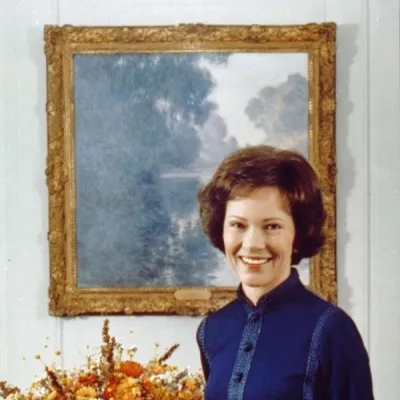
Rosalynn Carter
Human Design Chart
Biography
As a teenager, her beloved dad died and her grandmother the same year and her mother had a struggle. She married Carter on 7 July 1946. They had four children, John (born 3 July 1947), James (12 April 1950), Jeff, (18 August 1952) and Amy (19 October 1967).
After her husband's retirement, Rosalynn wrote that she thought they'd go home and be bored for the rest of their lives, but they simply did not have the time. She and Jimmy were both too busy with civic and philanthropic activities such as Habitat for Humanity, a network of volunteers who build homes for the needy. They jointly wrote a 1987 best-seller Everything to Gain, Making the Most of The Rest of Your Life. With a generous, practical, hands-on approach to life, she founded the Rosalynn Carter Institute at Georgia College in Americus, a research institute of the care giving process, a lifelong interest of hers. Her third book came out in 1994, Helping Yourself Help Others, A Book for Caregivers. She was petite, purposeful, serious, a little formal in interviews as a result of youthful shyness, but warm and open about her family.
In 1998, she put out her Helping Someone With Mental Illness (Times Books). Erasing the stigma of mental illness was one of her priorities. As the nation's first lady, she was honorary chair of the President's Commission on Mental Health, whose work resulted in passage of the Mental Health Systems Act of 1980, which advocated health insurance coverage for the mentally and ill and their protection against discrimination.
Rosalynn Carter was the second-longest-lived first lady after Bess Truman, and was the longest-married first lady. She and her husband received the Presidential Medal of Freedom in 1999.
Rosalynn Carter as a Reflector 6/3 in Human Design
Reflector 6/3 — Design at a Glance
Rosalynn Carter's design established a foundational disposition of deep perception: She was a Reflector. This meant that she did not possess constant, personal energies, but rather functioned as a mirror of humanity. She absorbed the energy of her surroundings – whether from people or nature – particularly intensively. Her inner self was open to the influence of seasons, planetary, and stellar constellations.
This configuration required living in harmony with natural cycles. Her strategy involved waiting at least one month, a full moon cycle, for important decisions. Through this patience, she could automatically find people and environments that suited her. By following this strategy, she could observe the world without attachment. As a reward, she experienced a feeling of joyful surprise.
If she lived against her design, however, a deep, persistent disappointment would arise. This disappointment was directed both at herself and at the state of the world. Her design thus did not describe a fixed, personal core, but a dynamic reaction to the external pulse. She was dependent on mirroring the rhythms of her environment rather than generating her own static energies. This openness shaped her entire way of experiencing and responding to the world.
No Inner Authority
Rosalynn Carter did not have an inner authority, a rare configuration that fundamentally shaped her decision-making. Instead of relying on a defined physical center, she found her orientation through exchanges with other people. As a mental projector without activation of centers below the Throat Center, she used her high resonance capacity in open centers. In dialogue, dormant potentials were activated, allowing her to view and express issues from multiple perspectives. This process was complex and required time and withdrawal to organize the collected information. She learned to filter the essential from a mass of data and structure it meaningfully, thereby developing her specific intelligence. Her success capital lay in recognizing the thread and distinguishing what made sense and belonged to her. A key for her was choosing an environment where she felt comfortable. There she met the right people with whom she could exchange confidently. This confident dialogue deepened her sense of what was right for her over time. Through this method of information evaluation and social exchange, she could make decisions without relying on an inner, physical authority.
The 6/3 Profile — Role Model / Martyr
Rosalynn Carter's design inclined her towards continuous experimentation, paired with a quest for extraordinary wisdom. As a person with the Profile 6/3, the Role of Role Model and Experimenter, she lived in the first thirty years of her life as a 3/3. This meant numerous self-experiments that slowed down after her first Saturn return but never fully ended due to the permanent Line 3. She did not seek ordinary perfection but a life away from standards, which often led to inner restlessness.
This configuration combined a love of adventure with the later development of responsibility and humor. Through her unusual experiences, she became a far-sighted role model. The mechanics of her lines promoted this path: The sixth line in Gate 4 required patience and self-control through repeated rule-breaking. She was less interested in prescribed answers and lived her own life, where excesses ultimately led to correct insights.
At the same time, the third line in Gate 8 showed a tendency towards adaptability through trial and error. Here, it was about not hiding the true nature to be accepted. Style was more important than content. Saturn acted here as a disciplining force against superficiality. So Rosalynn Carter used her many experiences to become a wise and humorous figure through patience and overcoming hypocrisy, inspiring others through her own lived example.
No Definition — Defined & Open Centers
Rosalynn Carter's Human Design showed the absence of any defined centers, which marked an extreme openness and sensitivity to the environment. As a person with a completely open design, she relied on her inner authority to guide her actions rather than on conditioned reactions. Her open Head and Ajna Centers meant that she did not consistently generate mental inspiration and concepts herself but rather absorbed them from her surroundings. She tended to question whether certain thoughts were truly valuable or merely distractions, and learned to act as a mirror for others' ideas without identifying them as her own truth.
Her open G Center did not provide a fixed identity or direction. Instead, her sense of 'Who' and 'Where' crystallized only in correct relationships and at appropriate places. She avoided the trap of seeking a static identity and recognized that she was initiated through interaction with others. Her open Heart Center lacked consistent willpower; she was not designed to make promises or prove her worth through competition. This protected her from committing to impossible obligations just to gain recognition.
Her open Sacral Center lacked a constant energy flow. She absorbed the life force of her environment, which made her vulnerable to exhaustion if she did not learn to set boundaries and listen to her inner authority to know when enough was enough. Her open Solar Plexus Center allowed her to take on and amplify emotions from her surroundings. She had to learn not to personalize these feelings to avoid being overwhelmed by others' emotional waves. Her open Spleen Center carried a fundamental survival fear that led her to cling to things that were not good for her to gain a sense of security. Her open Root Center absorbed external stress, leading to a sense of pressure that she did not generate herself. By trusting in her strategy and authority, she could use these open fields to become wise rather than fall into conditioning.
Channels & Gates
Rosalynn Carter's Human Design revealed a tendency towards sensitive transformation and strategic direction-finding. She was someone who combined principles with deft power maintenance.
Gate 49 represented transformation and sensitive reaction at the tribal level. It required obedience to principles, especially within family and tribe. The emotional wave determined her discernment regarding food and territory. A defined Solar Plexus Center allowed her to gain clarity about necessary principles. Gate 49 was also the Gate of Sacrifice, where resources were redistributed.
Gate 8 stood for contribution and promotion. It was about individually advocating for group goals and making a new contribution. The expression of identity was a central theme. Gate 8 required encouragement for mutation and could serve as a creative role model. Bringing uniqueness to life led to attention and promotion.
Gate 14 handled power and the possession of greatness with skill. It was one of the three gates of the individual process with a pulsing nature. The energy of Gate 14 drove the Sphinx Cross and provided direction. Mutation through Gate 14 led to a direction-finding process that required the influence of Gate 2. It was about the accumulation and preservation of power with grace and self-control. People had to learn to handle this power.
Gate 4 was the Gate of Formulation and part of a logical collective process aimed at the future. It answered questions from the Gate of Doubt (63) and developed formulas to clarify suspicious patterns. Gate 4 allowed her to succeed despite ignorance and be free from revenge and punishment. Formulas could protect her future if correctly understood and applied.
Circuit Signature
Rosalynn Carter's Human Design was completely undefined. This meant that in her chart, there were no fixed internal energetic connections between the centers. In Human Design, this is referred to as 'No Definition'. Such individuals often act like mirrors for their environment. They absorb the energies, moods, and expectations of other people and reflect them back. Since Rosalynn Carter had no permanent internal structures connected through channels, she lacked a fixed, unchanging inner voice or a rigid character core. Instead, she was highly adaptable and receptive to the context in which she found herself. This openness allowed her to seamlessly integrate into various social and emotional landscapes. She did not act from an isolated, rigid belief but responded authentically to what was present in her environment. For her design, it was crucial to consciously use this reflection and not try to impose a fixed identity that was not anchored in her chart. Her strength lay in her ability to understand and validate the reality of others without denying her own undefined nature. This created a unique dynamic of connection and empathy that did not rely on personal dogmas but on direct, unbiased perception of others.
Left Angle Cross of Revolution 2
Rosalynn Carter's Human Design profile carried the signature of the left cross of Revolution 2. This configuration set an internal tension between the desire for deep, personal connection and the drive to question or renew existing structures. She experienced relationships not only as a private retreat but as a space for growth and transformation.
In Human Design, this cross describes a specific life task: transformation through love. It is not about romantic idealization but the ability to break old patterns through authentic connection. Rosalynn Carter lived this mechanism by using her relationships as catalysts for personal and social evolution. The energy of this cross demands that one opens up to learn and learns to open up. It is a cycle of giving and taking that always occurs on a new level.
For Rosalynn Carter, this meant that she often took on the role of challenging the status quo in her close relationships, not out of a desire to destroy but from the need to create something more authentic. Her way of loving was active and demanding, as she grew through the relationship itself and transferred this growth to her environment. The left cross of Revolution 2 shapes people who understand that true intimacy requires change. Rosalynn Carter embodied this dynamic by using her personal relationships as a foundation for her public presence and work, always with the goal of transforming through connection.
Saturn Return · Uranus Opposition · Chiron Return · 2nd Saturn Return — Life Cycles
Rosalynn Carter's design indicated a tendency towards strategic patience and the ability to stabilize in times of crisis. Her life path was marked by moments when inner maturity transformed into outer responsibility. This became evident in 1977, at the age of 50, when she became the First Lady of the United States. This period coincided with her Chiron Return, a cycle of fulfillment and blooming. Here, one's incarnation cross increasingly unfolds in life, provided one has lived according to strategy and authority beforehand. Meaning and purpose become experiential, not as healing of old wounds but as the realization of the deepest purpose.
Another defining event occurred in 1982 when she and her husband founded the Carter Center. At 55, she was in her second Saturn Return. This cycle often marks the transition from personal achievement to legacy-oriented work. Years of groundwork condenses into a sustainable result that extends beyond the individual. Rosalynn Carter used this phase to pour her stabilizing strength into an institutional structure. The mechanics of her design supported her not just in reacting but in actively creating spaces where others could feel secure. Her role as First Lady and later as founder of the Carter Center was no coincidence but an expression of a deeply rooted ability to take responsibility while simultaneously creating space for others. This combination of inner strength and outer impact characterized her life path significantly.
Reflector · No Inner Authority — Synthesis
Rosalynn Carter lived a life profoundly influenced by the perception and reflection of her environment. As a reflector without defined centers, she absorbed the energies of others and nature intensely (Design View), which manifested in constant adaptability and openness. This ability to see the world through the eyes of many was strengthened by the profile of the role model and experimenter (Profile Role), as she accumulated countless experiences and continually reinvented herself. The lack of inner authority (Authority) underscored the need to exchange with others to gain clarity and make decisions – a process always influenced by the energy of the moment.
A central paradox in Rosalynn Carter's design lay in the tension between the openness of all centers (Centers) and the need for principles and obedience to them (Gate 49). While she was fundamentally receptive to all influences, she also sought fixed points and values to orient herself in constant fluctuation. This tension field was evident in her readiness to open up to new situations but also in her search for a clear stance and the desire to contribute (Gate 8) – a process underscored by cycles (Saturn Return, Chiron Return) and significant professional events.
Incarnation Cross - Left Angle Cross of Revolution 2
Solar Return
The Solar Return shows the moment when the sun returns to its exact birth position - your personal solar year.
Life Cycles
Discover the life cycles with a detailed triple view (birth chart, cycle chart, composite).
Human Design Profile
- Type
- Reflector
- Strategy
- Wait a lunar cycle (approx. 28 days)
- Authority
- No inner authority - learn more
- Profile
- 6/3 - Role Model / Martyr
- Definition
- No Definition
- Incarnation Cross
- Left Angle Cross of Revolution 2
- Date of Birth
- 18.08.1927 06:00
- Place of Birth
- Plains, GA, United States
Frequently Asked Questions
What was Rosalynn Carter's Human Design type?
What was Rosalynn Carter's Profile in Human Design?
What was Rosalynn Carter's Authority?
What incarnation cross did Rosalynn Carter have?
When was Rosalynn Carter born?
Discover your own Human Design
Are you also a Reflector? Find out in a personal reading how to find the right environment and understand your unique mirror effect.
More Personalities
Back to overviewBaekhyun

Jihyo

Laurent-Eynac
Starhawk
Jan Simon van der Aa
Rune Aanderaa