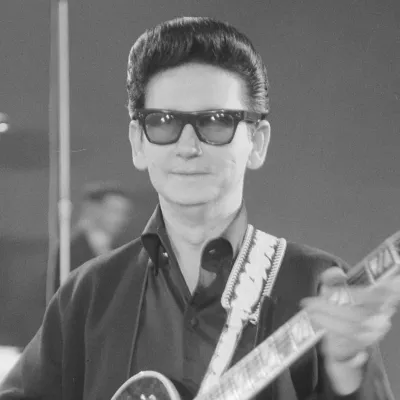
Photo: Wikimedia Commons
Roy Orbison
Human Design Chart
Biography
Orbison grew up in the oilfields in Wink, Texas and made his first public performance at age eight in a local radio station. He formed his first singing group as a teen with a band called the "Wink Westerners," followed by another band known as "The Teen Kings Trio." He had his first break with a record producer in Clovis, New Mexico where the "The Teen Kings Trio" recorded a single that was released locally.
Moving to Memphis, Orbison recorded a single for the Sun label in 1956, but despite his ability as a singer he spent the next four years focusing on songwriting, mainly for other artists. It was Elvis Presley's recording of "Only The Lonely" in 1960 that first put Orbison's name in the spotlight. With an astonishing 15 top hits in the early '60s written and performed by Orbison himself, he was one of the most respected figures in pre-Beatles rock, and his thrilling voice against the background of his thrumming guitar conveyed a different message than other rock performers of the time. His songs with themes of loneliness, heartbreak and anxiety featured such range, depth and intensity that critics lent the unusual accolades of "chilling" and "haunting" to his one-of-a-kind rock-and-roll style.
The only American vocalist to survive the British Invasion, Orbison toured England regularly where his singles often soared to No.1 for weeks at a time. He toured continuously from 1962.
Human Design Analysis: Roy Orbison as Projector 2/4
Projector 2/4 — Design at a Glance
Roy Orbison was a Projector. His design inclined towards a dense, focused aura that he directed like a bright flashlight onto his surroundings. This energy allowed him to immediately recognize errors in other systems or where work was done in the dark. His task was to illuminate the darkness for others and light their path.
Since Projectors do not have a constant, intrinsic source of life energy from a defined Sacral Center, Roy Orbison lived in phases. He had periods of high energy and rapid work, followed by necessary rest phases to avoid burnout. Traditional schooling and most jobs often did not accommodate this need for pauses.
When he followed his strategy – waiting for a valued and sincerely meant invitation – he was rewarded with success. Instead of directly and confrontationally addressing his observations, which would have quickly provoked resistance or anger in his environment, he acted more elegantly. By living harmoniously himself, he became attractive. Other people automatically came to him to ask for his insider tips. If he did not live according to this design, he would feel the non-self theme of bitterness sooner or later.
Splenic Authority
Roy Orbison had authority in the Spleen, which required a specific internal decision-making structure. This configuration is only possible if the Emotional and Sacral Centers are open, typical for Projectors or Manifestors. His defined Spleen Center served as his health and alarm system, equipped with a pronounced survival intelligence. This manifested as spontaneous inner knowledge that signaled to him instantly whether a situation, environment, or society was right for him. His instinct and physical well-being served as reliable indicators of what served him. Decisions therefore had to be made in the immediate moment; the first, spontaneous impulse was the correct one and protected his health. This allowed him to rigorously shield against harmful influences. Since this impulse was very subtle and only occurred once in the moment, there was a risk of ignoring it or having it drowned out by other influences. This required high vigilance from him. A withdrawal could be helpful for decision-making. Since he could only know what was right in the present, plans often changed short-term. Long-term commitments were difficult; he needed a lot of freedom and flexibility to avoid unnecessary binding.
The 2/4 Profile — Hermit / Opportunist
Roy Orbison's design inclined towards a constant shift between the need for withdrawal and the desire for community. As a person with Profile 2/4, he oscillated between Line 2, the Hermit, and Line 4, the Community. Line 2 projected a strong, caring aura outward, although Roy Orbison often did not recognize how powerful this effect was. This required clear boundaries to maintain self-sufficiency and avoid one-sided dependencies. During his 'me-time', he immersed himself in internal processes to gain clarity. Once this need was satisfied, he returned to spend time with his favorite people. Line 4 emphasized the necessity of social exchange. Experiences gained value for him only when they were shared and could flow into the collective experience. Friendships were crucial for his success, as they helped him externalize fantasies in a fixed way. The challenge was to integrate these two poles: reflecting and evaluating his network's knowledge during his alone time and developing brilliant ideas from it. A safe, loving environment was essential for this, where he could clearly communicate when he sought company and when he wanted to be undisturbed. This tension defined his way of interacting with others and shaping his own development.
Single Definition — Defined & Open Centers
Roy Orbison's design inclined towards intuitive, momentary perception, coupled with a persistent inner pressure. His defined Spleen Center endowed him with a reliable instinctual authority: the ability to recognize what was healthy and correct in the present moment without rational analysis. This spontaneous bodily intelligence served as a compass for decisions. Simultaneously, his defined Root Center acted as a source of physical, adrenalized pressure, propelling him forward and nourishing existential awareness. This pressure was not arbitrary but a structural energy for maintaining the life impulse.
At the same time, Roy Orbison was shown to be receptive to external influences through several open centers. His open Head Center meant he did not have a constant mental inspiration; he tended to engage with foreign questions or doubts rather than generate his own mental solutions. Similarly, his open Ajna Center was flexible for concepts, but lacked a firm conceptual structure, making him susceptible to absorbing and reflecting other people's ideas. His open Throat Center lacked a fixed identity; he adapted to his environments and gathered directions through interaction rather than following a rigid life plan.
His open Heart Center revealed a lack of consistent willpower. He was not designed to give promises or prove his worth through competition but tended to place himself in situations to seek recognition, often leading to exhaustion. His open Sacral Center meant he did not generate constant vital energy; he absorbed the energy of his surroundings, making him vulnerable to overloading if he did not listen to his inner authority. Finally, his open Solar Plexus acted as a barometer for foreign emotions; he picked up the moods of others and amplified them, making him emotionally vulnerable if he interpreted these feelings as his own. This configuration marked him as someone who navigated through intuitive clarity and inner pressure while simultaneously absorbing and reflecting the complex mental, emotional, and identity-forming fields of his environment.
Channels for the struggle for meaning and purpose in life.
Roy Orbison was someone who stubbornly followed his own path, even when the odds were against him, and found his life's meaning in these struggles. This attitude resulted from the Life Struggle channel 38-28. This connects the Root and Spleen Centers: Gate 38 exerts pressure to maintain individual integrity against external distractions, while Gate 28 intuitively recognizes which struggles have value and engagement is worthwhile. This channel provides a driving force that mutates the status quo through individuation and requires being spurred to action by inner authority rather than being driven by the mind.
Additionally, other energies influenced him. Gate 27 brought a genetic role of care, improving all activities through altruistic warmth and the impulse to preserve life. Gate 41 propelled him forward evolutionarily, guiding him from one experience to the next and playing a central role in the process of change and crisis, representing the source of feeling. Gate 31 represented the ability to exercise leadership through pure energetic transmission and transferring forces to others to achieve results. In the personality area, Gates 58 and 52 were active. Gate 58 in the Root Center brought pressure and cheerfulness, with the talent in recognizing and correcting incorrect patterns and experimenting for the perfection of the life process. Gate 52 demanded a self-imposed pause for concentration and pattern correction; without a clear goal, this could lead to stress, while focused application was productive. Finally, Gate 39 in the design provided the fuel for mutations through selective analysis and provocation to recognize the spirit.
Individual Circuitry — Circuit Signature
Roy Orbison's design was characterized by a simple, coherent structure that focused his energetic resources on a specific area of life. His defined centers – Spleen and Root – formed a direct connection, replacing his experience of the world as a disjointed set of parallel forces with a continuous flow.
Within the Knowledge Circuit, which deals with the development of a unique identity and the acquisition of new knowledge, Roy Orbison activated only the 28-38 channel, the so-called 'Life Struggle'. This channel directly connects the Spleen Center, responsible for intuition and selection, with the Root Center, the source of survival energy and endurance.
This configuration shaped an attitude where intuitive decisions were not just fleeting impulses but fundamental, energy-rich drivers for daily survival and progress. The energy of the Life Struggle served to strengthen his own individuality through persistent action. Rather than relying on the creative flashes or inspiring moments of other channels in this circuit that were not active in him, his expression focused on the connection of intuitive perception with the necessary endurance to translate these perceptions into reality. This created a pulsating, acoustic quality in his way of experiencing and shaping the world, strongly based on the immediate emotional wave.
Right Angle Cross of the Unexpected 1
Roy Orbison's design indicated a tendency towards unpredictable turning points that often came out of nowhere. This configuration, the Unexpected Right Cross, described a life dynamic where sudden insights or external events abruptly changed his previous path. It was not a linear development but rather jumps that forced him to adapt quickly. The mechanics of this cross show how unexpected impulses can recalibrate one's inner alignment. For Roy Orbison, this meant that his life phases were often marked by such surprises, challenging him to adopt new perspectives. This unpredictability was not a lack of planning but an integral part of his energetic structure, helping him find clarity in chaotic moments. His design allowed him to create order from the chaos of surprise by accepting and integrating the new circumstances. This ability to use the unexpected shaped his approach to challenges and enabled him to develop innovative solutions in moments of uncertainty.
Saturn Return · Uranus Opposition · Chiron Return — Life Cycles
Roy Orbison's Human Design indicated a tendency towards cyclical phases of confirmation and renewal. His first Saturn return marked 1964, at the age of 28, with the release of "Pretty Woman," his biggest hit. This point crystallized years of groundwork into a viable, public success, typical of the structure of this cycle.
Later, his Uranus return presented as a phase of sudden change. In 1976, at the age of 40, he briefly signed with Monument Records again. This career development showed the characteristic unpredictability and impulse for realignment that accompanies this planetary movement.
Around his Chiron return at the age of 49, this cycle functioned as a fulfillment phase, in which his incarnation purpose increasingly unfolded. In 1985, the re-release of "In Dreams" became popular. This was not a random success but the late bloom of his life's mission: the meaningfulness of his work became experiential and recognized in this phase, provided he had followed his strategy up to that point. These three cycles illustrate how Roy Orbison's chart-based structure shaped his life stations—from initial crystallization through disruptive changes to the final confirmation of his purpose.
Projector · Splenic Authority — Synthesis
He was a Projector who established a deep, focused presence through his ability to recognize errors in the system (Gate 11) and the resulting projection onto his environment. This gift, combined with a defined Spleen Center, gave him a strong intuition for what was right and healthy, allowing him to make spontaneous decisions in the present moment. His Profile as a Natural Talent and Networker points to an inner dynamic that fluctuated between the need for withdrawal and the desire for connection – a balancing act that allowed him to find clarity in isolation before resonating with chosen individuals again. The Life Struggle Channel (38-28) underscores his search for meaning and his ability to find value in the challenges of life.
A central paradox in his design lay in the tension between his projection power and his need for recognition. As a Projector, he was destined to bring "light into the darkness" for others, yet the subtle Spleen authority required an intuitive, spontaneous approach that did not always meet open invitations. This led to a constant weighing between expressing his unique perspective (Knowledge Circuit) and protecting his own energy, especially during withdrawal periods (Line 2), to gain the necessary clarity for authentic connections (Line 4). The recorded cycles showed that success and career often went hand in hand with phases of transformation and inner change.
1 Defined Channel
Incarnation Cross - Right Angle Cross of the Unexpected 1
Solar Return
The Solar Return shows the moment when the sun returns to its exact birth position - your personal solar year.
Life Cycles
Discover the life cycles with a detailed triple view (birth chart, cycle chart, composite).
Human Design Profile
- Type
- Projector
- Strategy
- Wait for the respectful invitation
- Authority
- Splenic Authority
- Profile
- 2/4 - Hermit / Opportunist
- Definition
- Single Definition
- Incarnation Cross
- Right Angle Cross of the Unexpected 1
- Date of Birth
- 23.04.1936 15:50
- Place of Birth
- Vernon, TX, United States
Frequently Asked Questions
What was Roy Orbison's Human Design type?
What Profile did Roy Orbison have in Human Design?
Which Authority did Roy Orbison follow?
What incarnation cross did Roy Orbison have?
When was Roy Orbison born?
Discover your own Human Design
Are you also a Projector? Find out in a personal reading how to unfold your leadership qualities and recognize the right invitations.
More Personalities
Back to overviewSissy Spacek
Aaliyah

Alain-Fournier
Alexia

Alizée

Anémone