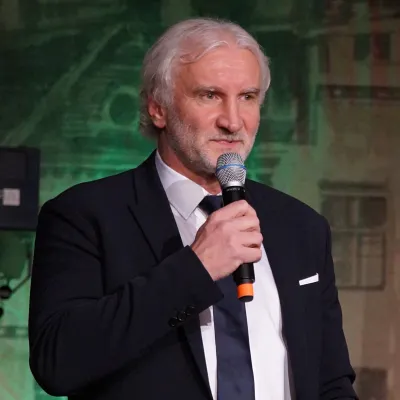
Rudi Völler
Human Design Chart
Biography
During his active years as a player he was sometimes nicknamed "Tante Käthe" ("Aunt Kathy"), a name bestowed upon him by Thomas Berthold in reference to his permed hairstyle, and in Italy, he is nicknamed "Il tedesco volante" ("The flying German") by supporters of Roma.
In February 2023, he was appointed director of the Germany national team.
The Human Design of Rudi Völler: Generator 4/6
Generator 4/6 — Design at a Glance
Rudi Völlers design showed a tendency towards extreme endurance and high work capacity. As a Generator, he had plenty of sacral energy, which made him seem like a strong working horse - provided he had the energy for his task. However, this configuration described two specific pitfalls: A burnout threatened if he continuously did things that he didn't enjoy, wasting his strength. Conversely, it was frustrating when he was held back from his heart project despite wanting to continue working with full power.
The successful use of this energy depended less on initiating than on responding. The motto was: don’t take the first step yourself but wait for signals from life. When his sacral center then sent a clear “yes,” he responded with action. This strategy of reacting from the gut was crucial. If Rudi Völler lived in harmony with this, he was rewarded with deep satisfaction and a sense of fulfillment. Ignoring this principle and constantly trying to initiate instead led him sooner or later to persistent frustration as well as a lack of energy. His success therefore depended on listening to impulses and then following through.
Emotional Authority
Rudi Völlers inner decision-making structure was characterized by emotional wave movements. His inner authority lay in the defined Emotional Center - a mechanism that always took precedence over all other definitions in his chart. This meant that his perception and judgments were always colored by his current mood: A project or person could appear extremely promising at one moment, only to be completely negative evaluated the next.
These fluctuations were not arbitrary but rather a natural rhythm of his inner energy. Since feelings in the moment are just a snapshot and not necessarily the final truth, quick, spontaneous reactions often led to negative consequences. Therefore, his design required patience: decisions needed time to mature. Only after “sleeping on” a situation and the initial emotional heat subsiding did Rudi Völler gain the necessary distance. In this phase clarity and calm set in - the sign that he had gone through his inner process and could recognize his true direction. This process was particularly crucial for long-term life decisions that could shape his further path.
The 4/6 Profile — Opportunist / Role Model
Rudi Völlers early years were marked by numerous experiments, especially in relationships and friendships, as he sought to find his identity. This early behavior matched the effect of his Profile Line 4, which acted similarly to a Line 3 before maturity, promoting curiosity and diversity. With age, marked by the Saturn Return, an internal conflict emerged: the deep need for belonging and community (Line 4) stood in contrast to the desire for distance and reflection on life's higher meaning (Line 6). This tension between heart and head shaped his development towards a role that was expected from him as a wise role model. His task was to work through cooperation with other people, where his big heart always acted cautiously to avoid opening up to the wrong people and getting hurt. The sixth line continuously checked the practicality of solutions in the collective; it decided whether insights were confirmed or rejected. Thus, he pragmatically mediated between individual experience and societal awareness, knowing cliches but often not listening to the collective.
Split Definition — Defined & Open Centers
Rudi Völler revealed himself as a person with an unshakable inner structure: His defined Heart Center endowed him with natural willpower and the need to determine his life and resources for himself. This energy was fueled by his also defined Sacral Center, which provided him with a constant source of vitality - assuming he responded to external impulses rather than initiating them himself. His mind was constantly active through his defined Ajna Center; he processed data and concepts in a consistent, specific way that protected him from easy mental influence by others. The connection between this Ajna and the defined Throat Center allowed him to articulate his thoughts directly and reliably, which also created pressure to consistently implement what was said.
At the same time, his open G Center shaped a special dynamic: Without a fixed identity or direction, he relied on interactions with his environment and other people to find orientation. He tended to try himself out in various roles or contexts to discover where he truly belonged instead of following a rigid life plan. Parallel to this, his open Head Center served as a receiver for inspirations; here the challenge was not to fall into endless questions or mental confusion about things that were not his own problems. Instead, this open center allowed him to take in new ideas and meaningfully integrate them through his defined mental structure (Ajna) without being overwhelmed by the pressure to find immediate answers. This configuration promoted a stance that was both resolute and adaptable, where emotional clarity - supported by the defined Solar Plexus Center - needed time to make stable decisions.
Channels for intimacy, logic, instinct, ambition and community.
Rudi Völler showed himself as someone who not only establishes relationships but strategically uses them to secure positions. His design linked intimacy with entrepreneurial instinct and logical structuring.
The Channel of Union 59-6 rooted him in sacral sexuality and emotional wave. This connection created a powerful aura that quickly attracted others and facilitated confidentiality. Rudi Völler could easily penetrate the auras of others through this intensity, which helped him build friendships before delving into deeper realms. The emotional wave determined timing: He had to wait for clarity to recognize whether a connection was truly fruitful or merely superficial.
Parallel to this, the Channel of Devotion 44-26 acted as his entrepreneurial motor. This link between Spleen and Heart Center gave him an acute sense of what others needed - often before they knew it themselves. Rudi Völler used this instinctive awareness to sell products or ideologies and generate resources for his team. He was the promoter on the front line bringing in money that would then be distributed. His success depended on whether the market or community recognized his gifts and invited him to contribute.
To control these dynamics, the Channel of Acceptance 17-62 helped organize mental details and translate visual patterns into language. Rudi Völler could logically break down complex situations and explain his opinions in detail. This gave him the ability to present information as formulas or theories that could be tested for feasibility. Timing was crucial: He spoke effectively when invited, which reduced resistance.
The Channel of Transformation 54-32 drove his ambition. Driven by fear of clan failure, Rudi Völler aimed for advancement and change. He worked hard to prove his worth and receive rewards for loyalty. His instinct recognized when support was available to increase prosperity.
Finally, the Channel of Community 37-40 secured group bonds. Rudi Völler sought his place in the whole and waited for personal invitations. He built bridges between individuals to create harmonious relationships based on mutual support rather than hierarchy. This allowed him to work in teams where everyone had an honorable place.
Tribal Circuitry — Circuit Signature
Rudi Völler was marked by separate energetic poles: on one hand, a clear, rational future perspective, and on the other, deeply rooted clan and protection instincts. These two areas were not directly connected in his design but existed as parallel forces side by side.
The Understanding Circuit linked his Ajna Center with Throat Center through the Channel 'Acceptance'. This created an ability for focused, logical communication without emotional distortion - a tool to analyze structures and clearly formulate insights.
At the same time, the Ego Circuit was strong, connecting Heart, Solar Plexus, Spleen, and Root Centers. Through the Channels 'Devotion', 'Community', and 'Transformation' emerged here a dynamic energy for cooperation, resource management, and mutual support within a group. This configuration promoted a traditional understanding of giving and taking as well as collective action but also required pauses for regeneration of life force.
A third aspect was the Archer Circuit, linking Sacral and Solar Plexus Centers through the Channel 'Union'. This gave him primal energies of protection, preservation, and care for his own family or close community.
Together these separate systems formed a profile that oscillated between strategic clarity, strong group loyalty, and instinctive protective needs - each self-contained but not experienced as one continuous flow.
Right Angle Cross of Maya 1
Rudi Völler demonstrated himself as someone capable of mastering complex challenges through a clear and structured approach. His design indicated the tendency to create order out of chaos while relying on proven principles. The right cross of Maya 1 describes this ability to connect inner clarity with outer action capability. It's about not just acting but embedding action into a larger context of meaning. Rudi Völler used this configuration to radiate calm, calculated presence in decisive moments. He relied on his internal knowledge and experience to make the right decisions. This attitude allowed him to remain stable under pressure and support others through his reliability. The right cross of Maya 1 emphasizes the importance of integrity and authenticity in action. Rudi Völler showed that true strength does not lie solely in dominance but rather in the ability to consistently uphold personal values. His design promoted a kind of leadership based on respect and mutual understanding. He knew how to motivate people by setting clear goals while also allowing space for individual contributions. This balance between structure and flexibility was an essential component of his success. Rudi Völler demonstrated that effective leadership depends less on authority than on the ability to inspire others towards a common goal. His approach was pragmatic and results-oriented, without losing sight of the human element.
Saturn Return · Uranus Opposition · Chiron Return · 2nd Saturn Return — Life Cycles
Rudi Völler showed himself as someone who in phases of extreme focus and discipline produced his greatest impact. This tendency to condense effort into concrete results became visible in 1988 at age 28: When Saturn Return set in, he played in all four EM games and scored both goals for victory against Spain – a moment when years of groundwork condensed into sustainable success.
At the age of 40 during Uranus Opposition, a new dynamic emerged: He became head coach of the DFB selection. This cycle often brings unexpected turns and requires adaptation to changed structures, steering his career in a new direction.
The Chiron Return around the 51st year marks the bloom of one's purpose. In 2011, Völler campaigned for the controversial energy provider Teldafax. During this phase, the incarnation cross increasingly unfolds; actions are often experienced as direct expressions of personal mission, independent of external evaluation.
The second Saturn Return at age 56 in 2016 brought new challenges: After accusations against referee Zwayer, he received a fine. This cycle tests the stability of earlier achievements and often requires readjustment when old patterns encounter resistance.
Generator · Emotional Authority — Synthesis
A central red thread in this chart is the deep connection between sacral energy and emotional process. The defined sacral energy (Generator type, Channel of Union) forms a basis for endurance and creative power, yet it is always filtered and matured through emotional authority. Decisions do not arise spontaneously but develop over time in waves of feelings – a process that requires patience but ultimately leads to clarity and authentic action (emotional center, defined Ajna). This shows repeatedly in key moments where waiting and feeling were crucial for the outcome.
The central paradox lies in the interplay between deep engagement and desire for distance. The profile as Networker/Role Model points to a longing for belonging and cooperation (Line 4), while Line 6 simultaneously implies an inner drive towards reflection and detachment. This conflict between heart and head leads to tension that manifests repeatedly in life – a dance between wanting to be part of the whole and needing to withdraw to find one's own truth.
5 Defined Channels
Incarnation Cross - Right Angle Cross of Maya 1
Solar Return
The Solar Return shows the moment when the sun returns to its exact birth position - your personal solar year.
Life Cycles
Discover the life cycles with a detailed triple view (birth chart, cycle chart, composite).
Human Design Profile
- Type
- Generator
- Strategy
- To respond - wait for something to respond to
- Authority
- Emotional Authority
- Profile
- 4/6 - Opportunist / Role Model
- Definition
- Split Definition
- Incarnation Cross
- Right Angle Cross of Maya 1
- Date of Birth
- 13.04.1960 17:54
- Place of Birth
- Hanau, GER
Frequently Asked Questions
What is Rudi Völler's Human Design type?
What profile does Rudi Völler have in Human Design?
What authority guides Rudi Völler?
What is Rudi Völlers incarnation cross?
When was Rudi Völler born?
Discover your own Human Design
Are you also a Generator? Find out in a personal reading how to use your sacral energy correctly and discover deep satisfaction.
More Personalities
Back to overviewAaliyah

Aldair

Alexia

Angèle

Anne-Marie

Arcángel