
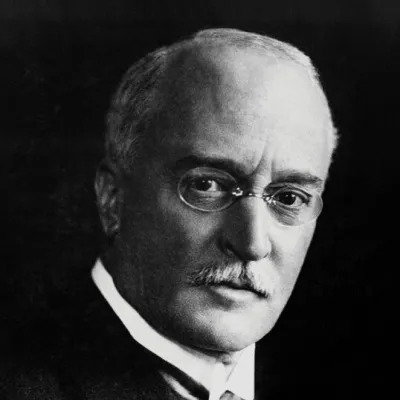
Rudolf Diesel
Human Design Chart
Biography
Human Design Analysis: Rudolf Diesel as Generator 6/2
Generator 6/2 — Design at a Glance
Rudolf Diesel had immense endurance and the ability to generate energy as his Generator. His design suggested he was like a strong workhorse: extremely capable, provided he had the energy for his tasks. This foundation defined his operational power not through initiation but by reacting to impulses from the environment.
Two central pitfalls shaped his energetic profile. The first occurred when he tackled tasks that did not bring him joy. In such moments, he wasted resources and tended towards exhaustion. The second pitfall was being held back from his heart project despite an inner drive to continue working on it. This significantly hindered his potential.
The strategy of his design required reacting to signals in life rather than initiating action himself. When he acted only after the internal 'yes' of his sacral center, he responded correctly to impulses, leading to deep satisfaction and a sense of fulfillment. However, if he lived against this principle, especially by constantly taking initiative, he faced frustration and energy depletion. His effectiveness depended on responding from the gut, not anticipating ahead. Only in harmony with this reactive nature could no one stop him; otherwise, burnout or suppression of his true creative drive threatened.
Sacral Authority
Rudolf Diesel possessed sacral authority as his inner decision-making center. His design dictated that he couldn't decide from the head but had to wait for an immediate physical response. This mechanism was evident through signals from his Sacral Motor: a grunt, hum, or noticeable surge of power in reaction to external stimuli.
This authority was specific to his type, Generator, whose strategy and inner guidance were identical. This simplified his process of orienting himself in the world. A prerequisite for this was his open emotional center. Once his sacral motor kicked in, he felt vital and alive. He then had seemingly inexhaustible energy and tackled tasks with great enthusiasm. His nature was geared towards performing activities with joy and satisfaction without external purpose constraints.
Additionally, his active spleen center acted as a supportive instance to the Sacral Center. This configuration allowed him particularly quick and spontaneous reactions. He possessed direct access to his physical well-being and instinctive perception, which he could reliably trust. The vitality of his design arose solely through this inner confirmation of the sacral motor, not through intellectual planning or external validation.
The 6/2 Profile — Role Model / Hermit
Rudolf Diesel showed a clear developmental line: in his youth, experimentation through trial and error dominated, while after age thirty, he entered a phase of reflective distance and inner wisdom. This pattern stemmed from his 6/2 Profile, the so-called Role Model/Natural Talent configuration. Before Saturn's return, the sixth line acted like a third: Rudolf Diesel gathered life experiences through active experimentation and corrected errors retrospectively. The sixth line promoted an attitude of freedom from expectations; for him, justice meant change without rigid goals, with crises seen as necessary corrections arising purely from feelings.
After about thirty years, the second line, seclusion, activated. Rudolf Diesel increasingly withdrew to maintain independence and filter out external conditioning. This isolation served not for escape but for mental fertility and deep self-knowledge. From this cave on the mountain, he looked back with distance at his earlier experiments. A period of healing and introspection followed. When the time was ripe, Rudolf Diesel emerged again – as a wise person whose life wisdom attracted others. They sought him out to learn from his ability for deep self-reflection. The integration of justice through freedom from expectations and the necessity of isolation shaped his path from an experimenting young man to an acknowledged advisor in old age.
Single Definition — Defined & Open Centers
Rudolf Diesel had a firm, unchanging foundation of defined G-, Sacral, and Spleen centers. His defined G-Center gave him clear inner direction and self-love; he knew intuitively where he belonged without having to control it. This contrasted with his tendency to impose his direction on others when he did not trust his authority. His defined Sacral Center generated constant vital energy that was only usable correctly through waiting and reacting. Initiating actions without invitation led to frustration and exhaustion in him, as the sacral power then lacked. His Spleen Authority offered momentary intuition for health and well-being in the present; he had to trust these spontaneous warning signals rather than rationalize them.
At the same time, Rudolf Diesel was exposed to six open centers that made him vulnerable to environmental pressure. His open Head Center tended to absorb mental confusion and inspiration from others, which could entangle him in endless questions. The open Ajna Center allowed his mind to be flexible but also uncertain about the validity of his own concepts. In his open Throat Center, he felt the urge to attract attention or control the conversation instead of waiting for natural invitations to speak. His open Heart Center often drove him to prove his worth through promises and competition, although he did not possess the consistent willpower for it. The open Solar Plexus absorbed foreign emotions, making him appear emotionally unstable when personalizing them. Finally, his open Root Center took on external stress, leading to a cycle of adrenalized pressure and attempts to rid himself of this by overactivity. This open configuration meant that his stability always depended on trust in his defined centers, while the open areas remained mirrors for outside influences.
Channels for powerful beat, rhythm and intuitive form.
Rudolf Diesel showed a basic attitude based on mutative impulse and biological timing. His design laid a strong drive towards innovation that did not arise through active pursuit but rather through trusting his own reaction. The Channel of Beat 14-2 connected the power competence of Gate 14 with the higher knowledge of Gate 2. This allowed him to create new directions by following the generative energy from the Sacral Center. He brought innovative perspectives into the collective simply through his pure being and authenticity.
This mutative impulse was supported by the Channel of Rhythm 5-15. Here, the firmness of Gate 5 connected with the love for extremes of Gate 15. This biological life flow guaranteed natural timing and a magnetic attraction that drew others into his energy flow. Rudolf Diesel was closely linked to the flow of natural life; his inner rhythm determined his course and propelled humanity forward without needing intellect or emotional waves.
Furthermore, the Channel of Perfect Form 57-10 shaped his intuitive survival behavior. The intuitive insight of Gate 57 connected with the self-behavior of Gate 10. This gave him the ability to spontaneously and appropriately react to his environment to secure his physical well-being. He perfected his existence through deep self-love and created something healthy and beautiful that served as an example. His uniqueness drew attention, making the world around him appear healthier because he taught how valuable it is to live authentically. This combination of mutation, rhythm, and intuitive form shaped his way of creating new perspectives for the collective.
Individual Circuitry — Circuit Signature
Rudolf Diesel's design set a tendency towards tension-filled dynamics: the connection between logical, emotionless ratio with the pulsating expression of individual identity. In simpler terms, these energies flowed directly into each other. The Understanding Circuit connected his Identity and Sacral Centers (Channel 15-5). This drove the will to improve society through structure and focus – shared as rational insight, free from conditioning. Parallel, the Knowledge Circuit also worked between identity and sacrum (Channel 2-14). Here it was about mutations and creative mind expressed through an emotional wave in the Solar Plexus. The tension lay in logical insights being transformed by this own emotional pulsation. Both circuits shared the connection between identity and sacral center, leading to a focused, acoustic expression form. Additionally, the Integration Channel (10-57) secured survival. It connected the Identity with the Spleen Center. This allowed intuitive reaction to life, drawing strength from experience and perfect manifesting it in the present moment. Rudolf Diesel thus showed himself as someone who did not coldly apply rational strategies but filtered them through his unique emotional individuality and intuitively implemented them here and now. Logical structure served the future while the emotional wave marked the intrinsic path. This configuration shaped a way of life where survival through intuitive adaptation went hand in hand with societal progress through shared, structured knowledge.
Left Angle Cross of the Plane 1
Rudolf Diesel was marked by the left cross of Level 1. This configuration set a specific foundational stance that reflected in his way of acting and being. The design significantly determined his inner orientation. It was a structural factor shaping his experience. Rudolf Diesel lived within these parameters. His reactions and decisions were influenced by this level. The left cross of Level 1 was a central component of his Human Design. It fundamentally shaped his existence. Rudolf Diesel carried this structure within him. It worked in the background of his personality. His design included this specific aspect. He followed the implications of this configuration. The left cross of Level 1 determined parts of his essence. Rudolf Diesel was permeated by this mechanism. It manifested in his daily life and actions. This level was relevant to him. It shaped how he encountered the world. Rudolf Diesel lived with this design element. It was part of his individual constellation. The left cross of Level 1 had an effect on him. He acted within this framework. His nature was influenced by it. Rudolf Diesel carried this burden and opportunity within himself. It formed his lifestyle. The left cross of Level 1 was real for him. It influenced his path. Rudolf Diesel lived according to this structure. It was part of his identity in the design.
Saturn Return · Uranus Opposition · Chiron Return — Life Cycles
Rudolf Diesel's professional career followed a clear pattern of structuring and later refinement. In 1898, at age forty, he founded the Dieselmotorenfabrik Augsburg. This step fell during his Uranus opposition, a cycle often characterized by a desire for autonomy and new structures. Here, his drive to establish independent systems and gain independence was evident.
Ten years later, in 1908, he achieved significant success with the construction of the first small diesel engine. This occurred during his Chiron return at age fifty. In Human Design mechanics, this period marks a phase of fulfillment and bloom, where life's work condenses and reveals its meaning. It was not about healing but rather the concrete realization of his deepest intentions. The development of the compact motor demonstrated this maturation: from earlier founding a factory emerged now a precise, functional solution that fully expressed his potential. Both events underscore how his inner cycles shaped external milestones – first through building a foundation, then by perfecting the core.
Generator · Sacral Authority — Synthesis
Rudolf Diesel primarily lived from his sacral energy (Generator type with Sacral authority). This power source, coupled with the Beat channel (14/2), drove him to constantly explore new paths and advance innovations. The ability to recognize clear direction through the G Center enabled him to focus his energy and bring others along in his endeavors – a process marked by deep understanding of natural development (G Center). His lifestyle showed continuous experimentation (6/2 Profile), where experiences were collected and later shared from a position of wisdom.
A central paradox in his design lay in the interplay between generative energy and the knowledge circuit. While the Sacral Center engaged him in material creation (Gate 14), the Beat channel demanded constant mutation and renewal (Gate 2). This led to an internal tension between the need for concrete implementation and the urge to break existing structures. Documented events – founding the factory (Uranus opposition) and building the small diesel engine (Chiron return) – illustrate this shift from creative energy release followed by reflection.
3 Defined Channels
Incarnation Cross - Left Angle Cross of the Plane 1
Solar Return
The Solar Return shows the moment when the sun returns to its exact birth position - your personal solar year.
Life Cycles
Discover the life cycles with a detailed triple view (birth chart, cycle chart, composite).
Human Design Profile
- Type
- Generator
- Strategy
- To respond - wait for something to respond to
- Authority
- Sacral Authority
- Profile
- 6/2 - Role Model / Hermit
- Definition
- Single Definition
- Incarnation Cross
- Left Angle Cross of the Plane 1
- Date of Birth
- 18.03.1858 15:43
- Place of Birth
- Paris, France
Frequently Asked Questions
What is Rudolf Diesel's Human Design type?
What profile did Rudolf Diesel have in Human Design?
Which authority guided Rudolf Diesel?
Which incarnation cross was active for Rudolf Diesel?
When was Rudolf Diesel born?
Discover your own Human Design
Are you also a Generator? Find out in a personal reading how to use your sacral energy correctly and discover deep satisfaction.
More Personalities
Back to overviewAaliyah

Alexia

Angèle

Anne-Marie

Arcángel

Arno
