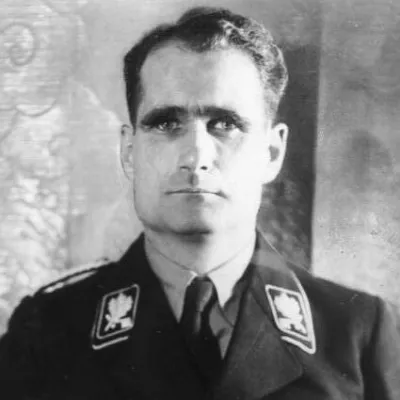
Rudolf Hess
Human Design Chart
Biography
Hess enlisted as an infantryman in the Imperial German Army at the outbreak of World War I. He was wounded several times during the war and was awarded the Iron Cross, 2nd Class, in 1915. Shortly before the war ended, he enrolled to train as an aviator, but he saw no action in that role. He left the armed forces in December 1918 with the rank of Leutnant der Reserve. In 1919, he enrolled in the University of Munich, where he studied geopolitics under Karl Haushofer, a proponent of the concept of Lebensraum ('living space'), which became one of the pillars of Nazi ideology. He joined the Nazi Party on 1 July 1920 and was at Hitler's side on 8 November 1923 for the Beer Hall Putsch, a failed Nazi attempt to seize control of the government of Bavaria. While serving a prison sentence for this attempted coup, he assisted Hitler with Mein Kampf, which became a foundation of the political platform of the Nazi Party.
Rudolf Hess — Manifesting Generator with Profile 5/1
Manifesting Generator 5/1 — Design at a Glance
Rudolf Hess's Human Design indicated a tendency towards hybrid energy: He had the constant power of a Generator, yet also possessed the ability to skip steps and quickly pull things into his life. This configuration as an Manifesting Generator created a tension between the need to respond to impulses and the drive for rapid implementation.
The mechanics of his type meant that while he had a stable energy source, his speed put him at risk of skipping important stages. When this happened, he often had to backtrack and make up missed steps, which could quickly lead to frustration – the specific non-self theme of this type. Additionally, his design tended to handle multiple things simultaneously as he responded to various impulses.
To harness this creative power effectively, it required him to first wait until life spoke to him and then act only when his inner authority agreed. Only under these conditions could he draw deep satisfaction from his work. In this state, parallel work was not a hindrance but rather promoted his play mode. Without this alignment, however, the initial enthusiasm quickly turned into exhaustion as speed without strategic response often led to overload. His design thus presented a life task of combining speed with patient responsiveness to experience lasting fulfillment instead of short-term frustration.
Emotional Authority
Rudolf Hess had an emotional authority that significantly shaped his decision-making process. His design indicated that he was subject to emotional waves resulting in constant mood swings. The world appeared colored by his current mood; a moment of enthusiasm could quickly be replaced by a negative outlook. This emotional fluctuation did not mean the first impression reflected truth. Quick, spontaneous decisions based on temporary emotions proved risky and often had negative consequences.
The mechanics of this configuration required patience. Since the emotional center carried his inner authority – a position that always took precedence regardless of other defined centers – he needed to let decisions mature. Only through gaining time and repeatedly reviewing an issue could intense feelings dissipate. Once emotional distance was gained, clarity and calmness set in. This process of delay served to gain deeper insights and separate short-term moods from long-term truth. For Rudolf Hess, this ability to wait and delay was not a hindrance but an essential mechanism for making the right decisions in important life matters and distinguishing transient emotional impulses from enduring insights.
The 5/1 Profile — Heretic / Investigator
Rudolf Hess's design indicated a tendency to appear as a Hero-Researcher (Profile 5/1): He used his deeply rooted knowledge base to offer solutions to others. This configuration created almost magnetic attraction; people actively sought him out for answers and problem-solving – aligning with the nature of Line 5, which represents experts like scientists who share their knowledge often at the expense of personal exhaustion.
Simultaneously, he carried the burden of Line 1, the Researcher, who first learns for himself. The challenge lay in balance: without clear boundaries, constant demand from others threatened to lead to overload. His design also included specific dynamics in resource management. Gate 27 (Line 5) gave him the ability to manage foreign resources effectively and provide practical solutions during crises – a trait Jupiter at an elevation angle favored. Yet Saturn at a restriction angle warned of the risk of power loss or negative reputation if this responsibility was not fulfilled.
Parallel to this, Gate 19 (Line 1), emphasizing mutual dependence and recognition of individual uniqueness, came into play. It was about successful approach without identity loss; one-sided dependency led to fear of rejection. Rudolf Hess thus navigated between the urge to deliver solutions and the necessity to protect his own resources and boundaries. His gifts flourished only when he learned to say no as well, maintaining a beneficial balance between research for himself and problem-solving for others.
Single Definition — Defined & Open Centers
Rudolf Hess's design inclined towards a tendency of constant, powerful expressive ability driven by deep emotional intelligence and a strong survival instinct. His defined Throat Center gave him a reliable voice that transformed information from the body into clear communication. This expression power was not isolated but rooted in his defined Sacral Energy - a source of vital life force that became active through reactions to life and enabled persistence in mastering skills.
At the same time, his defined Solar Plexus shaped his inner authority: He was designed to make decisions not in an emotional moment but to wait out the emotional wave to find clarity. His feelings served as a compass for what is right, yet required patience since truth only revealed itself over time. This structure was supported by his defined Spleen Center, which gave him spontaneous intuition and strong body awareness, along with the defined Root Center, providing necessary pressure for material prosperity and existential awareness.
In contrast, his vulnerability showed in open centers. His open Head and Ajna Centers meant he did not consistently generate mental inspiration himself but rather received it from outside; this could lead to confusion or attempts to solve foreign questions when he lacked trust in his authority. Notably, his open G Center: It lacked a fixed identity and direction. Instead, he tended to blend with the environment or seek 'borrowed' identity, making him vulnerable to false places and people. His open Heart Center lacked consistent willpower; he was not designed to make promises out of egoism or prove his worth through competition but learned to perceive the vibrations of others' egos without needing to prove himself.
Channels for intuitive clarity, synthesis, care and transformation.
Rudolf Hess's design inclined towards an intuitive immediate reaction, paired with a deep instinct for survival. This configuration manifested through Channel 57-20 of the Brain Wave, which translated intuitive insight directly into the language of the present moment. Here spontaneous knowledge found its expression without logical forethought; it was about immediate self-recognition and trust in inner impulses in the current moment.
Parallel to this, Channel 48-16 operated. It connected the search for life-critical information with the drive to perfect skills through repeated trial. This mechanism fostered a step-by-step development of skillfulness towards talent, where technical mastery and inner intelligence merged. It was not just about learning a skill but refining a pattern until mastery was achieved, supported by recognition and resources.
Another defining aspect was Channel 54-32 of Transformation. It drove ambition motivated by the desire for social elevation and continuity of the tribe. This channel instinctively recognized when support was available to improve one's position or secure prosperity. It involved a constant effort to be seen and prove value for the collective, trading loyalty for advancement.
Additionally, Channel 27-50 of Preservation linked care with the defense of traditional values. This created a basis of trust where responsibility was taken on and order maintained. The aura attracted others to be cared for, making it clear that only through one's own strength and correct self-care could a contribution to the survival of all be made.
Channel 19-49 of Synthesis rounded out the picture by linking emotional belonging with strict principles. It fostered cohesion through loyalty and rejection of what did not fit into tribal ideals. This frequency determined who belonged and who was excluded based on a deep sense of honor and mutual obligation.
Individual Gates like Gate 28 (Risks in the Now) or Gate 33 (Reflection) complemented these structures with the ability for immediate decision-making and necessary withdrawal to process experiences. Overall, Rudolf Hess was characterized by an interplay of intuitive quickness, perfectionist drive, social ambition, and strong tribal bond.
Tribal Circuitry — Circuit Signature
Rudolf Hess showed through a design that linked instinctive intuition with emotional resonance. His simple definition created a continuous energetic flow between Spleen, Root, Solar Plexus, Sacral, and Throat Centers. This enabled a direct connection from inner impulses to external expression.
In the Knowledge Circuit, Channel 20-57 (Flash of Insight) connected the Throat with the Spleen Center, promoting sudden, innovative insights that were immediately articulated. Parallel to this, the Understanding Circuit through Channel 16-48 (The Wave Length) also supported the connection between Throat and Spleen Centers. Here it was about sharing logical, rational insights free from emotional coloring, which favored clear, strategic communication.
In Rudolf Hess's Ego Circuit, Spleen, Root, and Solar Plexus Centers were connected. Channels 32-54 (Transformation) and 49-19 (Synthesis) created a space for deep transformation processes based on instinctive security and emotional processing. This was an energy of adaptation and integration, not individual ego expression but tribal support.
Finally, in the Guardian Circuit, Channel 27-50 (Preservation) connected the Sacral with the Spleen Center. This endowed a primal energy of protection and preservation driven by the constant life force of the Sacral. Overall, Rudolf Hess's design shaped a person whose inner intuitions and strategic insights were directly translated into tangible, protective, and transformative actions.
Left Angle Cross of Alignment 1
Rudolf Hess's design indicated a tendency towards a profound, often unspoken search for meaning. He was someone whose internal compass did not point toward external validation or logical planning but rather the discovery of a personal sense that lay beyond the visible. This attitude stemmed from the configuration 'The left cross of alignment 1'.
This structure in Human Design describes a life task where the individual is challenged to break free from society's pre-fabricated answers or their own intellect. It was not about constructing a fixed identity but rather finding an authentic inner truth through a process of hollowing out and reorientation, independent of external results or societal expectations.
For Rudolf Hess, this meant a constant internal movement towards clarifying his path. The mechanics of this cross promoted the ability to remain in uncertainty without prematurely committing oneself. It was a process of self-discovery by letting go of illusions and trusting intuitive guidance. This alignment shaped how he dealt with challenges: not through direct confrontation or strategic planning but through deep, often silent reflection on his role in the larger whole. The search for this inner orientation was an ongoing process of adaptation and understanding.
Saturn Return · Uranus Opposition · Chiron Return · 2nd Saturn Return — Life Cycles
Rudolf Hess's design indicated a tendency towards profound turning points that crystallized into concrete historical events during specific years of his life. In 1920, at age 26, he met Ilse Pröhl. This coincided with his first Saturn Return, a cycle often leading to long-term internal work culminating in a stable and supportive relationship or structure.
Later, another dynamic emerged: in 1934, at the age of 40, he participated in the Röhm Crisis and supported Hitler against the SA. This aligned with his Uranus Opposition, a time when one's self-image collides with external authority often leading to breaks or clear positioning.
His Chiron Return occurred in 1941 when he was 47 years old. During this fulfillment cycle where personal life purpose unfolds, Hess flew to Britain to persuade the British government towards peace. This act was not merely a desperate move but a direct result of his Chiron Return: His inner mission became an external action. His design did not view these moments as coincidences but necessary steps in his development where internal impulses were translated into real actions.
Manifesting Generator · Emotional Authority — Synthesis
He was a Manifestor Generator with emotional authority and the Profile of Hero/Researcher. This combination shaped a character driven by deep sacral energy (Manifestor Generator) yet requiring time for decisions to emotionally mature (emotional authority). He lived a dynamic where quick impulses clashed with an inner need for thorough engagement. The defined Throat Channel (communication and manifestation) points to someone whose expression was strongly influenced by their internal perception – a mediator between instinctive depth (Gate 48, Wave Length channel) and the desire to share knowledge (Hero/Researcher).
A central paradox lay in the tension between his sacral drive for quick responses to opportunities and the necessity of filtering these impulses through emotional waves. The cycles showed documented behavior: rapid actions led both to relationships (Saturn Return) and crisis situations (Uranus Opposition, Chiron Return), suggesting that skipping steps or insufficient emotional maturation had consequences. Thus, he was a person torn between the urge for quick implementation and the inner commitment to careful scrutiny.
5 Defined Channels
Incarnation Cross - Left Angle Cross of Alignment 1
Solar Return
The Solar Return shows the moment when the sun returns to its exact birth position - your personal solar year.
Life Cycles
Discover the life cycles with a detailed triple view (birth chart, cycle chart, composite).
Human Design Profile
- Strategy
- To respond - wait for something to respond to
- Authority
- Emotional Authority
- Profile
- 5/1 - Heretic / Investigator
- Definition
- Single Definition
- Incarnation Cross
- Left Angle Cross of Alignment 1
- Date of Birth
- 26.04.1894 10:00
- Place of Birth
- Alexandria, Egypt
Frequently Asked Questions
What was Rudolf Hess's Human Design type?
What profile did Rudolf Hess have in Human Design?
What authority determined Rudolf Hess's decisions?
What incarnation cross did Rudolf Hess carry?
When was Rudolf Hess born?
Discover your own Human Design
Are you also a Manifesting Generator? Find out in a personal reading how to unfold your multi-talents and direct your energy wisely.
More Personalities
Back to overviewAldair

Alizée

Angeli
Arletty
Artus
Balthus