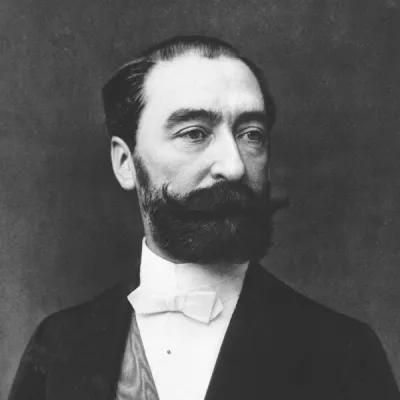
Sadi Carnot
Human Design Chart
Biography
Carnot died from an anarchist stabbing 25 June 1894, 12:15 AM, Lyon, France.
Attack of anarchist: 24 june 1894, 21:10, Paris Time in Lyon(9.10 p.m.)(annotation:mik
by BOR-8 via "Corriere")
Human Design Analysis: Sadi Carnot as Projector 6/3
Projector 6/3 — Design at a Glance
Sadi Carnot revealed himself as someone with a sharp eye for systemic flaws. As a projector, he had a dense, focused aura that acted like a bright flashlight: it directed itself precisely to areas in his environment that were still in the dark or not functioning optimally. This configuration allowed him to immediately recognize where processes were bumpy or where logical gaps existed.
However, his design also carried the risk of addressing these flaws directly and bluntly. Such direct illumination of others' weaknesses could quickly provoke resistance or anger in his counterpart, akin to shining a light directly into someone's face. The more effective alignment for his nature lay in shining through his own harmony and clarity, so that others would come to him of their own accord for advice. His strategy was to wait for appreciative and honest invitations rather than taking the initiative himself.
Since his sacral center was undefined, Sadi Carnot did not have a constant, intrinsic source of life energy. Instead, he experienced phases of high productivity, followed by necessary rest periods to avoid burnout. This fundamentally distinguished him from types with continuous energy flow. If he lived by these principles, he was rewarded with success. However, if he ignored the need for recognition and rest, this led sooner or later to his non-self theme: bitterness. His design required resonance and invitation, not constant, uninterrupted self-effort.
Self-Projected Authority
Sadi Carnot's design tended towards extreme openness, coupled with the risk of being distracted by external motoric energies. As a projector with the rare authority in the self, his inner truth was anchored in his identity. Decisions did not arise through logical analysis but through spontaneous self-dialogues or dialogical interactions if he was invited to do so. Crucial was the ability to distinguish between the impulsive expression of his true essence and the reflective mind. This spontaneous expression also served to make his uniqueness recognizable to others. Alternatively, a physical feeling could draw him geographically or thematically in a specific direction. By following this inner attraction, he could become a guide for others and unleash his specific potential for success. The greatest challenge lay in not losing himself in this openness and constantly chasing external energy, but rather faithfully following his own direction. This mechanism described a lifestyle based on invitation and authentic self-expression, rather than self-initiated assertion. Sadi Carnot thus revealed himself as someone who found his truth through listening to himself and through physical resonance, to guide others on their path.
The 6/3 Profile — Role Model / Martyr
Sadi Carnot's design inclined towards extensive self-experiments that spanned the first decades of his life. As a person with the Profile 6/3, he lived in this phase like a pure experimenter, learning through numerous trials and errors. This early phase was characterized by bold individuality and the testing of various roles, with mistakes serving as necessary steps towards understanding.
After the first Saturn return, around age thirty, this dynamic changed. Experimentation slowed down but never ceased entirely, as the line of the adventurer was permanently anchored in his profile. Carnot revealed himself as a very old soul who appeared internally restless, seeking an extraordinary life far from ordinary standards. This search for the perfect, unique path shaped his attitude.
Simultaneously, the ability to distribute power justly and delegate developed. The line 6 conveyed the insight that leadership means delegating responsibility and recognizing roles. Carnot used his unusual experiences to become a visionary role model. Humor and wisdom emerged from the synthesis of adventure-seeking and the accepted responsibility of age. He did not seek the ordinary but a profound, just structuring of his environment, based on the understanding that each person has their own role as a leader of their self.
Single Definition — Defined & Open Centers
Sadi Carnot's design inclined towards consequent, conceptual clarity, paired with a stable inner direction. His defined Ajna Center ensured constant, trustworthy thinking; concepts and theories emerged from him in the same logical patterns, unaffected by external opinions. This mental structure flowed directly into his defined Throat Center, enabling him to clearly and reliably communicate what he understood. His voice was not an impulsive outburst but the articulated form of his thoughts. Simultaneously, his defined G Center gave him a firm sense of self-identity and a clear sense of his life direction, without being distracted by others.
In contrast to this inner stability stood the vulnerability of his open centers. His open Head Center did not experience its own mental pressure but was sensitive to the inspirations and doubts of others, which he could take in without identifying them as his own truth. Particularly defining was his open Heart Center: It lacked a consistent willpower to keep promises or assert itself. Instead, he tended to be held back by the need to prove his worth, as he did not have the energy to establish himself in competitions or through sheer will. His open Sacral Center lacked a constant energy flow; he worked in spurts and had to learn to protect himself from the overwhelming generative energy of his environment to avoid exhaustion. His open Solar Plexus absorbed foreign emotions, making him vulnerable to emotional conditioning, while his open Spleen Center made him sensitive to questions of health and well-being, without giving him spontaneous intuition for decisions. His open Root Center amplified environmental stress, which he could not use as his own drive.
Channels for reflection, memory and structured insight.
Sadi Carnot revealed himself as someone who looked deeply into the past to recognize patterns relevant for the future. His design inclined towards reflective observation before acting or speaking.
This trait originated from the Lost Son Channel 13-33. It connected the G Center with the Throat Center. Gate 13, the Gate of Listeners, gathered information and secrets, while Gate 33, the Gate of Retreat, sorted these experiences. Sadi Carnot used this configuration to practice patience. He waited for deeper truths to emerge from the gathered memories, rather than judging prematurely. This allowed him to understand life stories and collective lessons and convey them clearly later.
Additionally, the Channel of Structuring 23-43 was at work. It connected the Ajna Center with the Throat Center. Here, spontaneous insights from Gate 43 met the assimilated processing of Gate 23. Sadi Carnot could thus formulate innovative perspectives that promoted efficiency. His thoughts often seemed light-years ahead, yet he had to learn to express his knowledge at a pace others could absorb. When the timing was right, his unique thinking was recognized; otherwise, he felt like an outsider.
Individual Gates complemented this profile. Gate 7 projected leadership patterns and hierarchies, which he tested through experiments for their future viability. Gate 35 sought change through interaction, with true satisfaction only arising retrospectively through the meaning of the experience. Gate 4 developed logical formulas to clarify suspicious patterns and create security for the future. Finally, Gate 1 emphasized uniqueness and creative mutation in the here and now, which wanted to act without restrictions as soon as the right moment came. Sadi Carnot's design thus connected patient reflection with innovative, structured communication.
Individual Circuitry — Circuit Signature
Sadi Carnot's design inclined towards structured, individual knowledge transmission. As a simply defined type, he had a coherent energetic flow between Ajna, Throat, and G Centers. This created an integrated line from mental conception through verbal expression to emotional identity.
The Knowledge Circuit worked through the Channel 'Structuring' (Gates 43-23). This connected the Ajna Center with the Throat Center. It was not about spontaneous inspiration or creative flashes but the ability to clearly organize and precisely articulate thoughts. Sadi Carnot showed himself as someone who not only thought new insights but brought them into a comprehensible, structured form.
Parallel to this, the Meaning Circuit worked through the Channel 'The Lost Son' (Gates 33-13). This connected the Throat Center with the Identity Center. Here, it was about sharing experiences from the past. Emotional waves and reflecting on past events flowed directly into his expression. He shared insights to learn collectively from history.
Since both circuits used the Throat Center, Sadi Carnot's clear structuring of the mind was connected with the emotional, experience-based sharing. His expression was thus both intellectually ordered and deeply rooted in personal, past experiences. This combination shaped his way of transforming and passing on knowledge, always anchored in his unique, emotionally felt identity.
Left Angle Cross of Masks 2
Sadi Carnot's design indicated a tendency towards a deep, often unspoken search for hidden truths. He was someone who sought the real motives and structures behind the visible facades of everyday life. This attitude stemmed from the left cross of the Masks configuration, an energy focused on penetrating the illusions of the surface. For Sadi Carnot, this meant that he did not stop at the superficial appearance of things but instinctively sought to understand the underlying principles and the 'truth behind the mask'. This mechanism shaped his way of viewing the world: less through external, often misleading signals, and more through an inner drive for authenticity and deeper understanding. It was less about actively uncovering in a public sense, but rather a quiet, inner alignment to distinguish the essence from the appearance. This configuration described a life task of uncovering hidden connections without being misled by the external masks presented by society or the environment. Sadi Carnot lived this search for deeper reality, driven by the need to find the real substance behind often superficial representations.
Saturn Return · Uranus Opposition · Chiron Return — Life Cycles
Sadi Carnot's design indicated a tendency towards structured, responsible leadership, showing a clear orientation towards collective well-being and orderly processes. His configuration promoted an attitude seeking stability and continuity, often linked to the need to maintain or stabilize systems rather than radically change them. This shaped his way of exercising authority: less through dominant impulses, more through reliable presence and the ability to integrate others into a shared framework.
The Chiron Return, occurring between the ages of 49 and 51, marks a fulfillment cycle in Human Design mechanics. During this phase, the individual's incarnation cross increasingly unfolds in life, provided the person has lived according to their strategy and authority. Meaning and purpose become tangible, and inner alignment finds its external confirmation. For Sadi Carnot, this cycle began in 1887 when he was elected as the French President at the age of 50. This event was not isolated but acted as a visible confirmation of a long-term development towards a role requiring order and responsibility on a large scale. The election marked the point where his inner structure aligned with external expectations, and his life task found full expression in a public, representative function.
Projector · Self-Projected Authority — Synthesis
He was a projector who navigated life and always recognized patterns (defined Ajna Center). This ability to see through the system (Gate 13/33 – 'The Lost Son') shaped his interactions, as he gathered and reflected on information before sharing it. The red thread of his existence was thus a deep need to understand the world and transform it through insight, fueled by mental clarity and the cyclical process of experience and reflection. He lived to observe, analyze, and ultimately, through sharing insights, guide others.
A central paradox lay in the tension between his need for recognition of his unique perspective (Knowledge Circuit) and the inherent risk of being distracted by external influences (Authority in Self). As a 6/3 Profile, he was an experimenter constantly seeking new experiences, yet also developing profound wisdom and responsibility. This combination of adventure-seeking and the urge to transcend the 'ordinary perfect' led to an inner restlessness that drove him forward but could also lead him astray.
2 Defined Channels
Incarnation Cross - Left Angle Cross of Masks 2
Solar Return
The Solar Return shows the moment when the sun returns to its exact birth position - your personal solar year.
Life Cycles
Discover the life cycles with a detailed triple view (birth chart, cycle chart, composite).
Human Design Profile
- Type
- Projector
- Strategy
- Wait for the respectful invitation
- Authority
- Self-Projected Authority
- Profile
- 6/3 - Role Model / Martyr
- Definition
- Single Definition
- Incarnation Cross
- Left Angle Cross of Masks 2
- Date of Birth
- 11.08.1837 18:00
- Place of Birth
- Limoges, France
Frequently Asked Questions
What Human Design type was Sadi Carnot?
What Profiles did Sadi Carnot have?
What Authority did Sadi Carnot have?
What incarnation cross did Sadi Carnot have?
When was Sadi Carnot born?
Discover your own Human Design
Are you also a Projector? Find out in a personal reading how to unfold your leadership qualities and recognize the right invitations.
More Personalities
Back to overviewSissy Spacek

Alain-Fournier

Anémone

Ann-Margret

Bourvil
Hergé